
The sharp rise in cases of “turbo” (aggressive) cancer in the post-COVID-19 and mRNA vaccine era has sparked a debate.
While US and European-based cancer treatments rely on expensive and often futile chemotherapy regimens, claims are increasingly surfacing that inexpensive and effective drugs—such as Ivermectin and Fenbendazole—can cure patients with advanced-stage cancer.
Ivermectin is popularly known as a horse dewormer, while Fenbendazole is recognized as a dog dewormer.
However, the reality is somewhat different.
Ivermectin is a potent antiparasitic (anthelmintic) drug used to treat parasitic infections in both humans and animals.
The story of Ivermectin does not begin in a pharmaceutical company laboratory, but rather in the soil near a golf course in Japan’s Shizuoka Prefecture. In the 1970s, while screening soil microorganisms, Japanese microbiologist Satoshi Ōmura discovered a previously unidentified bacterial species: *Streptomyces avermitilis*.
The compounds produced by this bacterium had a remarkable paralyzing effect on parasites. Ōmura sent his samples to American parasitologist William C. Campbell; Campbell and his team refined the compound, developing first “avermectin” and subsequently a safer, more effective form known as Ivermectin. It was launched as an antiparasitic drug by Merck in the 1970s.
The result was one of the greatest public health triumphs in medical history. River blindness (onchocerciasis)—which caused blindness in millions across Africa and Latin America—and elephantiasis (lymphatic filariasis)—which led to severe disabilities—were largely brought under control. Ōmura and Campbell shared the 2015 Nobel Prize in Medicine. Claims that ivermectin cures cancer first gained public attention following an interview with Mel Gibson.
It later garnered significant attention during the COVID-19 pandemic, as it was found to accelerate recovery times. However, it was consistently disparaged and dismissed by mainstream medicine and media, particularly in the United States.
The use of ivermectin as a systemic cancer treatment was pioneered by Dr. William Makis, a Canadian nuclear medicine specialist. While treating terminally ill cancer patients sent home in Alberta—using a regimen he developed involving ivermectin, fenbendazole, and mebendazole (alongside high-dose Vitamin C and other supplements)—Dr. Makis was branded a quack within a system dominated by major pharmaceutical companies and was prevented from practicing in Canada.
Subsequently, Makis continued his work in Florida, USA.
Dr. William Makis states that he can ultimately prove a phenomenon he observed during his cancer research: the fact that many different types of cancer may respond to ivermectin.
Makis’s argument hinges on a factor he considers particularly crucial: cancer stem cells.
According to him, while conventional chemotherapy can destroy vast numbers of rapidly dividing cancer cells, it may leave behind cancer stem cells, which can be more resistant due to their slower rate of proliferation.
Makis contends that these surviving cells can lead to disease recurrence and metastasis.
It is precisely at this juncture that he believes ivermectin could play a distinct role.
Makis highlights research revealing various potential anti-cancer mechanisms of ivermectin, including its effects on cancer stem cells. He holds the view that using Ivermectin alongside conventional (chemotherapy) treatment could target cancer cell populations that chemotherapy fails to effectively eliminate.
He also believes that Mebendazole could play a role in this strategy in the future.
This paves the way for his most significant claim: if future research confirms a meaningful clinical benefit, combining repurposed drugs with existing cancer treatments could shift the approach for certain advanced-stage cancers from being merely palliative (symptom-relieving) to curative.
However, this is not yet a confirmed clinical result; it remains merely a hypothesis.
This is because the mainstream medical establishment has not permitted human trials of Ivermectin for over 30 years. The lack of human studies is then cited as the reason for preventing the drug’s use.
Well, if the for-profit capitalist healthcare system—which controls all major funding—blocks research in this area, naturally no human studies get conducted!
It is a complete vicious circle.
Yet, Makis shares cases of recovery on his blog and social media accounts—such as a 59-year-old American male patient beating stage-four pancreatic cancer or a 73-year-old Turkish female patient recovering from stage-four breast cancer.
Makis alleges that the regulatory system, academia funded by wealthy interests, and giant pharmaceutical companies are lying to the public to protect the cancer industry, which has an annual volume of $233 billion.
Arguing that this system has now collapsed, Makis continues:
“There are currently seven clinical trials (involving human subjects) investigating the use of Ivermectin for cancer; one is being conducted in California (NCT05318469), while six are taking place in Florida (including NCT07487805). This makes Ivermectin one of the most exciting and actively researched approaches in the field of cancer today—far more compelling than any studies currently underway in mainstream oncology. There are also five clinical trials examining the use of Mebendazole (which is nearly identical to Fenbendazole) for cancer; these include two studies conducted by Johns Hopkins, as well as research by international centers in Sweden, Egypt, and India.”
The discovery of the similarity between cancer and parasites traces back to the USSR.
In 1946, wife and husband scientists Nina Kliueva and Grigorii Roskin observed that a serum derived from *Trypanosoma cruzi* dissolved tumors in mice. Based on their initials, the drug was named the “KR Preparation.” (Source: *The Cure: A Story of Cancer and Politics from the Annals of the Cold War* – Nikolai Krementsov)
Preclinical trials suggested that this substance—named KR after its developers’ initials—might also be effective in humans. Intense media interest surrounding KR prompted the US Ambassador to the Soviet Union to seek US-Soviet cooperation in developing this potential treatment. However, the escalating Cold War turned this interest from the American side into a double-edged sword.
While this interest enabled Kliueva and Roskin to secure significant research support from the Soviet leadership—Stalin included—it also thrust the pair into the very center of the ideological conflict between the superpowers. Accused of revealing “state secrets” to America, the couple was subjected to a show trial; their “anti-patriotic sins” were even condemned in Soviet theater and film productions.
Leveraging their newfound fame to secure further funding, Kliueva and Roskin continued their research; however, jealous colleagues discredited their work and seized control of their institutes. Work on KR was stalled for years and came to a complete halt upon the deaths of Kliueva and Roskin.
CIA Document: Is Cancer a Parasitic Disease?
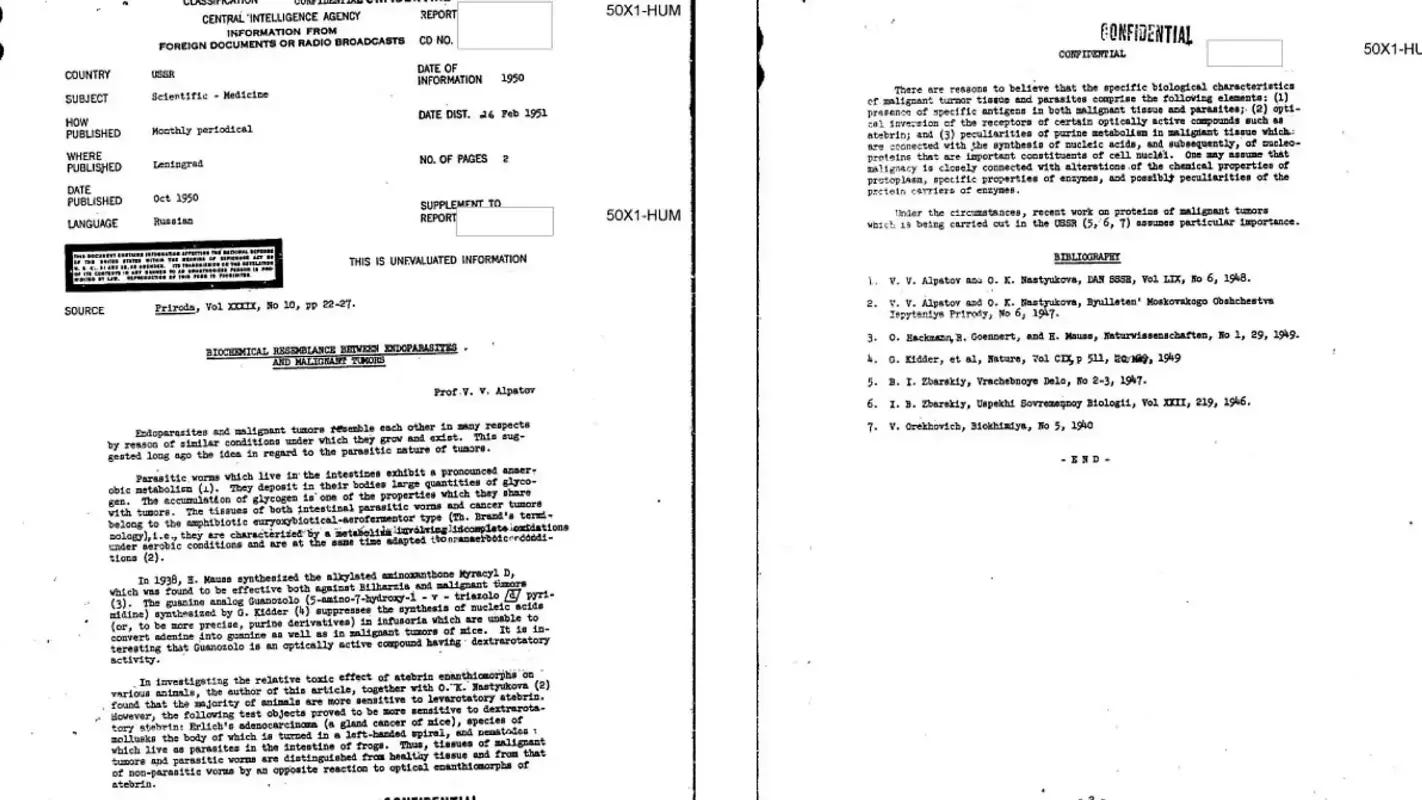
A CIA document from 1951, declassified in 2011, also indicates that Soviet scientists (likely Kliueva and Roskin)… …contained the abstract of a scientific paper examining the similarities between parasitic worms and cancerous tumors.
THE CIA’S SECRET CANCER FILE REVEALED! | Soviet Professor Alpatov’s 75-year-old “parasite” discovery: Do cancer cells feed like parasites? | World News
.
.
According to the report, researchers posited that both structures develop under similar metabolic conditions and accumulate large amounts of glycogen, a form of energy storage.
During the Cold War, the CIA’s regular monitoring of foreign scientific research was considered a standard intelligence activity.
The statement “This is unevaluated information” clearly appears at the top of the document. This statement indicates that the CIA did not confirm or endorse the findings contained therein.
The author of the article was Professor V.V. Alpatov, who published his work in 1950 in the Leningrad-based journal *Priroda*. Alpatov argued that endoparasites living within a host organism and malignant tumors shared a similar metabolic profile, suggesting a possible biological kinship.
One of the substances mentioned in the CIA report was a drug named Myracyl D, developed by German chemist H. Mauss in 1938. This compound was effective in treating bilharzia (a parasitic disease) and, according to the Soviet research, had also demonstrated certain effects on tumors.
Dr. Thomas Seyfried, a cancer biologist at Boston College, argues that parasites and cancer cells share certain energy-production pathways, which is why antiparasitic drugs can sometimes affect tumors as well.
It appears that—much like how Royal Raymond Rife’s 1920s method of destroying cancer via resonance techniques using his “super-virus microscope” was viewed as a major threat by the profit-driven Rockefeller medical establishment—drugs such as Ivermectin and fenbendazole (costing between $200 and $2,000 annually) were also perceived as threats by the industry and subsequently suppressed.
In addition to the profit motive, in 2019, Covid-19… The “world population reduction” plan that has come to light is yet another proof of just how heartless capitalists are.
If Cuba—a country groaning under embargoes and even facing power cutoffs—has managed to develop cancer vaccines and drugs over the last 30 years, I am certain that had the USSR not collapsed, a real cure for cancer would have been found.
[…]
Via https://www.globalresearch.ca/does-cancer-resemble-parasitic-disease/5940376

