The Most Revolutionary Act

Uncensored updates on world events, economics, the environment and medicine

The Most Revolutionary Act
Unknown's avatar

About stuartbramhall

Retired child and adolescent psychiatrist and American expatriate in New Zealand. In 2002, I made the difficult decision to close my 25-year Seattle practice after 15 years of covert FBI harassment. I describe the unrelenting phone harassment, illegal break-ins and six attempts on my life in my 2010 book The Most Revolutionary Act: Memoir of an American Refugee.

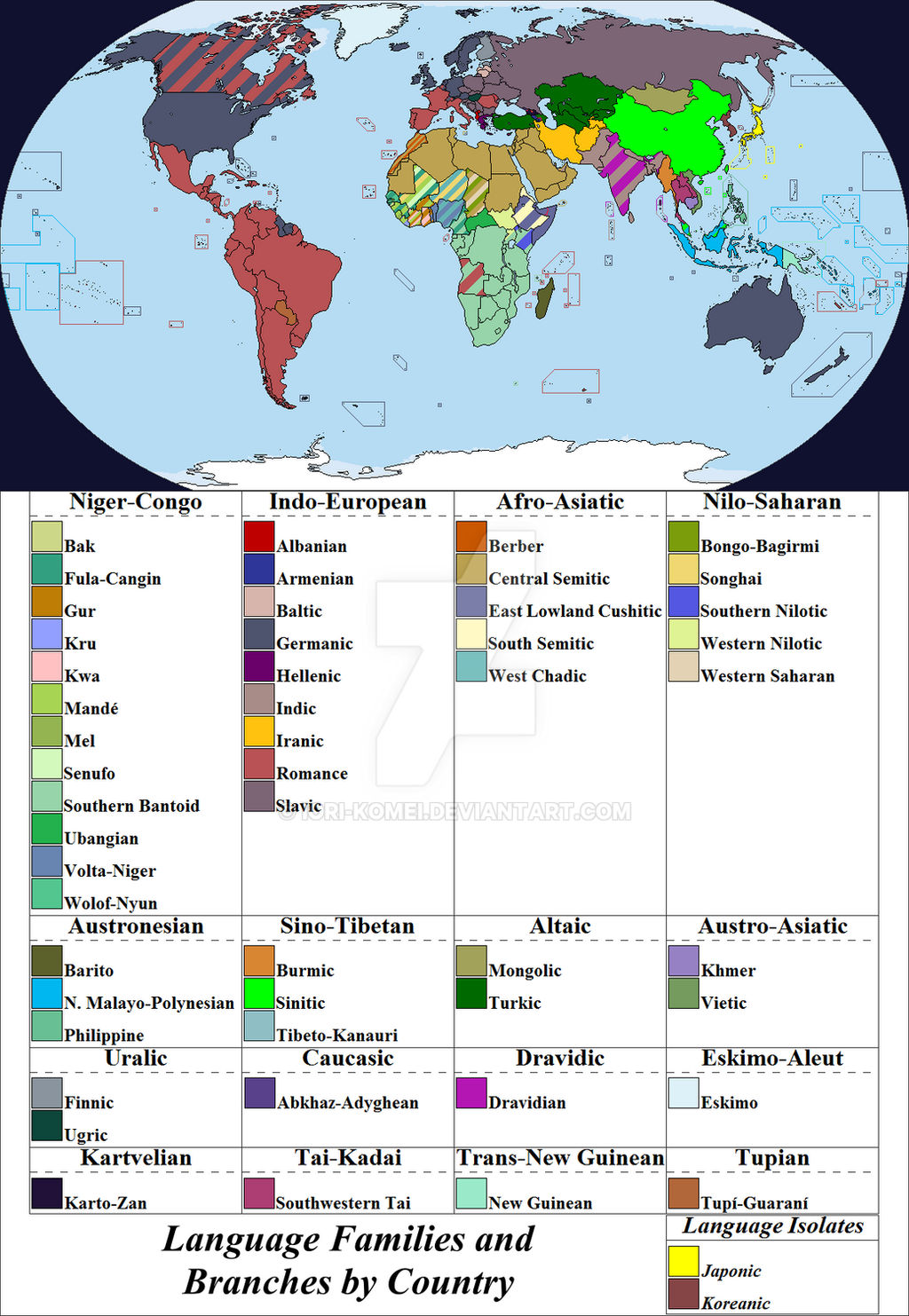
Linguistics and the Study of Language Families

https://images-wixmp-ed30a86b8c4ca887773594c2.wixmp.com/f/6484af3f-4d85-4a78-b6eb-55845c9eca72/d5xegde-e9c3bb82-ce39-4774-be91-3a56afc68c62.png/v1/fill/w_1024,h_1483,q_80,strp/language_families_and_branches_by_country_by_iori_komei_d5xegde-fullview.jpg?token=eyJ0eXAiOiJKV1QiLCJhbGciOiJIUzI1NiJ9.eyJzdWIiOiJ1cm46YXBwOjdlMGQxODg5ODIyNjQzNzNhNWYwZDQxNWVhMGQyNmUwIiwiaXNzIjoidXJuOmFwcDo3ZTBkMTg4OTgyMjY0MzczYTVmMGQ0MTVlYTBkMjZlMCIsIm9iaiI6W1t7InBhdGgiOiJcL2ZcLzY0ODRhZjNmLTRkODUtNGE3OC1iNmViLTU1ODQ1YzllY2E3MlwvZDV4ZWdkZS1lOWMzYmI4Mi1jZTM5LTQ3NzQtYmU5MS0zYTU2YWZjNjhjNjIucG5nIiwiaGVpZ2h0IjoiPD0xNDgzIiwid2lkdGgiOiI8PTEwMjQifV1dLCJhdWQiOlsidXJuOnNlcnZpY2U6aW1hZ2Uud2F0ZXJtYXJrIl0sIndtayI6eyJwYXRoIjoiXC93bVwvNjQ4NGFmM2YtNGQ4NS00YTc4LWI2ZWItNTU4NDVjOWVjYTcyXC9pb3JpLWtvbWVpLTQucG5nIiwib3BhY2l0eSI6OTUsInByb3BvcnRpb25zIjowLjQ1LCJncmF2aXR5IjoiY2VudGVyIn19.o5AQ3u8zGMCD-3mVSIBu7WKSkuVWJgtMu3hdMDU5hqg

Episode 1: Why Are There So Many Families?

Language Families of the World

Dr John McWhorter

Film Review

In this introductory lecture, Columbia linguistics professor Dr John McWhorter asserts the world has roughly 7,000 languages, which according to best evidence, developed from a single language in East Africa where the human species first arose.  He believes that language probably developed at the same time as tools and art. Although Homo sapiens first appeared on the planet 300,000 years ago, we only have evidence of art dating back 100,000 years. It’s still possible art and language developed earlier and we have yet to find the evidence.

McWhorter attributes the large number of modern languages to the inherent changeability of human speech. Each new generation makes language sounds somewhat differently.

For example

  • the “s’ sound can become “sh”, “zh” or “z”
  • “ah” can become “aw” or even “oo” or the French “ieu” sound
  • “k” can become a guttural “ch” as in German or “gh”

In addition words can get combined and shortened.

He gives the example of

  • “slowly” (shortened from the expression “slow-like” )
  • “only” (shortened from “one-like”)

and words derived from the Proto-IndoEuropean root word “mrecht meaning short

  • bra – from the word “brachial” meaning the short upper part of the arm (the “m” sound has changed to “b”)
  • merry – originally meaning short
  • pretzel – meaning crossed short arms (the “m” sound has changed first to “b” and then to “p”)

He completes the lecture by identifying the various language families found on each continent:

  • Europe (and parts of Asia) – Indo-European
  • Africa – has four completely different language families, excluding the click languages, which consist of three completely different families
  • Asia – has four completely different language families Altaic (Turkic), Chinese, Vietnamese and Thai
  • Austronesian is one language family with 1000 different languages – the main ones are Hawaiian, Maori, Tagalog (spoken in the Philippines), Indonesian and Malagasy (spoken in Madagascar off the coast of Africa). The immense similarities between modern Austronesian languages suggest the populations speaking them only separated very recently.
  • New Guinea – 25 different language families
  • North America (pre-Columbian) – 10 different language families
  • Mexico/Central America – seven completely different families
  • South America – 15 different families
  • Georgian languages (from the Caucasus mountains) – three different language families
  • Basque – last living language from an extinct language family.

Film can be viewed free with a library card on Kanopy.

https://www.kanopy.com/en/pukeariki/watch/video/6120000/6120002

Hospitals harvesting organs from donors who are STILL ALIVE

Hospitals harvesting organs from donors who are STILL ALIVE

Dr Eddy Betterman

Dr. Heidi Klessig, M.D., appeared on Children’s Health Defense (CHD) TV the other day to warn people that registering to be an organ donor puts them in danger of having their organs harvested from their bodies while they are still alive.

When registering to become an organ donor at the DMV, well-meaning people are told that they are “giving the gift of life,” but Dr. Klessig says this is a complete misnomer based on what she knows about how the process really works.

“When you go to sign up to be an organ donor, you go to the Department of Motor Vehicles and you see the brightly-colored signs saying ‘give the gift of life,’ you’re not offered a consent form,” she explains in the video below.

“You’re never told that when you become a brain-dead organ donor, you are not biologically dead. These people have a beating heart. Their lungs are working. Their digestive system works. Their kidneys work.”

Braindead doesn’t mean dead

Because of how the word sounds, braindead can make it seem like a person is pretty much already dead and ready for their organs to be harvested and given to someone else in need. The truth, though, is that being braindead does not mean that a person is actually dead.

“People who have been declared braindead have delivered healthy babies,” Dr. Klessig says. “These people are in no way dead.”

In recent weeks, there have been two such cases of organ donors who were declared braindead before their organs were extracted for transplant. Both individuals may have been able to recover were it not for being taken advantage of, it appears, by the organ transplant industry.

A 19-year-old athlete named Terrance Howard was declared braindead following a serious motor vehicle accident that left him with a terrible brain injury. Howard’s parents have what Dr. Klessig describes as “shocking and horrible” video footage that they shared to social media begging medical professionals to help their son get better, but to no avail.

The other case involves 23-year-old Jamaican business student Amber Ebanks who, following her braindead diagnosis, was neglected and left to die of starvation. Ebanks suffered some kind of injury that prompted her to drive herself to Montefiore Hospital in the Bronx, only to 10 days later end up actually dead with her organs harvested by the hospital.

“She had a beating heart. She had lungs that were working. She looked like every other patient in the hospital that was getting better. And her family fought for her. They wanted care for her, but they were pressured almost every other day – doctors wanted to remove her life support.”

“The organ procurement team actually showed up the very first day after her procedure, even before she was declared braindead – you know, being interested in seeing her become an organ donor, which her family refused.”

If you are interested in watching the full video interview with Dr. Klessig, visit ChildrensHealthDefense.org.

“Once on, it’s not easy to get off,” someone on X wrote about becoming an organ donor. “You can’t just request it like you can to add. You can’t even do it online. You fill out a form and mail it. You never hear from anyone that it was completed. Then you go to renew and tell them you’re no longer a donor and they tell you computer says you are.”

[…]

Via https://dreddymd.com/2024/10/06/hospitals-harvesting-organs-donors-still-alive/

“Shaken Baby Syndrome”: Concealing Vaccine-Induced Infant Deaths by Criminalizing Parents

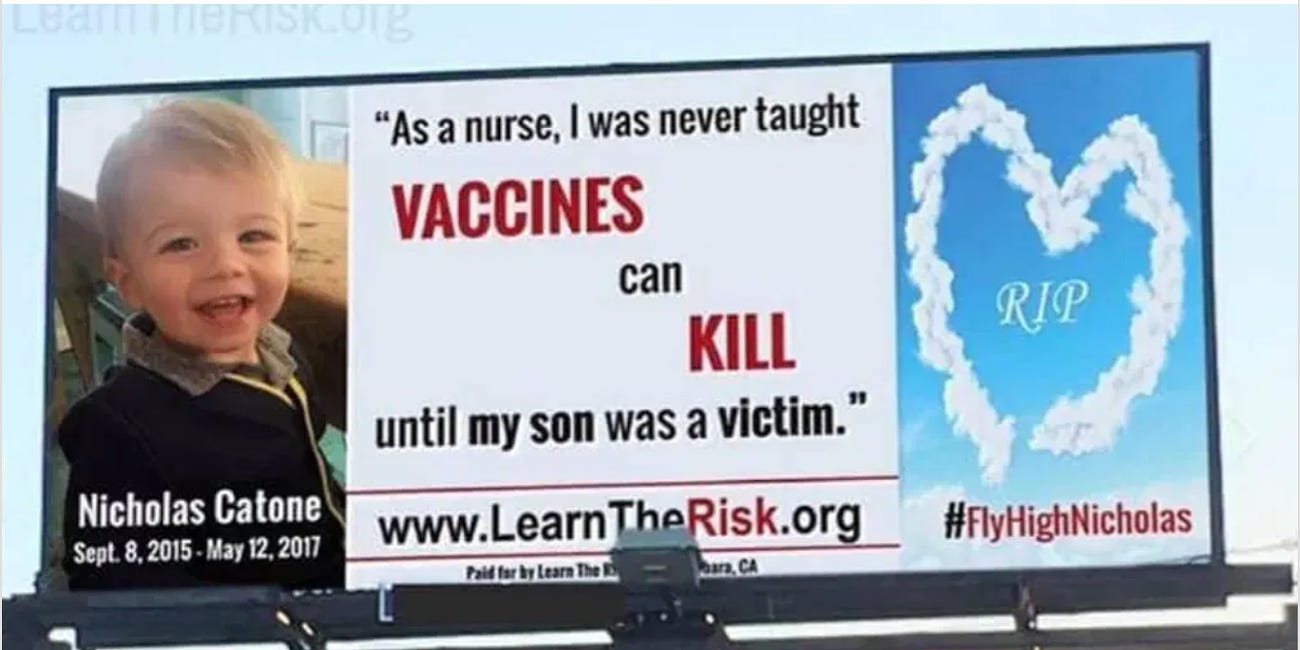
The Century of Evidence That Vaccines Cause Sudden Infant Deaths
A Midwestern Doctor

Note: yesterday, we put together a viral Twitter thread to bring attention to this case. Today, two pro-freedom Republican lawmakers are using an unprecedented subpoena to overturn the conviction. Please consider reaching out to both of them directly about this (here and here) or indirectly on Twitter here to support their efforts and create legislative pressure to overturn this execution.

In this publication, I have made the case that there is over a century of evidence that sudden infant death syndrome (all of which is comprehensively detailed here) is linked to excessive vaccination of infants.

The Century of Evidence That Vaccines Cause Sudden Infant Deaths

In that article, I provided extensive references for the following points:

•SIDS “mysteriously” clusters at 2 to 4 months of age—which is also when children happen to receive the vaccines most strongly associated with causing SIDS (e.g., the TDwP pertussis vaccine). Many doctors and patients noticed this, but it has been relentlessly dismissed by the medical industrial complex.

•As far back as 1933, case reports were produced of children experiencing brain damage and then infant death shortly after the TDwP shot. (e.g., a 1978 report that studied 15 million TDwP injections linked numerous cases of the vaccine to brain damage and death).

•In 1979, the CDC also completed its own analysis 1980 of 23 deaths within 28 days of DTwP vaccination, 12 (52.2 %) occurred within 24 hours, and 18 (78.3 %) occurred within one week. In 16 of the 23 deaths, autopsy findings were consistent with SIDS. Of the 16 SIDS deaths, 6 (37.5 %) occurred within 24 hours, and 12 (75 %) occurred within one week.

•A 1982 study that was inspired by observing 4 cases of SIDS within 19 hours of the TDwP vaccine that then studied 200 randomly selected SIDS cases. They found most of infants had been vaccinated prior to death (6.5% within 12 hours of vaccination, 26% within 3 days, 37% within a week, 61% within two weeks, and 70% within 3 weeks), with death typically following brief periods of irritability, crying, lethargy, upper respiratory tract symptoms, and sleep disturbance. Additionally, their autopsy findings were relatively consistent (e.g. petechiae of lung, pleura, pericardium, and thymus; vascular congestion; pulmonary edema; pneumonitis; and brain edema).

•In 2014, mass graves were unearthed for Irish orphans who coincidentally had been test subjects for the early diphtheria vaccine in the 1930s.

•In addition to there being countless cases of children receiving those vaccines and dying suddenly later in the night, many cases also exist of two twins both dying within 24 hours of the vaccine (e.g., the earliest was in 1946, while this article reviews 13 cases of simultaneous twin SIDS deaths)—something which is almost impossible to have occurred by chance. Additionally, in many cases (e.g., this 1987 one, this 2007 one, this 2010 one, and this 2013 one) of twins who died after vaccination and were found dead lying on their backs.

[…]

•In 1957, an Australian MD (Archie Kalokerinos) worked with the Aboriginal community (who were poorly treated in Australia and had abysmal living conditions resulting in a 10% infant mortality rate—compared to 2% in the neighboring regions). He realized this death was largely due to widespread vitamin C deficiencies (as their native diets had been destroyed by colonialism). In many cases, he was able to rescue infants on the verge of death in minutes by giving them vitamin C. Likewise, he showed that vitamin C deficiency also explained the children’s widespread epidemic of pneumonia, severe ear infections, severe infant irritability, and a frequent inability to feed. He eventually ignited national controversy by successfully defending an Aboriginal woman accused of killing her child by proving the bruising on the child’s body was due to scurvy (vitamin C deficiency) rather than child abuse, and when he at last convinced the authorities to start giving vitamin C to Aboriginal children, all of these conditions dropped dramatically. Most importantly, he found that much in the same way an illness (e.g., pneumonia or sepsis) rapidly depleted vitamin C levels (which is essentially why IV vitamin C is so helpful for treating sepsis), vaccination would severely exacerbate an existing vitamin C deficiency. This was best shown by a vaccination campaign killing 50% of the children in one Aboriginal community (you read that correctly 50%), and that giving vitamin C to animals before vaccinating them prevented them from dying.

[…]

• Japan’s decision to delay the scheduled DTwP vaccination by 20 months resulted in an 85-90% reduction in the instances of SIDS.

•When SIDS cases at morgues are examined, they cluster at precisely 2, 4, or 6 months of age (rather than spread throughout the 2 to 6 month period).

•Prior to the mass vaccination programs in America, SIDS was very rare (to the point few were even aware crib death occurred), but rapidly spiked (to the point a new diagnosis category had to be made) after national mass vaccination and before long became the leading cause of death in the first 12 months of life. For instance, between 1953 to 1992 in Olmstead County, Minnesota, the rate of SIDS went from 0.55% to 12.8% of live births (going from 2.5% to 17.9% of total infant deaths), with 85% occurring within the first 6 months of infancy. In contrast, during that same time, almost every other childhood disease was continually decreasing.

•A 2011 study showed there is a direct correlation between how many vaccines a country gives their children and their infant mortality rate.

•While the rates of SIDS steadily increased, once the TDwP vaccine was replaced with the safer TDaP vaccine between 1991-1996, it began to decrease. This reduction is commonly attributed to the Back to Sleep campaign, but this ignores the fact that the decline began before the campaign. That many infants (e.g., the twins) have been found dead lying on their backs, and that prior to the TDwP vaccine, sleeping on the back wasn’t an issue.

•When cases of SIDS are analyzed in VAERS, they cluster next to vaccination (e.g., 75% occur within 1 week of vaccination and comprise almost all infant deaths associated with vaccination).

•The National Vaccine Injury Act was passed in response to growing public outrage over DTwP deaths due to NBC airing a national story on the dangers of this vaccine (something which would never air in the more corrupt media of today):

•That documentary and the 1986 Vaccine Injury Act resulted in a safer DTwP vaccine (DTaP) being made (which still causes SIDS but not as frequently). Unfortunately, the DTwP vaccine is still used in Africa. When extensively studied, it was found to make children 5 times as likely to die (3.93 for boys and 9.98 for girls).
Note: while some died shortly after vaccination, the primary cause of their deaths was chronic immune suppression which made them more vulnerable to the numerous deadly infections existing in that region.

•When COVID happened, many in the vaccine safety community predicted the lockdowns would lead to a massive drop in SIDS cases (since children were skipping their non-essential vaccine appointments). As I show here, this indeed was what happened (and likewise happened shortly after in Florida once large numbers of parents opted out of routine vaccination). To this day, no explanation has ever been provided for this mysterious decline in SIDS.

The Forgotten Side of Medicine is a reader-supported publication. To receive new posts and support my work, consider becoming a free or paid subscriber. To see how others have benefitted from this newsletter, click here!

[…]

Shaken Baby Syndrome

In 1971, the diagnosis of shaken baby syndrome was created, which essentially argued that abusive parents/caretakers who violently shook their babies would cause diffuse bleeding and swelling in their brains. This diagnosis has been incredibly controversial because the evidence linking it is weak and inconsistent (e.g., the symptoms are non-specific), and in recent years, the medical consensus has gradually turned against the diagnosis (e.g., see this 2016 article and this 2017 review showing there is a severe lack of evidence substantiating this condition), resulting in more and more courts dropping convictions for shaken baby syndrome.

[…]

Note: the unrelating encephalitis cry (which many parents of vaccine injured children notice begins after vaccination) was one of the first things that made me aware of the fact vaccines weren’t safe, as if you feel into it, you can tell rather than being unhappy, something is wrong with the infant. Remarkably, in the book Peter Hotez (one of the world’s leading proponents of vaccination) wrote to debunk the link between vaccination and autism, he stated that prior to his daughter becoming autistic, she had a piercing cry that could be heard throughout the neighborhood—which again illustrates how blind the medical things are to obvious things right in front of them (e.g., the association between shaken baby syndrome and infants crying is widely assumed to be due to the crying provoking the parents into shaking them to death in an attempt to quiet them).

In turn, over the years, many physicians (besides just Archie Kalokerinos) have argued that shaken baby syndrome was a misdiagnosis for SIDS. For example:

•This 2004 rapid response published in the BMJ which noted:

  • A review where 9 children with the classic signs of shaken baby syndrome (subdural hemorrhages and retinal petechiae) had no suspicion by their doctors of having been abused that in the past.
  • The symptoms attributed to shaken baby syndrome were previously diagnosed as Barlow’s disease and attributed to a lack of vitamin C.
  • In the past, these signs of a clinical vitamin C deficiency in the mother were cited as a reason to terminate pregnancies (as the children would be at a risk of complications throughout life).
  • Low vitamin C raised histamine levels (which causes vessel bleeding).
  • When 437 outwardly normal adults in New York were tested, 3% were found to have dangerously low vitamin C levels and very high histamine levels.

•This 2006 paper noted that:

  • The children in the original paper used to create the diagnosis of “shaken baby syndrome” all had the characteristics of infantile scurvy (vitamin C deficiency).
  • That the histamine release trigged by the inflammation induced by vaccination could create the blood vessel leakage observed in those cases.
  • That children in Japan (where vaccination is delayed) mysteriously are “shaken” at 4-7 months of age rather than at 2-4 months of age in the United States.
  • That many bleeds that “result from shaking” were observed in children who could not have possibly been shaken (e.g., because they were still in the uterus or had just been born).

•This 2006 paper reviewed two cases of children with all the classic signs of shaken baby syndrome who had never been shaken, were vitamin C deficient, and had their symptoms emerge following vaccination (which in turn was followed by respiratory arrest).

•A physician who reviewed numerous cases of shaken baby syndrome found that in over half the cases, it was preceded by vaccination, signs of a vaccination injury and intense crying. He also noted that contrary to what the shaken baby syndrome experts claimed, there were a variety of medical conditions (besides shaking a baby) which could cause the classic signs of shaken baby syndrome.

Robert Roberson

A few hours ago, I found out about Robert Roberson’s case, which is presently being covered in the national media (including many liberal outlets) because it is viewed as an extremely unjust execution by the State of Texas (which is well-known for not granting clemency or stays of execution to convicted murders). His final appeal before his execution tomorrow night was denied.

If you view a brief video made about the situation, it should be clear why many (including the detective who originally convicted him) are extremely upset about this execution:

[…]

Via https://www.midwesterndoctor.com/p/please-help-prevent-a-medical-miscarriage

Canada Starts Euthanizing the COVID-19 Vaccine-Injured

Dr William Makis

An Ontario man in his late 40s with a history of mental illness died by euthanasia after his assisted death assessors decided that the most reasonable explanation for his physical decline was a post COVID-19 “vaccination syndrome.”

The term is controversial — Canada’s current vaccine reporting system for adverse events doesn’t include “post-vaccine syndrome” — and multiple specialists consulted before his death couldn’t agree on a diagnosis, raising questions as to whether the man’s condition met the criteria for an “irremediable,” meaning a hopeless, incurable condition.

The anonymized case is one of several highlighted in a series of reports issued by a 16-member MAID death review committee struck by Ontario’s chief coroner’s office in January.

Identified as “Mr. A,” the man experienced “suffering and functional decline” following three vaccinations for SARS-CoV-2. He also suffered from depression, post-traumatic stress disorder, anxiety and personality disorders, and, “while navigating his physical symptoms,” was twice admitted to hospital, once involuntarily, with thoughts of suicide.

“Amongst his multiple specialists, no unifying diagnosis was confirmed,” according to the report. However, the  Medical Assistance in Dying (MAID) Death Review Committee, MAID assessors “opined that the most reasonable diagnosis for Mr. A’s clinical presentation (severe functional decline) was a post-vaccine syndrome, in keeping with chronic fatigue syndrome.”

There were no “pathological findings” at a post-mortem that could identify any underlying physiological diagnosis, though people’s experiences can’t be discounted just because medicine can’t find what’s wrong with them.

Click here to read the full article on National Post.

My Take…

I predicted this dozens of times in various interviews and in my substack articles.

MAID will become the main vehicle to kill off the COVID-19 vaccine-injured. Logically, it has always made perfect sense. I just didn’t expect Canada to get there this quickly.

If you die from a COVID-19 vaccine injury, for everyone involved in the mRNA vaccine fraud, that is the best possible outcome. Since there are no autopsies and no staining for spike protein, it’s literally the perfect crime. And it’s legal.

The COVID-19 vaccine-injured, however, are an extreme inconvenience. They are living proof of the crime of vaccine fraud, contaminated vaccines, etc. They represent the worst possible outcome of vaccination.

Everyone involved in the COVID-19 vaccine fraud wants the vaccine-injured dead:

  • the doctors who gave the shots (you can tell by how they treat the vaccine injured).
  • the scientists who pushed the mRNA fraud (they despise the vaccine injured and viciously attack them online)
  • the media and propagandists for big pharma (they ignore the vaccine injured as much as possible and minimize the damage done to them – gaslighting)
  • the compromised health officials (they reject all vaccine injury reports)
  • the politicians (they pretend vaccine injuries don’t exist and aren’t an issue to be addressed)

Since the vaccine cult is a death cult, it was always going to go this way for the vaccine-injured.

That’s why the vaccine-injured receive no support, no funding, no research, no treatment and no compensation.

It’s not nice to say, but the goal of the vaccine cartel was always to kill them off.

The next step will be scaling up the MAID killings, as hundreds of thousands of Canadians are severely COVID-19 vaccine-injured.

Since Trudeau announced his intention to stay on, I’m certain this next step will come soon enough.

[…]

Via https://www.globalresearch.ca/canada-starts-euthanizing-covid-19-vaccine-injured/5871080

159 of 193 Countries Embrace the BRICS Settlement System: A Challenge to Dollar Dominance

BRICS

NEWNERVE

The global financial landscape is on the brink of a significant transformation as 159 out of 193 countries have signed up to use the new BRICS settlement system, a direct competitor to the SWIFT payment network. This development not only signifies a shift in the balance of economic power but also poses a challenge to the long-standing dominance of the U.S. dollar in international trade and finance.

The Limitations of SWIFT and the Need for an Alternative

SWIFT has been a cornerstone of global finance, enabling secure and standardized financial transactions across borders. However, its role as a tool for economic sanctions has made it vulnerable, particularly for nations like Russia, Iran, and several African countries, which have faced severe sanctions imposed by the U.S. and some European nations. These sanctions have effectively frozen billions in assets, locking these countries out of the global financial system and crippling their ability to transact with other nations.In response to these financial restrictions, the BRICS nations—Brazil, Russia, India, China, South Africa, and its new members—have developed a new system designed to bypass the need for SWIFT entirely. This alternative payment system not only provides a means for countries to conduct international transactions without fear of sanctions but also marks a significant step toward the de-dollarization of the global economy.

Enabling Transactions in Local Currencies

The BRICS settlement system allows countries to settle trades and payments in their own currencies, reducing reliance on the U.S. dollar, which has long been the dominant global currency. This move addresses growing concerns among nations about the risks associated with holding and trading in dollars, especially under the threat of sanctions that could result in asset confiscation.The potential erosion of the dollar’s status as the world’s reserve currency could lead to a reconfiguration of the global financial order, challenging the hegemony that the U.S. has long enjoyed. For the U.S., the rise of this alternative settlement system poses a direct challenge to its economic influence, as the dominance of the dollar has facilitated its ability to impose sanctions and control global financial flows.

Implications for International Trade and Finance

The BRICS settlement system could significantly alter the current economic landscape by reducing dependency on the U.S. dollar and shifting economic power. International businesses may need to adapt to new trading practices if the BRICS currency gains traction, potentially streamlining imports and exports within BRICS nations.Adopting a new currency affects trade relations, as businesses might favor dealing with BRICS countries due to reduced currency exchange risks. However, non-BRICS countries may face trade imbalances and need strategies to mitigate these challenges.

A Multi-Currency Reserve System

The emergence of a multi-currency reserve system could diversify global financial stability, lessening the singular reliance on the U.S. dollar and providing more options for countries in economic crisis situations. A multi-currency system could create balanced economic relations, as countries trading in different currencies may experience fewer fluctuations, contributing to stable global trade.If successful, the BRICS currency may encourage other regional groups to consider similar initiatives. This diversification in reserve currencies has the potential to create a more equitable financial system, limiting the power of any single nation’s economy.

Challenges and Opportunities for the BRICS Bloc

The BRICS bloc, which now includes Brazil, Russia, India, China, South Africa, Saudi Arabia, Egypt, the UAE, Iran, and Ethiopia, boasts a combined population of approximately 3.5 billion people. The economies of the BRICS nations are worth over $28.5 trillion, accounting for roughly 28% of the global economy.While the adoption of the BRICS settlement system presents opportunities for increased financial sovereignty and reduced impact from U.S. sanctions, it also introduces challenges. The transition to a new currency system may create global volatility as markets adjust, and the success of the BRICS system will depend on its widespread adoption and the stability of the new currency.

As the world watches the rollout of the new BRICS settlement system, the implications for global finance, trade, and the geopolitical landscape are enormous. This development marks a potential turning point in the history of international economics, as the global balance of power shifts away from traditional centers of influence toward a more diverse and distributed network of economic partnerships. The coming months will be critical in determining how this new system is adopted and how it impacts the longstanding dominance of the U.S. dollar in global finance.The BRICS settlement system is not merely a technical development; it is a statement of intent by many nations to challenge the existing economic order and assert their independence from Western-dominated financial institutions. As this system prepares to go live in October, it signals a significant shift in global economic power dynamics, paving the way for a more multipolar world.

[…]

Via https://newnerve.com/159-countries-embrace-the-brics-settlement-system/

Cash is Gold, Gold is Risky

Commentary by Brian Shilhavy
Editor, Health Impact News

I want to start out this article by stating that I do NOT give out financial advice. I like to publish facts and information that may not be popular elsewhere, and I may sometimes allude to what I am doing regarding finances.

But there is no one-size-fits-all financial “truth” when it comes to managing one’s own finances or investing, and you should be wary of those who promote such one-size-fits-all views, and see if they have any economic motive for their “advice”.

How you manage your finances and invest depends on a variety of factors, including what it is you want to accomplish, and sometimes it is better to ignore financial advice from “the experts”, and use just plain old common sense.

I start from a thoroughly “prepper” mindset, as I have since 1998 when I started prepping for Y2K, and my goals and financial principles have been more refined from a “prepper mindset” since 2020 and the COVID Scam.

That means I am a financial pessimist, and believe that the entire system could collapse any day now, and I prepare accordingly.

In the event of a loss of infrastructure, where either electricity or the Internet, or both, become unavailable, one must understand how the economy will operate under such dire circumstances, and we actually have an example of that right now, and it has been going on for a few weeks now in Western North Carolina.

I personally know people from this area, and I have heard more than one of them report that during the days following the hurricane and their flooding rains that caused so much death and destruction, that local stores, such as gas stations, were ONLY accepting cash, and even there, only small bills (they would most likely not be able to exchange a 100 dollar bill, for example).

So if they could not even give change for a $100 bill, then they most certainly would not be interested in, or have the ability to, give you change on a 1 ounce gold coin or bar either, since the going rate is now over $2700 for spot price.

And that is assuming that those who are invested in Gold even have physical gold on hand that they can use, as the vast majority of people invested in Gold hold only “electronic gold”, meaning that to access it and retrieve it, they need BOTH electricity, and the Internet.

We know that the number of people purchasing physical gold is drastically increasing, since places like Costco and Walmart can barely keep physical 1 oz. gold bars in stock.

But I can almost guarantee that in a time of national crisis, which many believe could be imminent in this election year, you will not be able to go back to those same retail chains and be able to use your gold bars to be able to purchase anything in their stores (and in fact you cannot even do that right now).

So in times of emergency, as we are seeing in Western North Carolina, CASH is Gold, and real gold is useless there.

If you are worried about a cyber attack or real attacks on U.S. soil, you might want to consider cashing in some of your gold to hard cash, so that you have something to use for local purchases in case the Internet or power grid goes down for any length of time.

But having some cash on hand is only a temporary solution to use just after an emergency event. If essential services remain offline for any extended period of time, your cash will most likely become worthless, after the local businesses run out of the inventory of whatever product they are selling, as supply chains choke.

Then local communities will need to develop some sort of barter system for basic goods, and you will need either goods or services you can trade that have value in a barter system.

And that’s why I have chosen for myself, to invest in long-term storable food, healthy and uncontaminated food.
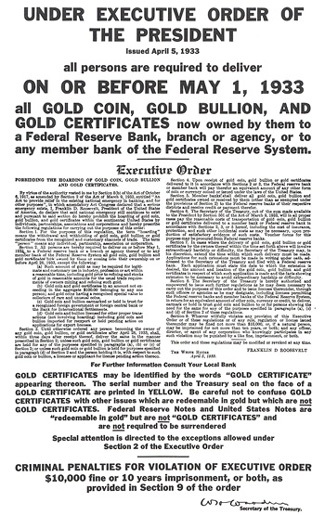
But even if the power grid and the Internet do not go down during a national crisis, there are other dangers for your financial assets, such as government confiscation.

Gold has been confiscated by the government in the U.S. in the past, and even today, have you ever tried to cash in any physical gold you own?

If you haven’t, you might want to look into it, because the U.S. government already requires anyone purchasing gold from someone else to report it to the IRS along with your name and personal info, over certain amounts (can vary by State).

If you don’t want the government to know about your personal gold sales over such limits that the IRS establishes, your options are few, and probably involves something like a local pawn shop giving you a lower rate, along with a suitcase of cash that is probably laundered money.

Getting involved in the criminal financial world is probably not something most honest Americans who have been convinced to invest in gold are wanting or willing to do (I know I’m not!).

Last week, ZeroHedge News published an excellent article about the many times throughout history governments have confiscated assets of private citizens:

Confiscation Games: Public Expropriation Of Private Assets

Some excerpts:

Executive Summary

Throughout history, governments around the world have occasionally resorted to confiscating the assets of their citizens in response to economic crises, political purges, or ideological pursuits. These actions, often justified as necessary for the greater good, have frequently resulted in widespread social disruption and significant hardship for the affected populations.

This report delves into four significant historical episodes of asset confiscation, examining the methods used by governments to seize property and the diverse strategies individuals and communities employed to resist or evade these confiscations. Each case provides insight into the complex relationship between state power and personal property rights, as well as the resilience of the human spirit in the face of adversity.

The Confiscation of Gold by the United States Government (1933)

The onset of the Great Depression in 1929 plunged the United States into a severe economic crisis unparalleled in its history. The stock market crash not only shattered the financial system but also led to catastrophic levels of unemployment, countless bankruptcies, and widespread despair. As banks collapsed and businesses shuttered, the American public grappled with unprecedented hardship.

By 1933, the economic situation had grown even more dire, with no sector of the economy untouched. Into this bleak landscape stepped Franklin D. Roosevelt, inaugurated as President in March of that year, bringing with him a new vision aimed at rescuing the nation from its economic plight.

Roosevelt’s New Deal was a series of programs and policies designed to revive the economy and restore confidence among the American people.

Among these initiatives, the decision to confiscate gold under Executive Order 6102 in April 1933 stands out as particularly bold and contentious.

This executive order mandated that all persons, businesses, and institutions within the United States surrender their gold coins, bullion, and certificates to the Federal Reserve, receiving in return paper currency valued at $20.67 per troy ounce.

Roosevelt’s rationale for such a drastic measure was rooted in the belief that hoarding gold was exacerbating the economic downturn. By hoarding gold, he believed that individuals were limiting the money supply available, which in turn deepened the deflation that was strangling economic growth.
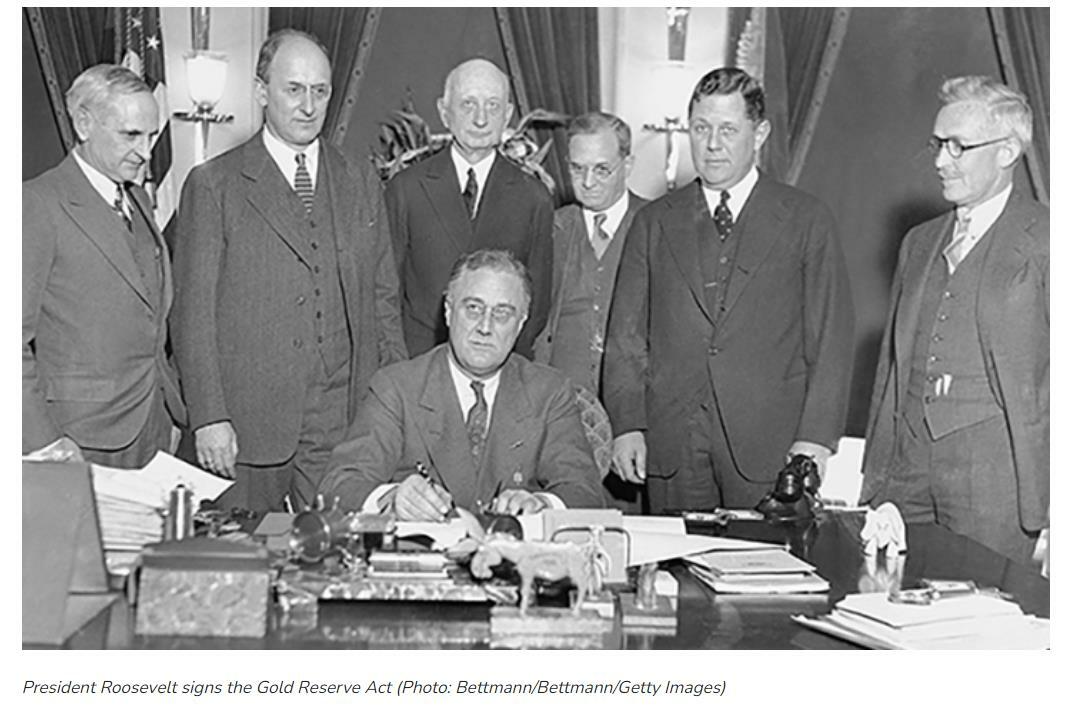
The move to confiscate gold was aimed directly at undermining the gold standard, a monetary system in which the value of national currencies was directly linked to specific amounts of gold.

This standard restricted the Federal Reserve’s ability to increase the money supply during economic downturns, thereby limiting its ability to stimulate economic activity.

By removing gold from private hands and centralizing it within the Federal Reserve, Roosevelt hoped to expand the money supply and thus combat the crippling deflation.

The following year, Roosevelt pushed forward with the Gold Reserve Act of 1934, which not only reaffirmed the government’s control over all gold but also increased the official price of gold from $20.67 to $35 per ounce.

This significant devaluation of the dollar sought to boost economic recovery by making American goods cheaper on the international market, thus increasing exports and reducing the balance of trade deficit.

The government enforced these new policies with stringent penalties, threatening violators with hefty fines and imprisonment, signaling a stern commitment to these drastic measures.

Public reactions to these gold policies were deeply divided. While many Americans complied with the order, either out of a sense of national duty or resignation to the economic emergency, a significant number resisted, driven by a combination of distrust in the government and a determination to safeguard personal wealth.

Resistance took many forms. Individuals went to great lengths to hide their gold, employing creative methods to evade confiscation. Gold was buried in backyards, secreted away in hidden compartments of homes, or transformed into innocuous items like jewelry or art.

Others exploited loopholes in the legislation, particularly the exemptions that allowed professionals like dentists, jewelers, and artists to retain necessary gold for their work. Some claimed these professional exemptions under dubious pretenses, while others rushed to invest in numismatic coins—rare and collectible coins that were initially exempt from confiscation.

The affluent and certain businesses looked beyond American borders, moving their gold assets to international banks or engaging in elaborate foreign transactions to protect their holdings.

As government scrutiny intensified, a black market for gold flourished, allowing covert trading and providing an avenue for transactions that circumvented official channels. In certain areas, barter systems emerged where gold acted as a medium of exchange, further undermining the government’s attempts to control the currency.

The long-term consequences of Roosevelt’s gold policies were profound and multi-faceted.

Economically, these measures provided the necessary liquidity to tackle deflation, facilitating a gradual recovery from the Depression. The increased money supply resulting from the devaluation of the dollar and the abandonment of the gold standard allowed for greater flexibility in monetary policy.

This adaptability was crucial not only during the remaining years of the Depression but also in shaping the economic strategies of subsequent decades.

The revaluation of gold and the shift away from a strict gold standard also laid the groundwork for the Bretton Woods system, which established the U.S. dollar as the backbone of the international financial system after World War II. This system played a pivotal role in global economic stabilization until its dissolution in the early 1970s.

The episode remains a potent symbol in discussions about government overreach and economic liberty, shaping the ideological debates that continue to influence American political and economic thought.

In retrospect, the U.S. government’s intervention in the gold market during the Great Depression was a watershed moment with lasting impacts. While it played a crucial role in addressing the immediate economic crisis and reshaping U.S. monetary policy, it also left a legacy of wariness about government power over personal assets.

These actions and their repercussions continue to echo through the financial markets and shape government policies, reminding
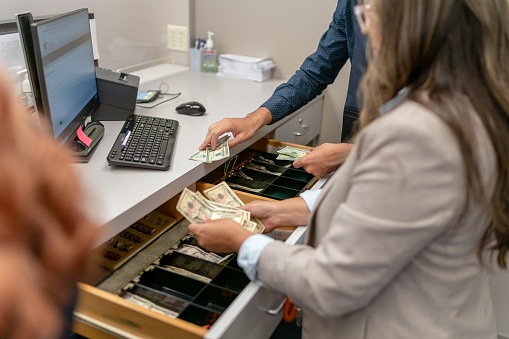
The biggest obstacle to putting everyone on a blockchain and requiring them to only do financial transactions through digital currencies, besides the flaws and weaknesses of the technology to even accomplish this in the first place, is the public consumer who must spend money for the economy to operate.

And if a majority of the consumers demand hard cash to make those transactions, there would be literally nothing that the Globalists could do about it.

[…]

Via https://vaccineimpact.com/2024/cash-is-gold-gold-is-risky/


Ukrainian Troops Increasingly Refusing Orders, Desertion Rates Explode

Illustrative file image: Reuters

Zero Hedge

The Ukrainian prosecutor’s office has opened 51,000 cases of desertion through the first nine months of 2024. The number of soldiers abandoning their posts is likely to double last year’s total.

The Times of London reported data from the Ukrainian government showing that “51,000 criminal cases were initiated for desertion and abandonment of a military unit between January and September of this year.”

El Pais previously noted that 45,000 Ukrainians were being prosecuted for desertion from the start of the year through August. Al-Jazeera says the number is at least 30,000 desertions.

At the start of the year, Kiev was estimated to have between 500,000 and 800,000 active-duty soldiers and an additional 300,000 reservists.

The Ukrainians have also sustained casualties fighting to defend from Russian advances and amid Kiev’s Kursk invasion.

Kiev has struggled to fill its ranks with fresh soldiers, leading Ukraine to drop its conscription age from 27 to 25. As Kiev is still facing manpower shortages, American politicians are pushing Ukraine to drop draft age to 18. Responsible Statecraft has reported:

Despite no evidence of victory on the horizon, the Republican senator is urging Ukrainian lawmakers to pass a mobilization bill that would force more Ukrainian citizens to be drafted into the military. Currently, men under 27 are exempted from the draft. Graham has a problem with that.

…Graham told reporters, “I would hope that those eligible to serve in the Ukrainian military would join. I can’t believe it’s at 27. You’re in a fight for your life, so you should be serving — not at 25 or 27.”

“We need more people in the line,” he said.

Ukraine has also resorted to allowing prisoners to leave jail if they join the military.

One Ukrainian who deserted told the Times that prison was a better option than the military because “at least in prison, you know when you will be able to leave.”

The number of Ukrainians that Kiev is prosecuting for desertion has significantly increased throughout the war. In 2022, the number was 9,000, and it had more than doubled to 24,000 last year.

[…]

Via https://www.zerohedge.com/geopolitical/ukrainian-troops-increasingly-refusing-orders-desertion-rates-explode

When Did Google Search Become Totally Useless?

When Google launched in the late 1990s, it quickly overtook the market for search engines. Its proprietary method of indexing led users to results they were actually looking for rather than producing the hodgepodge of results offered by other search engines of the time. Within just a few years, it was dominating the market. Today, it is a money-printing machine.

It’s also increasingly horrible at the core mission that produced such success. The company’s leadership may have realized early on that to dominate they needed to maximize the marketing angle of search, but over time that side of the business — the one that produces revenue — swallowed the informative results that drove the search engine’s success.

Now, Google’s true product, its users, are drowning in a sea of partisan slop and sponsored content rather than getting the results we’re looking for when we take to the World Wide Web. By doing so, Google is making it pointless for us to continue to allow ourselves to be the product.

Let’s say you have an artistic daughter who wants some oil paints for Christmas, but you’re unsure about which brand to buy or even what the definition of oil paint is. You head over to Google and type in “oil paint.” Is your first result a definition or even the Wikipedia page? Nope, it’s ads. You have to scroll to get to Wikipedia.

Similarly, you might find yourself hungry while on the road, so someone in the car Googles “restaurants near me.” There was a time when this feature was useful. Now, the restaurants are paying to play and the resulting results are ridiculously skewed. While I’m not going to dox myself here with screenshots of the results I get when I Google “restaurants near me” while sitting in my house, suffice it to say that the top results aren’t necessarily the closest, or even highest-rated, eateries. Some that I know are there — because I live in this area! — aren’t even listed.

Granted, these aren’t extremely pressing issues. People researched oil paints and found places to eat for decades upon decades without the assistance of the internet. What is a bigger deal is how nakedly partisan Google has become. Former President Trump has even complained about it, taking time to call CEO Sundar Pichai to point out the problem.

Naturally, his complaints were downplayed, but your Google search is supposedly tailored to your interests. As I am not suffering from Trump Derangement Syndrome and have written positively about him (and used Google to find info for such articles), my results should be reflective of that. Instead, I get the latest anti-Trump bromides of the day.

The same search on another day was slightly different, including some horse race articles.

When I clicked on the “more news” section, though …

At least those results are timely, if not all actually news, but what if the search is expanded to “What are some good things about Donald Trump?”

Points to Google for pointing to the National Archives in the first hit, I suppose. The second, though, is largely a list of things writers at Politico deem negative with the “upshot” being that President Biden was going to undo them. What if the search is changed to “Donald Trump achievements?”

Okay, Google really likes that Politico piece and has deemed anything Donald Trump did ever before becoming president irrelevant, but what about “Donald Trump achievements as president?” Surely, its algorithm can pop up a few pieces about the economy or immigration or Trump helping grow The Washington Post’s subscriber base so as to help keep democracy from dying in darkness or whatever.

Super cool, super helpful, super neutral. Now, let’s check in on Kamala Harris.

Well, that’s weird. Whereas Trump’s campaign website is pushed down the page when his name is Googled, beneath mostly negative opinion pieces, Harris’ website is right there, with the “top stories” below it. I’m sure that’s just how search engines work, with no biases programmed in whatsoever. The completely neutral algorithm just happens to display the info the campaign would prefer to be displayed first at the top of the page, with the top stories about the candidate being answers to questions people might have about her, as well as a hit piece on Bret Baier thrown in for good measure.

This isn’t just about the election, though, but also about the changing nature between users — again, the product — and the online services we allow ourselves to be pimped out for. The disparities between the results for Trump and Harris simply highlight how stark the problem is.

Whether it’s Google or Facebook or Instagram, the initial premise of expanding easy access to information and apprising us of stories we might have otherwise missed has been largely destroyed. Google and Meta show us what they want us to see, not what we signed up to see, and it’s starting to turn people off. Maybe that’s a good thing, because most people need to spend more time in the real world. But when we’re trying to find a restaurant or information about voting or see pictures of a friend’s new landscaping or figure out how to get Elmer’s glue off the hardwood floors, burying those things under a mountain of nonsense makes us more likely to tune out.

Which is probably not just a good thing but a great thing — but initially the internet and social media were supposed to be about connecting us, about decreasing barriers to information. It would be nice if our tech overlords could remember what their initial goals were — in Google’s case, it was “to organize the world’s information and make it universally accessible and useful” — and return to those ideals instead of pushing us toward full “Idiocracy.”

[…]

Via https://thefederalist.com/2024/10/22/when-did-google-search-become-totally-useless/

Voters in Georgia, Texas, and Shelby County Tennessee Report Voting Machines Are Flipping Their Selections

Voting machines in Georgia – 11Alive screengrab

Jim Hoft

It’s like 2020 all over again.

Voters in Georgia are reporting the voting machines are flipping their selections and changing totals.

On Friday Rep. Marjorie Taylor Greene (R-GA) reported that the Dominion voting machines in Georgia are flipping voter selections in her district from Republican to Democrat.

Rep. Marjorie Taylor Greene (R-GA) took to social media platform X to sound the alarm on a disturbing incident reported by a voter in Whitfield County, Georgia’s 14th district.

According to Greene, a constituent in Whitfield County noticed that their printed ballot did not reflect the selections they made on the voting machine, particularly changing their vote away from candidates they had chosen.

Rep. Greene warned voters on X:


MTG continued:

This happened in Whitfield County in my district – GA-14.

We vote on Dominion voting machines then it prints a paper ballot with our selections made on the machines.

This voter’s printed ballot had been changed from their selections made on the machine.

Good thing they checked their paper ballot before turning it in!

After several attempts of trying to change it to reflect their correct choices, they had to void the ballot and use a different machine.

Please double check your printed ballot before you turn it in to make sure it has marked the candidates you voted for!!!

Whitfield County Board of Elections later released a statement assuring voters that the issue “was quickly resolved.”

Meanwhile, in Shelby County Tennessee, election officials have received complaints that the voting machines are also switching the selections of voters.

Officials there say the machines are sensitive and it is an issue with voters and how they select their choice.

Via Jack and Catturd2 on X.

Shelby County Election Commissioner Venecia Kimbrow held a press conference Thursday, Oct. 17, to discuss the issue with the machines flipping votes.

Local election officials blamed user error.

Officials spoke out about the voting machine issues in Shelby County Tennessee on Friday. – screengrab

Local ABC 24 reported:

Kimbrow said that the boxes voters are going to are new machines, and there are some learning curves with them, but she did not think there was anything nefarious occurring.

She said she does not believe the machines are the problem, saying they have been tried and personally tested. The situation, she claimed, possibly stems from user error.

The issue comes down to how people are entering their votes. In some cases, people are using their finger when they should be using a stylus, or vice versa.

Kimbrow said that the calibration of the machines can cause the names to switch because of hand placements on the machine, but voters are able to request a stylus.

They blamed it on the voters – who are not using the stylus pens. Sounds like a machine problem.

George Behizy weighed in.


And now Dallas County, Texas GOP Chair Allen West is reporting problems with the voting machines in his county.

Allen West listed a series of issues the county found with the current machines in use there.

One of the issues stated, “Secretary of State, Attorney General personnel, and Dallas County Elections Administrator still have not explained vote flipping on ExpressVote observed on 10/8/2024 (TEC Sections 129.023 (e)(1)(b) and (e) (1)(c))”

[…]

Via https://www.thegatewaypundit.com/2024/10/here-we-go-voters-georgia-texas-shelby-county/

Deep State to Run Table Top Electoral Interference Exercise on Election Day

Major National Cybersecurity Exercise on Election Day

Jon Rappaport

Background: “AFCEA [Armed Forces Communications & Electronics Association International] Atlanta [Chapter] Homeland Security Conference on Critical Infrastructure, November 6-7, 2024, with a large scale cybersecurity exercise on November 5, 2024” (link in footnote)

—On Nov. 5, ELECTION DAY, there will be a special cybersecurity exercise at the Conference.

Get this. The exercise is described as a large-scale interactive event, with participants from federal, state, county, city government agencies, academia, and industry.

The exercise will simulate a cyber-attack on “critical infrastructure.”

That’s right. It’s a so-called “Jack Voltaic”-type exercise, which was developed to test responses to attacks on large infrastructures.

QUITE odd to schedule the exercise on Election Day.

QUITE odd to run an exercise simulating a cyber-attack on critical infrastructure ON ELECTION DAY, especially since electronic voting across the nation IS a piece of critical infrastructure.

IF bad actors were looking to mess with electronic voting, this exercise would create a reasonable cover and method.

If the actors wanted to rig electronic voting and needed an excuse to explain “anomalies” in the vote count, or to explain a sudden shut-down of key voting precincts, the cyber-exercise would provide those explanations.

“Well, you see, there was a temporary glitch owing to the fact that, parallel to Election Day voting, Homeland Security was running a crucial but unrelated cyber-exercise, and ‘wires were crossed,’ so to speak…”

“Nothing to see here, the problem was fixed, and the exercise proceeded, as did the vote count. Occasionally, these things happen. Homeland Security assures us that voting was not impeded…”

“Of course, some people are spreading rumors and conspiracy theories about ‘altered vote counts’. These accusations are entirely unfounded. The Homeland Security exercise had nothing to do with the vote count…”

“Accusations of vote rigging are very serious. They could be, in some cases, considered a form of election interference (if we, the government, want to shut people up and shut them down and obscure what we’re really doing)…”

—But again, scheduling a major Homeland Security cyber-exercise simulating an attack on critical infrastructure? ON ELECTION DAY? Really?

At the very least, it’s a great way for government to get people to distrust government.

CODA: You might be interested in reading the Wikipedia entry for the group, AFCEA, which is sponsoring the upcoming November Conference and the cyber-security exercise. It reads in part:

“Armed Forces Communications & Electronics Association International (AFCEA), established in 1946, is a nonprofit membership association serving the military, government, industry, and academia as a forum for advancing professional knowledge and relationships in the fields of communications, information technology, intelligence and global security. AFCEA provides a forum for military, government, academic and industry communities with altogether more than 30,000 members. AFCEA supports local chapters, sponsors events, publishes a magazine, promotes STEM education and provides member benefits.

“SIGNAL, not to be confused with the German Signal magazine, is a monthly [AFCEA] international news magazine targeting government, military and industry professionals active in the information technology and intelligence fields. The magazine was started in 1946. Among the topics covered in the magazine are command, control, communications, computers, intelligence, surveillance and reconnaissance (C4ISR); information security; cybersecurity; research and development; artificial intelligence, machine learning, big data, cloud technologies, electronics; and homeland security.”

Via https://jonrappoport.substack.com/p/major-national-cybersecurity-exercise-on-election-day

Ed: Sure sounds like the FAA simulated hijacking exercises on 11 September 2001 and the the October 2019 Event 201 tabletop exercises coinciding with the lab release of the Covid virus. What are they planning?