Unknown's avatar

About stuartbramhall

Retired child and adolescent psychiatrist and American expatriate in New Zealand. In 2002, I made the difficult decision to close my 25-year Seattle practice after 15 years of covert FBI harassment. I describe the unrelenting phone harassment, illegal break-ins and six attempts on my life in my 2010 book The Most Revolutionary Act: Memoir of an American Refugee.

Why American Big Oil isn’t buying the Venezuela ‘victory’

Why American Big Oil isn’t buying the Venezuela ‘victory’

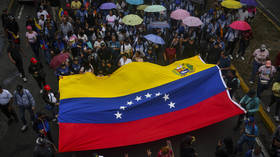
Demonstrators hold a giant Venezuelan flag during a protest in support of Nicolas Maduro on January 10, 2026 in Caracas, Venezuela. ©  Carlos Becerra / Getty Images

By Finian Cunningham

Everything has gone beautifully in Donald Trump’s Venezuela operation. An alleged narcoterrorist dictator was captured and brought to justice in a New York court, and the planet’s biggest oil wealth is now owned by the US. At least, according to Trump himself.

“We’re in the oil business,” he said after declaring billions of dollars’ worth of Venezuelan crude was now heading to the US. “You don’t talk to the Venezuelans, you talk to me,” he told Big Oil executives who gathered in the White House last week.

The trouble is, Big Oil doesn’t see it that way. The chief executives of ExxonMobil and ConocoPhillips are not rushing back into Venezuela.

Trump called the oil chiefs to the White House last Friday to urge them to invest $100 billion in upgrading Venezuela’s petroleum and gas industries. Decades of US economic sanctions are reckoned to have caused the country’s industrial infrastructure to deteriorate.

Venezuela’s oil industry was nationalized between 2004 and 2007 by former socialist President Hugo Chavez. This policy continued under his successor, Nicolas Maduro, who was kidnapped on January 3 when US special forces raided his residence in Caracas.

After Venezuela’s oil industry was nationalized and run by state-owned Petroleos de Venezuela (PDVSA), the US oil giants Exxon and Conoco quit operations in the country. They later sued in US courts, which ruled that Venezuela owes them $13 billion in expropriated assets. The third biggest US oil company, Chevron, continued to do business in Venezuela in partnership with PDVSA.

At the White House oil summit last week, Exxon and Conoco executives told Trump that they were not ready to return to Venezuela because of the risk to investment.

Exxon boss Darren Woods described Venezuela as “uninvestable.” Woods said: “We have a very long history in Venezuela… We’ve had our assets seized there twice. You can imagine to re‑enter a third time would require some pretty significant changes from what we’ve historically seen here and what is currently the state.” He added: “If we look at the legal and commercial constructs and frameworks in place today in Venezuela, today it’s uninvestable. And so significant changes have to be made to those commercial frameworks, the legal system, there has to be durable investment protections, and there has to be a change to the hydrocarbon laws in the country.”

The Exxon CEO’s comments were echoed by Conoco’s boss, Ryan Lance, who said: “We need to be also thinking about even restructuring the entire Venezuelan energy system, including PDVSA.”

What that means is that Venezuela is far from under US control.

Maduro may have been abducted, but the Venezuelan government continues under interim President Delcy Rodriguez and the same administration as when Maduro was in office. Rodriguez and her top aides, including Defense Minister Vladimir Padrino, have condemned the US aggression and are demanding the safe return of Maduro and his wife.

Venezuela has not collapsed, nor has its socialist government been overthrown. The scores of warships and 15,000 troops, as well as 200 special operations commandos, deployed at an estimated cost of over $600 million to kidnap Maduro, seem to have brought a Pyrrhic victory.

From the viewpoint of Big Oil, it’s not mission accomplished. Venezuela is ‘uninvestable’, which is the capitalist way of saying, there was no regime change to give the oil companies what they want – total control over Venezuela’s hydrocarbon wealth.

Big Oil backed Trump’s election campaign in 2024. Delivering Venezuela was part of the deal. But, from what the chief executives are telling the president, he failed to deliver enough for them to feel confident about going back into the South American country.

Hence Trump’s irritated reaction over the weekend. On returning to Washington from Florida, he was asked by reporters about Exxon’s reluctance to stump up $100 billion to go back into Venezuela. His response to reporters on Air Force One: “I didn’t like Exxon’s response… they’re playing too cute.” As a sign of his displeasure, Trump said he would block Exxon from returning to Venezuela in the future.

Big Oil just rained on the supposed victory parade about the Venezuela operation.

The spectacular raid did not change the government in Caracas. Independent journalist Camila Escalante, reporting on the ground, says the interim administration under Rodriguez is continuing the policies of Maduro. The Big Oil executives seem to be in agreement with this assessment.

If Trump wants to take control of Venezuela’s oil wealth instead of hijacking a few tankers, he will need to send US troops into the country in a large-scale invasion to install a new regime. This will come with huge, likely unbearable political and military costs.

[…]

Via https://www.rt.com/news/631011-us-venezuela-oil-victory/

How BRICS May Deliver Structural Shock To US Dollar System

By Pepe Escobar

The petrodollar is one of the key features of this Hegemony: a recycling machine channeling non-stop buying of US Treasuries then spent on Forever Wars. Any player even thinking of diversifying from this infernal machine is met with asset freezes, sanctions – or worse.

At the same time, the Empire of Chaos cannot demonstrate raw power by bleeding itself dry in the black soil of Novorossiya. Dominance requires ever-expanding – plundered – resources, side by side with that non-stop printing of US dollars as a reserve currency to pay for astronomic bills. Additionally, borrowing from the world works as imperial financial containment of rivals.

But now a choice becomes imperative – an inescapable structural constraint. Either keep astronomical spending on military dominance (enter Trump’s proposed $1.5 trillion budget for the Department of War.) Or keep ruling the international financial system.

The Empire of Chaos cannot do both.

And that’s why, when the math was done, Ukraine became expendable. At least in theory.

Against the weaponization of the US Treasury bond system – de facto monetary imperialism – BRICS incarnate the strategic choice of the Global South, coordinating a drive towards alternative payment systems.

The straw that broke the steppe camel’s back was the freezing – actually stealing – of Russian assets after the expulsion of a nuclear/hypersonic power, Russia, from SWIFT. Now it’s clear that Central Banks everywhere are going for gold, bilateral deals and considering alternative payment systems.

As the first serious structural shock to the system since the end of WWII, BRICS is not overtly trying to overturn the system – but to build a viable alternative, complete with large-scale infrastructure financing bypassing the US dollar.

Venezuela now illustrates a critical case: Can a major oil producer survive outside of the US dollar system – without being destroyed?

The Empire of Chaos has ruled, “No”. The Global South must prove it wrong. Venezuela was not that critical on the geopolitical chessboard as it represented just 4% of China’s oil imports. Iran in fact is the crucial case, as 95% of its oil is sold to China and settled in yuan, not US dollars.

Iran though is not Venezuela. The latest coordinated intel op/terror attacks/regime change attempt on Iran – complete with a pathetic mini-Shah refugee in Maryland – miserably failed. The threat of war, though, remains.

BRICS Pay, The Unit, or CIPS?

The US dollar now represents less than 40% of global currency reserves – the lowest in at least 20 years. Gold now accounts for more global foreign exchange reserves than the euro, the yen and the pound combined. Central Banks are stockpiling gold like crazy, while BRICS accelerates the test of alternative payment systems in what I previously defined as “the BRICS lab”.

One of the scenarios being directly proposed to BRICS, and designed as an alternative to cumbersome SWIFT, which does at least $1 trillion in transactions a day, features the introduction of a non-sovereign, blockchain-based trade token.

That’s The Unit.

The Unit, correctly described as “apolitical money”, is not a currency, but a unit of account used for settlement in trade and finance between participating countries. The token could be pegged to a commodity basket or a neutral index to prevent domination by any single country. In this case it would work like the IMF’s Special Drawing Rights (SDRs), but within a BRICS framework.

Then there’s mBridge – not part of the “BRICS lab” – which features a multi-central bank digital currency (CBDC) shared among participating central banks and commercial banks. mBridge includes only five members, but that includes powerful players such as the Digital Currency Institute of the People’s Bank of China and the Hong Kong Monetary Authority. Other 30 countries are interested to join.

mBridge tough was the inspiration behind BRICS Bridge, still being tested, which aims to speed up a range of international payment mechanisms: money transfers, payment processing, account management.

It’s a very simple mechanism: instead of converting currencies into US dollars for international trade, BRICS countries exchange their currencies directly.

The New Development Bank (NDB), or the BRICS bank, established in Shanghai in 2015, should be the key connectivity node of BRICS Bridge.

But that, for the moment, is on hold – because all the NDB’s statutes are linked to the US dollar, and that must be reassessed. With the NDB integrated into the broader financial infrastructure of BRICS member-nations, the bank should be able to handle currency conversion, clearing, and settlement under BRICS Bridge. But we’re still very far away from that.

BRICS Pay is a different animal: a strategic infrastructure for building a self-described “decentralized, sustainable, and inclusive” financial system across BRICS+ nations and partners.

BRICS Pay is on pilot mode all the way to 2027. By then the member-nations should start discussing a deal to set up a settlement unit for intra-BRICS trade no later than 2030.

Once again, that will not be a global reserve currency; but a mechanism offering a “parallel, compatible option” to SWIFT within the BRICS ecosystem.

BRICS Pay, for the moment, is also a very simple system: for instance, tourists and business travelers may use it without opening a local bank account or exchanging currency. They simply link their Visa or Mastercard to the BRICS Pay app and use it to pay via QR code.

And that’s exactly the crucial problem: how to circumvent Visa and Mastercard, under US financial system vigilance, and incorporate BRICS members cards such as Union Pay (China) and Mir (Russia).

Overall, for bigger and more complex transactions, the problem of bypassing SWIFT persists. All these “BRICS lab” tests need to solve two key problems: messaging interoperability – via secure, standardized data formats; and processing the actual settlement, as in how funds move via Central Bank accounts bypassing the inevitable threat of sanctions.

Internalization of The Yuan, Or a New Reserve Currency?

The inestimable Prof. Michael Hudson is on the global forefront of studying solutions to minimize US dollar hegemony. He is adamant that “the line of least resistance is to follow the already-in-place Chinese system.” That means CIPS – the China International Payment System, or Cross-Border Interbank Payment System, yuan-based, and already extremely popular, used by participants in 124 nations across the Global Majority.

Prof. Hudson insists “it’s very hard to create an alternative. The Unit’s principle (his emphasis), reported to be 40% gold and the rest in member currencies is fine. But this is best done through a new Keynes-style central bank to denominate debts and claims for payment to settle imbalances among member countries – along the lines of the Bancor.”

The Bancor was proposed by Keynes in Bretton Woods in 1944 – to prevent serious discrepancies in external balances, protectionism, tariffs and the scam of nations built up as tax havens. It’s no wonder the hyper-Hegemonic US at the end of WWII vetoed it.

In a new paper on the Weaponization of Oil Trade as the Bedrock of the US World Order, first published at democracycollaborative.org, Prof. Hudson clarifies how “Russian and Venezuelan freedom to export oil has weakened the ability of US officials to use oil as a weapon to squeeze other economies by threatening them with the same withdrawal of energy that has wrecked German industry and price levels. This supply of oil not under US control thus was held to be an infringement of the US rules-based order.”

And that brings us to one of the key reasons for the BRICS drive towards alternative payment systems: “The US foreign policy of creating choke points to keep other countries dependent on oil under US control, not oil supplied by Russia, Iran or Venezuela, is one of America’s key means of making other countries insecure.”

Prof. Hudson succinctly lines up the five imperatives for the Empire of Chaos: “control of the world’s oil trade is to remain a US privilege”; “oil trade must be priced and paid for in US dollars”; the petrodollar must rule, as “international oil-export earnings are to be lent to, or invested in, the United States, preferably in the form of US Treasury securities, corporate bonds and bank deposits”; “green energy alternatives to oil are to be discouraged”; and “no laws apply to or limit US rules or policies.”

Paulo Nogueira Batista Jr, one of the co-founders of the NDB, and its vice-president during 2015-2017, advances in parallel with Prof. Hudson, designing a viable path towards a new international currency in a paper that he is currently finalizing.

Considering that the US dollar system is “inefficient, unreliable and even dangerous”, and has become “an instrument of blackmail and sanctions”, Batista Jr cuts to the chase along the same lines of Prof. Hudson, arguing that “the only scenario that may present some viability would be the large-scale internationalization of the Chinese currency (…) But there is a long way to go before it can replace the dollar in a significant way. And the Chinese are reluctant to try.”

Batista Jr then proposes a solution similar to Prof. Hudson’s: “A group of countries in the Global South, something like 15 to 20 countries, which would include most of the BRICS and other emerging middle-income nations”, could be at the forefront of creating a new currency.

Yet “a new international financial institution would therefore have to be created – an issuing bank, whose sole and exclusive function would be to issue and put into circulation the new currency.”

That sounds very much like Bancor: “This issuing bank would not replace the national central banks and its currency would circulate in parallel with the other national and regional currencies existing in the world. It would be restricted to international transactions, with no domestic role.”

Batista Jr clarifies that “the currency would be based on a weighted basket of the currencies of the participating countries and would therefore fluctuate on the basis of changes in these currencies. Since all currencies in the basket would be floating or flexible, the new currency would also be a floating currency. The weights in the basket would be given by the share of each country’s PPP GDP in the total GDP.”

Inevitably, “the high weight of the Chinese currency, issued by a country with a solid economy, would favor confidence in the backing and in the new reserve currency.”

Batista Jr is fully aware of “the risk that the initiative will provoke negative reactions from the West, which would resort to threats and sanctions against the countries involved.”

Yet the time for action is pressing: “Will we gather economic, political and intellectual efforts to get out of this trap?

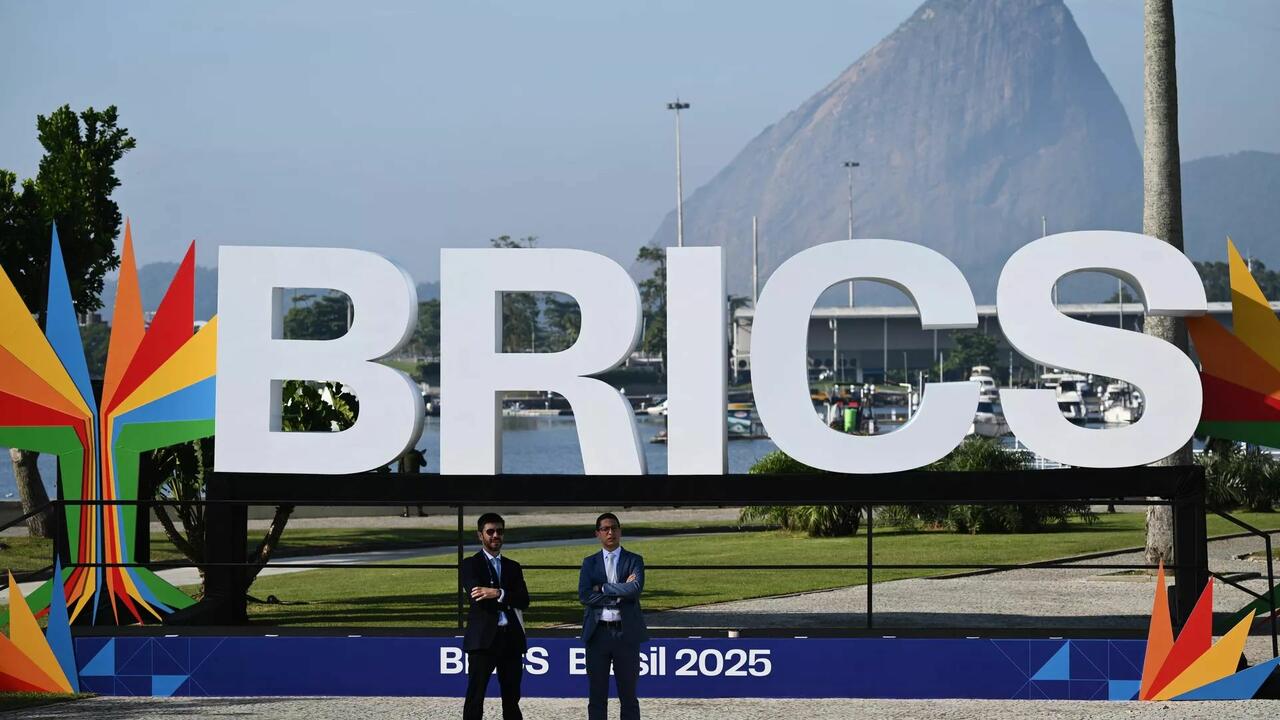
The costs of maintaining Hegemony are becoming prohibitive. BRICS, gathering forces for the annual summit later this year in India, must capitalize on the fact that we are fast approaching the structural change moment when the Empire of Chaos loses the ability to unilaterally enforce its will – except via all-out war.

[…]

Via https://www.zerohedge.com/geopolitical/how-brics-may-deliver-structural-shock-us-dollar-system

Higher Mortality Rates Detected in Vaccinated 3-Month-Olds Compared With Unvaccinated Infants

baby and vaccine

Infants vaccinated in their second month of life were more likely to die in their third month than unvaccinated infants, according to an analysis of data obtained from the Louisiana Department of Health. Female and Black infants died at higher rates than male or white babies.

Children’s Health Defense scientists Brian Hooker, Ph.D., and Karl Jablonowski, Ph.D., conducted the analysis, which was published Monday on Preprints.org.

Depending on which vaccines they received, vaccinated children were between 29%-74% more likely to die than unvaccinated children. Vaccinated Black infants were 28%-74% more likely to die, and vaccinated female infants had a 52%-98% greater risk of death.

Overall, children who received all six vaccines recommended for 2-month-olds were 68% more likely to die in their third month of life, the data showed.

Hooker and Jablonowski determined the death rates by analyzing immunization and mortality records from the Louisiana Department of Health for children who died before age 3 months between 2013 and 2024.

“This very important paper represents one of the first studies on the cumulative effect of vaccines given at 2 months of age following the Centers for Disease Control and Prevention’s (CDC) recommended schedule,” Hooker told The Defender.

He added:

“The highest infant mortality rates were seen when children received all six of the recommended vaccines in one visit. In addition to elevated mortality, the vaccination schedule also increased the likelihood that children were more likely to die of non-leading causes of death.

“This type of study is needed to guide the efforts of the U.S. Department of Health and Human Services, and especially the Advisory Committee on Immunization Practices (ACIP) as they revisit the recommended schedule.”

Hooker and Jablonowski compared infants vaccinated between 60 and 90 days of life — the window corresponding to the CDC’s recommended 2-month immunization visit — with children who were unvaccinated during that same period. Mortality was defined as death occurring between 90 and 120 days of life.

At the 2-month visit, during the period studied, a CDC-compliant infant would likely have received shots for respiratory syncytial virus or RSV; hepatitis B (Hep B); rotavirus; diphtheria, tetanus, pertussis; Haemophilus influenzae type B; pneumococcal; and poliovirus.

“It is the largest single-day antigenic assault a person is ever likely to encounter in their lifetimes, and may be accompanied with 1.225 mg [milligrams] of aluminum adjuvant … even though the … maximum per-dose limit allowable by the Food and Drug Administration (FDA) is 0.85mg,” according to the authors.

The infant mortality rate in the U.S. is about 1 in 200. However, “in what amounts to one of the greatest health hazards in the entire country, and a national injustice,” according to the authors, the mortality rate for infants born to Black mothers is approximately 1 in 100 — almost double the national rate.

Major departure from the standard narrative

Public health authorities have long maintained that childhood vaccines are safe and effective and that vaccination prevents far more deaths than it could plausibly cause.

However, some doctors and scientists, including some who spoke at recent ACIP meetings, are beginning to acknowledge that these claims are based on limited evidence, that many vaccines were recommended without sufficient safety data and that the expansion of the childhood schedule coincided with a rise in chronic illness among U.S. children.

The authors said their study — although limited to a few thousand children — is, to date, one of the largest studies of its kind.

“By epidemiological standards, it is a really small dataset, yet it is among the largest and most detailed of its kind,” Jablonowski told The Defender. “By contrast, when Vanderbilt University and the CDC published ‘Risk of Sudden Infant Death Syndrome after Immunization with the Diphtheria-Tetanus-Pertussis Vaccine,’ they analyzed only a couple hundred infant deaths”

He added:

“I didn’t have expectations on what we would find, because there is no comparator. A study this large, with this level of detail, focused on the second month of life, to my knowledge has never been done before.

“If vaccine safety were as heavily researched as vaccine proponents would like us to believe, this would have been a well-trodden exercise and we would have found nothing, not even the whisper of a disturbing trend. But there is nothing subtle about the measured safety signals. The records of children who are no longer with us demonstrate the hazard of the 2-month recommended vaccines.”

Study included an analysis of multiple vaccines administered at once

The researchers identified approximately 5,800 infant deaths during the period studied. Of those, 1,775 children could be exactly matched to their immunization records.

The analysis focused on a subset of 1,225 children who survived beyond 90 days of life and whose vaccination status could be evaluated.

They found increased mortality odds ranging from 29%-74% depending on the specific vaccine analyzed. The largest individual association was reported for the rotavirus vaccine, with an odds ratio of 1.74 — a 74% greater mortality rate — which the authors note reached the level of statistical significance.

When vaccines were analyzed in combination — reflecting how immunizations are typically administered — children who received all five non-hepatitis B vaccines at the 2-month visit were reported to be 60% more likely to die in their third month than unvaccinated children.

Children who received all six recommended vaccines, including Hep B, were reported to be 68% more likely to die during that period.

Across all comparisons in the dataset, unvaccinated children had the lowest observed mortality rates during the 90- to 120-day window.

Race and sex-based differences were notable 

For every vaccine analyzed, Black infants reportedly experienced higher relative increases in mortality compared to white infants when vaccinated during the second month of life. The finding was consistent across individual vaccines and vaccine combinations.

The strongest associations were reported among female infants. According to the analysis, vaccinated females experienced substantially higher increases in mortality risk than vaccinated males. In several comparisons, the reported increase in mortality odds for females exceeded 80% and, in some cases, exceeded 100%.

For females, they wrote, “The difference is so great, it is statistically significant almost everywhere it was measured.”

The authors suggest that sex-based differences in immune response may contribute to these findings, citing prior research that has shown stronger immune responses — and higher rates of adverse reactions — among females following vaccination.

There were also patterns in cause of death

The authors also analyzed reported causes of death, comparing distributions of those causes among vaccinated and unvaccinated female infants who died in their third month of life.

They found that vaccinated females were more likely to die from causes outside the leading categories of sudden infant death syndrome (SIDS), accidental suffocation and ill-defined causes.

Specifically, the analysis identified several deaths attributed to infectious diseases and nervous system conditions among vaccinated female infants, compared with none in the unvaccinated group during the same period.

This was significant, they wrote, because if vaccinations played no role in mortality, the distribution of causes of death would be expected to remain consistent between vaccinated and unvaccinated groups.

‘One of the most horrible experiences a parent can go through, multiplied by 1,225 times’

Jablonowski and Hooker described the analysis as a “proof-of-concept,” demonstrating that statistically significant associations between vaccination timing and infant mortality can be identified in real-world data.

They called on health authorities and researchers to make similar linked datasets available for independent analysis, arguing that transparency is essential for evaluating vaccine safety at the population level.

Jablonowski said the results weren’t just significant, they were deeply troubling. “I always knew it would be emotionally difficult to work for CHD. Our data is a record of one of the most horrible experiences a parent can go through, multiplied by 1,225 times.”

However, he said, “One study does not make consensus. It needs to be replicated many times over, in every state, province or nation willing to look. I am extremely grateful that CHD was able to pair with such courageous people in the state of Louisiana.”

Jablonowski and Hooker said that only broader access to comparable datasets — and independent replication — can determine whether the patterns observed in Louisiana reflect a localized anomaly or a more general phenomenon.

[…]

Via https://childrenshealthdefense.org/defender/higher-mortality-rates-detected-vaccinated-3-month-olds-compared-unvaccinated-infants/

From Musk to TikTok: How AI Fakes Fueled a Disinformation Frenzy Around Maduro

Fact Checker vs the Firehose
By Joshua Scheer

In the hours following the capture of Venezuelan President Nicolás Maduro, social media erupted with images and videos claiming to show Venezuelans “celebrating their liberation” by the United States. The posts went viral, amplified by high-profile accounts—including Elon Musk—but fact-checkers confirm that much of the content was entirely AI-generated, highlighting the deepening crisis of truth in the digital age. Elon has a tendency to amplify fake reports and misleading claims.

A video posted on X (formerly Twitter) by the account Wall Street Apes featured text claiming, “Venezuelans are crying on their knees thanking Trump and America for freeing them from Nicolás Maduro,” and racked up over 5 million views. But close analysis revealed glaring inconsistencies: elderly women appearing and disappearing, flags that change shape, and impossible crowd formations. The earliest version of the clip appeared on TikTok, where the account “curiosmindusa” has a history of AI-generated videos.

Similarly, images purporting to show Maduro in custody with DEA agents were widely circulated. One viral photo, shared by conservative activist Benny Johnson, shows the Venezuelan leader flanked by soldiers in fatigues marked “DEA.” Open source intelligence analysts traced the image to X user Ian Weber, who described himself as an “AI video art enthusiast” and later admitted, “This photo I created with AI went viral worldwide.” Analysis using Google’s Gemini AI model detected a hidden SynthID watermark, confirming the image was digitally generated.

Even more elaborate disinformation spread through fake celebration photos from Caracas and protests in New York. Flags had incorrect colors or star patterns, protest signs were illegible, and images were clearly manufactured by AI rather than capturing real-world events. Fact-checkers at PolitiFact rated the posts “Pants on Fire!”

Ben Norton tweeted this “This is a fake, AI-generated video. But it has more than 5 million views, 35K+ shares, and 118K likes. The US empire’s war propaganda is getting much more sophisticated. You can bet the US government will use AI to try to justify its many more imperialist wars of aggression.”

Another major problem arises when scenes from movies are circulated and presented as real news, blurring the line between fiction and reality.

The flood of misinformation comes amid a broader U.S. political context: Trump announced Maduro’s capture on Truth Social, stating the Venezuelan leader had been “captured and flown out of the country,” while U.S. Attorney General Pam Bondi announced indictments for narco-terrorism, cocaine importation, and possession of machine guns. Within hours, social media was saturated with AI-manipulated content, old footage misrepresented as recent, and misleading images that blurred the line between reality and fiction.

As WIRED and other outlets noted, even AI chatbots—including X’s Grok and ChatGPT—were unable to verify the events in real time, sometimes offering contradictory or false information.

The Maduro case shows a frightening new reality: in the era of AI-generated media, “seeing is no longer believing.” High-profile endorsements of fabricated content—whether by influencers, politicians, or tech executives—can spread disinformation faster than traditional fact-checking can respond. The result is a global information environment in which truth is increasingly unstable, and public perception can be manipulated with unprecedented speed.

In short: what is real anymore? In the digital age, the answer is more complicated—and more dangerous—than ever. The most important thing, whether the story is from yesterday or today, is to check sources and verify facts. If a story sounds unbelievable, it most likely is.

For more here on the latest Breaking Points episode exposes how fake and AI-generated videos are being used to manipulate public perception of Venezuela. Viral clips falsely depicting Venezuelans celebrating the “kidnapping” of President Nicolás Maduro—often recycled footage or entirely fabricated—have been amplified by influencers like Elon Musk and political commentators, spreading unchecked despite being debunked.

The hosts dissect how these videos manufacture consent for U.S.-backed intervention, contrasting the propaganda with reports from Venezuela showing fear, protests, and widespread concern. They highlight the stark divide between Venezuelans inside the country and the diaspora, noting how polling shows far higher support for foreign intervention among those living abroad.

The discussion also critiques the moral bankruptcy of those spreading misinformation, tracing a historical pattern of triumphalism and false narratives in U.S. foreign policy—from Iraq and Afghanistan to the Spanish-American War. Ultimately, the episode underscores the dangers of a media ecosystem where reality can be bent to fit political agendas and the urgent need for accountability in journalism and public discourse.

[…]

Via https://scheerpost.com/2026/01/05/from-musk-to-tiktok-how-ai-fakes-fueled-a-disinformation-frenzy-around-maduro/

Disorder instead of protest: Who tried to radicalize Iran’s streets – and why it failed

Disorder instead of protest: Who tried to radicalize Iran’s streets – and why it failed

By Farhad Ibragimov

Radicalization, diaspora politics, and fears of foreign interference have turned public discontent into a dead end

The wave of protests in Iran is showing signs of gradual decline. The number of people on the streets is decreasing, there are fewer areas of instability, and state institutions are slowly regaining control over the situation. This suggests that the protests have reached their peak and unrest is gradually declining.

However, the protests have not been uniform in their nature. When the first demonstrations erupted late last year, they were driven by socio-economic problems: rising prices, inflationary pressures, employment issues, and quality of life concerns. These demands were quite pragmatic and came from real social groups – primarily from the merchant class, which historically holds particular significance in Iranian society. Moreover, Iranian President Masoud Pezeshkian and Supreme Leader Ayatollah Ali Khamenei openly acknowledged people’s right to protest, recognizing the validity of their discontent and demands.

As time went on, however, things changed. By January 3 or 4, the initial demonstrators stopped protesting and returned to their jobs. But radical elements swiftly infiltrated the streets, using the social agenda as a pretext. The escalation of protests resulted in mass riots, assaults on infrastructure, and violence. The situation was perceived differently in Iran and globally. Many in Iran viewed this turn of events negatively, seeing it as a threat to public stability, while among the émigré community and non-systemic opposition, these actions were interpreted positively – as evidence of the protest movement’s “determination” and “irreversibility.”

Initially, security forces acted with restraint. During the first days of the protests, law enforcement officials in various regions refrained from using force; they patrolled the streets unarmed and relied on minimal measures to maintain order. In stark contrast, radicalized groups employed incendiary devices, cold weapons, and firearms, resulting in casualties and escalating violence. For a significant portion of Iranian society, the protests lost the image of “peaceful social discontent” and began to be associated with an attempt at violent destabilization, akin to the logic of “color revolutions.” This, in turn, sharply narrowed the “social base” of the protests and helped the authorities regain control of the situation. Consequently, the current phase of protests is characterized not only by decreased intensity but also by a loss of legitimacy in the eyes of the broader public; this significantly limits the potential for further escalation.

Iran has a population of nearly 90 million people, and its society is highly diverse. For this reason, protests in the country tend to be localized: some are driven by economic problems, others involve the youth, or flare up in certain cities. These isolated demonstrations do not merge into one large protest movement with clear leadership and an actionable agenda. The radical slogans of certain demonstrators and their use of the pre-revolutionary Iranian flag reflect the desperate state of the radical opposition groups. Decades after the establishment of the Islamic Republic, the diaspora still hasn’t found a recognizable or authoritative leader who would genuinely represent a national opposition force.

In this context, the diaspora has latched onto the figure of Reza Pahlavi, despite his marginal status within Iran itself. The vast majority of Iranians do not see him as a political leader and hold negative views towards him, especially due to his public endorsement of Israeli strikes on Iran in 2025. Such a stance, amid external pressures and conflict, is seen as unacceptable and only further alienates him from the Iranian public. Additionally, rumors circulate in Iran that Reza Pahlavi has abandoned Islam in favor of Zoroastrianism. Pahlavi himself does not directly refute these claims, instead offering evasive comments about his “personal spiritual identity.” In a society where Islam remains a vital component of cultural and social identity, this ambiguity is viewed negatively, and further distances him from the Iranian populace.

One of the key factors shaping the Iranian population’s attitude toward protests is the regional experience of the past 15 years. Iranians have closely observed the protest waves across the Arab world, particularly in Libya, Yemen, and especially Syria. The Syrian conflict has served as a stark example of what can happen when internal dissent meets active external intervention: rather than achieving political reforms, Syria ended up in a state of protracted war; this eventually led to the collapse of the state and deep social division.

This experience has instilled a cautious attitude toward street politics among Iranians. Even groups that are critical of the government and the socio-economic situation increasingly separate these issues from the idea of a radical political overhaul. Fears of chaos, national disintegration, and the loss of sovereignty often outweigh the desire to engage in protests.

At the same time, historical experience and comparative analysis reveal that in countries with rigid institutional frameworks and strong security apparatuses, successful protest movements are nearly impossible without external support – including financial, informational, diplomatic, and organizational support. Iran is no exception to this rule. However, this introduces a key paradox: as soon as external involvement becomes apparent (through the involvement of the diaspora, propaganda, or political statements by Western officials), the protests lose legitimacy in the eyes of Iranians. That’s because they are seen not as an internal social process but as a tool of external pressure. In the context of prolonged sanctions and so-called “hybrid pressure,” this perception only intensifies.

As a result, protests in Iran are caught in a bind: without external support, they fail to instigate significant political change, yet with too much outside backing, they risk losing their domestic appeal. This largely explains why the recent waves of protests, despite drawing international attention, have had only limited political impact.

The present-day protests reflect not so much a direct threat to the political stability of Iran, but rather the country’s deep-seated social contradictions. They signal a demand for reforms, changes to the socio-economic model, and the revision of feedback mechanisms between the government and society.

Both regional experience and the country’s own historical memory make Iranians increasingly skeptical about street politics as an effective tool for change. With no sufficient internal support and no public trust in scenarios associated with foreign intervention, protests remain an important but constrained element of Iran’s internal dynamics.

On January 12, an estimated 200,000 people flooded the streets of Tehran and its Enqelab (Revolution) Square. Simultaneously, tens of thousands in other cities participated in mass demonstrations in support of the current regime and Supreme Leader Khamenei. These gatherings were open and public, indicating the genuine level of public support of the government.

Such events are crucial for understanding the political resilience of modern Iran. If the ruling authorities and Khamenei himself lacked legitimacy or real public support, they wouldn’t attract so many supporters on the streets. People do not take to the streets during the day, with their faces uncovered, waving national flags and chanting slogans in favor of the regime unless they are willing to defend it openly. The diaspora may attempt to portray these demonstrations as “staged” or “bought,” but these claims do not hold up under scrutiny.

Experience shows that when coercion or bribery is involved, individuals either stay home entirely or participate passively. Genuine mass engagement, emotional slogans and signs are all signs of real public motivation. Moreover, in situations where society senses an impending “revolutionary turning point,” such groups tend to rally around victors rather than show support for the existing power structure.

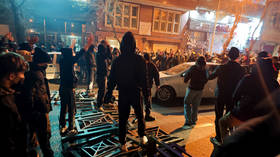
The contrast between pro-government rallies and the protests held by radical groups is also striking. Supporters of the current regime take to the streets openly during the day, while radicals tend to act at night, hiding their faces and engaging primarily in vandalism and violence. These represent fundamentally different forms of political behavior, and Iranian society clearly sees the difference.

All this indicates that the Iranian political system remains stable and the ruling authorities are supported by a large segment of society that is willing to express its stance openly. While social discontent is certainly present, it is evident that it does not equate to a mass rejection of the government or a loss of its public legitimacy. As to the country’s issues, Iranians will address them in their own way.

[…]

Via https://www.rt.com/news/630957-disorder-instead-of-protest-iran/

Life Under the Persian Empire.

The timeline of democracy | PPTX

Episode 19: City and Countryside

The Persian Empire

Dr John W I Lee (2012)

Film Review

Most of the Persian empire’s urban centers were in Mesopotamia and Persia. The city of Babylon, the largest, had a population of 100,000. The western empire had fewer cities and none with over 10,000 people. In Mesopotamia, cities continued to hold popular assemblies following Persian conquest.

Eighty per cent of Persians farmed for a living, with Persian nobles and wealthy merchants owning the vast majority of land. Some farms were irrigated (in the Nile, Indus and Tigris/Euphrates valleys). Farmers relying on the Tigris/Euphrates and Indus river had to dig the silt out of their irrigation canals to combat desertification. In some areas, farmers used karnats for irrigation – underground channels they dug relying on gravity driven flow.

Elsewhere dry farming relied on rainfall to water crops. Farmers planted in the fall after summer rain had softened the soil and harvested in the spring. Those in mountainous areas raised olives, grapes and grains. Those in Egypt and Mesopotamia raised barley dates and emmer wheat. Those in Bactria and modern day Iran grew hardier wheat and those in the Indus valley cotton. Farmers throughout the empire also kept sheep, goats, pigs, duck and geese, but commoners only only ate meat on special occasions. They also produced alcohol: wine in Ionia and beer in the eastern empire.

Farmer timed their lives around the date harvest in August because that’s when debts and taxes were due. They paid taxes (in crops) to the government and landlord and sold any excess in local markets.

Many inhabitants of the eastern Empire were  pastoral nomads, who shifted their sheep and goats either vertically (in the Zygros mountains, Persepolis and Parthia) or their horses and camels horizontally from the steppes and deserts, where they wintered, to the river valleys.

There were four social classes in the Persian empire

  • nobles, government officials and wealthy merchants
  • craftsmen (potters, metal workers and weavers), merchants and freehold farmers
  • dependents of rich nobles, government or temples. This included palace laborers (who were either prisoners of war or owed taxes) and deportees from conquered territories.
  • slaves – either debt-slaves or prisoners of war. There was active slave trade in Egypt and Babylonia from pre-Perisan times. Those forced to work in mining and agriculture lived horrible lives. In contrast, Babylonian slaves could own property, take people to court, own their own slaves and hire freemen to do their work.

https://www.kanopy.com/en/pukeariki/watch/video/15372393/15372440

Pasco, Washington, Latest City to End Water Fluoridation

girl holding cup of water and Washington state flag

Pasco, Washington, joined 80 other communities, including two states — Utah and Florida — and several counties that have ended fluoridation since September 2024, when a federal judge ruled that fluoridated water poses an “unreasonable risk” to children.

The city of Pasco, Washington, became one of the largest cities to end water fluoridation since September 2024, when a federal judge ruled that fluoridated water poses an “unreasonable risk” to children.

City officials in November 2025 voted 4-2 to end the practice. 

Pasco, which has a population of about 80,000, is one of at least seven city councils in the state to debate water fluoridation.

Before voting on the issue, the city held a public debate. According to the city’s website, the debate attracted “the highest level of participation for any public input campaign in recent City history.”

“The more people know about fluoridation, the more they’re opposed to it,” Fluoride Action Network (FAN) board member Rick North told The Defender. City by city, they’re finding out, and more and more city councils are voting accordingly.”

Pasco now joins 80 other communities, including two states — Utah and Florida — and several counties that have ended fluoridation since U.S. District Judge Edward Chen’s landmark ruling in a federal lawsuit against the U.S. Environmental Protection Agency.

Citing the lawsuit against the U.S. Environmental Protection Agency (EPA), Pasco city council members declared that fluoridation takes away our right of informed consent to take any drugs, North said. As one council member said, “People should make their own healthcare decisions.”

Public controversy continues to grow over the issue as new research published in top journals continues to link fluoride exposure — including at current U.S. fluoridation levels — to neurodevelopmental issues in children.

President Donald Trump, U.S. Health Secretary Robert F. Kennedy Jr. and U.S. Food and Drug Administration Commissioner Marty Makary have all publicly raised concerns about the danger water fluoridation poses to children’s health.

EPA Administrator Lee Zeldin said the agency would review the science on the issue.

However, the U.S. Department of Justice continues to pursue its appeal in the EPA case — even though in its appeal filing, the agency didn’t challenge the court’s finding that current fluoridation levels pose an “unreasonable risk” of neurodevelopmental harm to children.

The Centers for Disease Control and Prevention (CDC) continues to recommend the practice.

Nearly 30 million fewer people drinking fluoridated water since 2023

The CDC typically updates its statistics on water fluoridation on a biannual basis. However, the agency hasn’t updated the figures since 2022.

Since then, communities serving water to about 29.5 million people have ended, suspended or prevented water fluoridation, according to FAN.

Only two cities — Buffalo and Albany, both in New York — are known to have begun adding fluoride to their water. FAN independently tracks water fluoridation statistics.

FAN recently released updated statistics on national changes to water fluoridation practices between Jan. 1, 2023, and Dec. 31, 2025.

The CDC’s 2022 figures, commonly cited in the media, reported that 209.1 million people, or 62.8% of the U.S. population, drink fluoridated water.

However, according to FAN’s updated statistics, today that number is only 191.5 million, or 55.5% of the population, now that cities are discontinuing the practice.

FAN said it has worked for 25 years with citizen campaigners, community organizers, coalition partners and decision-makers to end fluoridation, Executive Director Stuart Cooper told The Defender.

“We’re definitely witnessing a groundswell of support for fluoride-free water,” Cooper said. “We’re now within striking distance of the majority of U.S. residents consuming non-fluoridated water.”

“This is a crushing defeat for the American Dental Association, which continues to protect the fluoride industry that makes up their corporate sponsors rather than protecting the health of our children.”

[…]

Via https://childrenshealthdefense.org/defender/pasco-washington-becomes-latest-city-to-end-water-fluoridation/


UK drops plans for mandatory digital ID for workers in latest U-turn

Protesters take part in a 'No to Digital ID' demonstration, near to the Labour Party Conference in Liverpool

Protesters take part in a ‘No to Digital ID’ demonstration against the planned introduction of a government-issued digital ID for all British adults, near to the Labour Party Conference in Liverpool, Britain, September 28, 2025. REUTERS/Hannah McKay Purchase Licensing Rights

(Reuters) – Britain is set to drop plans to make it mandatory for workers to hold a digital identity document, The Times newspaper, the BBC and other media reported on Tuesday, potentially marking another policy U-turn for the Labour government.

The government said the digital ID would be held on people’s mobile phones and become a mandatory part of checks employers must make when hiring staff.

The plan drew criticism from political opponents, with some arguing it would not deter illegal migration and others warning it could infringe on civil liberties.

The Times said the government abandoned the plan amid concerns it could undermine public trust in the scheme, noting that when introduced in 2029, digital IDs would be optional rather than mandatory.

“We are committed to mandatory digital right to work checks,” a government spokesperson said. “We have always been clear that details on the digital ID scheme will be set out following a full public consultation which will launch shortly.”

If plans for a mandatory digital ID are dropped, it would mark another policy climbdown for Starmer.

In December, the government scaled back a plan to raise more tax from farmers, months after it backed down on cuts to welfare spending and scaled back a proposal to reduce subsidies on energy bills for the elderly.

[…]

Via https://www.reuters.com/world/uk/uk-drops-plans-mandatory-digital-id-workers-latest-u-turn-media-reports-2026-01-13/

US senators target Trump branding of federal institutions

US senators target Trump branding of federal institutions
RT

The measure would prohibit federal assets from being named or renamed after a sitting president

A group of US senators has introduced legislation that would prohibit naming or renaming federal buildings, land, and other government property after sitting presidents. The move aims to counter US President Donald Trump’s efforts to link his personal brand to public infrastructure and programs.

US Senator Bernie Sanders, joined by Senators Chris Van Hollen and Angela Alsobrooks, announced on Tuesday the Stop Executive Renaming for Vanity and Ego (SERVE) Act, which would bar what they called illegal and self-serving efforts to brand public institutions with the name of a sitting president. The bill’s sponsors have submitted the two-page proposal as an amendment to government funding legislation currently before the Senate.

The move follows recent efforts by the Trump administration to put his name on prominent national institutions. While US leaders are often honored with their names on naval vessels, currency, buildings, and other institutions, Trump has become the first US head of state to do so while in office.

Sanders, one of the new bill’s lead sponsors, claimed that Trump was “undermining democracy and moving this country toward authoritarianism,” adding that part of that strategy was creating a “myth of the ‘Great Leader’” by naming public buildings after himself, something he said “dictators have done throughout history.”

The senator claimed that Trump putting his name on federal buildings was “arrogant” and “illegal,” and that legislation would “put an end to this narcissism.”

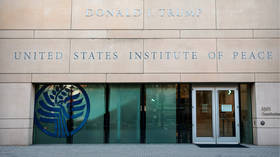
Since returning to the Oval Office last January, Trump has had several buildings and federal initiatives named or renamed after him, including the Donald J. Trump United States Institute of Peace, the Trump-class USS Defiant battleship, the prescription drug website TrumpRx, and the Trump Gold Card visa.

One of the most controversial moves was the renaming of the John F. Kennedy Memorial Center for the Performing Arts to include Trump’s name – a step that has prompted protests from members of the public and from performing artists.

[…]

Via https://www.rt.com/news/630942-ban-presidents-naming-buildings/

US is ‘main enemy of the dollar’ – ex-IMF director

US is ‘main enemy of the dollar’ – ex-IMF director

RT

Washington’s “abuse” of financial instruments through sanctions is pushing the rest of the world away from the greenback, Paulo Batista has told RT

The US is the main enemy of the dollar, prominent Brazilian economist and former International Monetary Fund (IMF) executive director, Paulo Nogueira Batista Jr., has told RT.

Washington has increasingly weaponized its national currency, undermining trust in the greenback and the broader Western financial system, he said, in an exclusive interview with RT.

“The main enemy of the dollar and of the international payment system controlled by the West is the US itself,” Batista said. “There is a move away from the dollar, from US Treasuries, to a large extent derived from the abusive use by the US of instruments [such as] SWIFT, of reserves.”

He said the “most notable case” of such abuse is Russia, which saw about $300 billion in Central Bank reserves frozen in the West under sanctions imposed after the escalation of the Ukraine conflict in 2022. Beyond the asset freeze, the US and its allies removed most Russian banks from the SWIFT interbank messaging system and imposed full transaction bans on key financial institutions, effectively cutting Russia off from the dollar- and euro-dominated Western financial system.

According to Batista, 2022 was a turning point when de-dollarization and the shift away from US-linked financial institutions – already slowly progressing – picked up pace.

“Countries like Russia and China, also Iran, had already suffered sanctions or fears of sanctions from the US… But this was a watershed because of the scale of Russia’s reserves and the assets frozen. Since 2022, major central banks, for example China’s, are moving away from US Treasuries,” he said.

RT

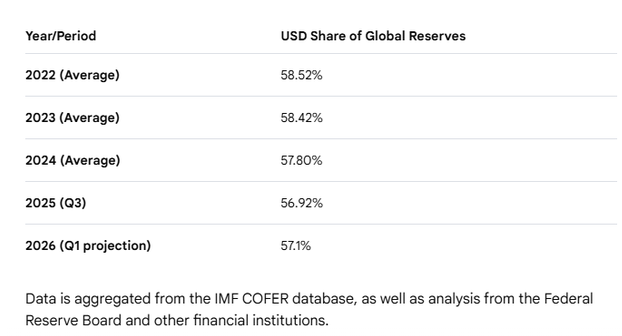
The dollar’s share of global foreign exchange reserves has steadily declined over the past four years. Russia has essentially eliminated Western currencies in trade with CIS and BRICS nations, which have been doing the same with their other partners. Looking ahead, Batista said that while the greenback will remain an an “important” global currency, the move away from the dollar will continue and its “hegemony” will gradually weaken.
[…]