
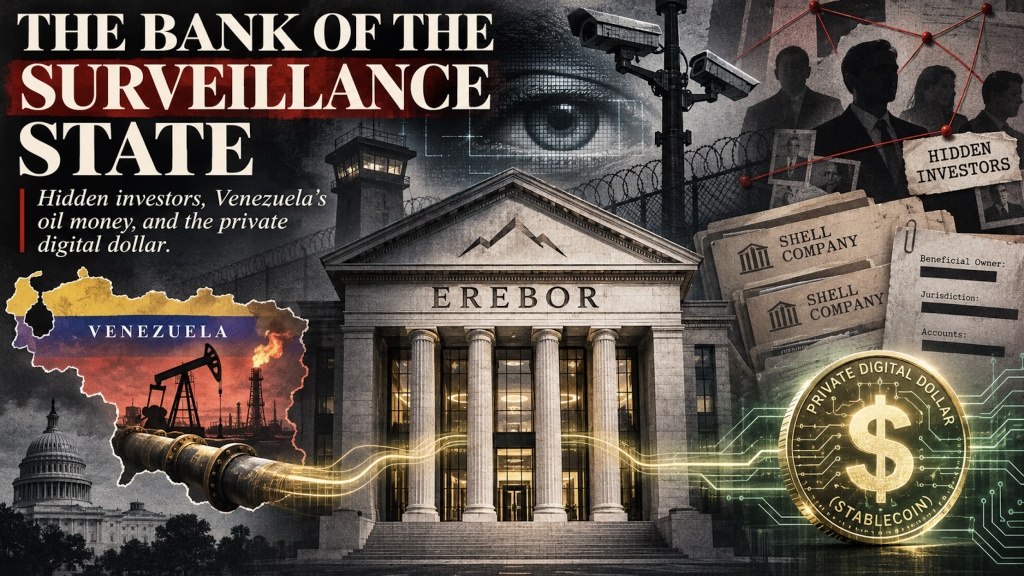
 When the same men control both the money and the watching, a digital dollar can arrive without Congress ever voting on one, and in this case a private company would hold it. – The Leah Files
Comments by Brian Shilhavy
Health Impact News
The first U.S. federally chartered bank to deal in cryptocurrencies was formed earlier this year, in Venezuela.
While this did not make it into the news feeds of the corporate media, Leah of The Leah Files has just done a deep dive into this new U.S. bank operating in Venezuela, claiming that it is the first bank dealing with private digital dollars that is being tested in Venezuela.
The name of the bank is Erebor, but most of its investors are hidden from the public.
Continuing with her series on the Epstein Digital Financial System being built here in the U.S., Leah unmasks many of the players linked to this first-of-its-kind private digital bank.
Her investigative path leads to Peter Thiel’s Founders Fund, and two tech companies serving the military and its spy agencies, Palantir and Anduril.
Her path also leads to the President’s Council of Advisors on Science and Technology, with Tech heavyweights and other notable Trump allies such as Pam Bondi, Sergy Bin, Michael Dell, Larry Ellison, Mark Zuckerberg, and the recently disgraced but now restored Jensen Huang of Nvidia.
Leah’s trail to this new bank also leads to one of Jeffrey Epstein’s financial advisors, who is called the “Female Warren Buffet”, and her name appears 1,622 times in the Epstein files.
THE SURVEILLANCE STATE NOW HAS A BANK, AND IT IS HANDLING VENEZUELA’S OIL MONEY
The men who built the border and police tech are building a private digital dollar, Venezuela is where they are testing it, and the bank in the middle hides who owns it.
by Leah
The Leah Files
Excerpts:
On November 18, Secretary of War Pete Hegseth landed in Caracas and announced a deal to restore military ties with Venezuela.
The other thing happening in that country got far less attention, which is that a bank in Columbus, Ohio that opened in February has signed a correspondent banking agreement with Venezuela’s largest state bank and is advising on a $5 billion loan from the same Pentagon office that holds the government’s 35% stake in Venezuela’s oil.
The bank was started by the same men who are building America’s surveillance state.
That bank is Erebor. Palmer Luckey, who runs Anduril and builds the border towers, started it with Joe Lonsdale, who co-founded Palantir and stitches government databases together, and Peter Thiel’s Founders Fund paid for the start.
Those men now hold a federally chartered bank that the Financial Times reported in October holds more than $7 billion in deposits. If you have read my work on the dollar, you know where this leads, because a bank like this is the plumbing for a private digital dollar, and the Treasury has been building the legal path for one all year.
What I found when I lined up the SEC filings, the UK company records and the campaign finance data is that the people who own this bank are hidden.
Erebor’s ownership has been split across 39 shell funds that report $116 million from 858 investor positions without naming a single investor, and when I traced the names that do surface, they lead to a Russian family in Monaco whose London partnership runs a shell that put $5.15 million into the bank sixteen days after the son’s business partner signed for a Venezuelan oil field at Miraflores Palace, and to Jeffrey Epstein’s former publicist, who sold stakes in the bank through her venture fund. I think the structure was built so that nobody can see who gets paid when Venezuela’s oil money starts moving through it.
The timing makes that harder to dismiss. Investors started buying into this bank six weeks after it applied for a charter and three months before the Comptroller approved the charter, and the people who bought early have watched the reported value more than quadruple.
HOW THE SURVEILLANCE STATE ENDED UP WITH A BANK
If you read How the U.S. Turned Venezuela’s Oil Money Into a Payday for Insiders, you heard me mention Erebor. Its co-founder, Jacob Hirshman, was the only American bank executive on the attendee list for Interior Secretary Doug Burgum’s breakfast in Caracas in March, according to Bloomberg, and over the next two months he kept going back.
He offered Erebor’s services to Luis Pérez, the interim head of Venezuela’s central bank, and to the country’s private banks, proposing to open correspondent lines and sub-accounts that would reconnect them to American banks, and one person told Bloomberg that he said the bank had the backing of the U.S. government.
On May 20, Banco de Venezuela signed a correspondent agreement with Erebor. The bank is also advising the AI company Fluidstack on its application for a $5 billion loan from the Office of Strategic Capital, the Pentagon office that holds the government’s 35% stake in the Venezuelan oil venture.
Anduril, Palantir and Founders Fund are the spine of The Names Behind America’s Surveillance State, and Erebor is where their money and their government contracts finally meet a bank charter. Hegseth’s trip to Caracas is what moved Erebor from a mention in that article to the subject of this one.
HOW A BANK HIDES ITS OWNERS
Erebor’s public investor list is about a dozen venture firms, and it tells you very little about who owns the bank.
I pulled every Form D with Erebor or its nickname, ERBR, in the title, and I count 39 of them. Together they report $116,203,709 from 858 investor positions. One pair, called Friends of Erebor, took $19,954,675 from 312 people in an offering that opened on a single day with a $1,000 minimum, and nothing in the filing says who those 312 people are.
Bank regulators generally vet anyone who owns 10% or more of a bank, and an investor who stays under that line never has to be named.
That is why I treat a bank whose ownership is split into dozens of small stakes as a place to look closely.
THE RUSSIAN IN MONACO
The money I can trace most clearly is $5,154,639 that went into a Delaware shell called KOSH ERBR Sep 2026 on September 18, 2026, the same week Erebor was selling stock in a round reported at a $9.5 billion valuation. The SEC filing reports a single investor, it is signed by Nikolay Koshikov as manager, and the only related party it names is KOFF Investments LLP, a partnership on the third floor of 207 Regent Street in London.
Companies House shows that KOFF is controlled by Oleg Koshikov, a Russian citizen born in December 1964 who lives in Monaco and holds at least 75% of the voting rights, and I believe he is Nikolay’s father.
The partnership has three members, who are Oleg, Nikolay, who joined in December 2021, and Lafayette Management, a company in Nyon, Switzerland that has also served as a member of two other London partnerships that have since been dissolved. A company formation agent in Watford filed the paperwork that created KOFF on June 7, 2021.
The partnership’s accounts show a vehicle with almost nothing in it. It reported no assets and no income through June 2023, and in the following year it paid a £812,810 deposit toward an investment that was financed by a long-term loan of the same amount.
Its accounts for the year ended June 30, 2025 show £16,970 in the bank, £32,000 of capital put in by Oleg, who absorbs 98% of the losses, and a single investment of £812,810 in unlisted equity that is matched by a loan of exactly £812,810 from a lender the filing does not name.
A partnership with that balance sheet did not produce $5.15 million from its operations, so I think the single investor in KOSH ERBR is the Koshikov family and that the money came from somewhere the British filings do not show, and the lender behind the £812,810 is the first place to look for who is financing the family’s American bets.
[…]

