
The Cradle
Nov 20, 2026
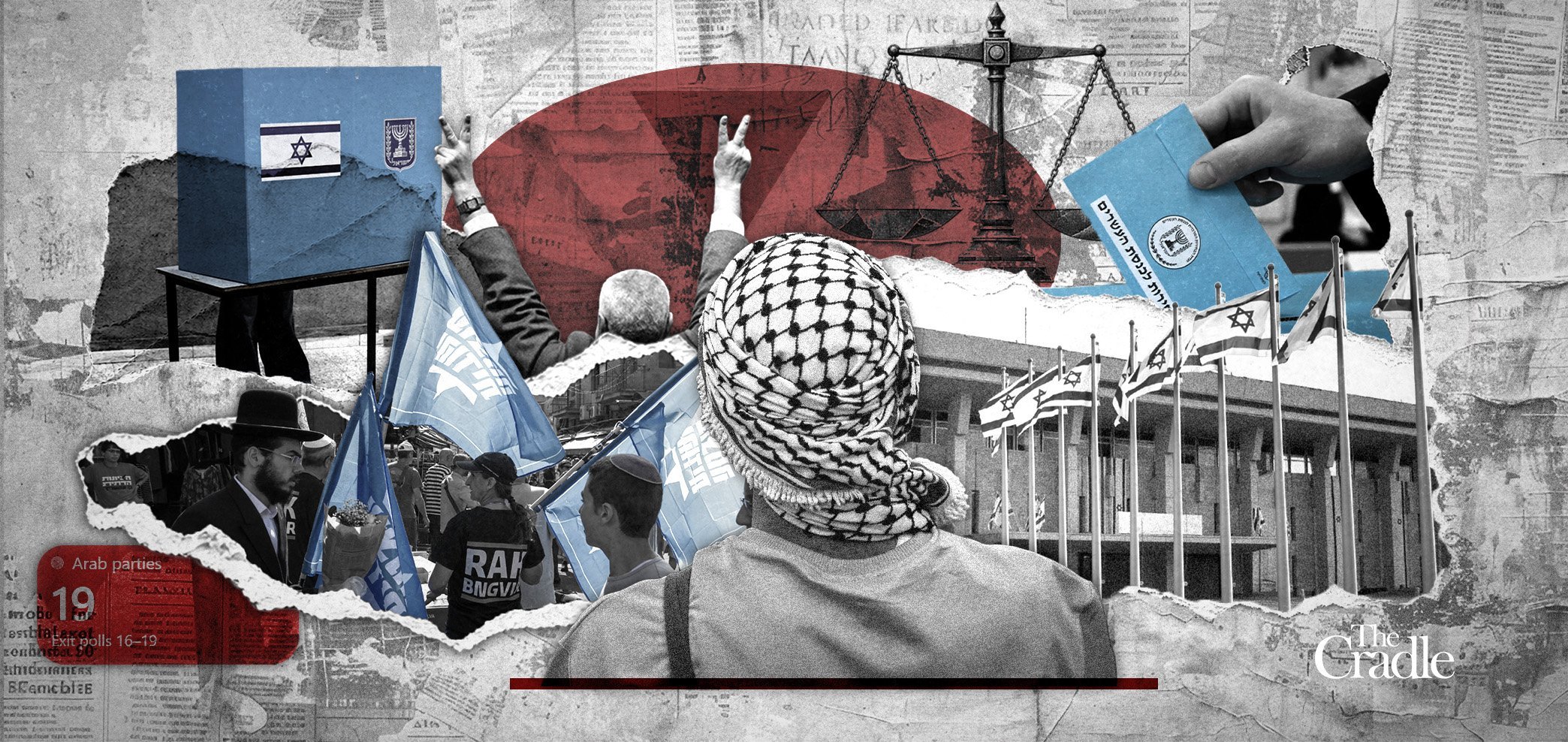
Palestinian parties won a record 19 seats in Israel’s 27 October election – the strongest showing by Palestinian lists in the history of the Knesset. Prime Minister Benjamin Netanyahu’s bloc took 53 seats, and Gadi Eisenkot’s opposition camp took 48, leaving both short of the 61 required for a majority.
On 17 November, Palestinian lawmakers helped elect Eisenkot ally Matan Kahana as speaker. Kahana won 66 votes to 52 for Netanyahu’s candidate, Ofir Katz.
For all its significance, the result raises a deeper question. Can Palestinian citizens of Israel turn unprecedented parliamentary representation into a say over what the government does?
Speaking to The Cradle, Suleiman Bisharat, director of the Yabous Center, and Mohammed Halsa, a specialist in Israeli affairs, describe the forces that can blunt that influence. Netanyahu’s right-wing bloc has spent years delegitimizing the Palestinian parties. The Zionist opposition borrows from that same discourse, and resistance to Palestinian participation in government extends well beyond the Knesset.
The official results give the Joint List 11 seats and the United Arab List, known as Ra’am, eight. Together they could give Eisenkot a majority if 48 of his lawmakers voted alongside them. Either list on its own would leave his camp short of 61. The two lists ran separately, and the fact that both backed the new speaker leaves open what each would ask for in negotiations over the next government.
The three vetoes on Palestinian power
“The Arab parties carry considerable weight in parliament,” Halsa says. “Can they turn parliamentary strength into power in government?” He doubts it. Netanyahu and his allies have imposed a political veto by demonizing the Palestinian parties.
Halsa also points to reluctance within the Palestinian parties themselves and to an opposition that accepts part of the right’s narrative. Beyond the parties, he says, an Israeli society that has moved to the right remains uneasy with the idea of governing alongside Palestinian parties.
The right’s veto is explicit. The opposition’s can be harder to pin down, precisely because its leaders speak in the language of change and democracy. Avigdor Lieberman’s Yisrael Beytenu, part of the anti-Netanyahu camp, has already ruled out serving in a coalition with Palestinian-led parties. That leaves Eisenkot asking for votes from lawmakers whom one of his own prospective partners refuses to sit with.
The Palestinian lists also have to reckon with their own differences. Bisharat says they came together around the effort to unseat Netanyahu even though “each lawmaker or parliamentary bloc has its own intellectual, ideological, and political ties.”
A common vote in the Knesset can conceal deep disagreements over what to demand in return – or whether to join a cabinet at all rather than sustain it from the outside.
The West Bank and Gaza beyond the coalition bargain
On the occupied West Bank, Halsa’s assessment is bleaker. Palestinian lawmakers will carry little weight if left outside the governing coalition, he argues. Even as coalition partners, they would have limited power to block moves on the West Bank or Gaza Strip. A party might extract a commitment on funding or policing and still find that the cabinet pushes ahead with military offensives or settlement expansion over its objections.
Halsa points to the Bennett–Lapid government, which Mansour Abbas’s Ra’am joined in 2021. The coalition gave a Palestinian party a place in government, but its participation did little to alter Israeli policy toward the Palestinians as a whole. Israel launched a military assault on Gaza in August 2022, under Lapid’s caretaker government, after the Knesset dissolved and called an early election.
The gains Halsa considers most attainable are measures to curb violent crime, better infrastructure, funding for local councils, and improvements in healthcare and education. For Palestinian citizens of Israel, these are urgent demands. Local councils need the means to provide services, and families living with organized crime have immediate reasons to demand action.
Palestinian parties can spend their votes on needs that successive governments have neglected, even if their leverage stops short of the occupied territories.
Demolitions and the struggle over land
Bisharat places demolitions and displacement in the context of what he calls an existential struggle for demographic supremacy. He sees a common purpose behind policies pursued in the occupied West Bank, Gaza, occupied Jerusalem, and Palestinian communities inside Israel, including in the Naqab (Negev).
In his view, Israeli authorities and the Zionist movement regard a Palestinian demographic advantage in historic Palestine as an obstacle to consolidating the Jewish state.
Home demolitions are one part of that policy, Bisharat argues. He also points to killings, daily assaults, checkpoints and iron gates, economic pressure, and restrictions on political activity and basic rights. He sees the Jordan Valley, the refugee camps of the northern West Bank, and the Naqab as parts of a wider struggle over land and who is allowed to remain on it.
These policies operate under different legal and administrative arrangements across each area, unified by a single demographic logic.
What a change of government could mean for the Naqab
A change in government could still affect the pace of demolitions. Bisharat expects intensified demolitions if the right returns to power. A government drawn from the opposition, he says, might move more slowly, particularly in the Naqab, where demolitions in Palestinian Bedouin communities intensified in 2025. He argues that the right made a political display of demolitions and that an opposition government would be less invested in that style of public enforcement.
A slower pace would matter to families facing the loss of their homes. Bisharat’s warning is that an opposition government could dispense with the spectacle while keeping the underlying machinery of demolition, control, and settlement intact.
In the Naqab, Palestinian Bedouin communities have long faced disputes over the recognition of villages and access to basic services. A government can ease enforcement for a time without resolving those underlying claims – and it is municipal recognition and zoning policy, rather than rhetoric, that will show where a new coalition actually stands.
A change bloc moving in three directions
“The opposition resembles a body with three heads, each pulling it in a different direction,” Bisharat says. In his account, Lieberman looks toward the Haredi parties, Eisenkot tentatively courts the Palestinian lists, and others favor a unity government. Israeli President Isaac Herzog tasked Eisenkot with forming a government on 8 November.
Opposition leaders have backed Eisenkot for prime minister, but that endorsement settles neither the government’s program nor who would be allowed to join it. Representatives of Netanyahu and Eisenkot were also due to hold unity government talks on 15 November.
“What holds all the conflicting elements of the change bloc together is the desire to remove Benjamin Netanyahu from the political scene,” Bisharat says. Once he is gone, the divisions over the next government’s priorities would become harder to put aside.
For Palestinian parties, that makes pre-coalition guarantees critical: once Netanyahu is voted out, the opposition’s incentive to accommodate them drops sharply.
What the speakership gives the opposition
Kahana’s election gave the opposition control of a post previously held by a Netanyahu ally. Halsa calls it a step forward that deprived Netanyahu of one of his most important legislative tools.
The speaker has influence over what reaches the floor, and the vote showed what Palestinian lawmakers and the opposition could achieve together in a single parliamentary maneuver.
The same vote exposed how much further the opposition would have to go to put together a government. Ousting a rival from the speaker’s chair required only a shared tactical vote; governing together requires settling terms the opposition has so far avoided.
Palestinian parties can use their numbers in the chamber to shape its leadership and legislative agenda, while core questions over military rule and land remain unresolved.
The terms of a Jewish state
Eisenkot has set four conditions for prospective partners. They must recognize Israel as Jewish and democratic, accept its declaration of independence, support military or civilian national service for all citizens, and recognize Hamas as a terrorist organization.
For the Palestinian parties, the conditions reach beyond the mechanics of forming a government. They ask Palestinian representatives to sign on to foundational terms set by the parties seeking their support.
Halsa sees a deeper struggle over the kind of state Israel will be, pitting those who want its institutions to serve all citizens against a religious nationalist right seeking greater control over them.
He reads Eisenkot’s conditions as evidence that even opponents of the religious right give precedence to the state’s Jewish character over liberal principles. He also points to the departure of skilled Israelis as a sign of anxiety over the country’s direction.
A Tel Aviv University study counted 268,509 Israeli citizens who left the country for at least three consecutive months in 2023–2025 – a figure capturing extended absences rather than confirmed permanent emigration.
The institutional question predates the election. The 2018 Nation-State Law reserves the right to national self-determination in Israel for the Jewish people and makes the development of Jewish settlement a national value.
For Bisharat, the law gives legal expression to a hierarchy that Palestinians experience in public life. He points to political exclusion, restrictions on civil rights, and the spread of organized crime in Palestinian communities. The Abraham Initiatives recorded 252 Palestinian citizens killed in circumstances related to crime and violence in 2025.
The limits of a change in government
Halsa expects a narrow range of policy changes under the opposition. He sees broad agreement within the camp on treating Palestinians as a security issue, retaining military control, and using force.
Some parties might offer humanitarian relief or ease restrictions, he says, yet there is little political will within the bloc to pursue a process leading to Palestinian statehood – meaning the occupation itself would continue, even if its administration shifts.
This is where the experience of the previous change of government bears on the current one. Joining a coalition can secure resources and give Palestinian lawmakers a direct role in budget negotiations.
It also requires them to decide whether to continue backing a cabinet when that cabinet launches military operations in Gaza or the occupied West Bank. The price of withdrawing support may be the loss of gains secured for the communities that elected them. For the parties counting on their votes, that dilemma is itself a source of leverage.
With 19 seats, Palestinian lawmakers helped break Netanyahu’s hold on the Knesset leadership. What remains open is whether that leverage can extend to the policies that brought these voters to the polls.
The right’s hostility, the opposition’s restrictions on coalition partners, and the wider resistance to sharing power all bear on the answer. So does the willingness of the Palestinian parties to make demands on matters that the other parties would prefer to leave outside the bargain.
For now, the parties seeking to replace Netanyahu can count on Palestinian lawmakers when they need a parliamentary majority and set terms that keep them away from the cabinet table.
The test of Palestinian electoral power will come when those lawmakers press for a say on demolitions in the Naqab, settlement in the West Bank, or war in Gaza. Those are the decisions by which Palestinians will judge what their record representation has bought them.
Via https://thecradle.co/articles/the-struggle-for-power-behind-the-knessets-19-palestinian-seats

