
[…]
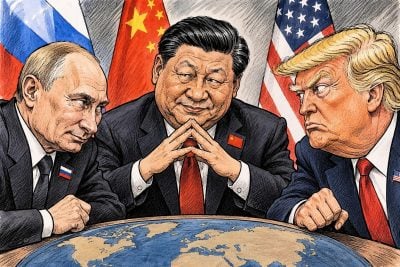
The renewed speculation about a trilateral meeting on the sidelines of an international gathering, possibly the APEC summit, has been presented in parts of the American press as a step toward a new Yalta, yet that label is disingenuous because no such formal settlement is confirmed and Russia has not been the party publicly calling for a Yalta-style summit. The reports instead describe a possible leaders’ meeting whose purpose and format remain unconfirmed, while the Yalta comparison has been pushed largely by US media retellings rather than by any confirmed Russian request for a formal division of the world into spheres of influence.
The renewed talk of a Yalta 2.0 reflects a misreading of both history and the current strategic posture of the United States and the idea of a trilateral summit between the US, Russian and Chinese leaders to formally divide the world into spheres of influence has been floated in recent months with reports suggesting that such a meeting could take place on the sidelines of a major diplomatic gathering.
This proposal draws an explicit parallel to the 1945 conference where the victorious powers of the Second World War set the terms of the postwar order, but a careful examination of Washington’s behavior reveals that the United States is not preparing for a negotiated geoeconomic settlement among equals. The US system lacks both the domestic capacity and the strategic will to engage in the kind of sustained geoeconomic competition that a genuine multipolar concert would require and what Washington seeks instead is the restoration of a unipolar arrangement through coercive financial and military pressure, a course that is already demonstrating its own severe limitations.
[…]
The primary obstacle to a Yalta 2.0 is the fundamental mismatch between the rhetoric of a grand bargain and the reality of US economic statecraft, because a true geoeconomic competition would involve the United States building alternative productive capacities, offering attractive development finance to the Global South and competing for market share through superior infrastructure and industrial output. Washington has shown no sustained willingness to do any of these things and the US manufacturing base has suffered from decades of neglect with infrastructure decay and a policy environment that often discourages long-term investment.
Moreover, even high-profile efforts to revive domestic industry through tariffs have failed to produce meaningful results, as supply chains remain deeply integrated with partners and competitors alike and corporate investment commitments frequently turn out to be repackaged existing spending rather than new productive capacity. The United States has struggled to provide a credible alternative to Chinese development finance, repeatedly criticizing Beijing’s Belt and Road Initiative without offering a comparable vehicle for infrastructure investment that recipient countries actually find attractive and a power that cannot build at home and will not finance abroad is in no position to negotiate a stable division of global economic space from a position of strength.
The strategic logic driving the Yalta 2.0 discussion is therefore not a genuine embrace of multipolarity but a tactical maneuver born of relative decline, because the long-standing US objective has been to restore the unipolar moment by coercing rivals into submission rather than by outcompeting them. The instruments favored by Washington are financial sanctions, tariff threats and military pressure, all of which are designed to force other states to accept unfavorable terms rather than to create a durable framework for coexistence and this approach treats geoeconomics not as a domain of productive competition but as a weapon of denial.
The problem is that these weapons are blunt and increasingly ineffective and sanctions have failed to derail the Chinese economy or to force a change in Russian behavior while tariff campaigns have not reversed the underlying erosion of US industrial capacity. The effort to coerce China into a lopsided trade arrangement that would derail its rise is a central feature of this strategy, but it has not succeeded in producing the desired submission and a Yalta 2.0 would require the United States to accept the permanence of a multipolar world and to bargain within it, which is precisely what the current US strategic consensus refuses to do.
The decisive point is that once Washington cannot mount a grand geoeconomic strategy, any Yalta-style negotiation loses its positive content and becomes a demand for unilateral restraint by others, because a United States that cannot offer competitive infrastructure finance, reliable supply chains, or attractive market access can only ask Russia and China to limit their own industrial policies, refrain from deepening strategic coordination, accept dollar-centered financial discipline and accommodate US firms that are no longer competitive.
That is not a stable settlement among equals but a request for self-sabotage by states that have no reason to accept it and Russian and Chinese leaders would see such a proposal as a demand that they go against their own interests in order to preserve a declining and non-competitive United States and no rational leadership in Moscow or Beijing would accept such terms when the alternative is continued development on its own terms. The Yalta 2.0 idea therefore reduces to an attempt to freeze the advantages of a power that has lost the capacity to compete, which is why it cannot form the basis of a durable agreement.
The internal contradictions of the US position make a stable trilateral settlement highly improbable, because the Russian and Chinese leaderships have little reason to believe that Washington would honor a spheres-of-influence agreement when its stated objective remains the restoration of unipolar primacy. From Moscow’s perspective the United States has repeatedly used its financial power to punish states that deviate from US preferences and the dollar system remains a source of coercive leverage rather than a neutral public good.
From Beijing’s perspective the US campaign to restrict access to technology and to build exclusionary economic blocs demonstrates that Washington is not prepared to compete on the basis of productivity and innovation but instead seeks to sabotage the productive capacities of its rivals and a genuine Yalta 2.0 would require the United States to abandon these methods and to accept a world in which no single power dictates the rules of economic exchange while the US political system, which remains deeply attached to the idea of exceptionalism and primacy, shows no signs of making such an adjustment.
The historical analogy itself exposes the weakness of the Yalta 2.0 concept, because the 1945 conference took place among allies who had just defeated a common enemy and who possessed the industrial and military capacity to enforce the settlement they reached. The current situation is entirely different, since there is no common enemy and the three powers in question have deeply conflicting interests and visions for the global order and moreover the United States is not in a position to dictate terms to either Russia or China, both of which have demonstrated their ability to withstand US pressure and to build alternative economic and security arrangements. The Yalta precedent also carries a cautionary lesson for those who advocate a new division of the world, namely that such settlements tend to produce new conflicts rather than lasting stability and a power that enters a negotiation from a position of declining geoeconomic strength cannot expect to secure a favorable outcome.
The most likely trajectory is not a grand trilateral settlement but a continuation of contested multipolarity in which the United States pursues coercive strategies that are increasingly disconnected from its actual economic capabilities and the Yalta 2.0 idea will remain a talking point in diplomatic circles and a subject of speculation in the media but it will not become a reality because the United States is not prepared to do what such a settlement would require. A genuine geoeconomic competition demands patience, productive investment and a willingness to accept that other powers will have a say in shaping the rules of the global economy and Washington has shown no inclination to embrace any of these requirements, so until it does the prospect of a new Yalta will remain an illusion and the world will continue to muddle through a period of unstable multipolarity with the US trying to impose its will on others.
Via https://www.globalresearch.ca/yalta-2-unlikely-us-does-not-want-compete-geoeconomically/5945729

