
by Brian Shilhavy
Health Impact News
While it has taken longer than I thought, people are finally waking up to the fact that AI LLMs (large language models) are not capable of thinking and reasoning like human beings are.
When ChatGPT was launched in November of 2022 by Microsoft, it became the most downloaded app of all time, and the AI LLM races began.
While the actual technology behind AI LLMs is actually pretty amazing, it was the belief system that quickly developed around it that drove massive amounts of spending to try and apply it to many applications, some of which were merely pure fantasy and science fiction.
Because the results of an AI search or response to a question were being displayed in speeds we had never seen before, and because those results were programmed to be delivered in human language form, the illogical leap of faith was made that these were more than just machines with incredibly fast microprocessors and huge amounts of computer RAM stored in computer Clouds.
The belief was that these AI models could do more than just present the data it searched, but that it could somehow take the data and reason and think like a human being does even though it was not programmed to do so, which would result in new frontiers of research and achievements.
But at the end of the day AI LLMs are still just computer code being run on computer hardware, doing what it was programmed to do.
This fact was realized very recently in the area of Big Pharma drug development, where $billions were invested into new research that was brought about due to AI LLM technology.
Billions of dollars were invested into these two drugs which had made it to Phase 3 drug trials.
But this past weekend, it was acknowledged that these two drugs were a complete failure, performing no better than placebos, and they were halted.
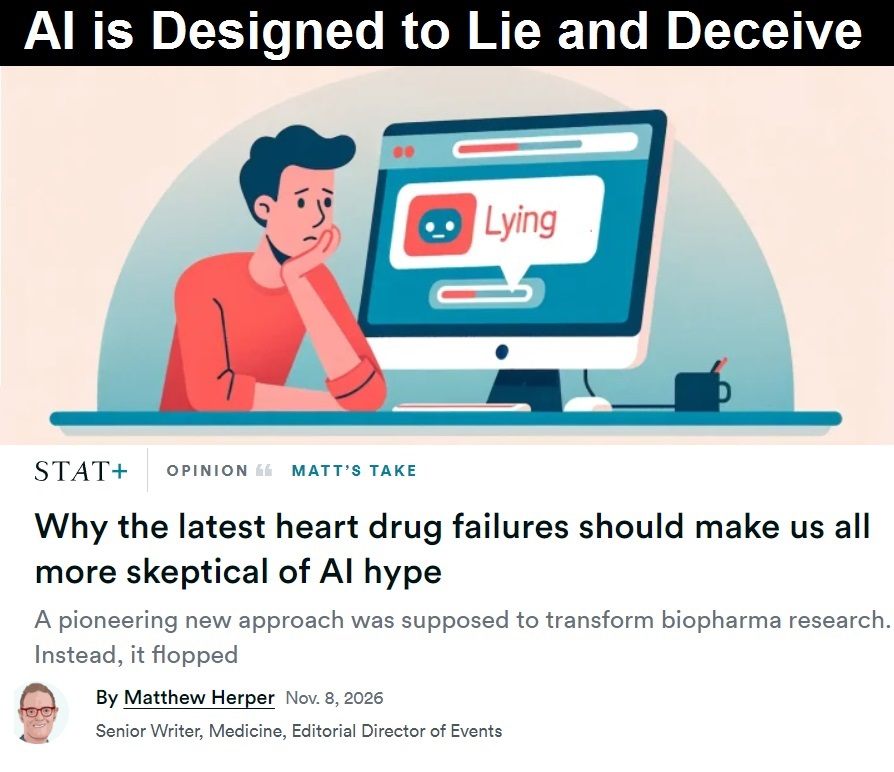
Why the latest heart drug failures should make us all more skeptical of AI hype
A pioneering new approach was supposed to transform biopharma research. Instead, it flopped
Excerpts:
The next time someone tells you that artificial intelligence, or any other new technology, is going to cure every disease, point them to the effort to fight heart attacks and strokes, which together are the largest killer in the developed world.
Because again and again, pharmaceutical researchers have learned the same hard lesson: Technologies that were supposed to speed new medicines to patients have fallen short. Two studies presented Saturday at the annual meeting of the American Heart Association are a perfect example. A new understanding of genetics was supposed to increase the odds of success — and did anything but.
Novartis, Novo Nordisk Heart Drug Failures Should Temper AI Hype
Two large trials of heart drugs from Novartis and Novo Nordisk found no benefit against heart attacks and strokes, results presented at the American Heart Association meeting. A medicine writer says the setbacks are a caution for claims that new technology will cure disease.
Excerpts:
Two large trials of heart drugs from Novartis and Novo Nordisk showed no benefit in preventing heart attacks and strokes, according to results presented at the American Heart Association’s annual meeting in November 2026.
The heart drug failures should make investors and the public more cautious about promises that new technology will quickly deliver cures, argues Matthew Herper, a senior medicine writer who covered the meeting.
Novartis tested a drug called pelacarsen. It lowers a substance in the blood called Lp(a), which genetic research had indicated should reduce cardiovascular risk. The trial found no effect on the rate of heart attacks and strokes.
Novo Nordisk ran a separate large study of an anti-inflammatory drug that targets a protein called IL-6. That study also showed no benefit.
Both drugs were aimed at targets that looked promising on paper. Neither delivered in patients.
Heart attacks and strokes together are the largest killer in the developed world, Herper noted. Drugmakers have spent years searching for new ways to prevent them.
Both trials were built on newer ideas about how the disease works. Herper says the genetics behind these targets was supposed to improve the odds of success. In his words, it “did anything but.”
Herper draws a wider lesson for anyone pitching artificial intelligence, or any other new technology, as a way to cure every disease. He points to the repeated record in heart disease, where pharmaceutical researchers have learned that technologies meant to speed new medicines to patients have fallen short.
For companies, a failed late-stage trial is costly. These studies involved large numbers of patients and tested whether a drug cut real events, such as heart attacks and strokes, rather than a number on a lab test. Lowering Lp(a) did exactly what the drug was designed to do, yet it did not change the outcomes that matter to patients.
A promising drug for an inherited heart risk flops, stunning doctors
Excerpts:
The study randomly divided 8,350 people who’d previously experienced a cardiovascular event like a heart attack or stroke and high levels of Lp(a) into two groups: Half received pelacarsen, while the other half got a placebo.
Neither the patients nor the study investigators knew who was getting the drug and who wasn’t. Most patients were followed for nearly five years.
At the end of the study, researchers’ main comparison between the two groups was an outcome called MACE — major adverse cardiovascular event. It included any kind of heart-related death, as well as non-fatal heart attacks, strokes, and whether patients had needed an urgent procedure to treat a blocked blood vessel, like heart bypass surgery.
When the study results were unblinded, however, there was a surprise. While high-risk patients taking pelacarsen had much lower levels of lipoprotein (a) than at the start of the study, they had virtually the same risk of dying of heart disease or having a serious cardiovascular event as someone in the placebo group. Roughly 12% of patients in each arm of the study had a serious heart-related event over the course of the study, whether they got pelacarsen or not.
[…]
The medication did exactly what everyone expected it would, lowering Lp(a) levels by an average of about 77% in patients who took it. But there was no sign that it had any impact on the risk of death from cardiovascular disease, heart attacks, strokes, or the risk that a person might need a stent or bypass surgery to treat a clot near their heart.
[…]
In my almost two decades of covering the deception and corruption in Big Pharma, I have seldom, if ever, found such admissions of failures in pharmaceutical drugs like I have seen in these reports. But in order to blame AI for these failures, they had to first admit that they were failures.
In fact, ever since Merck’s cholesterol lowering drug Lipitor was the all-time best-selling drug before it lost its patent, the results have always been the same as these drug trials: the drug will lower one’s cholesterol, but it will not prevent death by cardiovascular disease.
This has ALWAYS been true! It is just that Big Pharma did not want to admit this, due to the massive profits they have made over the years by selling drugs to people to lower their cholesterol, a substance our body needs, or we would instantly die.
25% of our body’s cholesterol is in our brains, and there is solid research that the increase in prescribing these statin cholesterol-lowering drugs is linked to an increase in neurological diseases in older people such as Alzheimer’s, Parkinson’s, and dementia.
[…]
The Clue to Why Low Fat Diet and Statins may Cause Alzheimer’s
However, due to the belief that AI could look at the same data and come up with new ideas about cholesterol and heart disease, is what drove this most recent research, and ended up in a total failure.
AI is Designed to Lie to You – Fake Viruses and Fake Intelligence
This religious belief in AI and the thinking that it can act and reason like human beings, is destroying our economy.
From the New York Times:
Tech Stocks Had a Terrible Day. What’s Coming Could Be Worse.
Excerpts:
We’ve been here before. As with so many other transformational inventions — railroads, electricity, the internet — outsize enthusiasm for artificial intelligence is supporting a level of spending that’s gotten ahead of plausible profit expectations, a defining characteristic of a financial bubble.
Now that the stocks of some A.I. builders and suppliers are wavering, we think it’s important to ask the next critical question.
What happens to the American economy if this bubble bursts? The damage could run deep.
[…]
What happens if the A.I. boom goes bust?
There’s a consensus building among investors, academics and market analysts that any downturn would be relatively mild, similar to what happened in the early 2000s, after the dot-com bubble burst.
The inflation-adjusted value of the overall economy, or real gross domestic product, shrank less than half a percent. And while unemployment rose, it was considerably lower than it was at the peak of the financial crisis.
Unfortunately, this consensus looks too optimistic.
First, the A.I. bubble is by all measures substantially larger than the dot-com bubble; the stock market has increased by more than it did between 1996 and 2000 and is currently worth 240 percent of G.D.P., versus 160 percent at the peak of the dot-com bubble.
This difference in magnitude means that if the stock market fell as much as it did over the course of the dot-com bust, the amount of lost wealth could translate into a reduction in real consumer spending that would be twice as large. That reduction would show up as a lower demand for goods and services, which could in turn reduce business investment, hiring and overall growth.
Our current economy is also more fragile than it was back in 2000.
Hiring has been sluggish and real wages are falling, the latter because of elevated war-induced inflation. The Federal Reserve has been gradually raising interest rates, leading to higher borrowing costs and potentially dialing back economic activity.
Additionally, today’s fiscal conditions and outlook are much worse. In 2001, the federal government ran a budget surplus of 1.2 percent of G.D.P.; today, it is running a historically large deficit of 6.2 percent of G.D.P. That could limit Congress’s willingness to inject even more borrowed money into the economy to offset any downturn.
[…]
And not only are AI investments destroying our economy, they are giving evil state actors another thing to use to instill fear into the public over something that does not even exist, similar to the fake viruses, with the COVID “virus” being the most “successful” fake virus to date, in terms of controlling the populations by locking them in their homes and then beginning to injure and kill them with dangerous vaccines and drugs as a “solution” to a fake problem.
I have frequently referred to AI as FI, Fake Intelligence, because that is what it actually is. It has ZERO intelligence, and simply repackages data in human language format, making people think they are communicating with an intelligent being.
But that has not stopped people like Bill Gates and other Tech billionaires who all probably know that the hype around AI is fake, from making doomsday predictions about how “rogue AI agents” will soon take over the world and wipe out humanity.
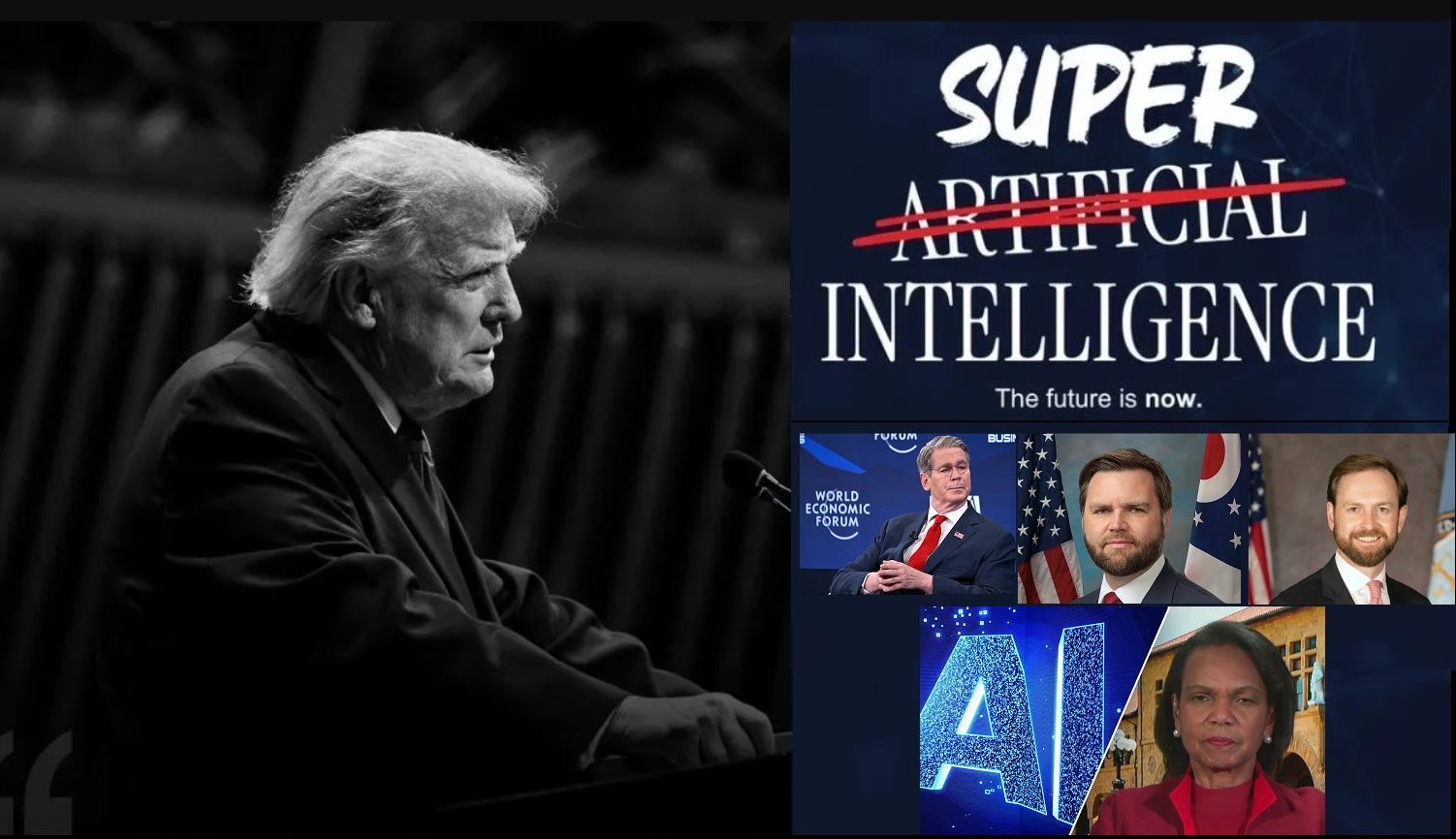
Their puppet in the White House, Donald Trump, is going along with the hoax by issuing an executive order to rename “AI” to “SI”, or “Superior Intelligence.” See: Trump Announces that “Artificial Intelligence” (AI) is Now Renamed “Super Intelligence” (SI) – What Comes Next?

[…]

