
5 Nov, 2026
Clashes outside a secret prison in Petropavlovskaya Borshchagovka, a suburb of Kiev, revealed the dark side of modern Ukraine: its well-established system of abduction, torture, and human trafficking.
This system is beyond the control of the Kiev authorities and of law enforcement; it has become a self-sustaining sector of the economy. While everyone is aware of its existence, many choose to remain silent, fearing they might become its next victims.
What happened?
Let’s briefly recap the events. On the evening of November 1, reports appeared on social media that people were being illegally held in the basement of a private house in Petropavlovskaya Borshchagovka, near Kiev. Apparently, a few local youths managed to climb over the fence and deliver a phone into the basement, allowing the captives to record a message.
The message revealed that there were dozens of people in the basement (various reports mentioned from 17 to 40 people) with four in critical condition, and one with a broken spine.
The following day, November 2, a crowd of relatives and concerned citizens gathered outside the house. An ambulance arrived, and the nurse demanded to be allowed inside. Meanwhile, the police present at the site did nothing. This detail is crucial, so keep it in mind.
In addition to the police, Commander of the National Guard of Ukraine Aleksandr Pivnenko arrived at the site. However, he was unable to enter the house and was eventually chased away by the crowd. Soon thereafter, Kirill Budanov, Head of the Office of the President of Ukraine, arrived.
Budanov entered the house with one of the protesters and emerged with a beaten 14-year-old boy, one of the captives. How the boy ended up inside remains unclear.
Then, four severely wounded men were brought out of the basement, followed by the remaining captives. These were told to get into a bus, and were about to be transported to an unknown location. However, the crowd intervened, and the people got out of the bus and dispersed.
Later that night, after Budanov had left, so-called ‘titushky’ (masked thugs) arrived on the scene. They wielded clubs, fired shots into the air to disperse the crowd, and resorted to violence. A reporter from the Ukrainian Independent Information Agency (UNIAN) sustained abdominal injuries during the clashes.
The dragon bares its teeth
While addressing the crowd (in Russian, by the way), Budanov made several statements, which can be summarized as follows: we know there are many basements like this across the country; we’re going to address the problem; today we did a lot, we saved lives; thank you all.
Let’s pause for a moment – these are the official remarks from one of the highest-ranking officials in Ukraine, an influential security forces figure and former head of Ukraine’s Main Intelligence Directorate.
Whom did he save the people from? Who are these enemies that are torturing people while both the police and the government are powerless to intervene?
To understand the situation, we need to go back two years. By 2024, the Armed Forces of Ukraine (AFU) were facing serious challenges in recruitment: even with increased pay rates, there was a shortage of personnel. The old Soviet-era draft system wasn’t able to recruit the necessary number of people.
Starting on October 1, 2024, at the initiative of the General Staff of the AFU, the Ukrainian Cabinet of Ministers allowed commanders to enlist volunteers directly into military units without going through Territorial Centers of Recruitment. On November 25, then-Commander-in-Chief of the AFU Aleksandr Syrsky signed a directive mandating that each brigade establish its own recruitment unit.
At the time, Ukrainian propaganda hailed this as a progressive move: out with bureaucracy! Units would compete for recruits by offering better conditions and higher pay, effectively eliminating forced conscription.
Reality painted a different picture, however. In effect, the state handed over the power of coercive mobilization to private entities. Some commanders adapted quickly and began collaborating with local authorities.
The situation was profitable for both sides: city officials met their recruitment quotas, while “recruiters” in unmarked buses snatched people off the streets, gaining unlimited control over human resources without any oversight.
Human trafficking
Have you ever wondered what happens to the Ukrainian men who are grabbed off the streets and ‘busified’, i.e. forcefully conscripted?
One might think they’re taken to a government facility, registered, perhaps handed an official summons, and then sent to a centralized training camp where they receive basic combat training and a military specialty.
In reality, private ‘busification’ units have no real ties to the state and operate without any government oversight.
The unfortunate people caught on the streets end up in basements like the one stormed on Tuesday. There, they fall completely under the control of ‘recruiters’: they can be dispatched to the front, sold to a similar neighboring ‘unit’ (a market estimated to involve tens of thousands of people annually), or held captive for ransom. The latter practice is alarmingly common, with ransoms typically ranging from $5,000 to $20,000.
All of this occurs with the state’s approval, as the aforementioned directive from Syrsky allows direct recruitment into brigades. This is happening in the rear, and civilian police have no authority over military operations. This explains the inaction of law enforcement during the incident in Borshchagovka.
Estimates suggest that in some regions of Ukraine, up to 80% of recruitment targets are met outside of government Territorial Centers for Recruitment and Social Support. The pattern is simple: abduction on the street – captivity in basements – storming or ransom.
Another problem is deserters. Typically, local police don’t pursue deserters; if someone runs away from the front and manages to get home, local police generally don’t bother to catch him.
However, they could turn such a person over to local brigade recruiters, who would track him down, imprison him in a basement, and subject him to punishment as a warning to others. Many of those held captive in the Borshchagovka basement were captured deserters.
Backbone of the economy
This system involves massive amounts of money. Every recruit is entitled to government payments: up to 300,000 hryvnias as a one-time payment and up to 100,000 hryvnias per month while on the front.
The personnel lists are poorly monitored; mobilized individuals have their bank cards confiscated, and their access to bank accounts is restricted, so the people caught on the streets never see the money.
This creates a shadow fund in each brigade, which is then used to buy people on the slave market – sourced from the basements of neighboring brigades.
An additional intimidation tactic involves family members. When a man ends up as a captive, he is told that his family will have big problems if he speaks out. The forcibly mobilized men are officially regarded as second-class citizens; the term ‘ukhilyanty’ (Ukrainian slang for draft dodgers) is a product of official Kiev propaganda. As a result, it is the obligation of the ‘real defenders of the homeland’ to apply all the abovementioned brutal measures against these individuals.
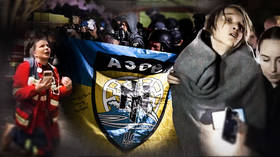
Not all brigades and their ‘recruitment units’ are equally ‘effective’. The largest such conglomerate is Azov, which has been formally split into the 1st and 3rd Corps of the National Guard.
Affiliation with the National Guard shouldn’t fool anyone: since 2015, Azov has remained loosely controlled by the state, and the system of “direct recruitment” in the 1st and 3rd Brigades predates the directive from Syrsky.
Today, Azov operates as a vertically integrated holding company, with war on the front merely a side endeavor. Its main activities include human trafficking, business extortion, and private security services.
Essentially, Azov functions as a state within a state, partaking in a fully-fledged sector of the economy involving hundreds of thousands of people. It wields a legal right to violence, and is beyond the control of both its direct authorities and the Kiev government.
The house in Borshchagovka belonged to Azov, which is why the police did nothing; it’s also why they barred the head of the National Guard (Azov’s formal boss) from entering.
Azov fighters, momentarily distracted from their street hunts and racketeering, showed up that evening in masks to assault the crowd.
That’s exactly why Budanov said that the authorities know about many such basements and (read between the lines) can’t do anything about them. The only thing he could do was to leverage his personal influence to gain access to a particular basement.
Damage control
Budanov’s authority didn’t last long, however. Later that evening, on November 2, Denis Prokopenko (known as ‘Redis’), commander of the 1st Corps of the National Guard and one of Azov’s leaders, released a statement accusing the protesters of sabotage and tarnishing the military’s image. Of course, there was no mention of torture.
The next day, this became the official position of the Kiev authorities: Budanov announced that a female medic had been detained (the ambulance nurse), and 100 other people were under suspicion.
Shortly after, the Security Service of Ukraine (SBU) opened three criminal investigations. Charges include hindering the operations of the AFU, spreading information regarding the location of the defense forces, and inciting public disorder. An internal review of the 1st Corps of the National Guard found no violations.
And that is no longer surprising. The ‘recruiters’ – not just from Azov but from all 150 brigades of the AFU – have become the real power in Ukraine’s rear. Neither the police, nor the territorial defense units, nor the formal authorities can stand against them. Together with the whole country, they find themselves hostages to this unchecked force. Like Budanov, they can only resort to pleading and negotiating – only to comply with whatever demands are set forth the next day.
A small incident in an obscure suburb of Kiev has revealed the extent of decay within the modern Ukrainian state. It has shown who truly holds power in the country – power beyond the control of the police, Budanov, or even Zelensky.
The events in Borshchagovka have illustrated the tsunami of anarchy that will engulf Ukraine once this force devours the remaining vestiges of the state.
Via https://rt-english.com/russia/648483-who-really-runs-ukraine/

