
[…]
It is thus worth taking the time at this moment of crisis to review the true reasons for America’s last British intelligence managed Civil War 160 years ago, how Lincoln revived a system of constitutional banking to preserve the nation, how Russia saved the beleaguered nation in 1863, and how the Anglo-American oligarchy killed Lincoln, and undid his vision for a world liberated from empire after his murder.
What in Hell was Lincoln Actually Dealing With?
Beyond the dangers of secession, Lincoln had to contend with the Wall Street financiers and anglophile families who worked tirelessly to sabotage the president’s ability to acquire the funds necessary to execute the war.
[…]
While modern defenders of the confederacy maintain the lie that slavery itself would have disappeared peacefully in time had Lincoln not made it an issue, the fact is that the Confederate Constitution enshrined slavery as perpetual, actually making it illegal for any one at any point to pas any law “denying or impairing the right of property in negro slaves” [Article 1, Section9].
In Article 4, section 2, the constitution enshrined the Dred-Scott fugitive slave amendment into law saying: “No slave or other person held to service or labor in any State or Territory of the Confederate States, under the laws thereof, escaping or unlawfully carried into another, shall, in consequence of any law or regulation therein, be discharged from such service or labor; but shall be delivered up on claim of the party to whom such slave belongs, or to whom such service or labor may be due.”
Perhaps most indicative of the nature of the struggle that nearly undid the republic in 1861 is the following devotion to British liberal monetarism banning protectionism, national banking, or investments into internal improvements. In Article 1 section 8 of the Confederate Constitution, we read: “no bounties shall be granted from the treasury; nor shall any duties or taxes on importations from foreign nations be laid to promote or foster any branch of industry; and all duties imposed and excises shall be uniform throughout the Confederate States” and Congress shall never “appropriate money for any internal improvement intended to facilitate commerce”.
The City of London’s Two American Confederacy Operations to Undo 1776
Russian Ambassador to London de Brunow reported to Moscow of England’s desire to break the Union writing in January 1861:
“The English government, at the bottom of its heart, desired the separation of North America into two republics, which will watch each other jealously and counterbalance one the other. Then England, on terms of peace and commerce with both, would have nothing to fear from either; for she would dominate them, restraining them by their rival ambitions.”
This was not only the opinion of Russia’s ambassador to London, but Robert Gascoyne Cecil (later called the Marquess of Salisbury and three-time Prime Minister of Britain) expressed his viewpoint on the matter in the British Parliament:
“The Northern States of America never can be our sure friends because we are rivals, rivals politically, rivals commercially…With the Southern States, the case is entirely reversed. The population are an agricultural people. They furnish the raw material of our industry, and they consume the products which we manufacture from it. With them, every interest must lead us to cultivate friendly relations, and when the war began they at once recurred to England as their natural ally.” [emphasis added]
British Traitors in America
150 years of revisionist historians have obscured the real Lincoln and the true nature of the Civil War as a British run operation to undo the revolution of 1776. The martyred president was always an opponent to slavery and always situated himself in the traditions of the American System of Hamilton describing in 1832 a policy which he later enacted 30 years later: “My politics are short and sweet, like the old woman’s dance. I am in favor of a national bank. I am in favor of the internal improvement system, and a high protective tariff. These are my sentiments and political principles.”
As early as 1839 Lincoln was a loud advocate for reviving a third Hamiltonian National Bank and worked to get Whig president William Harrison elected on that ticket in 1840 (who unfortunately died after only three months in office with a national bank revival act sitting unsigned on his desk). The second (and last) Whig leader to become president in 1851 supported by Lincoln was Zachary Taylor who also died under similarly conspicuous circumstances in the middle of his first term while fighting against America’s proto Deep State. Official cause of death? Eating too many cherries and cold milk.
From this period in the Congress where he became a leading ally of John Quincy Adams alongside other Henry Clay Whigs, Lincoln played a leading role in opposition to the unjust U.S.-Mexican War, Lincoln committed himself consistently to ending not only systems of slavery but also all hereditary power structures internationally which he understood were inextricably connected . . .
[…]
Putting this economic policy into action during the height of the war occurred in a 3-step operation which began with Banking and Currency Acts in 1862 and 1863. These acts established placed the thousands of local state banks under a federal charter with federal supervision for the first time in decades. By imposing a 10% tax on state bank notes, private independent state banks shrank from 1466 in 1861 to only 297 by 1865 and over 1630 national banks took their place.
The Bank Act of 1863 established reserve requirements for the first time, and also capped the interest rates in order to destroy usury within the nation itself. In order to eliminate international interference and manipulation from Wall Street financiers, the Bank Act also forced 75% of all bank directors to reside in the state in which the bank was located and all directors had to be American citizens.
The most important step in this fight was the sovereign control of credit issuance which, according to Article 1 section 8 of the U.S. constitution, can only be affected through the U.S. treasury (an important lesson for anyone serious about ending the privately run Federal Reserve controls over national finance today). Following this constitutional principle, Lincoln issued a new form of currency called Greenbacks which could only be issued against U.S. government bonds. These began being issued with the 1862 Legal Tender Act.
[…]
These measures were accompanied by a strong protective tariff to grow American industries as well.
[…]
Some Uncomfortable Questions
The story has been told of Lincoln’s murder in tens of thousands of books and yet more often than not the narrative of a “single lone gunman” is imposed onto the story by researchers who are either too lazy or too corrupt to look for the evidence of a larger plot.
How many of those popular narratives infused into the western zeitgeist over the decades even acknowledge the simple fact that within John Wilkes Booth’s possessions was found a $500 bank draft signed by Ontario Bank of Montreal President Henry Starnes (later to become Montreal Mayor) when he was (apparently) shot dead at Garrett Farm on April 26, 1865?
How many people have been exposed to the vast Southern Confederacy secret service operations active throughout the civil war in Montreal, Toronto, and Halifax which was under the firm control of Confederate Secretary of State Judah Benjamin and his handlers in British intelligence?
How many people know that Booth spent at least 5 weeks in the fall of 1864 in Montreal associating closely with the highest echelons of British and Southern intelligence including Starnes, and confederate spy leaders Jacob Thompson and George Sanders?
[…]
On The Trail of the Assassins
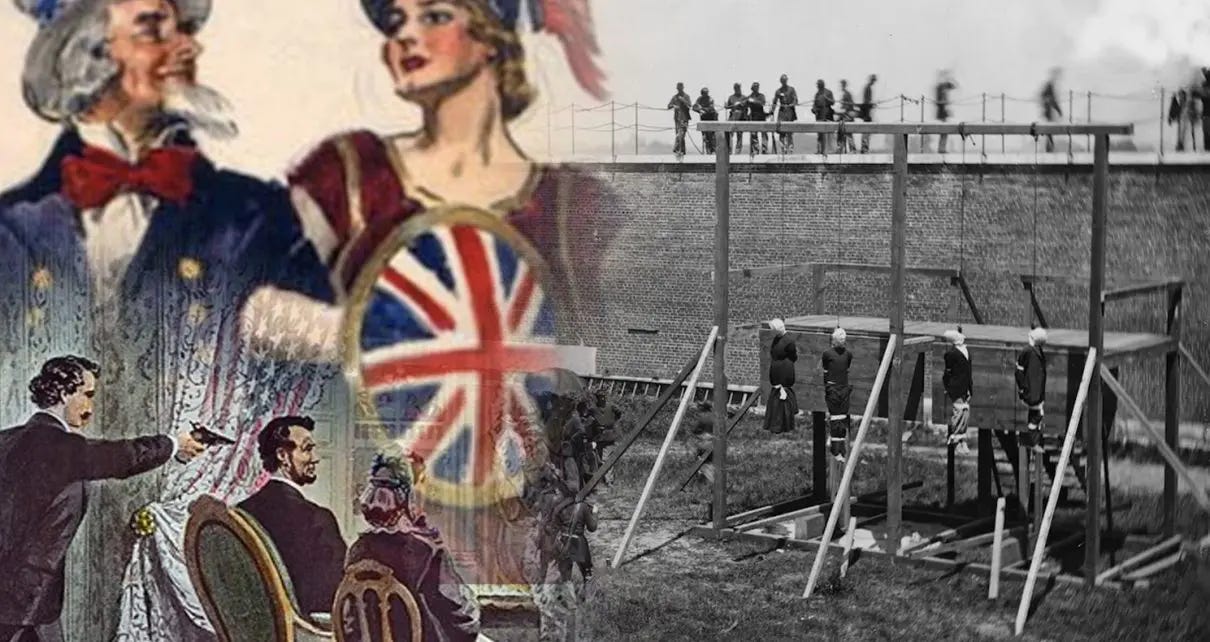
After Lincoln was murdered, a manhunt to track down the intelligence networks behind the assassination was underway that eventually led to the hanging of four low level co-conspirators who history has shown were just as much patsies as John Wilkes Booth.
Days later, President Johnson issued a proclamation saying:
“It appears from evidence in the Bureau of Military Justice that the … murder of … Abraham Lincoln … [was] incited, concerted, and procured by and between Jefferson Davis, late of Richmond, Va., and Jacob Thompson, Clement C. Clay, [Nathaniel] Beverly Tucker, George N. Sanders, William C. Cleary, and other rebels and traitors against the government of the United States harbored in Canada.”
Two days before Booth was shot, Secretary of War Edwin Stanton wrote:
“This Department has information that the President’s murder was organized in Canada and approved at Richmond.”
[…]
In the book Montreal City of Secrets (2017), author Barry Sheehy proves that not only was Canada the core of Confederate Secret Services, but also coordinated a multi pronged war from the emerging “northern confederacy” onto Lincoln’s defense of the union alongside Wall Street bankers while the president was fighting militarily to stop the southern secession.
[…]
The Many Shapes of War from the North
Although not having devolved to direct military engagement, the Anglo-Canadian war on the Union involved several components:
Financial warfare: The major Canadian banks dominant in the 19th century were used not only by the confederacy to pay British operations in the construction of war ships, but also to receive much needed infusions of cash from British Financiers throughout the war. A financial war on Lincoln’s greenback was waged under the control of Montreal based confederate bankers John Porterfield and George Payne and also JP Morgan to “short” the greenback.
By 1864, the subversive traitor Salmon Chase had managed to tie the greenback to a (London controlled) gold standard thus making its value hinge upon gold speculation. During a vital moment of the war, these financiers coordinated a mass “sell off” of gold to London driving up the price of gold and collapsing the value of the U.S. dollar crippling Lincoln’s ability to fund the war effort.
Direct Military intervention Thwarted: As early as 1861, the Trent Crisis nearly induced a hot war with Britain when a union ship intervened onto a British ship in international waters and arrested two high level confederate agents en route to London. Knowing that a two-fold war at this early stage was unwinnable, Lincoln pushed back against hot heads within his own cabinet who argued for a second front saying “one war at a time”. Despite this near miss, London wasted no time deploying over 10,000 soldiers to Canada for the duration of the war ready to strike down upon the Union at a moment’s notice and kept at bay in large measure due to the bold intervention of the Russian fleet to both Atlantic and Pacific coasts of the USA. This was a clear message to both England and to Napoleon III’s France (who were stationed across the Mexican border) to stay out of America’s war.
[…]
Despite Russia’s intervention, Britain continued to build warships for the Confederacy which devastated the Union navy during the war and which England had to pay $15.5 million to the USA in 1872 under the Alabama Claims.
Terrorism: It is less well known today than it was during the 19th century that confederate terror operations onto the north occurred throughout the civil war with raids on Union POW camps, efforts to burn popular New York hotels, blowing up ships on the Mississippi, and the infamous St Albans raid of October 1964 on Vermont, and attacks on Buffalo, Chicago, Sandusky, Ohio, Detroit, and Pennsylvania. While the St Albans raiders were momentarily arrested in Montreal, they were soon released under the logic that they represented a “sovereign state” at conflict with another “sovereign state” with no connection to Canada (perhaps a lesson can be learned here for Meng Wanzhou’s lawyers?).
[…]
The Truth is Buried Under the Sands of History
While four low level members of Booth’s cell were hanged on July 7, 1865 after a four month show trial (1), the actual orchestrators of Lincoln’s assassination were never brought to justice with nearly every leading member of the confederate leadership having escaped to England in the wake of Lincoln’s murder.
[…]
Via https://matthewehret.substack.com/p/the-original-deep-state-the-anglo

