
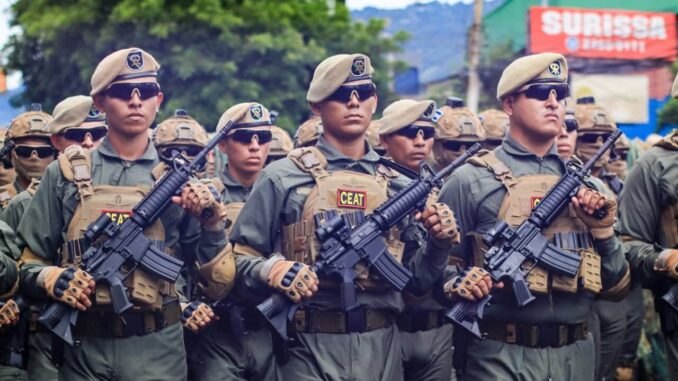
The first plane-load of 100 Salvadoran “special forces” soldiers that Bukele illegally deployed to Haiti arrived on Oct. 22, the day after he announced his “rescue operation.”
On Feb. 29, 2024, the Viv Ansanm (Live Together), an alliance of greater Port-au-Prince’s neighborhood armed groups, blocked the capital’s international airport thereby thwarting the return to Haiti of reviled de facto Prime Minister Ariel Henry.
He was returning from Kenya where he had just signed an agreement to allow the deployment of the Multinational Security Support mission (MSS), a proxy “Coalition of the Willing”-like force that then Secretary of State Antony Blinken cooked up to fight the Viv Ansanm, which a Pentagon spokesman called a “proto-insurgency” this past summer.
The Haitian people almost universally welcomed Henry’s ouster.
But nine days later, Malaysian far-right Elon-Musk-finger-puppet Ian Miles Cheong tweeted out: “Haiti has collapsed. The President [sic] is no longer in the country. The ports are officially closed. Cannibal gangs are besieging the national palace in Port-au-Prince,” to which Musk immediately replied “End of days. This is bleaker than Mad Max.”
But a savior quickly stepped forward. The next day, El Salvador’s hard-right president Nayib Bukele, tweeted back to Cheong: “We can fix it. But we’ll need a UNSC [UN Security Council] resolution, the consent of the host country, and all the mission expenses to be covered.”
Steamrolling international law
Now, two and a half years later, Bukele’s Rambo moment has finally come. At this writing on Oct. 27, some 450 Salvadoran soldiers have already landed in Haiti in the past five days, with another 700 reportedly to arrive soon. The first deployment was 100 “special forces” troops deployed on Oct. 22, the day after Bukele announced his “rescue operation.” (As we go to press, the Salvadoran outlet Tendencias reports that there are now 1,000 Salvadoran soldiers in Haiti.)
But these soon-to-be 1,100-odd Salvadoran troops are not deployed as part of the Gang Suppression Force (GSF), launched in September 2025, which is current Secretary of State Marco Rubio’s enlarged and overhauled version of Blinken’s MSS. The Salvadorans sent this past week are commanded unilaterally by Bukele, an egregious departure from his Mar. 10, 2024 tweet (need “a UNSC resolution”) and a flagrant violation of the UN Charter.
What prompted the unlawful Salvadoran deployment was the Oct. 18 killing of five GSF mercenaries, four of whom were Salvadoran aircraft mechanics that were part of a contingent of some 80 Salvadorans attached to both the MSS and GSF.
Although Haïti Liberté reported last week that the mercenaries had burned to death in their armored car, the United States and El Salvador continued to insist, without any evidence, that they were alive. So the troops that Bukele is sending are a supposed “rescue mission.”
But this ruse appeared to be foiled on Oct. 24 when the Chen Mechan (Mean Dog) armed group, a Viv Ansanm affiliate, returned the bodies of the mercenaries, whom they said were killed in the armored car ambush and burning.
However, Bukele rejects that the bodies are those of his GSF-attached soldiers, even though the GSF command itself contradicts him, saying that it does not know.
Fils-Aimé missing in action
Meanwhile, the second of Bukele’s 2024 “fix it” conditions was also not met. There was absolutely no “consent from the host country.” First, this consent is impossible to obtain because Haiti only has a United States-protected, increasingly unpopular, de facto Prime Minister, Alix Didier Fils-Aimé, who rules by decree. But the second reason was that Fils-Aimé was not even present in Haiti when Bukele started to land his troops there. Fils-Aimé had left the country on Oct. 22 on a private jet to attend a wedding in Mexico, not returning until Oct. 27.
[…]
“Viewed strictly as invaders”
Whatever Rubio did or didn’t promise, Bukele’s troops have landed on a battlefield that his “Bukele model” was never built for. Salvadoran soldiers rounding up tattooed youths in San Salvador’s barrios is one thing. Fighting the Viv Ansanm in the warrens of Croix-des-Missions and the open plain of Croix-des-Bouquets is something else.
[…]
The foreign offensive, he argues, is propping up “an unrepresentative proxy government that contains zero elected officials and governs strictly by executive decree” – the government of the jet-setting Fils-Aimé. In doing so, it “forces a nationalist consolidation.” Rivalries among armed groups are “instantly erased by the presence of a foreign boot,” and the armed groups can now present their fight “as an indigenous defense of national sovereignty,” with the community becoming their “intelligence and logistical shield.”
[…]
Enter the Dominicans
That patriotic reaction is likely to grow sharper still with the appearance of Dominican soldiers alongside the Salvadorans.
At about 3:30 p.m. on Oct. 26, a correspondent for Live Tanbou Verite was at the Carrefour Marin in Croix-des-Missions, in the Chen Mechan neighborhood, just as a large firefight between the Salvadoran forces and Viv Ansanm fighters was getting underway. The correspondent saw a soldier in a Dominican military uniform step out of an armored vehicle. As the shooting became intense, the soldier climbed back into the tank.
This sighting flatly contradicts Dominican President Luis Abinader, who said on Oct. 26 that “the participation of Dominican personnel was never contemplated” in the international mission’s operations in Haiti.
[…]
“No one is permitted to leave”
The scale and ferocity of the offensive are documented in a GSF Situation Report dated Oct. 26 and obtained by Haïti Liberté.
[…]
The report adds that the fighting has caused “the collapse of hospital operations” in the area. “To prevent a mass escape of armed criminals and an incursion into its territory – driven by the ferocity of the offensive – Dominican President Luis Abinader has ordered a total and absolute closure of the borders,” the SITREP (in military parlance) says. “The military has been deployed on high alert, and armed clashes have also been reported along the border.”
[…]
The cost of this operation is being paid, as always, by the people who live in these neighborhoods. Dozens of local residents have been killed in the fighting that the Salvadoran, GSF, and PNH assault has unleashed in and around Croix-des-Missions and Croix-des-Bouquets.
[…]
The invaders are also taking losses: according to a highly placed source in the Viv Ansanm, 11 Chadian GSF soldiers were killed in battles after Oct. 18, but their deaths have not been announced by the force.
Meanwhile, the drone war being waged on the capital’s popular neighborhoods continues. Five drones were exploded in Belair on Oct. 25, and four soldiers of the Village de Dieu armed group, headed by Johnson “Izo” André, were killed.
Three armies against one
The result is a war without precedent in Haiti’s modern history. The Viv Ansanm is now fighting three different armies at once: a private one, Erik Prince’s Vectus Global, whose mercenaries operate the drones and armored car death-squads that have killed hundreds in the capital’s poor neighborhoods; a multinational one, the GSF, authorized by the UN Security Council but designed in Washington; and now a binational one, the Salvadoran expeditionary force, with Dominican support, at the very least.
None of these three forces answers to the Haitian people. Not one has been authorized by an elected Haitian official, because there are none left.
The “Shield of the Americas”
The Salvadoran-Dominican partnership in Haiti is not happening in a vacuum. On Oct. 26 and 27, Abinader hosted in Santo Domingo a conference of the Americas Counter Cartel Coalition (A3C), co-organized by the Dominican Defense Ministry and the United States Southern Command (SOUTHCOM), whose commander, Marine Gen. Francis L. Donovan, opened the gathering alongside Abinader and United States Ambassador Leah Francis Campos. Defense and security officials from 19 hemispheric nations attended to finalize “a strategic operational plan” and a “governance charter” for “combined operations” against “criminal networks,” according to the United States Embassy. SOUTHCOM itself trumpeted the meeting on X.
The A3C was announced in March by Pete Hegseth, Trump’s “Secretary of War,” and the United States Embassy describes it as “independent, but complementary” to the “Shield of the Americas,” the United States-led military and political coalition that Trump launched on Mar. 7 in Doral, near Miami. Headquartered at SOUTHCOM, the Shield promises member states “increased access to U.S. military equipment, training, and intelligence.” Among its founding members: El Salvador and the Dominican Republic. Bukele personally attended its launch.
So Bukele’s “rescue mission” and Abinader’s logistical and intelligence support are not improvised acts of neighborly solidarity. They are the first live-fire test of the Shield of the Americas, the vehicle through which Washington aims to militarize the Caribbean and Latin America under the banner of fighting “cartels” and “narco-terrorists.” That banner has already been used to justify lethal United States strikes on boats in the Caribbean and eastern Pacific (there was another strike on Oct. 27) and the military campaign against Venezuela.
[…]
Rubio’s Haitian interests?
Which brings us back to Marco Rubio, the architect of both the GSF and the hemispheric crusade against “narco-terrorism.” Does he have more than a policy interest in Haiti?
According to a very reliable Haïti Liberté source in Haiti, Rubio’s longtime friend and former roommate, ex-Congressman David Rivera, told him that Rubio had 140 businesses in Haiti. Rivera said this in August 2019, during a lengthy meeting with our source in Haiti. Rivera was in the country, the source said, seeking to bribe then-President Jovenel Moïse into opening the Haitian market to a range of Dominican products. It was while pitching this scheme that Rivera spoke about Rubio’s business interests in Haiti.
Haïti Liberté has not been able to independently verify Rivera’s claim. But if Rubio, or people close to him, have significant commercial stakes in Haiti, that would give him a powerful incentive to back a military offensive to “clear” the country of the armed groups that the Haitian bourgeoisie and its foreign masters see as a threat to their hegemony, business interests, and power.
Rivera and Rubio go back a long way. Before Rivera served in Congress from 2011 to 2013, the two Florida Republicans shared a home in Tallahassee as they rose together through the state legislature, and they remained close allies afterwards.
On Oct. 2, a federal judge in Miami sentenced Rivera to 10 years in federal prison for concealing a $50 million lobbying campaign on behalf of Venezuela’s government during Trump’s first term. Tapped by Maduro’s Foreign Minister Delcy Rodríguez, now Venezuela’s acting president, to get Washington to normalize relations, Rivera and a co-defendant, Esther Nuhfer, obtained a three-month, $50 million contract from an affiliate of the state oil company PDVSA. The two then “sought to manipulate influential friends, including Rubio,” the Associated Press reported (Rubio testified that Rivera never mentioned the contract). In the conspirators’ encrypted chat group, Maduro was the “bus driver” and Rubio was “Miss Clairol,” a play on rubio, Spanish for “blond.”
Prosecutors said Rivera hid the deal behind backdated documents and sham agreements, including one covering a $3.75 million payment to maintain his Venezuelan go-between’s luxury yacht. “He used his position of trust – and betrayed it consistently and repeatedly,” said Assistant United States Attorney Roger Cruz.
It was not Rivera’s first brush with scandal. He was accused of secretly funding a Democratic spoiler candidate in a 2012 congressional race (the case was eventually dropped) and was investigated, though never charged, over a $1 million contract with a gambling company while a Florida legislator. In other words, the man our source describes as trying to buy access to Haiti’s National Palace in 2019 had a long track record of exactly that kind of dealing.
Rivera, a stalwart of Miami’s Cuban-American anti-communist establishment, did not work for Caracas out of any sympathy for the government of Nicolás Maduro. He kept the lobbying secret, prosecutors argued, precisely because it “would ruin Rivera’s reputation as an anti-communist stalwart.” Judge Melissa Damian denounced him for betraying his life’s mission. “There’s no dispute this money came from the Maduro regime,” she said. Or, as United States Attorney Jason Reding Quiñones put it after the sentencing, “He sold his anti-communism to communists to fill his greed.” His lawyers have now applied for a presidential pardon from Trump.
[…]

