
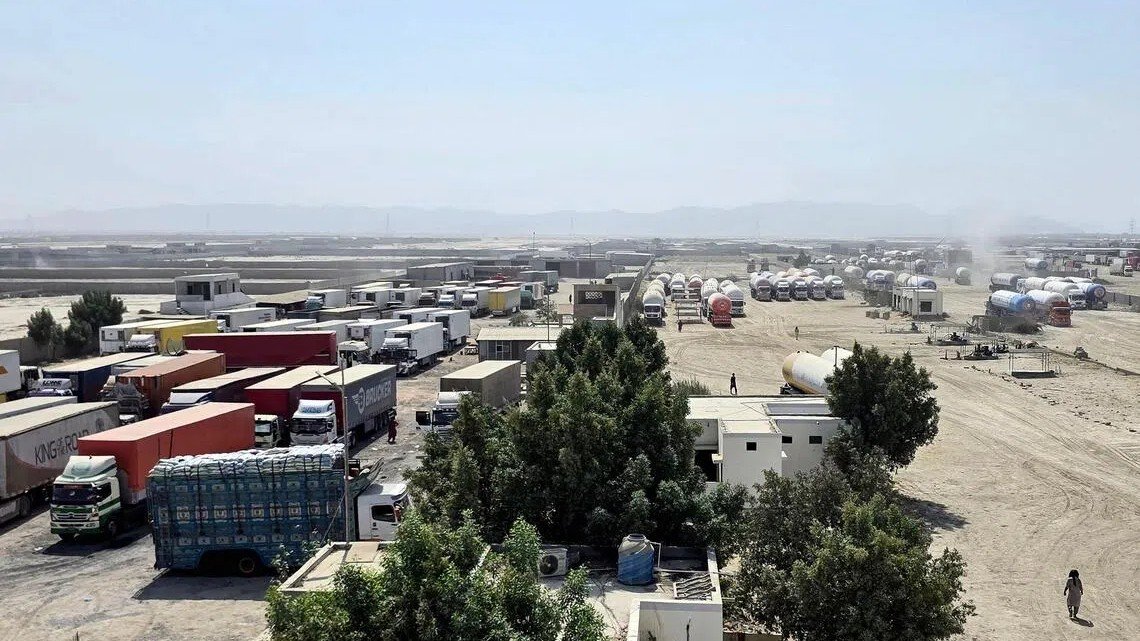
 (Photo credit: AFP)
The Cradle
OCT 25, 2026
Washington is seeking to strangle Iran economically through a land and sea blockade
Pakistan reopened its border crossing with Iran at Gabd-Rimdan, restoring bilateral trade and allowing stranded trucks to resume movement, Pakistani newspaper Dawn reported on 25 October.
The border was opened after a week-long closure that choked off vital food and liquid petroleum gas (LPG) imports from Iran to Pakistan.
Pakistani border officials cleared commercial vehicles possessing a consignment note dated 16 October or earlier to cross the Gabd-Rimdan gate in Gwadar.
“Pakistan has opened the border with Iran at Gabd-Rimdan this morning and allowed trucks and other vehicles to move toward Iran and Pakistan with import and export goods,” confirmed Mir Naveed Jan Kalmati, president of the Gwadar Chamber of Commerce and Industry.
Pakistan’s resumption of cross-border trade with Iran is expected to ease a nationwide LPG shortage and reduce soaring energy and food prices.
Hundreds of trucks were stranded on the border, many carrying perishable foods.
Pakistan imports about 7,000 metric tons of LPG a day from Iran, including more than 4,000 tons a day through Gabd-Rimdan.
The closure caused the price of a 12 kg LPG cylinder to rise from 4,500 Pakistani rupees ($25) to 7,000 rupees ($45) within days.
The Gabd-Rimdan and Taftan crossings were closed on 17 October amid unclear circumstances, Reuters reported last week.
Local Pakistani officials said they ordered the closure to address security concerns and fight smuggling. Iran’s foreign ministry cited technical issues.
On Thursday, unidentified gunmen attacked commercial vehicles stuck near the closed border crossing, setting dozens of trucks ablaze and damaging several others.
However, pressure from Washington on Pakistan to enforce US sanctions on Iran may also have played a role in the border closure.
“Although Pakistani officials have cited security concerns, the decision to close the border appears to be motivated by broader strategic considerations, with security as a possible factor amid economic sanctions on Iran,” Imtiaz Baloch, a Quetta-based independent researcher, told Al Jazeera.
On Thursday, unidentified gunmen targeted the backlog of freight vehicles parked near the closed Gabd-Rimdan crossing, setting dozens of trucks on fire.
Meanwhile, Iraq shut the strategic Al-Sheeb border crossing with Iran on 21 October, in response to intense US pressure on Baghdad to strangle the Islamic Republic.
An Iraqi source told AFP that the crossing was shut “until further notice.” Two other sources said Washington is pressuring Baghdad to close more border crossings.
Iranian judiciary-linked website Mizan reported that the shutting of the crossing came “following a decision by the Iraqi prime minister’s office.”
According to other sources, the US wants Iraq to close all its border crossings with Iran.
Separately, the UAE-based Al-Ain outlet reported that Iraqi Prime Minister Ali al-Zaidi informed leaders of the Shia-led Coordination Framework, during a 19 October meeting, that Washington had demanded the closures.
Zaidi was reportedly informed that the US will resume its war on Iran. “Iraq cannot become involved in this war, and its repercussions will affect the political system and the state,” an Iraqi source told Al-Ain.

