
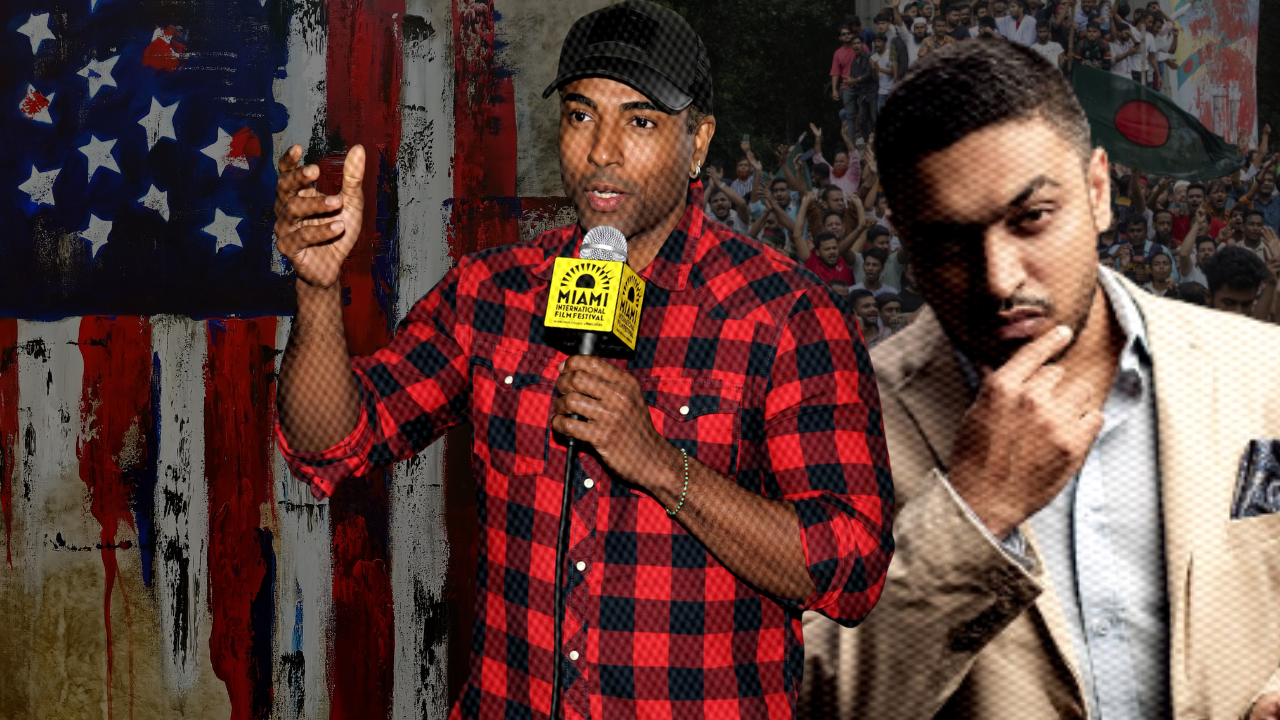
Bangladesh: Songs of Subversion
“The U.S. government has observed the power of hip hop culture as a vehicle for expression, protest, and a political voice for young people,” Professor Sujatha Fernandes, a sociologist at the University of Sydney and the author of the book, “Close to the Edge: In Search of the Global Hip Hop Generation,” told MintPress News.
[…]
One of those countries is Bangladesh. In 2024, longstanding prime minister Sheikh Hasina was toppled in a U.S.-supported revolution.
[…]
Hasina was replaced by Muhammad Yunus, a longtime associate, mentor, and close friend of Bill and Hillary Clinton.
[…]
One of the leaders of the demonstrations was rapper and barrister Towfique Ahmed, who shot to prominence after he offered to provide free legal support to anyone arrested by Hasina’s forces.
Yet Ahmed had for years been on the U.S. government payroll, explicitly as an agent of change, the International Republican Institute (IRI) – a CIA front group – funding and promoting his music career far and wide.
[…]
Ahmed’s music became an anthem of the protests, thanks in part to the IRI consistently promoting it, including on its own televised cultural program, that, it boasted, “reached over 79,000 households in Bangladesh.” In total, the IRI spent millions supporting a wide range of artists, musicians, dancers and actors, all with the goal of removing Hasina from power.
[…]
Senegal: The Revolution Will Be Organized
If Bangladesh was the perfect insurrection, Senegal was the blueprint. Western media called it the “Rap Revolution.” In 2012, enormous protests against President Abdoulaye Wade broke out.
[…]
The demonstrations were led by a rap collective called “Y’En a Marre” (Enough is Enough). Y’En a Marre capitalized on public discontent over corruption, blackouts, and economic stagnation, inflaming tensions and encouraged people out on the streets.”
[…]
West Africa: Rage on Behalf of the Machine
[…]
For the United States government, the point of sponsoring huge numbers of individuals and organizations around the world is far less about training the shock troops who will lead a color revolution (although that certainly happens), and more about ensuring that a giant cadre of pro-U.S. agents exists in all countries and in all manner of influential fields, from politics and business to academics and the arts.
[…]
One country, however, where hip hop artists are very much at the forefront of the U.S.’ regime change plans is Cuba.
Cuba: The Great Astroturfed Revolution
The United States has been trying to overthrow the government of Cuba since the Revolution of 1959. And in July 2021, they thought they had concocted the perfect plan. Washington spent enormous amounts of resources encouraging Cubans into the streets in an attempt to topple President Miguel Díaz-Canel.
America believed it had found the ideal figurehead in Yotuel, an aging rapper who left Cuba in the 1990s, and had released the anti-government song, “Patria y Vida” (Fatherland and Life) to great U.S. fanfare just months earlier.
[…]
On the same day as Rubio’s tweet, a huge swath of U.S. media outlets, including The New York Times, NPR, The Wall Street Journal, Rolling Stone, Voice Of America, and National Geographic, all simultaneously published articles profiling the song.
Collectively, this coverage identified “Patria y Vida” as the clarion call for a new generation, noted that it was a retort to the communist slogan “Patria o Muerte” (fatherland or death), and presented Yotuel as a crusading warrior of democracy. But none told readers that anti-government Cuban rappers like Yotuel had been sponsored, hothoused, and coached for years by the U.S. government for precisely this purpose.
The NED was, at the time, financing numerous schemes training Cuban rappers as agents of regime change. One project entitled “Empowering Cuban Hip-Hop Artists as Leaders in Society,” stated that its goal was to “promote citizen participation and social change,” and to “raise awareness about the role hip-hop artists have in strengthening democracy in the region.” Another, called “Promoting Freedom of Expression in Cuba through the Arts,” claimed it was partnering with local musicians on projects related to “democracy, human rights, and historical memory,” and to help “increase awareness about the Cuban reality.” This “reality,” as President Biden himself stated the week of the insurrection, was that the Cuban government is an “authoritarian regime” that has meted out “decades of repression” while its leaders only “enrich themselves.”
At the same time, USAID was offering $2 million worth of funding to groups that could use culture to bring about a color revolution in Cuba.
[…]
In the end, despite the impeccable coordination from the U.S. government, social media, the Cuban-American lobby, celebrities, and the press, all of whom came together to bombard the country with messaging telling them to get out on the streets, barely a few thousand people island-wide heeded their call. Moreover, they were dwarfed by far larger, pro-government counter-demonstrations (images of which, for some time, Western media often presented as anti-government marches).
The reality was that Patria y Vida’s supposed popularity was largely astroturfed. Yotuel had not even lived in Cuba for a quarter-century, and instead led a much larger sympathy demonstration in Miami. Days later, President Biden invited him to the White House for a special meeting.
[…]
This was not the first time that Washington had been caught using hip hop to overthrow the Cuban government. In fact, inside Cuba, the rap scene is notorious for being full of undercover U.S. agents. Gaining popularity in the late 1990s, local rappers had a considerable impact on society, helping bring to the fore many previously under-discussed topics. The United States saw their biting critiques of racism as a wedge they could exploit, and attempted to infiltrate their ranks.
In 2009, the U.S. government sent Serbian music promoter Rajko Bozic to the island with a mission: to recruit a stable of rappers to use as anti-government shock troops. Bozic was a veteran of Otpor, a CIA-backed political group that led the insurrection against Yugoslav president Slobodan Milosevic – the first successful color revolution of the century.
Bozic soon found willing partners in rap group, Los Aldeanos. With seemingly limitless funds for the operation, he immediately started aggressively promoting the duo, producing an anti-government TV show they starred in. Although it was not broadcast on television, Bozic and his team simply paid for it to be distributed around the country on DVDs and USB drives instead.
He also used Washington’s money and connections to get their music on the radio, and to bribe big Latino music stars into allowing them to open for them at their gigs, thus buying them more credibility and exposure. Los Aldeanos were even flown to Serbia for secret training, under the guise of playing at the Exit Music Festival.
Cuban authorities eventually exposed the scheme, however, and Los Aldeanos fled to Florida.
[…]
Yet, for all its efforts, Fernandes told MintPress that the U.S. government has had little success. Cuba, she said, is a place with an organic hip hop movement built from the ground up, and rappers are “not trying to overthrow their government but to create more spaces for their demands of anti-racism and equality under an expanding market economy. They had little reason to collaborate with U.S. agencies.”
[…]
Funding a Global Medium
In the Republic of Congo, President Denis Sassou Nguesso has been faced with over a decade of opposition from the Ras-le-Bol movement, which, in 2015, […coordinated the largest anti-government protests in the country’s history in response to his attempts to change the constitution.
Ras-le-Bol shares many similarities with Y’En a Marre in Senegal. For one, they were both co-founded by a rapper, in this case, Martial Pa’nucci. Pa’nucci noted that he took direct inspiration from Senegal. Indeed, Ras-le-Bol is a direct translation of Y’En a Marre, both meaning “enough is enough.” And like Thiat, Pa’nucci is a former Reagan-Fascell Democracy Fellow at the National Endowment for Democracy.
While at the NED, he used the time to produce “Music for a Democratic Future in Congo”, a 12-track album the NED describes as “denouncing the dictatorship and kleptocracy that undermines his country.”
Unlike in Senegal, however, Ras-le-Bol has been unsuccessful in dislodging Sassou Nguesso, who first came to power in 1979.
The U.S. government has also supported the career of Moroccan political rapper Youssra Oukaf, better known as Soultana. Soultana takes on issues such as patriarchy and sexism in her music, and has helped other women enter the arena. While finding no aid from her own government, she has found plenty from Washington. “For me, it’s so big. It’s not just support, it’s an honor,” she said of her U.S. backing.
In Jordan, a USAID audit reveals that the agency greenlit a project to produce a rap song “targeting first-time voters” ahead of the 2007 elections. The song, it claims, was “played by most commercial radio stations” and reached “more than 2 million Jordanians.”
The U.S. government has also sponsored rap projects on a smaller scale in Uganda, South Africa, Tanzania, Ghana, and El Salvador. These initiatives range from concerts in Haiti featuring Wyclef Jean, to small scale workshops aimed at youths.
[…]
Rap as a Pacifying Force
While successive American administrations have used rap as a wedge to divide populations against each other and heighten existing contradictions within societies, they have also used it as a uniting force in nations with friendly governments, tamping down tensions and papering over divisions.
That was the case in Colombia, a country ravaged by decades of brutal drug war and mass killings by U.S.-backed far-right militias. In 2020, USAID’s Alliances and Reconciliation Program created an initiative aimed at the country’s youth with a message of coexistence, truth, dialogue, and reconciliation.
It appointed local rappers, Melisa MC, and Ken Zingle, as ambassadors of the program. Together, the pair produced the song, “Rímalo” (Rhyme It), which served as the project’s anthem.
Later, USAID also developed an outreach program targeting youths in conflict-affected areas of Colombia (where it was often the United States itself supplying the weapons). The program aimed to channel young people’s anger and frustration into peaceful co-existence and music creation. USAID published one of these rap songs, “Queremos” (We Want) on YouTube.
At the same time in Kenya, USAID partnered with well-known rapper King Kaka to launch its #16BarsforPeace hip hop campaign, wherein it challenged Kenyan youth to submit videos of themselves rapping about peace and conflict resolution.
[…]
From “Fight the Power” To Working For Power
[…]
In 2024, the State Department announced it was joining forces with YouTube to create a new “Global Music Ambassador” program. The initiative was directly modeled on Washington’s Cold War-era efforts to use the arts to inspire U.S.-backed regime change in Eastern Europe, and to use musical tours as covers that the CIA could use to assassinate foreign leaders.
[…].
The CIA has long used music as a cover for overthrowing foreign governments. In 1960, it embedded itself on Louis Armstrong’s tour of the Congo, accompanying the jazz legend in order to secretly gather information on the movements of the country’s prime minister, Patrice Lumumba, whom CIA director Allen Dulles described as Africa’s Fidel Castro. Lumumba was assassinated later that year, plunging the country into decades of U.S.-backed dictatorship, from which it has never recovered.
The project continued until the successful overthrow of Communism and Eastern Europe; events in which the U.S. government played a significant role. There have long been credible rumors that the CIA wrote and promoted the Scorpions’ hit song “Winds of Change” as regime change propaganda. Meanwhile, David Hasselhoff – the American singer who has long been inexplicably popular in Germany – has strongly insinuated that he worked with the agency to bring down the Berlin Wall. His song, “Looking for Freedom,” became the unofficial anthem of the wall’s destruction, and he played it to a huge Berlin crowd in 1989.
More recently, in Venezuela, the NED funded and supported rock bands producing music aimed at destabilizing and overthrowing the socialist government.
[…]

