
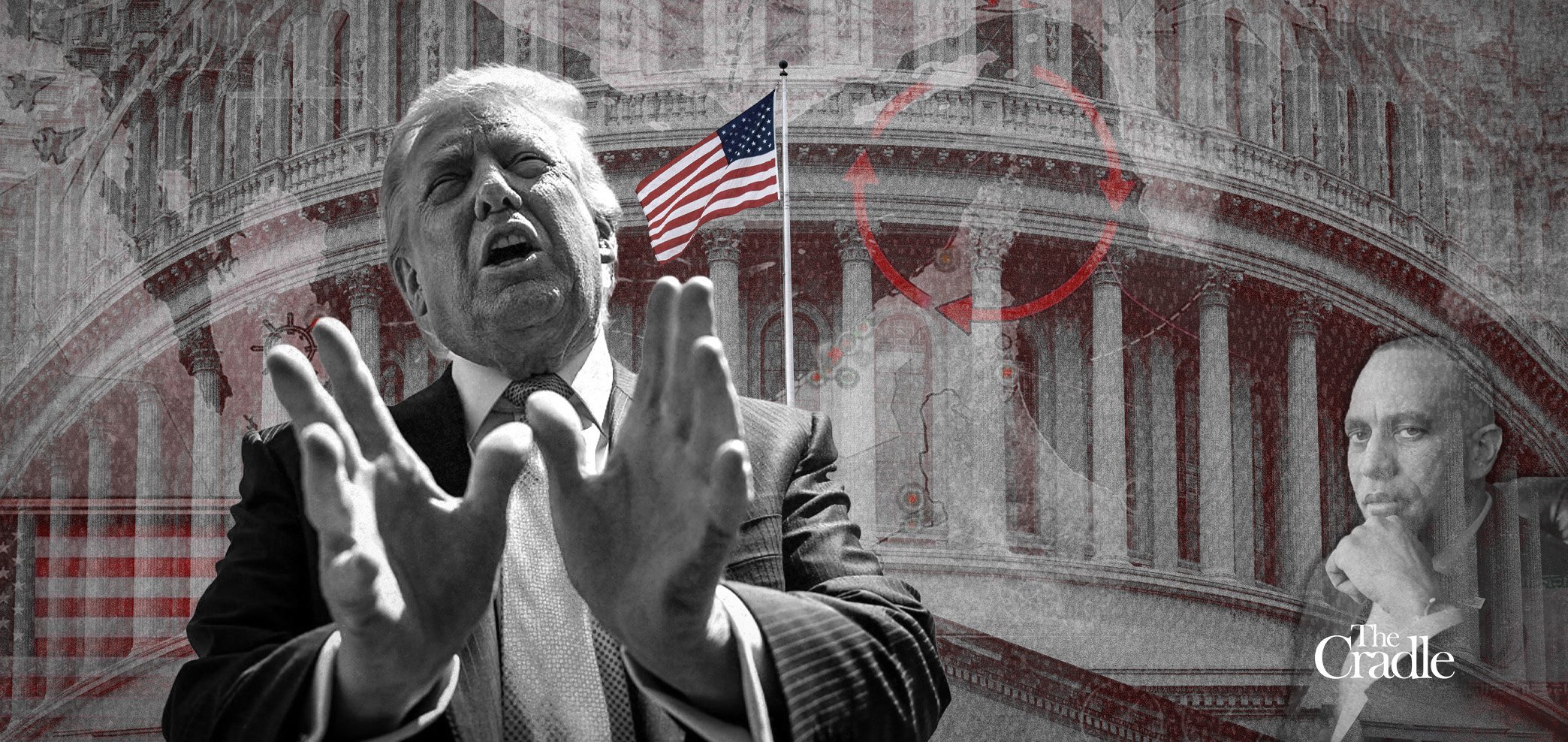
 Photo Credit: The Cradle
OCT 15, 2026
West Asia has little reason to stake its security on a change of hands in Congress.
Washington’s political class has already begun preparing for a Democratic takeover of the House. Erin Covey of the Cook Political Report wrote on September 25 that Democrats will most likely gain five to 15 seats, leaving them with 220 to 230 members next year. Decision Desk HQ’s forecast, updated on 13 October, gives Democrats a 77 percent chance of winning the House and a 56 percent chance of flipping the Senate.
A Democratic majority would almost certainly hand the gavel to Hakeem Jeffries. Nothing guarantees it, since the new House must elect its speaker by a majority of members voting for a named candidate. Axios reported in July that a growing set of progressive candidates refuse to commit to him, and one told the outlet, “I hope to have an alternative to Jeffries to vote for.” At the time, no challenger had organized against the Brooklyn Democrat, and he remains the presumptive speaker.
Jeffries and the limits of dissent
Voters who expect Speaker Jeffries to end the Iran war should lower their hopes. Jeffries has attacked the conflict relentlessly, giving voters ample reason to expect opposition from a Democratic House. In a June 24 statement, he declared, “After repeatedly promising to end foreign wars, [US President] Donald Trump and [Secretary of War] Pete Hegseth plunged America into Operation Epic Failure with no objective, strategy or support.”
He has backed efforts to force Iran war powers votes this year and called for an end to the conflict. Jeffries’ objection, however, leaves Washington’s broader policy toward Iran largely intact. He insists that Congress, not the president, holds the power to start offensive wars, while branding Iran a state sponsor of terrorism that must never obtain a nuclear weapon.
He supported the 2015 Joint Comprehensive Plan of Action (JCPOA) and voted against legislation restricting sanctions relief, yet he voted for military aid to Israel after Iran’s 2024 attacks and this year voted to reaffirm Iran as the world’s largest state sponsor of terrorism. In March 2023, he joined 148 fellow Democrats and 171 Republicans to defeat a resolution withdrawing American troops from Syria by 103 to 321.
Even a unified Democratic caucus faces serious obstacles to stopping Trump. On 3 June, the House passed a War Powers resolution 215 to 208, with four Republicans joining every Democrat. The Senate also approved the June measure on 23 June, 50 to 48.
On 23 July, after Trump restarted the war following collapsed peace talks, the House approved another measure, 214 to 208, while the Senate killed Senator Chris Van Hollen’s measure to restrict US military involvement in the conflict, by 47 to 49, with John Fetterman as the lone Democrat voting no.
Trump mocked the June vote online, writing, “Yesterday, in a meaningless vote, the House voted, 4 bad Republicans and all of the Dumocrats, to limit my War Powers, right in the middle of my final negotiations to end the War with the Islamic Republic of Iran.”
He has every reason for confidence. Binding legislation to halt the war or cut its funding would face a presidential veto. Overriding it requires two-thirds of those voting in each chamber, and neither of the war powers resolutions Trump vetoed during his first term secured an override, as PolitiFact recounts. With all 435 House members voting, 230 Democrats would still sit 60 votes short of the required 290.
The veto shield
Trump’s first term shows how the veto has protected his warmaking in West Asia. Of the 10 vetoes he issued from 2017 to 2021, five blocked congressional efforts to curb military involvement or arms sales in the region.
He rejected S.J.Res.7, the Yemen War Powers resolution, on 16 April 2019, calling it “an unnecessary, dangerous attempt to weaken my constitutional authorities,” and the Senate override failed 53 to 45.
On 24 July 2019, he vetoed S.J.Res.36, 37, and 38, which would have blocked arms transfers to Saudi Arabia and the UAE, warning that they would “weaken America’s global competitiveness and damage the important relationships we share with our allies and partners.”
Override attempts collapsed 45 to 40, 45 to 39, and 46 to 41. On 6 May 2020, he vetoed S.J.Res.68, Senator Tim Kaine’s (D–VA) Iran War Powers resolution passed after Quds Force commander Qassem Soleimani’s assassination, insisting in his veto message that “This joint resolution is unnecessary because it rests upon a faulty premise.” That override failed 49 to 44.
Republican dissent never reached the numbers needed to overcome those vetoes. Just seven GOP senators backed final passage of the Yemen measures in December 2018 and March 2019, with Mike Lee, Rand Paul, Todd Young, Susan Collins, and Jerry Moran forming the core.
In the House, 16 Republicans including Thomas Massie, Jim Jordan, and Matt Gaetz backed the April 2019 resolution, but only four Republicans supported the arms sale blocks that July. Lawfare’s Scott Anderson observed that half the Republicans who voted to advance the measure in November 2018 “ultimately opposed the joint resolution itself.”
Democrats supplied defectors too, with five Democrats in June 2017, including Joe Manchin and Mark Warner, helping preserve a $510 million munitions sale to Riyadh, while 10 Democrats voted in March 2018 to table the first Yemen resolution.
The party’s hawkish wing endures in the Senate, where John Fetterman, Jacky Rosen, and Chris Coons champion confrontation with Iran and support for Israel, while House Democrats such as Jared Moskowitz, Brad Schneider, Debbie Wasserman Schultz, Greg Landsman, and newly elevated Foreign Affairs member Wesley Bell anchor the party’s Israel hawks.
On 29 September, Senate Republicans and Fetterman blocked advancement of Van Hollen’s resolution seeking a State Department report on the killings of nine Americans in the occupied West Bank, 47 to 51, while Rand Paul crossed over in favor.
The escalation Biden kept
This bipartisan consensus explains why Joe Biden failed to reverse Trump’s campaign against Iran. Trump abandoned the JCPOA on 8 May 2018, and launched a maximum pressure campaign that the White House described as “intended to bring Iran’s oil exports to zero, denying the regime its principal source of revenue.”
His administration imposed more than 1,500 sanctions, branded Iran’s Islamic Revolutionary Guard Corps (IRGC) a terrorist organization in April 2019, the first such label for another state’s military, and assassinated IRGC Quds Force commander Soleimani near Baghdad’s airport on 3 January 2020.
Biden treated that wreckage as leverage through a “compliance for compliance” formula that, according to the Congressional Research Service, envisaged a mutual return to compliance, with the sequencing of sanctions relief and Iranian nuclear steps contested, while Tehran insisted that the party that walked away should lift sanctions first.
Biden kept the IRGC designation and could not promise that a future president would honor any deal. Ali Shamkhani, then-secretary of Iran’s Supreme National Security Council, summed up the impasse in November 2021. “The US President, lacking authority, is not ready to give guarantees,” he wrote. Talks stalled under Ebrahim Raisi’s presidency, with disputes over guarantees and safeguards investigations unresolved; Iranian drone transfers to Russia and the response to the 2022 protests further hardened Washington’s position, and Biden left office without rejoining.
In Syria, he maintained the US military presence and Caesar Act sanctions. The Pentagon disclosed in December 2024 that roughly 2,000 troops were deployed, more than twice the previously stated 900. Carnegie’s Diwan captured this continuity in one line: “The difference between Trump and Biden on Syria is tactical rather than strategic.”
Moscow has a name for this pattern, with Russian Foreign Minister Sergei Lavrov complaining in February that Washington had backed away from proposals it offered at the August 2025 Anchorage summit, and echoing Deputy Foreign Minister Sergey Ryabkov, who told TASS in 2020 that Russia does not view the US “as a partner who is able to negotiate.” A country that Russian diplomats deem “agreement incapable,” as this author has previously argued, pushes the world toward a multipolar order that Washington can no longer prevent.
Regional powers have also begun acting on their doubts about Washington. On 7 August, Saudi Crown Prince Mohammed bin Salman (MbS), Turkiye’s President Recep Tayyip Erdogan, and Pakistani Prime Minister Shehbaz Sharif signed the Mecca Joint Defense Agreement, whose collective-defense clause treats an armed attack against any one of the three states as an attack against them all.
Steven A. Cook of the Council on Foreign Relations argued that the pact’s implications extend beyond its formal guarantees. “Rather, it reflects a change underway in the Middle East’s regional order – one that reduces the United States’ decades-long leadership role.”
Cook faulted American policy built on “anything but what the previous President did,” and warned that Trump’s swings between force and diplomacy leave Gulf partners wondering “whether they will be left in the lurch to face an empowered Iran on their own.”
Iran and its Axis of Resistance allies have absorbed months of American and Israeli strikes, yet Tehran still retains the ability to restrict traffic through the Strait of Hormuz, while Washington’s own clients hedge against its unreliability.
Regardless of who holds the gavel in January, Congress will not abandon its hyper-interventionist foreign policy agenda during Trump’s lame duck phase as president. Its anti-war bloc lacks the votes to override a veto on binding legislation, its leaders share the White House’s hawkish premises, and both parties have spent eight years ratifying each other’s escalations.
Any durable settlement will come from the region itself, from governments that have stopped waiting for Washington to keep its word and from an Axis of Resistance that will no longer tolerate the Washington-Tel Aviv axis’s flagrant violations of international law and supremacist ambitions in West Asia.
[…]
Via https://thecradle.co/articles/washingtons-war-consensus-survives-the-midterms

