
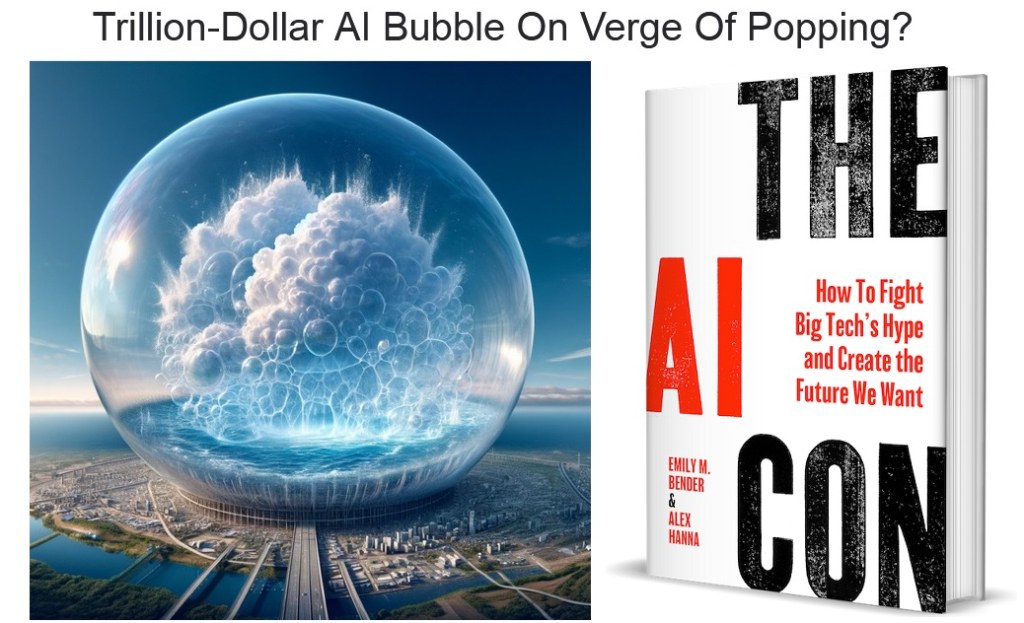
The AI CON by Dr. Emily M. Bender and Dr. Alex Hanna. Source.
by Brian Shilhavy
Health Impact News
The AI bubble and impending financial collapse is now being reported more than ever before.
And while the corporate media and even the alternative media are still participating in the AI Con with doomsday scenarios about computers becoming smarter than humans and “rogue AI agents” threatening our very existence, more and more people are drawing back the curtain and noticing that there is actually nothing there, and that most of what is being published in the media about AI is NOT real science, but simply science fiction.
At some point reality and the truth about AI will become evident to all, but will that time come before the entire economy of the U.S. is completely destroyed by what is being described as “The largest misallocation of capital in history“?
AI Fantasies Have Become a Dangerous CULT!
After I published my last update on AI, Is AI a Threat to “Destroy Humanity” or is the Real Threat Those Who Control the Technology?, I received several comments from a reader that probably totaled over 3000 words “explaining” to me how wrong I was to not fear AI, claiming supernatural evil powers were evolving from it.
And the kicker?
This commentor admitted that HE HAD NOT EVEN READ MY ARTICLE yet.
This is called “a Cult“, because it is a belief system that will withstand any amount of logic or truth you throw at it, because most of the time they will not even read or listen to anything that contradicts their belief system, and their “mission” to warn the world about the doomsday future ahead where AI takes over everything and replaces humans.
The AI CON
Let’s start with the AI Con first, which is what is fueling the AI Cult. The AI CON is the title of a new book that was co-authored by Dr. Emily Bender.
And while I have not read this book, I am very familiar with the work of Emily Bender. Like myself, Dr. Bender has a background in linguistics and technology, and is a Professor of Linguistics at the University of Washington where she is also the Faculty Director of the Computational Linguistics Master of Science program.
Dr. Bender co-authored an article that was recently published in The MIT Technology Review titled “Don’t be fooled by this summer of AI hype“.
[…]
The AI Financial Apocalypse is now Widely being Reported
If you search beyond the AI hype and religious fever producing their click-bait “news” which everyone prefers reading about these days, you will find genuine fear and concern about where all this massive AI spending is leading us.
“Apocalyptic” is not really hyperbole when you drill down to the facts, instead of reading the hype.
It just isn’t making it into most of the corporate news feeds, because the facts don’t sell as well as the hype.
[…]
And here’s another article from the latest The MIT Technology Review that does a deep dive into current AI spending, which also looks at Jessica Wachter’s analysis, and where this is probably leading us.
[…]
Here are a few other articles from The Information (subscription needed to read the full articles) on AI finances that have been published recently showing the increasing debt to fund AI build-outs.
Cracks Emerge in AI’s Debt-Fueled Data Center Boom
Excerpts:
Bond markets are getting tough for lower-rated borrowers. One example: CleanSpark, which is developing a data center for Meta Platforms, had to offer investors big concessions to land financing earlier this month.
That deal is among the clearest signs yet that financing the data center boom is getting expensive across the board, and investors are getting picky about which new projects they’ll back. The bank loan market too is showing signs of strain, with some lenders like Société Générale, Sumitomo Mitsui Banking Corp. and Mitsubishi UFJ Financial Group becoming more selective in lending to data center projects, people arranging the deals say.
Those dynamics mean companies could struggle to borrow for planned data centers, jeopardizing growth plans for the broader AI industry.
Pressures on the AI financing market are coming from a number of different directions. Big data center operators like Amazon, Google and Microsoft will together spend some $700 billion on capital expenditures this year, and are expected to continue at around that level the next few years. They’ve issued nearly $160 billion in investment-grade debt this year, flooding the market with new supply.
That hyperscaler debt is getting more expensive relative to other highly rated corporate bonds, though the tech companies generate enormous operating cash flows. The extra yield investors are demanding to hold hyperscaler debt has risen by about 0.25 percentage points this year, compared with just 0.04 percentage points for the broader investment-grade market.
At the same time, several of these big tech companies are offloading spending onto other ventures raising money in the high-yield bond market. Meanwhile, developers building data centers for AI firms like Anthropic and OpenAI are leaning on the market too.
All told, the high-yield market has seen around $55 billion of AI-related bonds sold this year.
AI Risks, Macro Volatility Collide
Meanwhile, government bond yields are spiking, fueled in part by fears that persistently high inflation will prompt aggressive Federal Reserve interest rate hikes.
The AI boom itself is adding to the pressure—Fed Chair Kevin Warsh said last week that government yields have climbed in part because heavy tech debt issuance is crowding out investors.
AI Data Center Debt Is Showing Up Everywhere
Excerpts:
Debt financing for data centers and related infrastructure has grown rapidly enough that it’s become its own category these days—credit analysts are breaking out AI versus non–AI-linked debt across markets to analyze new issuance and performance. Several asset managers in recent months have filed to create exchange-traded funds focused on AI or AI infrastructure–related debt.
And right now, parts of this category aren’t doing so hot.
There’s a lot going on, from wider spreads on tech giants’ corporate debt in the investment-grade market; to investors demanding bigger concessions in recent bonds for AI data center projects in the high-yield market; to skittishness in the bank loan market for AI project financing. Investors are getting choosier and taking a harder look at project-specific construction and other risks.
Zeroing in on the high-yield market in particular, there’s a group of bonds that anyone with an interest in the AI build-out should be keeping an eye on. Overall, there have been at least 20 high-yield bond deals financing data center projects over the past 12 months.
The companies behind these projects, such as CleanSpark or TeraWulf, are hardly household names, and the project debt is often issued through even more obscure special purpose entities.
But if you do a little digging, many of the biggest names in AI show up connected to these data center projects in some form, as direct tenants, customers of the tenants or providing some kind of credit support to get the financing done. That means markets for lower-rated issuers are financing at least some of the infrastructure supporting the biggest AI companies.
Wall Street and Silicon Valley Split Over AI’s Price Tag
Excerpts:
Shifting economic forces are driving a widening divide between the financial views of Silicon Valley and Wall Street, clouding the outlook for trillions of dollars invested in AI.
Stock market angst has already caused delays for several medium-sized initial public offerings, and it is starting to cool once-red hot sentiment about Anthropic’s giant IPO, which is coming later in the year than investors expected.
While venture capitalists are still tripping over each other to invest at ever loftier valuations in AI startups showing any sign of traction, public market investors say they are retreating to big, safe stocks and growing skeptical about a flurry of data center companies trying to go public amid rising interest rates and high oil prices.
“Anything going public today needs to be priced right, and I don’t see it,” Samantha Lau, chief investment officer of small and mid-cap growth equities at asset management firm AllianceBernstein, referring to the IPO market overall.
“The only way to open the market is to be conservative.”
Leading AI companies like OpenAI and Anthropic will likely require a steady stream of financing, even after their IPOs, to help pay for their hundreds of billions of dollars worth of data center commitments.
Anthropic, for example, had committed to agreements for at least 14.8 gigawatts of compute capacity that could cost well over $500 billion over the next decade, The Information reported earlier this month. Data from Anthropic’s draft IPO prospectus reported this week by Reuters have renewed investor attention to the size of its financial commitments and other risks it faces.
‘Who’s Paying for It?’
Lau said that she is optimistic about agentic software capabilities that tech firms are demonstrating, showing new benefits to all the money invested in chips and data centers.
But it isn’t clear if investment firms would see a return on their investment, especially with rising interest rates that increase companies’ borrowing costs.
[…]

