
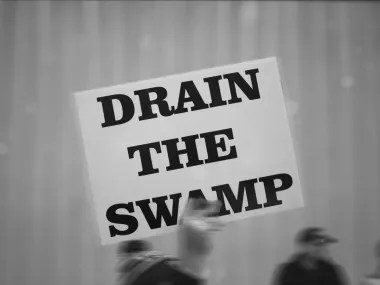
America is in a populist moment. Or at least, that’s what we’ve been hearing for the last decade.
Ever since Donald Trump shocked the legacy press, “expert” pollsters, and the political establishment more broadly in November of 2016, we’ve seen endless attempts to explain what was, at the time, seen as a perennial sea change in American politics.
A consensus quickly emerged that pointed to a “populist surge” on the right, driven by rural white voters who were angry about the financial crisis and the political class’s failure to “stem the tide” of illegal immigration. The establishment tried to frame this all in a way that was flattering to themselves. Trump’s popularity, we were told, came from a particularly nasty group of uneducated rural whites who were enraged about having to compete with non-white people and stupid enough to fall for Trump’s lies.
But anyone looking closely could see that that characterization was, at best, a gross and overly narrow simplification. While rural white populations provided a lot (not all) of the votes and fuel for the Trump movement, its ideological thought leaders were largely young men living in or around blue cities, connecting and interacting with each other online.
Also, at the same time, there was a significant populist surge on the left. This was a bipartisan, or even non-partisan, political phenomenon. Establishment Democrats have done a far better job than their Republican counterparts at keeping their populist wing in line—largely thanks to its political leader, Bernie Sanders, who was always willing to roll over and support the establishment candidate when the time came. That said, the success of several “post-woke” democratic socialists in this year’s primaries suggests that establishment Democrats are now also losing control.
So it’s not merely some handful of uneducated rural white voters. There has been a widespread sense, across the political spectrum, that America’s institutions are not merely failing, but are actively working against the interests of everyday Americans. And that is true.
The massive federal government built up in DC over the last century or so was never meant to serve the interests of the American people as a whole. It has always been a tool for enriching the political caste and their well-connected friends in the “private sector.” They’ve done that directly with tax-and-spend programs and indirectly by using rules and regulations that warp entire industries to benefit some well-connected firms already on top.
The political establishment has gone to great lengths to hide their expropriative activities behind deceptive propaganda and fake appeals to the common good. But especially after they’ve taken the opportunity to greatly ramp up their schemes in response to crises of their own making—like the 2008 financial crisis—it became a lot harder to stop people from noticing that, somehow, the elites are ripping them off.
The “populist anger” against the elites that resulted has enabled Trump’s dominance of the Republican Party and fueled an escalating civil war within the Democratic Party that appears to be nearing a similar establishment defeat. And this anger has been the defining feature of American politics for at least ten years now.
What, then, has this populist moment accomplished? What has been done to liberate the American people from our corrupt political class, or at least to meaningfully improve the safety and material well-being of everyday Americans?
The truth is, on nearly all fronts, the results have been abysmal.
Broadly, this populist wave was meant to end the “corruption” in DC—or to stop politicians and bureaucrats from using government to enrich themselves and their friends. It was meant to end the endless series of wars fought to benefit foreign groups and governments along with well-connected firms in the “defense” and energy sectors. And it was meant to reorient the American system from one that serves the interests of corporate giants and financial elites to one that serves small businesses and local communities.
On the right, populists also wanted to stop or reverse the demographic changes resulting from the post-1965 immigration system. And populists on the left wanted to reverse the rising levels of economic inequality.
Over the last decade, every single one of these problems has gotten worse. Why?
There are, of course, plenty of specific mistakes, shortcomings, or outright failures we could examine on all these fronts. But, at the end of the day, all come back to the same fundamental problem: the populist right grew bored with economics.
The truth is, the current wave of anti-establishment, anti-elite political sentiment did not really begin ten years ago with the election of Donald Trump. It began earlier, right in the wake of the financial crisis. There was, of course, the Occupy movement on the left, but that mostly boiled down to calls to send bailouts everywhere in the economy rather than just to the big banks, or even for a full-on socialist revolution. Economic literacy was never at home in that movement.
However, on the right, the post-meltdown anger was channeled in a much sounder direction. First with the early TEA (Taxed Enough Already) Party protests, which at least identified the correct villain. But then especially with the presidential campaigns of Ron Paul.
What set Ron Paul’s presidential runs apart was not that he spoke about how the current system was ripping people off and needed to be radically reformed—all candidates speak like that to at least some extent. What set him apart was that he, and he alone, correctly identified the mechanism the political class uses to rip the American people off: the Federal Reserve System.
If you listened to Ron Paul argue for ending the Fed, it’s clear he didn’t view it as one policy position among many on his domestic platform, but as the single federal entity fueling every other issue—at home and abroad—that he was talking about. And he was exactly right.
The control the central bank gives the political class over the banking system, the financial sector, and the monetary system itself has allowed it to transcend previous fiscal limits and fund its various ballooning federal programs with inflation, or money printing.
In other words, all the things the populists have claimed to oppose: the ever-growing administrative state that is warping the economy—and increasingly all parts of life—to the benefit of well-connected companies and interest groups, the enormous warfare state that we’re constantly forced to pay to expand only for it to get offered up for sale to the highest bribers, and what is effectively a massive corporate welfare system for the well-off firms at the top of the financial sector; all of it is only possible at the levels we see today because of the Federal Reserve.
That is not because the shift from traditional taxing and spending to inflation eliminates the cost or makes it more affordable. It’s because printing the money hides the cost, initially, from those who pay it. The political class is able to impose heavy taxes on the population that are barely noticeable at first, only appearing later as a general and unavoidable rise in prices that is easy to blame on “greedy” grocery store owners, for example.
That unceasing rise in prices that is clearly making just about everyone worse off does generate a lot of anger. But it’s anger that has, so far, been easily directed away from the actual culprits towards politically-convenient villains for both parties.
Add to that the ways the Fed’s manipulation of interest rates traps us in our familiar cycle of artificial, unsustainable economic booms and painful recessions, and encourages people to engage in high-time-preference behavior—a major institutional driver of much of the “degeneracy” the populist right has been speaking out against. And how the “culture wars” and ethnic conflicts that inevitably result as multiple nations, peoples, or cultures are forced to live under a single state get supercharged when that state is able to transcend normal limits and grow far more powerful, and it starts to become clear why the Fed sits right under the surface of most of the seemingly unrelated political issues animating people today.
That is why Ron Paul and the anti-establishment movement he led made opposition to the central bank their top priority. But it didn’t last.
By the time Trump came in and took control of the anti-establishment, populist energy on the right, Ron Paul’s focus on the Fed had already grown old, or stale, in the minds of populist right-wingers. They had moved on.
But importantly, what had happened was not some intellectual shift from one economic vision to another. It was a shift in focus from the root of the problem to various isolated symptoms.
And that, more than anything else, is why the populist right will continue to fail.
“Populists” can talk, until the end of time, about how they want to restructure federal policy to benefit Americans rather than the big multinational corporations it’s designed to serve, rein in the warfare state and the various foreign and domestic lobbies using it for their own ends, and tackle the nation’s cultural rot and escalating degeneracy. But as long as they remain uninterested in targeting the central federal apparatus that is fueling all this behavior, they’re not really serious about stopping it.
And that clearly describes the Trump movement, as it exists today. The lack of interest in actually taking on the root of the problems he ran on and talks about has made it easy for the political establishment to co-opt Trump’s administration and direct it back towards maintaining and even expanding the federal rackets causing the populist anger.
Now, Trump’s unwillingness to fix the inflation crisis is likely to hand power to the democratic socialists on the left. Americans tend to have a default—and justified—aversion to socialism. But these are the only candidates leaning into the populist anger who remain largely unstained by having been in office in recent years as this inflation crisis goes unaddressed. But, of course, the socialists also have no interest in actually addressing it. They merely want to use it as an excuse to ram through all their dream tax-and-spend programs—all of which will only make the problem far worse.
In other words, the populist anger we’ve seen escalate for years now is unlikely to dissipate any time soon. But, as long as today’s populists refuse to confront the economic foundation of the system they claim to oppose, that anger will keep getting redirected toward fighting symptoms while the machinery producing them grows stronger.
Ron Paul, Murray Rothbard, Ludwig von Mises, and the intellectual tradition they embodied already identified that system’s real center of gravity. We already know the answer. All that’s left to do is act on it.
Via https://mises.org/mises-wire/why-our-populist-moment-keeps-failing

