
Comments by Brian Shilhavy
Health Impact News
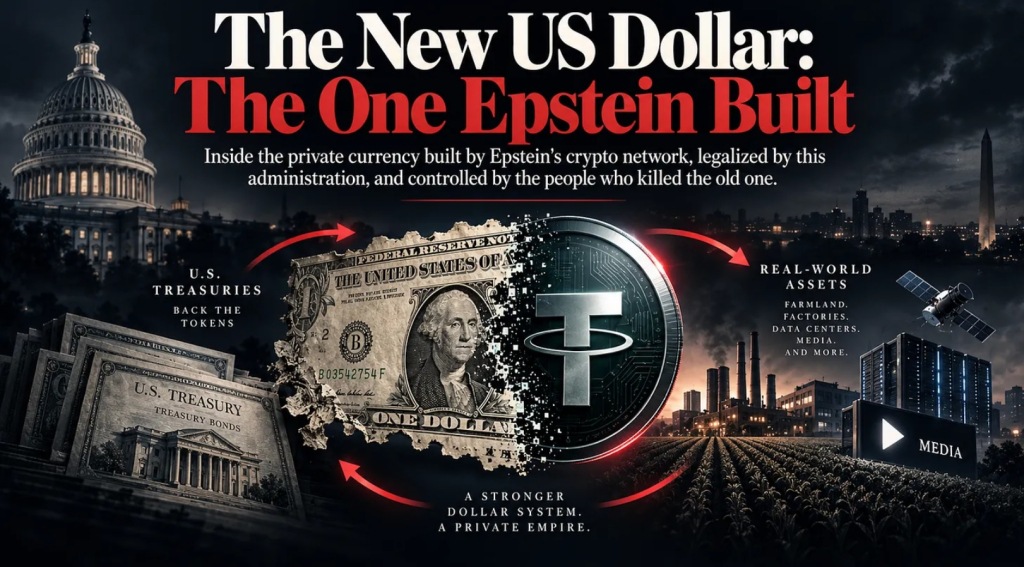
Leah of The Leah Files has just published Part III of her Currency Killer series, The New US Dollar: The One Epstein Built.
This series is, by far, the best intel I have read in the Alternative Media regarding the takeover of the U.S. Dollar in an attempt to replace it with digital currencies.
[…]
Read Health Impact News‘ coverage of her first two articles in this series, which is our most-read article so far in September, here: Treasury Secretary Scott Bessent Just Restructured The American Financial System to Destroy the U.S. Dollar
The New US Dollar: The One Epstein Built
Inside the private currency built by Epstein’s crypto network, legalized by this administration, and controlled by the people who killed the old one.
Excerpts:
I think they are replacing the US dollar with a private one.
Not in some distant future, not as a theory, but right now.
[…]
The United States government banned itself from making a digital dollar. Then it crashed the real one. Then it handed the replacement to a private company connected to $17 billion in organized crime, whose co-founder spent eight years as Jeffrey Epstein’s personal crypto advisor, and whose largest shareholder was convicted of software piracy before becoming the richest man in Italy.
That company is called Tether. It controls $183 billion in digital currency and it is now the 17th largest holder of US government debt on earth. It has never completed a publicly released independent audit. The UN has linked it to $17 billion in organized crime.
Tether is a stablecoin company, but it also owns 210,000 hectares of South American farmland and operates Argentina’s sole fertilizer producer. It holds a majority stake in a brain-computer interface company. It is the lead investor in a humanoid robotics firm. It owns 48 percent of a conservative media platform. Its third-largest shareholder controls a 10 percent stake in the privatized research arm of the UK Ministry of Defence.
[…]
Howard Lutnick’s sons’ own a piece of Tether. His firm, Cantor Fitzgerald custodies its reserves. Lutnick’s former minion, Bo Hines, championed the law regulating it from inside the White House and resigned one month after the president signed it, becoming CEO of the company the law was written for.
Scott Bessent is blocking a billion dollars in suspicious Epstein banking records while his old fund was paying an intelligence firm controlled by Epstein’s partner. Trump’s family has made over a billion dollars launching their own stablecoin.
This is not deregulation, it’s a heist. And I am going to show you what they are doing.
[…]
What Is Tether
Most people have never heard of Tether. So let’s start there.
A stablecoin is a digital token pegged to the US dollar. You send a company one real dollar, and they give you one digital token that is supposed to be worth one dollar. The company holds your real dollar in reserve.
[…]
Tether is the largest stablecoin on earth.
It has $183 billion of these tokens in circulation. That makes it bigger than the GDP of most countries.
The company is supposed to hold $183 billion in real reserves to back them. It earns interest on those reserves, mostly US Treasury bills, which generated $13 billion in profit in 2024 alone. It has roughly 200 employees.
Here is the problem: the CFTC found in 2021 that Tether was actually fully backed by reserves only 27.6 percent of the time. The company paid $41 million in fines.
The New York Attorney General’s office reached a separate $18.5 million settlement over similar misrepresentations. The UN has linked Tether’s token to $17 billion in criminal activity.
The DOJ has an active criminal probe. And the company has never completed a full, publicly released independent audit.
[…]
The Man Who Built Tether
His name is Brock Pierce. Before he co-founded Tether, he was the teenage Vice President of a company called Digital Entertainment Network (DEN).
[…]
In the late 1990s, Pierce became Vice President of Digital Entertainment Network (DEN), a pioneering internet video company founded by Marc Collins-Rector, at the age of 17, earning a salary of $250,000.
At DEN’s Hollywood Hills parties, Collins-Rector and others allegedly sexually assaulted half a dozen teenage boys, including a 15-year-old, according to civil lawsuits filed between 1999 and 2002. When Collins-Rector fled the country to avoid prosecution, Pierce went with him.
They ended up in a villa in Marbella, Spain, which police raided in 2002 and found Collins-Rector, Pierce, and a third DEN executive, along with child pornography and firearms.
Collins-Rector was convicted of child sexual abuse in 2004. Pierce was never charged, but the civil lawsuit resulted in a $2,000,030 default judgment plus $1 million in interest because Pierce and his co-defendants never responded to the allegations of rape, assault, and death threats.
[…]
The Emails
The DOJ released over 3.5 million pages of Epstein files, including direct correspondence between Pierce and Epstein spanning 2011 to 2019.
Pierce was mentioned 1,815 times, more than almost any other private figure.
The emails continued for months after Epstein’s second arrest on federal sex trafficking charges. Here is what they show.
By 2012, the correspondence had turned dark. Pierce sent Epstein dozens of photographs of a Ukrainian woman named Anastasia, three days after Epstein asked him to “take photos and find me a present.” Pierce wrote back that “Ukraine is now my favorite country.”
In a separate exchange, Pierce told Epstein there was “a boat in Antigua full of amazing Ukraine’s finest” waiting for him.
In another email, Epstein’s assistant wrote that Brock had a “great time with the girls in St. Barths.” Pierce’s own assistant sent Epstein’s team photos from Ukraine and mentioned upcoming meetings. There were references to visits on Epstein’s boat and coordination around events with Epstein’s inner circle.
These are the emails of a man inside the operation. Not an acquaintance. Not a networking contact. Pierce was coordinating women, referencing boats, sending photographs on request, and maintaining this relationship for years after Epstein’s first conviction.
But the business side of the relationship is what changed the world.
Pierce was not just advising Epstein on crypto. He was the bridge between Epstein’s money and the people who would build the infrastructure that now threatens to replace the US dollar.
He brokered the Coinbase deal.
In December 2014, Pierce connected Epstein to Coinbase’s Series C round through his venture firm, Blockchain Capital. Epstein invested $3 million. Coinbase co-founder Fred Ehrsam emailed asking to meet Epstein in New York.
[…]
The Network
Pierce and Epstein did not operate in a vacuum. Their shared network reached into the political and financial circles that now control American crypto policy.
Steve Bannon. Pierce and Bannon had worked together for seven years before any of this. Pierce hired Bannon in 2005 to run the financial side of his company Internet Gaming Entertainment, later saying
[…]
Peter Thiel. Epstein invested $40 million into Thiel’s venture firm, Valar Ventures, in 2015 and 2016. Reid Hoffman made the introduction.
That bet became the single largest asset of the Epstein estate, valued at roughly $170 million by the time Epstein died.
Thiel’s proteges now run US crypto policy: JD Vance is Vice President, David Sacks served as crypto czar, and Thiel’s Founders Fund was the largest investor in Polymarket.
[…]
Where Pierce Is Now
Brock Pierce lives in Puerto Rico, where Act 60 allows him to pay near-zero taxes on capital gains. He is still Chairman of the Bitcoin Foundation. He still runs the Integro Foundation, whose most recent IRS filing shows $78 in total assets.
[…]
Tether Today
Now that you know what Tether is and who built it, here is who runs it.
Who Owns It
Tether has never voluntarily disclosed who owns it. It is a private company incorporated in the British Virgin Islands with no public reporting obligation.
The only known ownership data comes from leaked documents reported by the Wall Street Journal in 2023, showing stakes as of 2018. As of those documents, four people controlled 86 percent of the company.
The Empire Build
Starting in late 2023, Tether began spending its profits at an extraordinary pace, acquiring stakes in companies across sectors that have no obvious connection to stablecoin issuance.
The Farmland
This is the part of the story that made me stop and ask what we are actually looking at.
Adecoagro is not a farm. It is a vertically integrated agro-industrial conglomerate incorporated in Luxembourg and listed on the New York Stock Exchange.
When Tether took control in April 2025, it took control of the entire chain from soil to supermarket shelf: the land itself, the crops grown on it, the mills that process them, the dairy plants, the rice processing facilities, the peanut sorting plants, the branded consumer products, the export terminals, and the port infrastructure.
In mid-2026, Adecoagro launched a Bitcoin mining pilot at its Brazilian sugar mills, using surplus electricity from sugarcane bagasse cogeneration to power approximately 1,280 mining machines. This connects directly to Tether’s stated goal of becoming the world’s largest Bitcoin miner.
[…]
Profertil
In December 2025, eight months after Tether took control of Adecoagro, the company acquired a 90 percent stake in Profertil for approximately $1.1 billion.
Profertil is Argentina’s sole producer of urea, the most widely used nitrogen fertilizer in the world. The plant in Bahia Blanca produces 1.3 million tons of granular urea per year and supplies roughly 60 percent of Argentina’s domestic fertilizer demand.
This means that a company whose co-founder was sending photos of Ukrainian women to Jeffrey Epstein and brokering introductions between Epstein and the people who now control American financial policy now also controls the fertilizer supply that South American agriculture depends on.
[…]
Now here is the part that made me consider this one the most important articles of the Currency Killer series.
This is not a hedge fund buying farmland as an inflation hedge. Tether looks to be building something specific.
Adecoagro co-founded a company called Agrotoken, which has already created three grain-backed stablecoins: SOYA, CORA, and WHEA.
Each token represents one ton of grain.
Farmers can use them as currency. Agrotoken partnered with Visa so producers can spend grain tokens with a card. They have already tokenized 230,000 tons of grain and transacted $70 million in deals. Adecoagro’s CEO said the goal was to build “tokenized land.”
[…]
The company is building its own real-world asset tokenization platform designed to create digital versions of bonds, stocks, funds, and physical commodities.
Now connect the pieces.
Tether now controls the land, the crops grown on that land, the fertilizer those crops need to grow, the mills that process the harvest, and the platform that can tokenize all of it into digital currency. It already issues the largest stablecoin on earth.
This is a closed loop. Own the physical asset, process it, tokenize it, and issue the currency it trades in. They are not replacing the dollar with a digital version.
They are building an entire parallel financial system backed by food, land, and fertilizer, controlled by four people who have never disclosed who they are to the public, operating out of the British Virgin Islands.
The Switch
On January 23, 2025, Trump signed Executive Order 14178. It banned all federal agencies from developing or promoting a central bank digital currency. No government digital dollar.
The only digital dollars allowed in America would be private ones.
The Replacement
On July 18, 2025, Trump signed the GENIUS Act into law. It created the first federal framework for privately issued stablecoins, the exact product Tether sells.
The law allows stablecoin issuers to operate under a three-year grace period before meeting full compliance requirements and does not mandate independent audits.
Treasury Secretary Scott Bessent signaled that the law “will drive demand from the private sector for US Treasuries,” and indicated that stablecoin firms could buy up to $1 trillion in US government debt.
[…]
The Thiel Network
Peter Thiel took $40 million from Epstein through the Valar Ventures fund, an introduction brokered by Pierce. That investment produced $170 million in returns and became the largest single asset in the Epstein estate.
[…]
Read the Full Article at The Leah Files.
What I have re-published here is NOT the full article! Please consider supporting her work – I do.
 The Most Revolutionary Act