
After fighting the longest war in its history, the US stands at the brink of defeat in Afghanistan.
How could this be possible? How could the world’s sole superpower have battled continuously for more than 16 years – deploying more than 100,000 troops at the conflict’s peak, sacrificing the lives of nearly 2,300 soldiers, spending more than $1tn (£740bn) on its military operations, lavishing a record $100bn more on “nation-building”, helping fund and train an army of 350,000 Afghan allies – and still not be able to pacify one of the world’s most impoverished nations? So dismal is the prospect of stability in Afghanistan that, in 2016, the Obama White House cancelled a planned withdrawal of its forces, ordering more than 8,000 troops to remain in the country indefinitely.
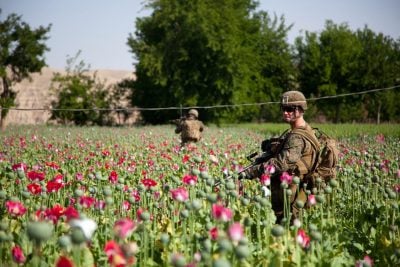
In the American failure lies a paradox: Washington’s massive military juggernaut has been stopped in its steel tracks by a small pink flower – the opium poppy. Throughout its three decades in Afghanistan, Washington’s military operations have succeeded only when they fit reasonably comfortably into central Asia’s illicit traffic in opium – and suffered when they failed to complement it.
It was during the cold war that the US first intervened in Afghanistan, backing Muslim militants who were fighting to expel the Soviet Red Army. In December 1979, the Soviets occupied Kabul in order to shore up their failing client regime; Washington, still wounded by the fall of Saigon four years earlier, decided to give Moscow its “own Vietnam” by backing the Islamic resistance. For the next 10 years, the CIA would provide the mujahideen guerrillas with an estimated $3bn in arms. These funds, along with an expanding opium harvest, would sustain the Afghan resistance for the decade it would take to force a Soviet withdrawal. One reason the US strategy succeeded was that the surrogate war launched by the CIA did not disrupt the way its Afghan allies used the country’s swelling drug traffic to sustain their decade-long struggle.
Despite almost continuous combat since the invasion of October 2001, pacification efforts have failed to curtail the Taliban insurgency, largely because the US simply could not control the swelling surplus from the country’s heroin trade. Its opium production surged from around 180 tonnes in 2001 to more than 3,000 tonnes a year after the invasion, and to more than 8,000 by 2007. Every spring, the opium harvest fills the Taliban’s coffers once again, funding wages for a new crop of guerrilla fighters.
At each stage in its tragic, tumultuous history over the past 40 years – the covert war of the 1980s, the civil war of the 90s and its post-2001 occupation – opium has played a central role in shaping the country’s destiny. In one of history’s bitter ironies, Afghanistan’s unique ecology converged with American military technology to transform this remote, landlocked nation into the world’s first true narco-state – a country where illicit drugs dominate the economy, define political choices and determine the fate of foreign interventions.
During the 1980s, the CIA’s secret war against the Soviet occupation of Afghanistan helped transform the Afghani-Pakistani borderlands into a launchpad for the global heroin trade. “In the tribal area,” the US state department reported in 1986, “there is no police force. There are no courts. There is no taxation. No weapon is illegal … Hashish and opium are often on display.” By then, the process of guerrilla mobilisation to fight the Soviet occupation was long under way. Instead of forming its own coalition of resistance leaders, the CIA had relied on Pakistan’s powerful Inter-Services Intelligence agency (ISI) and its Afghan clients, who soon became key players in the burgeoning cross-border opium traffic.
The CIA looked the other way while Afghanistan’s opium production grew from about 100 tonnes annually in the 1970s to 2,000 tonnes by 1991. In 1979 and 1980, just as the CIA effort was beginning to ramp up, a network of heroin laboratories opened along the Afghan-Pakistan frontier. That region soon became the world’s largest heroin producer.
By 1984, it supplied a staggering 60% of the US market and 80% of the European.
Inside Pakistan, the number of heroin addicts surged from near zero (yes, zero) in 1979 to 5,000 in 1980, and 1.3 million by 1985 – a rate of addiction so high the UN termed it “particularly shocking”.
Click here to read the full article on The Guardian. (published in 2018)
Via https://www.globalresearch.ca/heroin-trade-explains-us-uk-failure-afghanistan/5940045
 The Most Revolutionary Act
Drug addiction is still out-of-control here in the states. People are nodding everywhere. Yesterday on the bus, a nodding drug addict fell out of the seat and onto the floor of the bus. The bus just kept going since this scenario is all too common. Folks are sitting at the bus stop nodding off and missing their bus. The situation is unreal.
LikeLike