
 (Image credit: Getty Images)
By Jake Roach
The President says to “let Data Reign” if communities “want to be successful and rich.”
Donald Trump doesn’t appear to be a fan of the data center backlash that has swept the nation. Posting on his Truth Social platform, the President said that communities that reject data centers only do so because “they want to end up being backwards and poor,” and posited that China “could not be happier with this anti Data Center movement.” The comment comes amid a wide, albeit unorganized, pushback to data center buildouts in the United States that’s left local communities and municipalities reckoning with an unanticipated and rapid infrastructure buildout.
Local pushback has been widespread and consistent across the country. Earlier this month, an Amazon data center came under fire for circumventing public feedback based on old laws. Since April, leaders across the nation have received an elevated number of credible death threats related to data centers since April. And last month, the number of local bans on data center developments crossed over 500 within the United States.
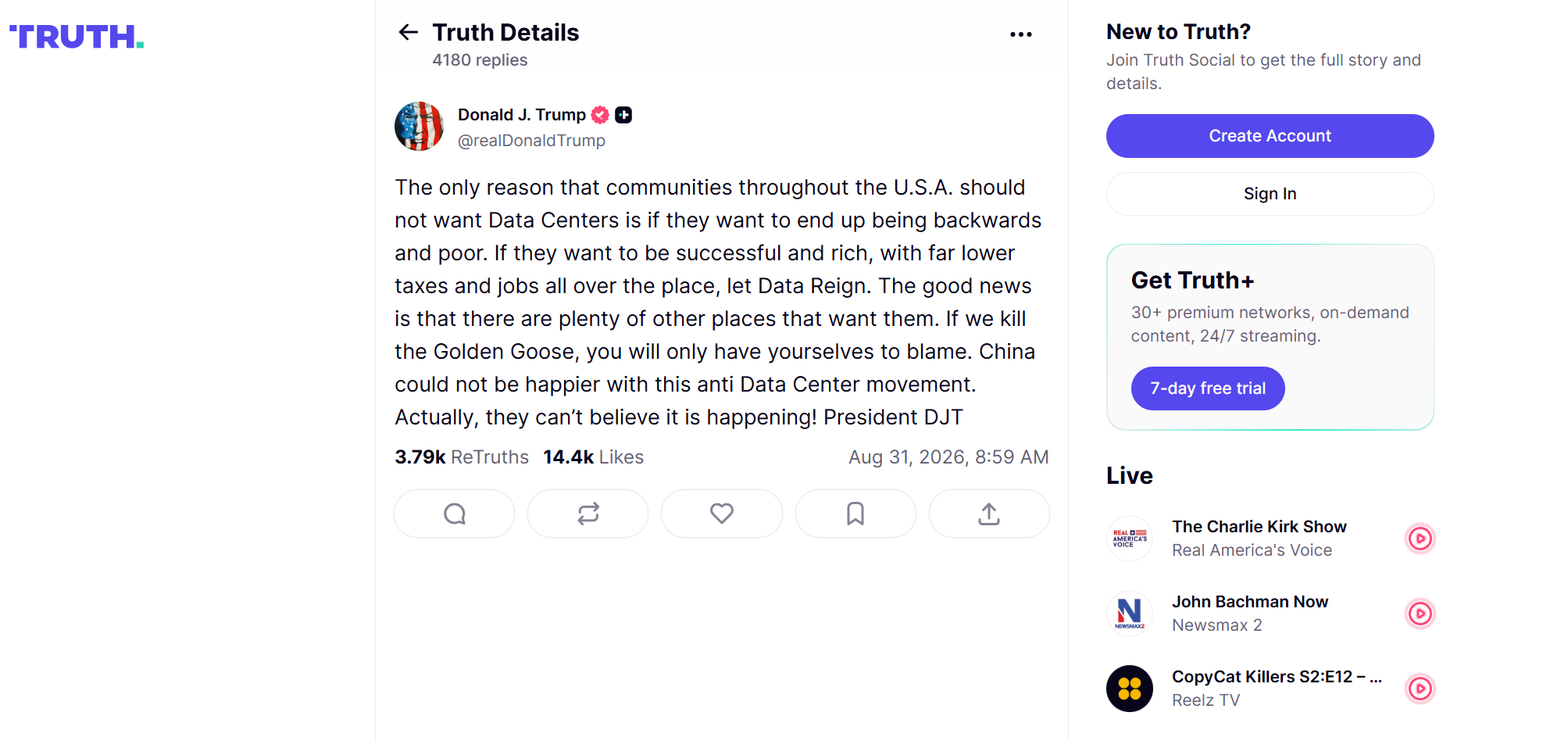
The President says to “let Data Reign” if communities “want to be successful and rich, with far lower taxes and jobs all over the place.” Presumably, the President missed a comma after “taxes” and does not mean that data centers will lower the number of jobs available. The economic argument surrounding data centers is a tough issue to quantify, though it’s not completely detached from reality.
A July study from Georgia Tech found that data center developments increase local employment by 3.5%, total wages by 5%, business establishments by 4.7%, and median household income by 1.9%. Further, the developments reduce unemployment rates. Critically, however, the study found that these benefits mainly show up in metropolitan areas, calling the benefits in rural areas “negligible.” The study also highlights that data centers often employ fewer than 100 permanent workers, with specialized services “imported from outside the country.”The research also looked into trade-offs with electricity prices, finding that prices rise an average of 5% after a data center is built in a community.
[…]


“Presumably, the President missed a comma after “taxes” …”
According to proper English grammar, that is not allowed, as the next word is a conjunction. In a way, the comma sign should be considered as a conjunction. Two conjunctions in a row is a no-no. (When reading a text out loud, conjuntions and comma signs are used as [natural] breathing pauses. A double breathing pause would then cause an audience to pay attention, but probably not as expected …)
LikeLiked by 1 person
Your understanding of the English language is probably better than most people who speak it!
LikeLike
Maybe, perhaps. My English is not flawless though, but I at least payed some attention during the language classes I attended in primary and scondary school (Swedish, English, French and German) By coincidence, two English teachers reached out a couple of years ago, as they where curious about my origin. They couldn’t figure it out by the way I wrote. One was from England and the other from Australia. I took the opertunity to ask about the use of commas. Both confirmed that a comma followed by a conjunction in respectively English language versions was not allowed and they could vouch for neighboring countries (Ireland and New Zeeland) too. Both also informed that the influence of the US English has become an issue …
What I’ve seen so far, no other language using a Latin alphabet allowes it.
LikeLiked by 1 person
Unlike many other languages, the British language is a borrowed language including Latin, French and some other European influences. You can bet the original British tongue bears no resemblance to the native language of tribes such as the Iceni(Boudica)who battled against the Romans, or other Celtic, or Gaelic or Roman or Highland Picts or Vikings or French Kings all of whom probably adulterated the original language.
In other words, the British Language is a mongrel concoction of a great many other influences. No wonder it’s so muddled!
LikeLike
According to a linguist I really admire, English became simplified and lost all it’s tense and case endings found in other European languages owing to the vast number of feudal slaves forced to learn it as a second language. The same is true of Polynesian languages, including Maori, which is spoken in New Zealand. To make a verb past tense in Maori, you just put the letter “i” in front of it. For example “i kai au” means I ate and “ka kai au” means I will eat. You can also change nouns into verbs by using tense markings. “Te kai” means “the food” and “kei te kai au” means “I eat.” It makes Maori much easier to learn than European languages
LikeLike
I think Trump, who’s notorious for his refusal to read written briefings, skipped his language arts classes in school.
LikeLike
I think he skipped a lot more than language classes
LikeLike
To be honest, Susan, I don’t think he writes his own tweets.
LikeLike
Pingback: Trump Expands His Plan to Have Data Centers Take Over Public Lands | Worldtruth