
 Comments by Brian Shilhavy
Health Impact News
A Health Impact News reader reached out to me today about a Substack Page named The Leah Files, and Leah’s most recent posts about Treasury Secretary Scott Bessent and Secretary of Commerce Howard Lutnick’s efforts to intentionally crash the U.S. dollar and replace it with digital stablecoins.
Leah claims to have 20 years of experience in intelligence as a former CIA and NSA employee. She also has a YouTube channel.
Leah appears to have discovered the Trump Administration’s plan to crash the U.S. Dollar and profit from it, and her research appears to be rock solid.
Some of this information I already knew, but she covers the most recent actions by Bessent and ties the pieces together, which was a real eye-opener for me, so I decided to feature her work here on the Health Impact News network.
She gives great background on Scott Bessent and how he has a history of destroying countries’ currencies, and profiting from it.
This is what she wrote regarding Bessent and the actions he took as the U.S. Treasury Secretary during a 13-day period in August of 2026:
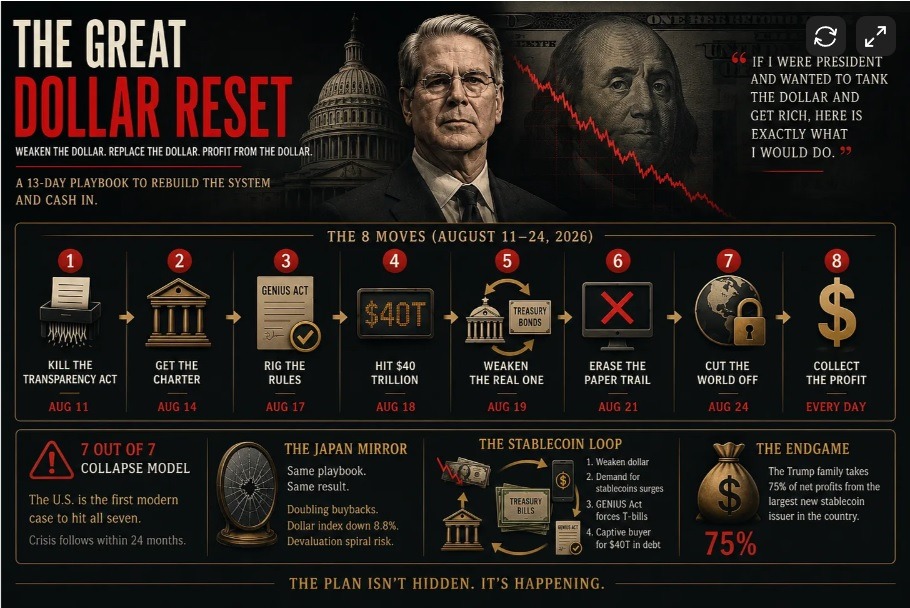
Between August 11 and August 24, 2026, Treasury Secretary Scott Bessent executed a sequence of decisions that, taken together, amount to the most aggressive restructuring of the American financial system in modern history. He did it in thirteen days and it’s being buried in the news…for good reason.
I am quoting extensive excerpts from her two-article series, and I encourage you to support her work (I did).
THE CURRENCY KILLER: SCOTT BESSENT
He broke five currencies and made billions. Then, he got the keys to the USD. All while having connections to Epstein and Ehud Barak.
by Leah
Excerpts:
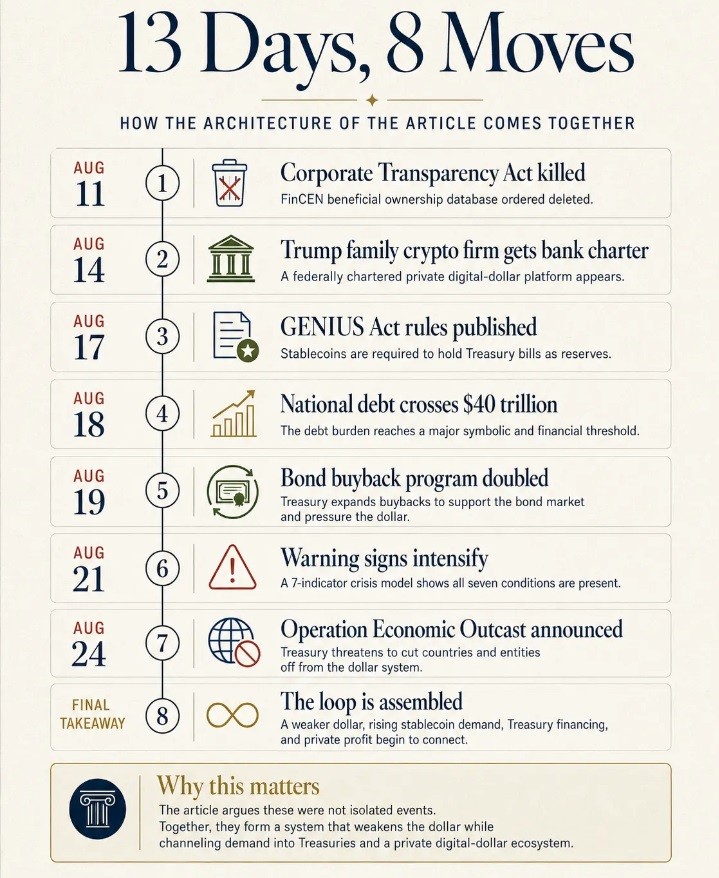
Between August 11 and August 24, 2026, Treasury Secretary Scott Bessent executed a sequence of decisions that, taken together, amount to the most aggressive restructuring of the American financial system in modern history. He did it in thirteen days and it’s being buried in the news…for good reason.
On August 11, Bessent killed the Corporate Transparency Act and ordered the FinCEN beneficial ownership database deleted. Three days later, the President’s family crypto company received a federal bank charter.
Three days after that, Bessent published rules requiring every stablecoin in America to hold its reserves in Treasury bills. The national debt crossed $40 trillion the next day.
On August 19, he doubled the Treasury’s bond buyback program, the same mechanism he once used to make $3.5 billion breaking Japan’s currency. And on August 24, he announced “Operation Economic Outcast” and threatened to cut entire countries off from the dollar system.
I built a model to measure how close the United States is to a currency crisis.
I took the seven indicators that preceded every major currency collapse since 1992 and checked the U.S. against each one. Unfortunately, all seven are present. The historical record says that has never happened without a crisis following within twenty-four months.
The model turned out to be the easy part. The harder thing to explain is what I found behind the numbers: a system that appears designed not just to weaken the dollar, but to profit from the weakening. And the man running it has spent forty years doing exactly that to other countries.
The Man Behind the US Dollar
Scott Bessent’s career has one through line. He finds countries whose governments are weakening their own currencies, he bets against those currencies, and he collects when they break.
He started on George Soros’s team in the early 1990s. In 1992, Soros shorted the British pound on Black Wednesday and made a billion dollars in a single day.
Bessent was part of that trade, living in London and running the London office at the time. He went on to become Soros Fund Management’s chief investment officer, where he ran what the Wall Street Journal called the most profitable currency bet in the fund’s history: the yen.
Japan’s government had been buying its own bonds to suppress interest rates, which had the side effect of weakening the yen. Bessent recognized the pattern, shorted the currency, and made $3.5 billion when it crashed.
[…]
He left Soros in 2015 and started his own fund, Key Square Capital, running the same strategy. Then Donald Trump nominated him for Treasury Secretary, and the man who had spent his career betting against vulnerable currencies was handed control of the most important one on earth.
What he has done since become the US Treasury Secretary with control of the US Dollar is worth a closer look.
He crashed the Iranian rial from 700,000 to 2 million per dollar through sanctions. Rice prices in Iran went up 60% and beef went up 150%. The broader conflict cost American consumers $53 billion in higher gas prices, according to the Dallas Fed.
He used between $20 and $40 billion in American taxpayer money to prop up Argentina’s peso ahead of a political ally’s midterm elections.
He blockaded Cuba’s economy and tourism collapsed by half with rolling blackouts becoming a permanent normalcy.
[…]
The pattern is consistent. When the target is an adversary, he destroys their currency. When the target is an ally, he props theirs up with American money.
In both cases, the American public pays.
Seven Out of Seven
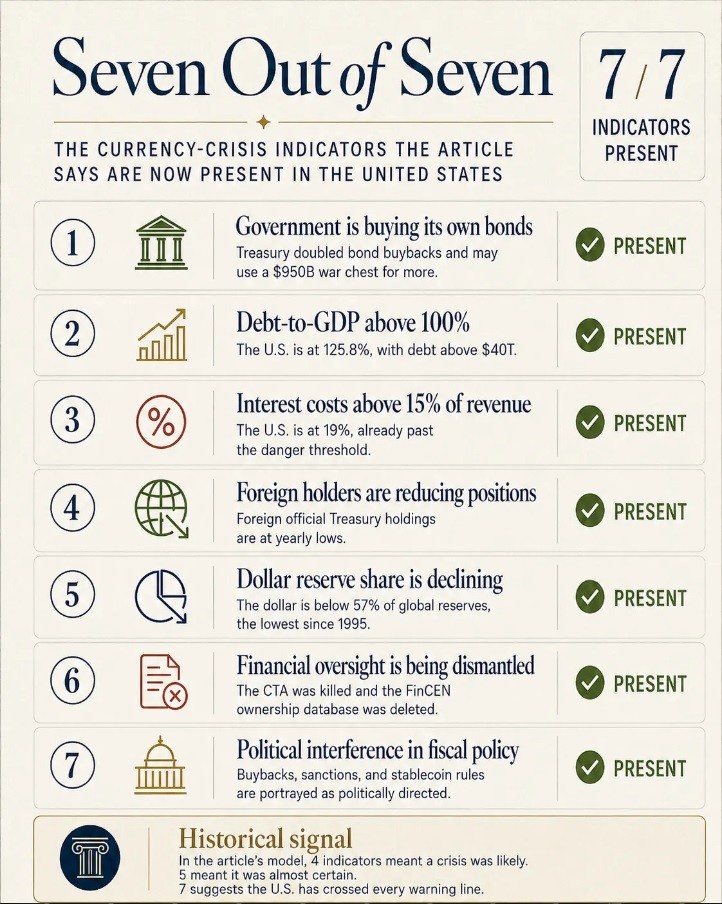
As an economist, I have studied historical currency collapses for years and I found that eery major one in modern history followed a pattern. I identified seven indicators that were present before the collapse. And I wanted to know how many of those indicators are currently present in the United States.
The answer…all of them.
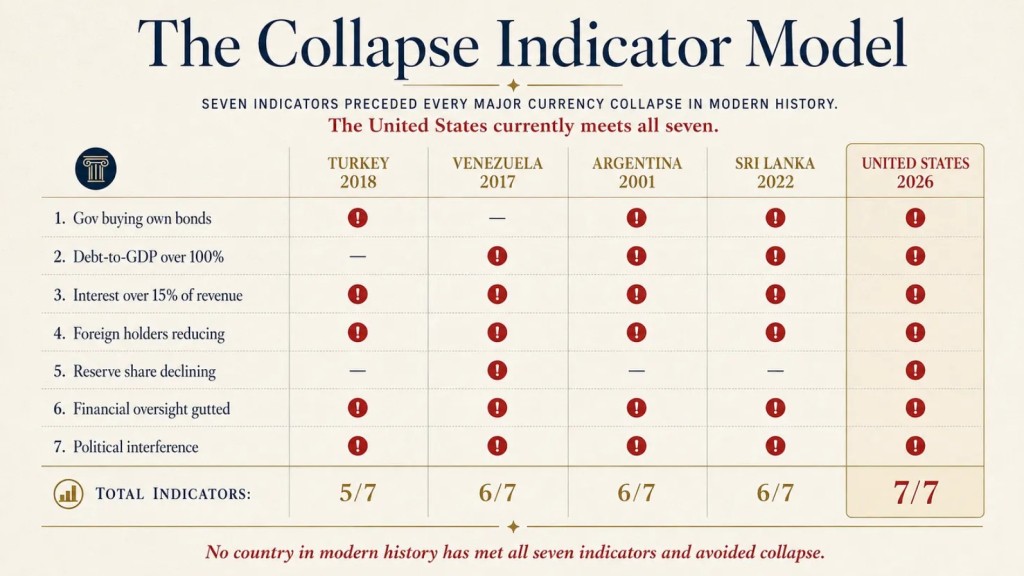 In the historical record, four of these indicators meant a crisis was likely. Five meant it was almost certain.
I found all seven.
Operation Economic Outcast
On August 24, Bessent held a press conference and announced what he called “the single greatest financial offensive ever marshaled against an adversary.”
He sanctioned nearly 60 corporations, individuals, and vessels connected to Iran. He introduced five new categories of secondary sanctions targeting digital assets, cryptocurrency, gold, aviation, and shipping. He seized $1 billion in Iranian cryptocurrency.
Then he said:
“Any entity that facilitates money laundering on behalf of Iran will be removed from the U.S. dollar system. The clock just started ticking.”
When asked whether Chinese banks would be exempt, he said
“no one is above the reach of U.S. sanctions.”
The Treasury Secretary of the United States just threatened to cut entire nations off from the dollar. He did this while actively weakening the dollar through buybacks. While the debt just crossed $40 trillion. While he had just gutted the financial transparency system, and while the President’s family owns the only federally chartered private digital dollar in existence.
Countries that get cut off from the dollar system still need a way to transact in dollars. The only private digital dollar with a federal bank charter is USD1, owned by the Trump family.
Bessent is driving countries away from the dollar while the President’s family owns the replacement.
The Digital Dollar Play
Let’s play connect the dots.
On January 23, 2025, Trump signed an executive order banning any federal agency from creating a Central Bank Digital Currency. No government digital dollar, ever. He eliminated the only thing that could have competed with a private one.
Two months later, his family’s company, World Liberty Financial, launched USD1, a private stablecoin pegged to the U.S. dollar and backed by Treasury bills. The Trump family receives 75% of net profits. Abu Dhabi’s sovereign wealth fund, controlled by Sheikh Tahnoon bin Zayed, owns 49%. USD1 now has $4.6 billion in circulation.
In May 2025, Abu Dhabi’s MGX fund routed a $2 billion investment in Binance through USD1 specifically. That single transaction represented 75% of USD1’s total market cap at the time. Eric Trump and Zach Witkoff, the son of Trump’s Middle East envoy, announced the deal from a stage in Dubai.
Congress then passed the GENIUS Act, which requires every stablecoin issuer in the United States to back its tokens with Treasury bills maturing within 93 days. This means every dollar of USD1 in circulation must purchase government debt. Brookings projects that stablecoin holdings of Treasury bills could reach $2.3 trillion by 2030.
On August 14, the OCC, run by Trump appointee Jonathan Gould, granted World Liberty Financial a conditional federal bank charter. The President’s family crypto company can now issue USD1 directly, with federal authority.
Now let’s follow the money through the loop.
The President banned the government from building the competition, then the Trump family built the product. His appointee gave them a bank charter.
Congress passed a law requiring it to buy government debt. His Treasury Secretary is weakening the real dollar to drive adoption of the digital one, and his Treasury Secretary is now cutting countries off from the dollar system, pushing them toward the private replacement his family owns.
Trump’s 2025 financial disclosure reported $1.4 billion in crypto income. That is more than he made from real estate. $550 million came from World Liberty Financial token sales. $600 million came from meme coins. His family has taken at least $1.2 billion in cash from WLF in sixteen months.
Former White House ethics lawyer Richard Painter reviewed the disclosures and said this level of conflict “would be a violation” for every other executive branch employee.
But there is no enforcement mechanism for a sitting president.
The Epstein Connection
There is one more thread, and it is the one that explains why the financial transparency infrastructure had to be destroyed.
In August 2024, a hacker group called Handala breached the personal email archive of Ehud Barak, the former Prime Minister of Israel.
Barak was one of Jeffrey Epstein’s closest associates. He visited Epstein’s Manhattan townhouse dozens of times, invested in companies alongside Epstein, and has never denied the relationship.
The emails were published by Distributed Denial of Secrets, a legitimate transparency organization. Journalists Jack Poulson and Harrison Berger spent months going through them and published their findings in September 2025.
What they found was a direct, documented financial relationship between Ehud Barak and Scott Bessent.
The emails show Barak communicating with senior Soros Fund executives about Bessent’s currency trades. They used code names.
Bessent was referred to as “Sterling.” A major yen trade was called “Ichiban,” the Japanese word for number one. There are emails from August 2013, December 2013, May 2014, February 2015, and May 2015 documenting meetings, fund seeding discussions involving $100 million to $450 million, and ongoing financial coordination between Barak and Bessent.
Barak’s corporate structure was designed by Darren Indyke, Epstein’s personal lawyer. Epstein’s Southern Trust Company invested 50% into the entity. The same entity that took consulting payments from Bessent’s fund is the same entity that controlled where Epstein’s money went.
Bessent is also blocking the release of $1.5 billion worth of Epstein’s Suspicious Activity Reports: 4,725 flagged wire transfers from JPMorgan and $378 million from BNY Mellon. Senator Ron Wyden introduced the PETRA bill to force their release. A Republican senator blocked it.
Wyden called Bessent “a willing participant in a cover-up.”
And he is.
On August 11, Bessent killed the Corporate Transparency Act and deleted the FinCEN database. Three days later, the bank charter was approved.
The man with documented financial ties to Epstein’s business partner is not just running the Treasury, he is dismantling the infrastructure that would allow anyone to trace what is happening now.
Read the Full Article at The Leah Files.
THE CURRENCY KILLER PART II: HOWARD LUTNICK
How Howard Lutnick Built the Infrastructure For America’s Largest Financial Conflict of Interest
by Leah
Excerpts:
THE OTHER HALF OF THE SCHEME
In Part I of “The Currency Killer”, I showed you how Treasury Secretary Scott Bessent is using the same tools he deployed as a hedge fund manager to manipulate the US bond market. He doubled the Treasury buyback program to $4 billion per operation.
[…]
But in summary, he is, in my opinion, one of the worst of the worst of this administration.
[…]
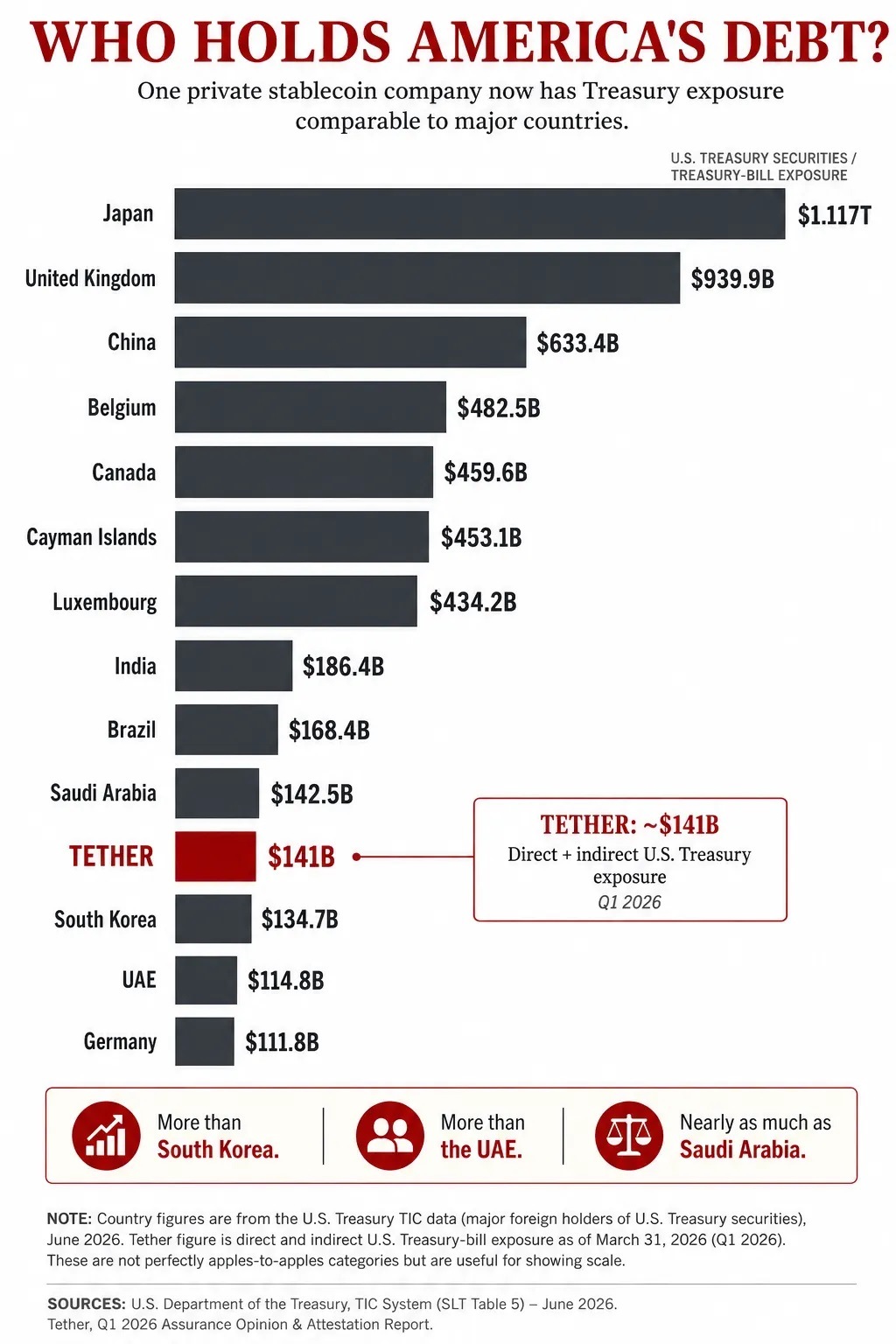
His firm has a client that matters more than any other in this Currency Killer series. That client is Tether, the largest stablecoin in the world, with $185 billion in circulation. Cantor Fitzgerald is Tether’s primary custodian, holding $141 billion in US Treasury bills backing Tether’s reserves.
[…]
 The Most Revolutionary Act