
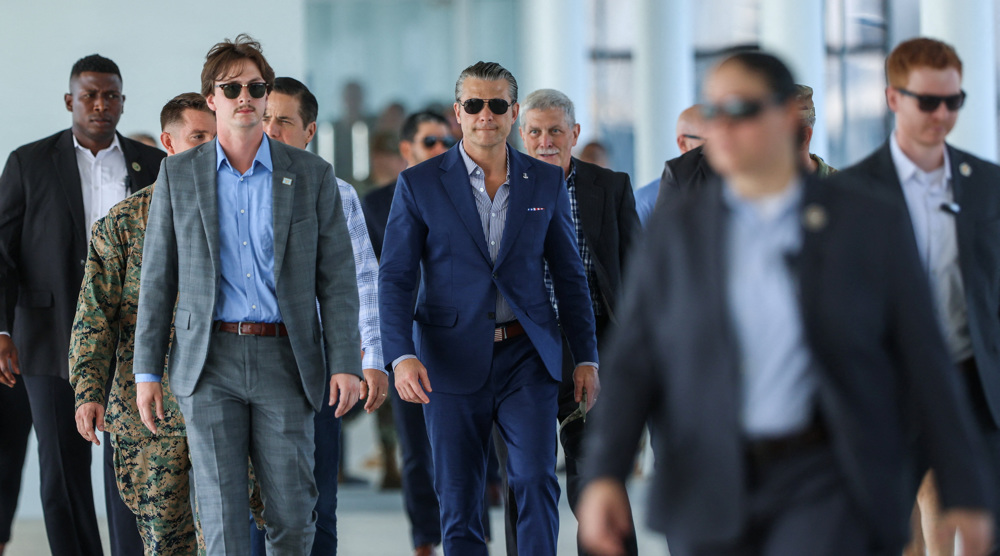
US Secretary of War Pete Hegseth arrives to attend the closing ceremony of PANAMAX 2026 in Panama City, Panama, August 13, 2026. (Photo: Reuters)
Press TV
Aug 30, 2026
Senior US military leaders have stark warnings for War Secretary Pete Hegseth, cautioning that prolonging large-scale military offensives against Iran is unsustainable and is actively degrading America’s ability to confront threats elsewhere, including the defense of the US homeland.
The warnings, detailed in the classified August 14 edition of the Secretary of Defense Orders Book (SDOB), reveal deep fractures within the Pentagon over the six-month-old war, according to the Washington Post.
According to individuals familiar with the assessment, the heads of the Army, Navy, and Air Force, alongside four-star commanders overseeing operations in Europe, the Indo-Pacific, and Latin America, have formally registered their concerns.
Leaders of the US European, Indo-Pacific, and Southern Commands, along with the Navy’s top admiral, submitted a formal “non-concur” to Hegseth’s directives.
While they are bound to execute the orders, their dissent highlights a severe strain on US forces.
Ships, aircraft, and personnel have been continuously pulled from other theaters to support the Iran war, severely limiting training and operational readiness.
The material toll of the war has been staggering. Admiral Daryl Caudle, Chief of Naval Operations, reportedly informed Hegseth that barely one-quarter of the Navy’s destroyer fleet is currently ready to deploy, a sharp decline from pre-war levels.
The Air Force has lost approximately 25 percent of its Reaper drone fleet, and US bases in the region have sustained billions of dollars in damage from Iranian counterstrikes.
Furthermore, the depletion of Patriot and THAAD missile interceptors, exacerbated by previous commitments to Ukraine, has left American facilities and regional allies increasingly vulnerable.
Mounting criticisms of the war strategy
The classified warnings have amplified growing domestic and strategic criticisms of President Donald Trump’s handling of the war.
Critics argue that the administration’s strategy of maximum pressure and naval blockade has devolved into a costly, unwinnable quagmire.
Despite keeping more than 50,000 troops on alert for months and enforcing a stringent maritime blockade to force the reopening of the Strait of Hormuz, Tehran has refused to capitulate.
Analysts point out that Iran, fully aware of the war’s deep unpopularity among the American public and the mounting toll on the US arsenal, has successfully outlasted Washington’s initial timeline for victory.
Strategic experts have condemned the administration for prioritizing a stubborn, open-ended confrontation over long-term national security.
By draining critical munitions and stretching naval assets to their breaking point, critics warn that the US is inadvertently signaling weakness to adversaries like China and Russia, who are closely monitoring America’s depleted stockpiles and extended deployment cycles.
“The ongoing Iran operation has been ‘too much for too long,’” noted one individual familiar with the assessment, reflecting a growing consensus that the war’s trajectory is not only uncertain but actively jeopardizing broader US strategic interests.
In response to the mounting concerns, the Pentagon has maintained a defensive posture. Sean Parnell, a spokesman for Secretary Hegseth, said that decisions regarding force commitments are based on “current threat assessments, strategic priorities established by the President, and the advice of the Chairman of the Joint Chiefs of Staff.”
Parnell added that the Pentagon “does not discuss internal operational processes… or specific concurrences, non-concurrences, or risk assessments provided by the Services or Combatant Commands during force allocation deliberations.”
Nevertheless, the rare and explicit “non-concurs” from uniformed leaders mark the most significant internal pushback yet, underscoring a Pentagon grappling with the severe consequences of a stalemated war with no clear end in sight.
[…]


Pentagon translation: We oppose the senseless and unnecessary criminal war of aggression against the Iranian people. We oppose the greatest geo-strategic blunder in American history.
LikeLiked by 1 person
Well said, Jerry
LikeLike
Who is more incompetent – Israel or America? Who planned this “WAR?” It’s a meltdown of America. And most Americans are sleeping or watching baseball.
LikeLike
I think the US is mainly to blame. Every president since Clinton could have stopped Israel’s violence against Palestinians by simply cutting off their military aid.
LikeLike