
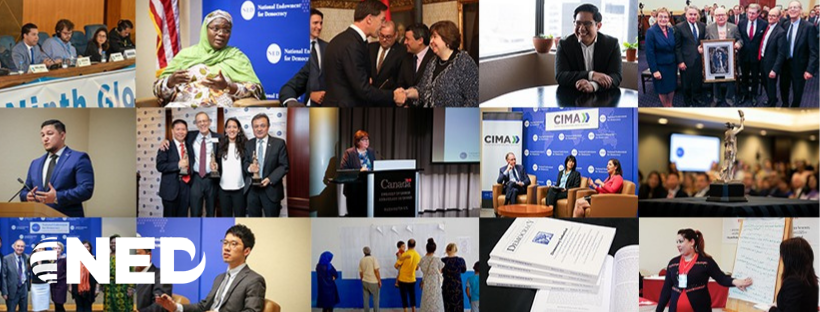
Various programs, meetings, and publications of the National Endowment for Democracy (NED). Photo: facebook.com.
By Jeremy Kuzmarov – Aug 26, 2026
The National Endowment for Democracy (NED) is a CIA off-shoot that was founded in 1983 with the purpose of advancing political propaganda and U.S. regime-change operations.
The NED routinely supports dissidents and highlights human rights abuses occurring in countries that are geopolitical rivals of the U.S., like China, Iran and Russia, or socialist countries that have tried to assert control over their natural resources, like Cuba, Venezuela and North Korea.
Meanwhile, the NED is silent about the human rights abuses that occur in countries like Ukraine, Israel, Bangladesh, Kenya, Rwanda, Syria or others whose governments are supported or have been installed by the U.S.
Many of the dissidents that the NED honors advocate for sanctions, bombing and war on their own countries. Some were even indicted for inciting insurrection or terrorist acts.
The NED’s function as a front for CIA covert operations was apparent in February when NED President Damon Wilson—who was invited to give the 2026 commencement address at the University of Maryland School of Public Policy—bragged to a House committee about the NED’s aggressive efforts to spark unrest in Iran, including by smuggling Starlink terminals (a satellite technology to ensure secure communication) and fashioning anti-Iran narratives for the media.
Before he could finish the sentence, Wilson was cut off by the ranking member of the House Appropriations Subcommittee on State, Foreign Operations, and Related Programs, Lois Frankel (D-FL), who told Wilson: “You know what, I’m going to interrupt you—we’d better not talk about it.”
In the same congressional hearing, Wilson appeared to take credit for the election of a right-wing government in Bolivia to “prevent lithium from falling under Moscow’s control” and revealed that NED is funding and training media in Nicaragua with an eye toward undermining the country’s socialist-oriented Sandinista government.[1]
Continuing the long history of intimate ties between the CIA and academia[2], many students at prestigious universities, sadly, will be taught by professors this academic year who are affiliated with the NED.
Stanford’s Freeman Spogli Institute for International Studies (FSI) has on its faculty, for example, Larry Diamond, the editor of the NED’s in-house Journal of Democracy, who was also a former senior adviser to the Coalition Provisional Authority (CPA) in Iraq, and Francis Fukuyama, a neo-conservative ideologue and former State Department staffer who was on the NED’s Board, edited and frequently contributed to the NED journal and received the NED’s 2010 Democracy Service Medal.
At least seven additional faculty who teach at FSI are, or have been, affiliated with the NED,[3] including Condoleezza Rice, the Secretary of State during the Iraq War who served on the Journal of Democracy’s editorial board,[4] and Michael McFaul, former U.S. Ambassador to Russia who currently sits on the Journal of Democracy’s editorial board. Like Rice, McFaul is known for his hard-line positions towards Russia and has advocated for the censorship of anyone who questions U.S. military and economic aid to Ukraine.[5]
In 2025, Stanford’s Walter H. Shorenstein Asia-Pacific Research Center gave an award to NED-backed media outlet Netra News, a media outlet that helped advance a regime-change operation in Bangladesh that ousted a leader who had established strong relations with China and resisted U.S. efforts to establish a military base on a strategic island off its coast.
Stanford’s ties to the NED, unfortunately, are no anomaly in higher education today. A review of the NED’s current Board of Directors finds that three are deans at elite universities:
a) Amaney Jamal of Princeton’s School of Public and International Affairs; b) Alyssa Ayres, Elliott School of International Affairs at George Washington (one of her predecessors in that position, Harry Harding, was on the editorial board of the Journal of Democracy in the 1990s); and c) Scott Taylor at the Frederick S. Pardee School of Global Studies at Boston University, which has a history of employing CIA agents as professors.[6]
Two NED Board members are also professors: Victor Cha, Georgetown University, and Minxin Pei, the Pritzker Professor of Government at Claremont McKenna College.
Additionally, Elizabeth Economy is a senior fellow and co-chair of the Program on the U.S., China, and the World at the Hoover Institution at Stanford[7] and, until May 2026, was on the Board of Managers at Swarthmore College.[8]
NED Board member Victoria Nuland, a key figure in the 2014 U.S. backed Maidan coup in Ukraine that empowered far-right extremists and led to a deadly war with Russia, was appointed in March 2024 as a Professor of Practice of International and Public Affairs at Columbia University’s Harriman Institute of Russian, Eastern Eurasian and Eastern European Studies.[9] Covert Geopolitics called Nuland the “Lady Macbeth of perpetual war,” who “promoted a foreign policy of intervention, coups, proxy wars, aggression, and occupation…in Afghanistan, Iraq, Libya, Syria, and Ukraine.”
A review of the scholarship of past and present NED Board member faculty shows that it dovetails with the worldview and agenda of the NED, presenting biased analysis that demonizes American geopolitical adversaries and offers support for capitalist and imperialist policies.
Minxin Pei,[10] for example, spotlights crony capitalism, political autocracy and alleged totalitarianism in China, while Scott Taylor emphasizes the importance of big business and private sector investment in Africa.[11]
Director of Asian affairs at the National Security Council (NSC) under George W. Bush, Victor Cha is a hawk on North Korea whom the former Foreign Minister of South Korea accused of advancing a “simplistic history” of the Korean conflict that demonized North Korea.[12]
Alyssa Ayres worked for the CIA-linked Asia Foundation and McLarty & Associates and served as Deputy Assistant Secretary of State for South and Central Asian Affairs; while Amaney Jamal is a protégé of CIA-linked Harvard professor Samuel P. Huntington, an arch-conservative and imperialist targeted by student protesters during the Vietnam era who lectured frequently under the NED’s aegis in the 1990s and wrote for The Journal of Democracy.[13]
Elizabeth Economy fits in well with the NED professors in advancing anti-China themes in her writings, and in supporting a U.S. military buildup in the Asia Pacific and the Trans-Pacific Partnership (TPP), a corporate-friendly free trade agreement introduced as a pillar of Obama’s “pivot to Asia” policy that excluded China and intended to isolate it economically.
Andrew J. Nathan is a former NED Board member and member of the editorial board of the NED’s journal, who is the Class of 1919 Professor of Political Science at Columbia University.
He is the former chair and current board member of Human Rights in China, an NED funded group that uses human rights as a political weapon against China (causing China to sanction it), and, with Larry Diamond, a member of the board of the Hong Kong Democracy Council, which supported a U.S.-backed color revolution against China in Hong Kong.
An article that Nathan wrote for the Journal of Democracy characteristically examined China’s supposedly deleterious effect on democracy around the world and manipulative nature of its global propaganda effort.
Founded in 1990, the NED’s Journal of Democracy[14] generally advances the NED/State Department line on global affairs.
Obscuring the aggressive U.S. drive to control natural resources and expand its network of military bases, its articles routinely vilify left-wing governments and celebrate U.S. regime-change operations for their democratizing potential and governments that were empowered by them.
A February 2026 article, “Venezuela’s Best Chance for Democracy” characteristically made it seem like the Trump administration’s kidnapping of Venezuelan President Nicolás Maduro—in a brazenly illegal act that killed more than 100 people—brought new hope for Venezuela’s democratization.[15] A previous Journal of Democracy article written by Javier Corrales, Dwight W. Morrow 1895 Professor of Political Science at Amherst College,[16] and Dorothy Kronick, assistant professor at the Goldman School of Public Policy at the University of California, Berkeley,[17] aims to affirm CIA/NED/State Department talking points that Maduro stole Venezuela’s 2024 election and that Edmundo González, whose CIA links and extreme right-wing background is not discussed in the article, won in a landslide, which does not appear to be true.[18]
Advancing a cartoonish view of world affairs, the Journal of Democracy makes it seem like the world is divided between good U.S. backed democrats and bad authoritarians—as American Cold Warriors saw things in the 1950s McCarthy era. The sanctions and covert warfare that the U.S. adopts are rarely if ever discussed or blamed for causing hardships in targeted countries whose problems are solely blamed on their own leaders.[19]
Most of the articles are rooted in an ethno-centric, “end of history” worldview,[20] which assumes that U.S. and other Western governments are morally superior and that countries that adopt different political systems that draw on their own traditions and are designed to overcome the legacies of Western colonialism and neo-colonialism will only show progress if they become more like the U.S.[21]
The two editors of the Journal of Democracy are: Harvard Professor of Government Steven Levitsky, and University of Toronto[22] political scientist Lucan Way, who holds the title of distinguished professor of Democracy ironically enough.
In 2022, Levitsky and Way co-authored a book called Revolution & Dictatorship: The Violent Origins of Durable Authoritarianism (Princeton University Press), which analyzes countries that fall into the crosshairs of U.S. foreign policy like Cuba, China, Vietnam, Iran and Soviet Russia. Echoing their depiction by the U.S. State Department and CIA, the revolutions that took root there are presented negatively, with little attention to their success in overcoming colonialism and neo-colonialism, in fueling industrialization and in combating poverty, advancing women’s rights and improving living standards.
Levitsky and Way also fail to adequately address how U.S. counter-revolutionary policies and subversion helped facilitate more authoritarian methods and how the durability of the regimes that they analyze was in part linked to the establishment of local governing councils and community projects that enhanced citizen political engagement at a time this was markedly declining in perceived model Western democracies.[23]
In a piece centered on Latin America, Levitsky characterized Cuba, Venezuela and Nicaragua as authoritarian states, though the latter two countries had elections that were internationally sanctioned and these were countries that adopted leftist policies designed to redistribute wealth and to establish control over their natural resources.
For his part, Lucan Way promotes the right-wing theory that, “when economic resources are concentrated in the hands of the state, autocracy becomes more likely”—an argument favored by U.S. corporations which do not want their assets nationalized.[24]
Way’s extreme views were apparent in his condemnation of Barack Obama and Angela Merkel for an allegedly “soft response to Russia’s 2014 invasion” of Ukraine that, Way says, “paved the way to the current horror in Ukraine.”
A big problem with this statement is that Russia did not invade Ukraine in 2014, rather, Obama and Merkel supported what the private intelligence agency Stratfor called a coup in Ukraine at that time. The latter eventually precipitated Russian intervention in eastern Ukraine to assist the beleaguered people there who were subjected to violent Ukrainian government attacks carried out with U.S weapons that Way fervently supported.[25]
Way claims that the Ukraine war has given Western democracies a “renewed sense of unity” and holds the potential for weakening the emerging “authoritarian international”—which somehow does not include Ukraine when its government banned 17 parties, killed its opponents, censored the press and held an estimated 20,000 political prisoners. [26]
Adopting the language of the new McCarthyism, Way wrote on X that Pope Francis was a “Russian stooge.” Way happens to be best friends with Chrystia Freeland, Canada’s former Deputy Prime Minister, who is the granddaughter of a Ukrainian Nazi and helped get Canada to become a major weapons supplier to Ukraine.
Amazingly, for someone who claims to champion democracy, Way co-wrote an article in May 2024 in the Journal of Democracy entitled “Why Ukraine’s Elections Can Wait.”[27] Four years earlier, Way wrote an article in the same journal praising a color revolution in Belarus whose support from the NED and other U.S. government agencies he predictably failed to mention.
[…]


Pingback: Large Faculty Numbers at Elite Universities Linked to NED, CIA Cutout Specializing in Propaganda | Worldtruth