
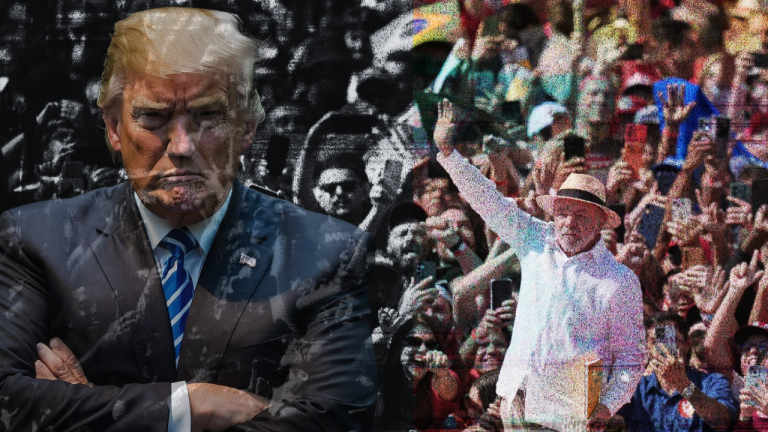
(MintPress News) The United States is interfering in the Brazilian presidential elections, pressuring the Brazilian electorate into voting for right-wing candidate Flavio Bolsonaro, the son of disgraced former president, Jair Bolsonaro. If that does not work and President Lula da Silva secures a fourth term in office, the groundwork is already being laid for a potential military intervention. From sanctions and economic warfare, to coaching influencers and journalists on how best to attack the left-wing government, the Trump administration is doing everything it can to overthrow Lula.
Meanwhile, the State Department’s recent decision to designate Brazilian gangs as “foreign terrorist organizations” just as it did with Venezuela’s Tren de Aragua, signals a willingness to intervene militarily.
Brazil is Trump’s next target, and builds upon recent U.S. and Israeli interference in May’s Colombian elections, where pro-Trump candidate Abelardo de la Espriella won a razor-thin victory.
MintPress examines the Trump administration’s attempts to undermine Brazilian democracy and install another Bolsonaro back into power.
A Thumb on The Scale
Brazil’s October elections are rapidly approaching, and while thirteen people are standing for president, two principal candidates have already emerged: current left-of-center president Lula da Silva, and far-right challenger, Flavio Bolsonaro. Flavio is the son of disgraced former president, Jair (sentenced to 27 years in prison for leading a January 6th-inspired coup attempt), and the brother of Eduardo (convicted in absentia for lobbying the United States to intervene in his father’s trial).
It is obvious which candidate Washington prefers. The Bolsonaro’s are politically, ideologically, and personally very close to the MAGA movement, and Flavio has already promised that, if elected, his country will become one of the U.S.’ closest allies.
Lula currently holds a double-digit lead on Bolsonaro (40% to 28%, with no other candidate holding more than 10% of the public’s voting intentions). But Brazilian politics can change very quickly; in 2018, Lula held a 20-point lead over Jair Bolsonaro when the Brazilian Supreme Court blocked him from running. He was imprisoned on bogus charges in a case orchestrated by the U.S. government, leaving the path clear for Bolsonaro’s victory.
Lula has sounded the alarm that Brazilian democracy is once again under threat from Washington. “As far as I’m concerned, [Trump] can continue liking Bolsonaro, the father, the son, the grandson… There is no problem with that. It’s his problem. There’s no accounting for taste,” he said. “Now, don’t meddle in the Brazilian elections, because the Brazilian elections are a Brazilian problem, just as American elections are their business, not mine,” he added: “All I want is the same respect for Brazil that I have for the United States. That’s it.”
Washington, however, has other ideas. On May 26, Flavio Bolsonaro traveled to Washington to meet with Trump, Vice President J.D. Vance, and Secretary of State Marco Rubio to sell them on the concept of military intervention in Brazil. Two days later, the U.S. State Department designated two Brazilian gangs, Comando Vermelho and Primeiro Comando da Capital, as “Specially Designated Global Terrorists” and “Foreign Terrorist Organizations, a decision that Brian Mier, an American journalist who moved to Brazil in 1991 and is now Brazil correspondent for TeleSur English, described as “a preemptive move to possibly invade if Lula wins reelection.”
In 2025, the State Department did the same with Venezuelan gang, Tren de Aragua. Just months later, the U.S. carried out an operation to kidnap President Nicolás Maduro, decapitating the Venezuelan government.
Free Speech or Hate Speech?
Mier noted that the United States government is also actively coaching Brazilian influencers in methods and techniques to best attack Lula and the government. Earlier this year, it was revealed that the U.S. Consulate in São Paulo held a series of workshops with selected prominent right-wing figures.
One of these is influencer Maria Fernanda Schmidt, who confirmed the validity of the reporting by posting a set of pictures of the event on her Instagram. “It was an excellent opportunity to share with diplomats the challenges faced by influencers, journalists, and content producers in the digital environment, in an enriching dialogue about the direction of freedom of expression in Brazil,” she wrote.
The U.S. Consulate has also arranged for visas and trips to the United States for local journalists. The objective was to entice them into attacking Lula and promoting Bolsonaro’s candidacy by promoting the U.S.-backed line that freedom of speech and freedom of expression is under attack in Brazil, thanks to Lula’s government.
This idea is based largely on a 2024 spat between Brazilian authorities and U.S. billionaire Elon Musk. Musk refused to comply with a Brazilian court order to delete far-right accounts on Twitter (now officially called X) that broke the country’s hate speech and misinformation laws. Musk, a champion of far-right politics himself, and someone who has openly used his platforms to promote regime change around the world, refused to do so, leading to X’s temporary shutdown across Brazil.
“Powerful actors in the Trump administration and Republican Party as well as Silicon Valley tech allies and pundits who make up part of the integral U.S. state (Steve Bannon, Elon Musk, Peter Thiel, Michael Shellenberger, etc.) have been working closely with the Bolsonaro family since Jair Bolsonaro first ran for President in 2018,” Mier told MintPress.
Its no secret that the Brazilian right-wing are deeply influenced by the MAGA movement. Indeed, Brazil even had its own January 6 moment – on January 8, 2023. After he lost the 2022 presidential election to Lula, Flavio’s father, Jair Bolsonaro took to the airwaves denouncing the result, claiming irregularities, and calling for an insurrection. Thousands of people marched on the streets in Brasília, rioting and calling for the military to intervene.
Like the United States’ January 6, the rioters were unsuccessful. But unlike in America, Bolsonaro was held to account for his coup attempt, and was sentenced in 2025 to 27 years in prison.
There is little doubt of his guilt. During his trial, Bolsonaro admitted that he met with top Brazilian generals to discus how to hold onto power, even after losing the election.
Trump, however, was incensed by the decision. “The way that Brazil has treated former President Bolsonaro, a Highly Respected Leader throughout the World during his Term, including by the United States, is an international disgrace,” he said, demanding the immediate end of the trial. Trump placed punishing economic sanctions on Brazil, and against the country’s Supreme Court Justice, Alexandre de Moraes.
This decision was likely influenced by Jair’s son and Flavio’s brother, Eduardo, who heavily lobbied the Trump administration on his father’s behalf, demanding his country be sanctioned. Brazil considered this an attempt to pervert the course of justice, and sentenced Eduardo to four years in prison in absentia. He currently lives in a mansion in Texas and cannot return to his homeland. There, he plays a similar role to what Maria Corina Machado did in Venezuela, lobbying the U.S. to militarily intervene in his country to put his family back in power. In October, he publicly called for the U.S. military to bomb Rio de Janeiro under the guise of fighting drug trafficking.
Trump also commented on Eduardo’s trial, although he appeared to believe Eduardo is his sibling, Flavio.“ I hear they arrested somebody that’s running for office today,” Trump said in June. “ I heard that they arrested the Bolsonaro junior, who was doing well in the polls.” In fact, it is Flavio Bolsonaro who is running for president.
Economic and Diplomatic Warfare
If elected, Flavio has promised the United States considerable influence inside the country, offering the Trump administration control over his transition team. This would mean, according to some, that U.S. officials would take considerable power over of Brazil’s economy and society, in a not too dissimilar way in which they controlled Iraq.
The upcoming elections between Lula and Flavio Bolsonaro are also taking place in a context in which the United States is actively trying to crash the Brazilian economy, in order to sink Lula’s chances. The United States has placed sweeping 40-50% tariffs on Brazilian goods, with more in the pipeline. These measures were quite different to the generalized tariffs placed on much of the world last year. For one, the U.S. actually maintains a healthy trade surplus with Brazil, unlike most other countries. Secondly, in his executive order, Trump explicitly stated that (emphasis added):
“Should the government of Brazil take significant steps to address the national emergency declared in this order and align sufficiently with the United States on national security, economic and foreign policy matters described in this order, I may further modify this order.”
The clear implication of this statement is that Brazil is being punished for being insufficiently loyal to Washington.
Diplomatic ties worsened earlier this month, after the United States revoked the visa of Brazilian Ambassador, Maria Luiza Ribeiro Viotti, forcing her to return home. That same day, Brazil had instructed the Argentinian ambassador to leave the country.
“The Trump administration has been closely working with [Argentinian president] Javier Milei to delegitimize left parties, leaders, and administrations across Latin America,” Mier said, noting that Milei had traveled to São Paulo in July to attend the far-right Liberal Party’s national convention, where Flavio Bolsonaro was officially chosen as the party’s presidential candidate. Milei has been extremely vocal about his wish to see Lula’s demise, attending Bolsonaro rallies and calling Lula “corrupt,” a “thief” and a “convict.”
“A Gift From the CIA”
Milei’s use of the word convict refers to Operation Car Wash, a U.S.-backed scheme that saw Lula imprisoned on corruption charges. Lula had been leading Jair Bolsonaro by over 20 points in the polls for the 2018 general election, but was incarcerated and forbidden from running for office, even from his prison cell.
The prosecution worked closely with Washington to ensure Lula remained behind bars and unable to contest the election, paving the way for Bolsonaro’s rise. Bolsonaro later appointed Sergio Moro, the judge that sent Lula to prison, as his justice minister.
[…]


It’s almost laughable but for the tragedy of it all. The CIA got Lula put in jail and promoted hard man Jair Bolsonaro, only to then get Lula released when Jair turned on the US, their thinking being that Lula would be easier to control and now they have to find a way to put Lula back in jail so the corrupt fanatical Flavio can do their bidding.
I don’t think Trump is actually that demented enough to start a war again Brazil, but with his delusions and ego – who knows?
LikeLike
I’m starting to think it’s one of Trump’s advisors who’s actually controlling US foreign policy. I don’t think Trump has the mental capacity to think about more that one country at the time.
LikeLike