
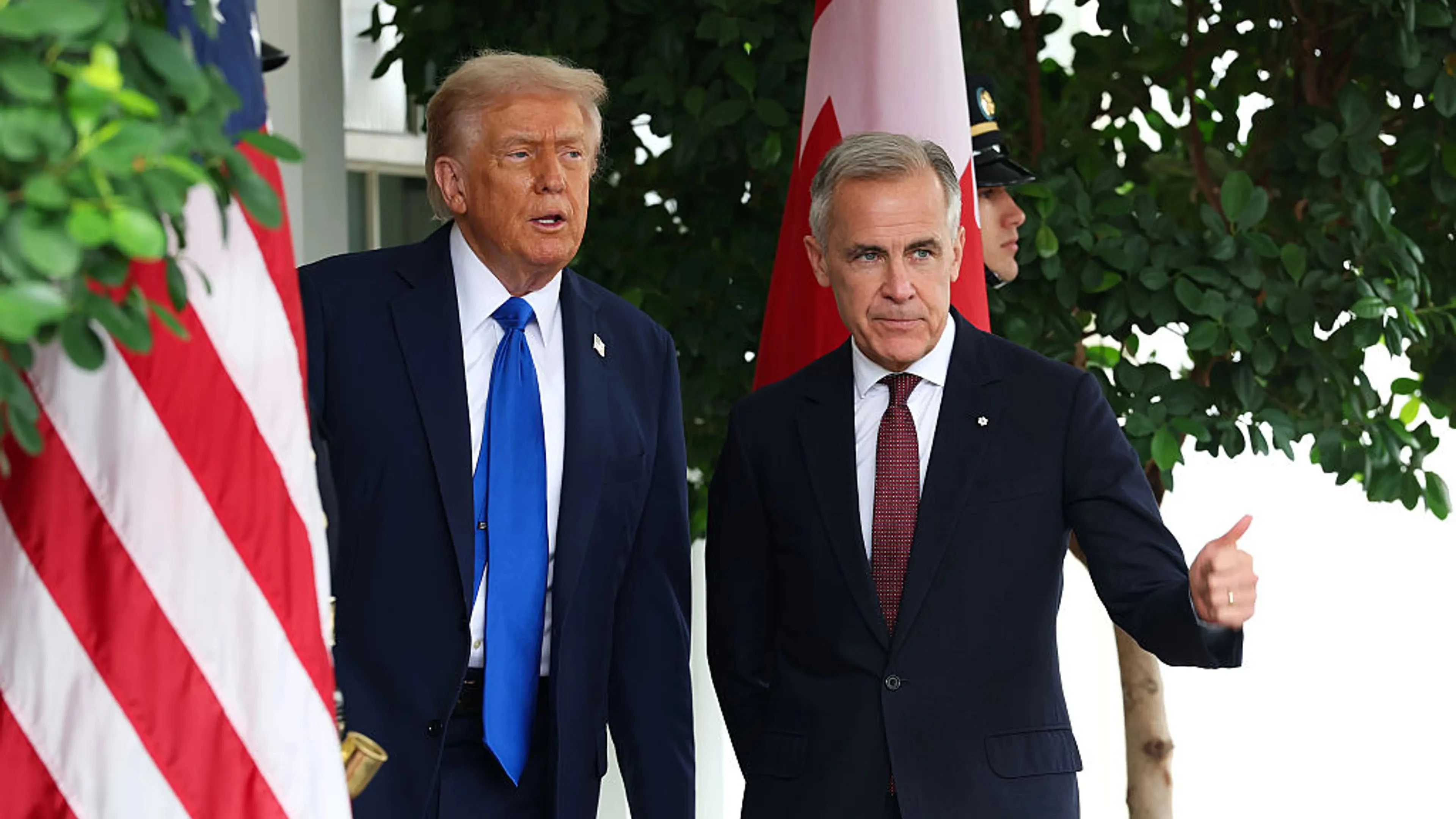
 (Photo credit: Anna Moneymaker/Getty Images)
The Cradle
AUG 22, 2026
The US has imposed a 50 percent tariff on $20 billion worth of Canadian goods, after last-minute trade talks between Washington and Ottawa fell apart late on 21 August.
The two sides had been close to a deal earlier this week, with Canadian Prime Minister Mark Carney congratulating negotiators on making “significant progress” in the trade talks.
According to US Trade Representative Jamieson Greer, the US was offering Canada the “best treatment” of any major US trading partner.
However, the talks fell apart Friday evening when Carney sent a last-minute email rejecting the deal.
Carney blamed last-minute changes by the US side, which he called “unfair” and “uneconomic,” and vowed to impose dollar-for-dollar retaliatory tariffs on US goods.
According to the Wall Street Journal (WSJ), the collapse of the negotiations risks “escalation into an all-out trade war.”
The 50 percent tariffs, which apply to about 5 percent of Canada’s exports to the US, took effect just after midnight Saturday morning.
US President Donald Trump first threatened to impose tariffs last month in an effort to persuade Canada to reverse bans on imports of US-produced alcoholic beverages, lift restrictions on imports of US dairy products, and reduce tariffs and quotas on certain US-made automobiles.
Many of those restrictions and tariffs were first imposed by Canada in response to US tariffs of up to 50 percent on Canadian automobiles, steel, aluminum, and forest products.
The US-Canada relationship has deteriorated since Trump was elected to a second term in 2024. Trump has publicly mocked Canadian leaders and suggested making Canada the “51st state.”
Last month, Trump blamed Carney for smoke from Canadian wildfires that “invaded” the US.
“[The] cost of this pollution must of necessity be added to the TARIFFS Canada is currently paying,” the US president wrote on Truth Social.
Trump has also criticized Canada’s growing trade relationship with China.
The new 50 percent tariff on Canadian goods is likely to be challenged in US courts because it relies on a “novel interpretation” of a federal emergency law that no previous president has used, according to the WSJ.
Earlier tariffs imposed by Trump on other nations were struck down in the US courts, forcing the federal government to issue refunds to US importers.
The tariff refunds sparked controversy after reports emerged that the family of Trump’s Commerce Secretary, Howard Lutnick, stood to make millions following the court’s decision to issue refunds.
While Lutnick was publicly advocating for new US tariffs, Cantor Fitzgerald, a Wall Street investment firm formerly run by Lutnick and now run by his two sons, reportedly spent $10 million to buy importers’ rights to future tariff refunds, paying roughly 20 to 30 cents for every $1 of potential refund.
Documents seen by Wired suggested that Cantor Fitzgerald had the “capacity to buy the rights to hundreds of millions of dollars in potential refunds from companies who have paid Trump’s tariffs.”
[,,,]


Trump is a lunatic and wherever there is a scam involving money, there are the zionists waiting with their hands out and their victim cards at the ready!! The orange toddler is always yapping about Canada becoming the 51st state of the JooSA, but the JooSA is actually the 1st state of Israel!!
LikeLike
I think Canada’s biggest problem is a 2 century conspiracy by the Bank of England and Wall Street to prevent Canada from fully industrializing. If you look at a map of Canada, the vast majority of its big cities and major industries are within 100 miles of the US border.
LikeLiked by 1 person