
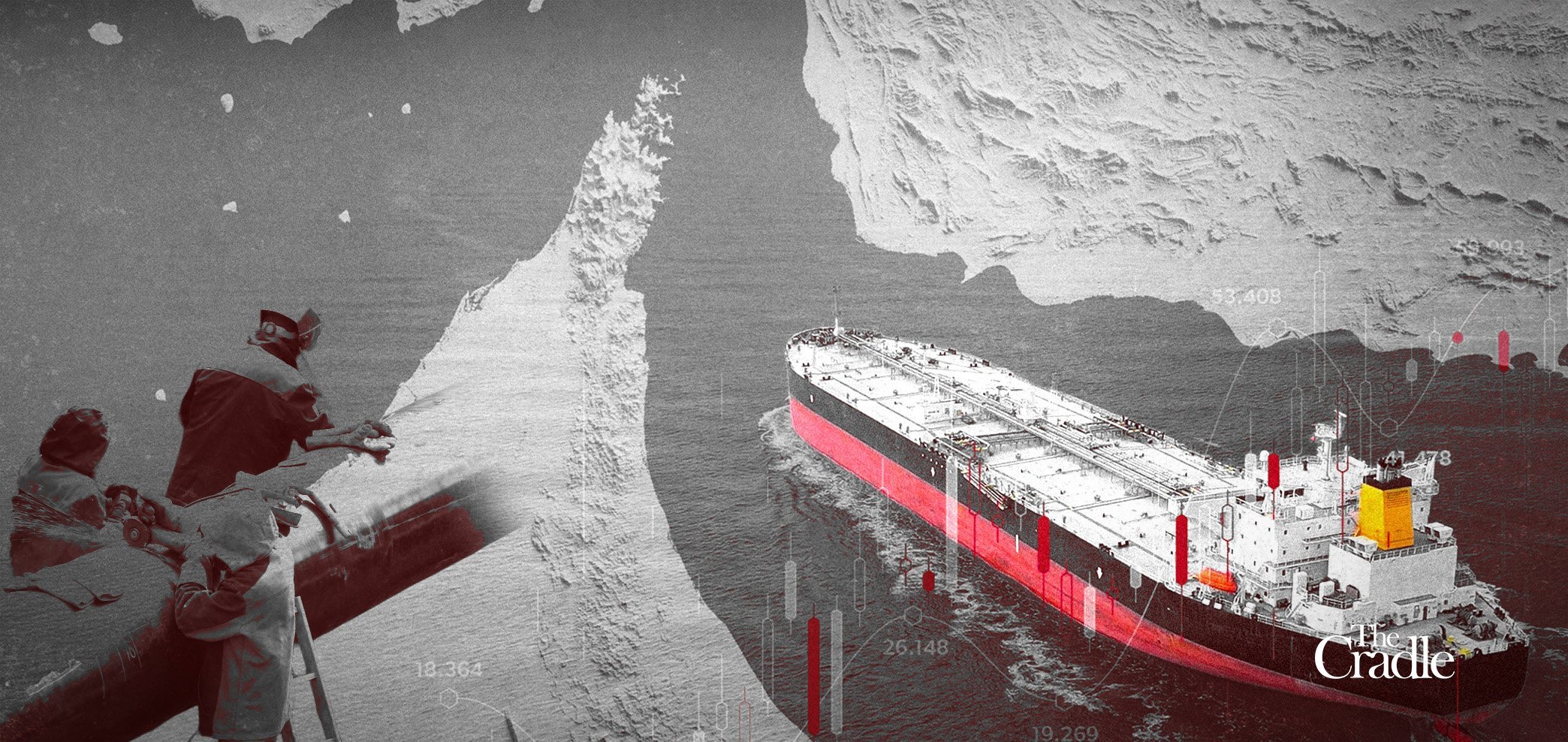
 Photo Credit: The Cradle
JUL 23, 2026
The rush to bypass Hormuz leads back to the same problem: Every alternative route remains hostage to war, rival chokepoints, or political disputes.
“The only alternative to the Strait of Hormuz is the Strait of Hormuz.”
This blunt assessment, offered by an Iraqi expert in a recent interview, captures the central weakness in the rush to revive old pipeline schemes and promote new ones across West Asia. Since Iran effectively closed the Strait of Hormuz after Israel and the US launched their second war against it in February 2026, the region has been flooded with proposals for alternative oil-export routes.
Washington has encouraged these plans, while several governments have presented dormant or unfinished pipelines as strategic solutions. Yet the closer one looks at geography, markets, costs, capacity, and security, the clearer it becomes that most of these projects cannot substitute for Hormuz.
Even if oil bypasses the strait, it still faces the rival chokepoint of Bab al-Mandab, where the Ansarallah-aligned armed forces have declared a maritime blockade against Saudi Arabia and attacked Saudi tankers.
These expensive detours will remain exposed unless security in the Persian Gulf itself improves. Until the war on Iran ends and an inclusive regional security architecture is established, Iranian and Yemeni missiles and drones can reach the pipelines and loading terminals built to evade them.
Asia still runs through Hormuz
The first reason is straightforward. The Strait of Hormuz is the natural outlet of the Gulf energy system. In 2024, oil flows through the strait averaged about 20 million barrels per day (bpd), roughly one-fifth of global petroleum liquids consumption. The International Energy Agency (IEA) describes it as one of the world’s most important oil transit chokepoints.
Most of this oil is not heading west. About 80 percent of the oil moving through Hormuz is destined for Asia, with China, India, Japan, South Korea, and other Asian economies as the principal buyers. The pattern is even clearer for liquefied natural gas (LNG).
The US Energy Information Administration estimated that 83 percent of LNG moving through Hormuz in 2024 went from Persian Gulf exporters to Asian markets, especially China, India, and South Korea.
This market reality matters because many proposed alternatives send oil away from its main customers. Pipelines to the Mediterranean, the Red Sea, or the Levant may appear useful on a map, but they often move Gulf crude farther from Asia rather than closer to it.
Commercially, building multibillion-dollar infrastructure to move oil westward, only to redirect it by sea toward Asian markets, is inefficient. If Hormuz is open, the direct route remains cheaper and faster. If it is closed by war, the underlying problem is not a lack of pipelines but the collapse of regional security.
Old routes, unresolved disputes
The older pipeline options illustrate the point. The Kirkuk–Baniyas pipeline once carried Iraqi oil across Syria to the Mediterranean. Built in the early 1950s, it had genuine strategic value in its time but has been largely inactive since it was damaged during the 2003 US-led invasion of Iraq. Washington is now backing efforts to revive the route, with US companies expected to play a role. Yet the project still requires extensive reconstruction and years of work before it can provide meaningful export capacity.
Estimates for a full restoration and expansion to around 700,000 bpd run as high as $8 billion. It cannot answer an immediate crisis in Hormuz, and if regional peace is restored before completion, the commercial case for reviving it weakens sharply.
The Iraq–Turkiye pipeline faces a different but equally serious problem: politics. The route through the Kurdistan region to Turkiye’s Mediterranean port of Ceyhan was repeatedly interrupted by disputes among Baghdad, the Kurdistan Regional Government (KRG), Ankara, and international oil companies.
A 2023 arbitration ruling against Turkiye over unauthorized Kurdish exports led to a two-and-a-half-year shutdown. Flows resumed in September 2025, and exports have continued, but the route still depends on fragile agreements over contracts, payments, federal authority, and revenue sharing.
Its limited throughput and political vulnerability prevent it from becoming a structural replacement for a maritime passage that normally carries a vast share of the world’s seaborne oil.
The Iraqi pipeline in Saudi Arabia, known as IPSA, is another example of strategic nostalgia. Built in the 1980s during the Iran–Iraq war, it was designed to move Iraqi crude from the Basra region to the Red Sea.
It stopped operating after Iraq’s 1990 invasion of Kuwait, and Saudi Arabia expropriated it in 2001. Reopening the line would therefore require a Saudi–Iraqi political settlement over ownership and control, as well as a major technical assessment after decades of disuse. In other words, IPSA is not an available alternative; it is a diplomatic and engineering problem dressed up as a solution.
The proposed Basra–Aqaba pipeline is even more controversial. Its advertised purpose is to move Iraqi oil from southern Iraq to Jordan’s Red Sea port of Aqaba, bypassing Hormuz. Yet it has faced intense objections inside Iraq because of its projected cost, uncertain financing, and questionable strategic value.
Since much of Iraq’s crude is sold to Asian customers, sending it westward to Aqaba would add distance and complexity rather than solve the basic market problem. The pipeline would also move Iraqi exports closer to another zone of instability, including the Israeli military sphere and the wider Red Sea security environment.
A bypass route that merely exchanges one security risk for another is no solution. Iraq’s severe fiscal pressures also leave Baghdad poorly placed to finance such an expensive project, while international investors are unlikely to embrace it without strong political and security guarantees.
Bypasses within missile range
The existing Saudi and Emirati bypasses are more credible but still limited. Saudi Arabia’s East–West Pipeline, or Petroline, moves crude from the eastern oil region to Yanbu on the Red Sea. The UAE’s Abu Dhabi Crude Oil Pipeline carries oil from Habshan to Fujairah on the Gulf of Oman.
These systems reduce exposure to Hormuz for Saudi Arabia and the UAE and have become important national energy-security assets. But they cannot replace the strait for the region as a whole. They offer little to Kuwait, Qatar, Bahrain, Iran, or most Iraqi exports, and they do not solve the LNG problem, especially Qatar’s dependence on Hormuz.
The IEA estimates that only 3.5 to 5.5 million bpd of spare pipeline capacity is available to bypass the strait. Neither Yanbu nor Fujairah are immune from attack; regional conflict has already shown the vulnerability of ports, tankers, and energy infrastructure.
The crisis pipelines cannot solve
This is why the alternative pipeline debate is misleading. It treats the closure of Hormuz as a logistical puzzle when it is primarily a political and security crisis. If the Persian Gulf remains militarized and unstable, no pipeline network can fully protect exports.
Pipelines cross vulnerable territory, depend on political agreements, and terminate at ports that can also be threatened. If Gulf security improves, however, Hormuz will almost certainly reopen because this serves the interests of producers and Asian consumers alike.
Once that happens, the commercial rationale for many alternative pipelines will fade. Why spend tens of billions of dollars duplicating a natural route with unmatched capacity and direct access to the main buyers?
The more honest conclusion is that alternative pipelines may offer limited resilience for individual states, but they are no strategic replacement for Hormuz. They are costly, slow, politically fragile, geographically inefficient, and in some cases obsolete before construction begins.
The answer to the crisis is a security arrangement that keeps the Persian Gulf open, prevents attacks on shipping, and restores normal trade through the strait.
Under such an arrangement, oil and LNG would continue to flow mainly to Asia by the most direct and economical route. Hormuz will remain indispensable, while the grand pipeline alternatives amount to expensive insurance policies against a crisis that only diplomacy and regional peace can resolve.
[…]
Via https://thecradle.co/articles/no-route-around-hormuz-why-west-asias-pipeline-alternatives-fall-short

