
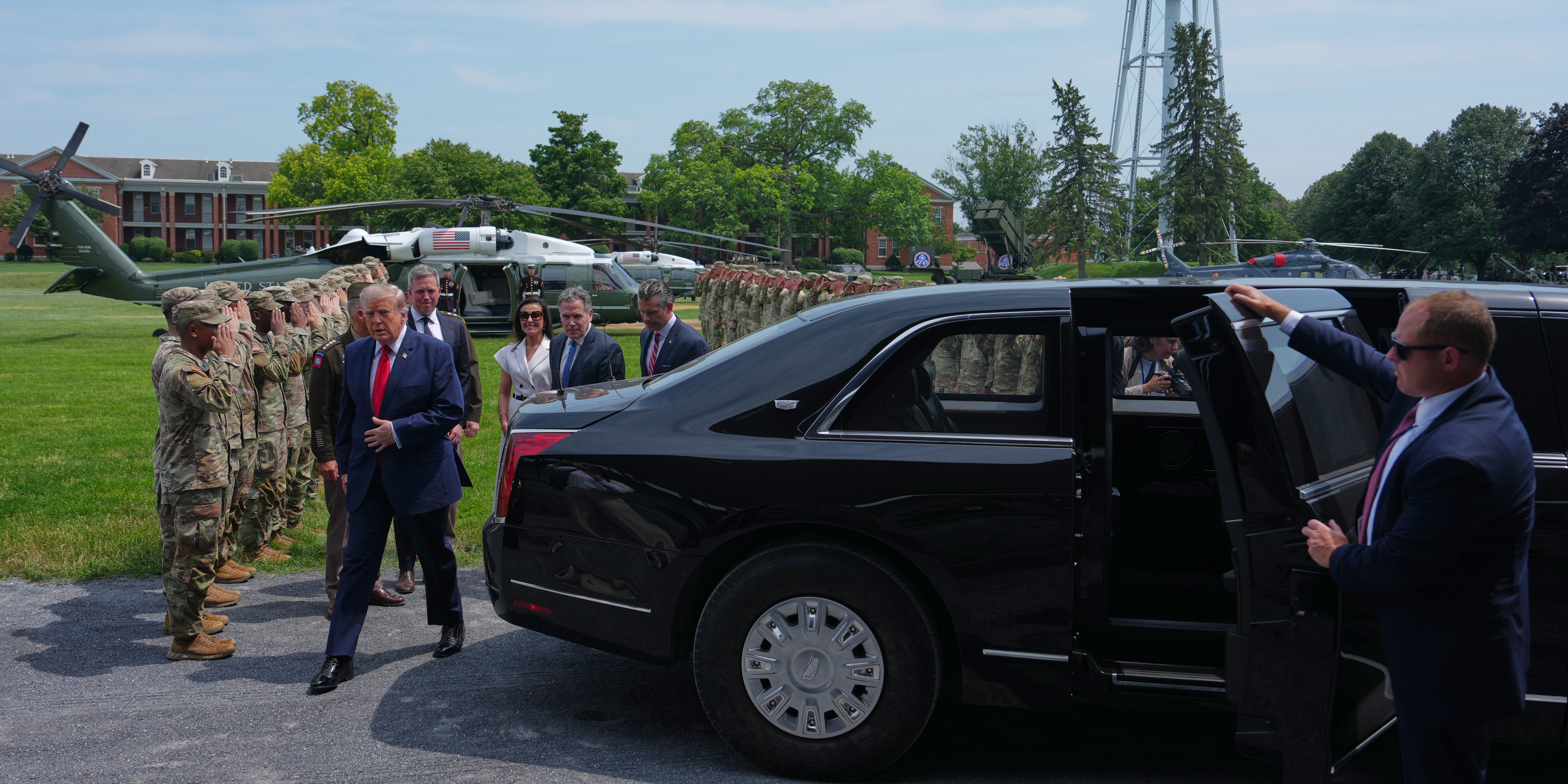
President Donald Trump walks with Army Secretary Dan Driscoll, Sen. Dave McCormick, R-Pa., and Defense Secretary Pete Hegseth as he arrives at the United States Army War College in Carlisle, Pa., for the Pennsylvania Defense and Innovation Summit, Wednesday, July 15, 2026. Photo: Julia Demaree Nikhinson/AP
The Intercept
U.S. casualties of the Iran war spiked even as U.S. Central Command withheld information about Americans killed and injured from the public. It’s part of a long-running pattern of the Trump administration manipulating such data.
A crushing wave of attacks in Bahrain, Iraq, Jordan, and Kuwait left U.S. forces in “disarray,” causing significant damage to facilities, dozens of injuries, and the first troops killed in action since a June ceasefire collapsed, according to a U.S. official. Three Army soldiers were killed in “devastating” ballistic missile attacks on Muwaffaq Salti Air Base in Jordan, said the official whom The Intercept is not naming because they are not authorized to speak publicly.
Pvt. Isabella Gonzales, 19, of Carrollton, Texas, was killed in action on Friday. Lt. Tyler James Feehan, 25, of Ewa Beach, Hawaii, was killed on Saturday. The third soldier is provisionally listed as missing, but the official said that “unidentified remains” found after the attack were “certainly” those of the missing soldier. A second official confirmed this assessment. At least four and as many as 10 troops were also injured in the attacks in Jordan, according to the first official.
In northern Iraq, a U.S. service member was killed and another wounded on Saturday when ordnance from a downed Iranian drone exploded. CENTCOM claimed that the injuries occurred during a “controlled detonation” of the downed aircraft.
The surge in deaths and injuries raise the official U.S. casualty count to at least 446. U.S. casualties have increased by more than 15 percent since the first ceasefire between the U.S. and Iran was struck on April 8. The first official told The Intercept that recent attacks had wounded “far more” personnel than are reflected in the Pentagon’s current casualty count. They did not provide numbers but said “dozens” had received medical attention.
Neither CENTCOM nor the Pentagon replied to numerous requests by The Intercept for information on the casualties, nor would either address the effort to cover up U.S. losses.
Reporting by The Intercept previously found that the Pentagon’s official tally of dead and wounded personnel is a gross undercount, stemming from what one U.S. government official called a “casualty cover-up.” The Defense Casualty Analysis System, or DCAS, which tracks “deceased, wounded, ill or injured” service members for Congress and the president, is missing hundreds of dead and wounded personnel. The official tally was also previously adjusted downward by 15 casualties without explanation. For months, the Pentagon has ignored requests by The Intercept for comment or clarification.
On Monday, the New York Times reported that the Pentagon withheld information on “dozens of U.S. military injuries in Iran War.” Pentagon spokesperson Sean Parnell called the article “baseless and malicious.”
U.S. bases across the Middle East suffered “significant” damage over the last week, according to the official speaking on the condition of anonymity. That source said Iran had learned how to defeat U.S. air defense systems by overwhelming them using a mix of ballistic missiles and attack drones. They said multiple U.S. aircraft had also been damaged in the attacks. Videos circulating on social media showed the impact and aftermath of Friday’s missile strikes on Muwaffaq Salti Air Base.
“They’ve got some missiles. They’ve got some drones,” Trump said on Sunday of an Iranian military he has insisted, for months, had been annihilated. “We hit them very hard, again, tonight and we did that in honor of the probably three, probably three as opposed to two, great patriots.”
U.S. Central Command announced later on Sunday night that it had “successfully completed the ninth consecutive evening of strikes,” claiming that the “U.S. military is holding Iran accountable at the Commander in Chief’s direction.”
“Their sacrifice only stiffens our resolve.”
The office of self-styled War Secretary Pete Hegseth attempted to keep information about the new casualties under wraps. “We have nothing to provide beyond what is listed on the website,” a representative of Hegseth’s office told The Intercept late Friday night, without specifying which website, when questioned about U.S. casualties. Hours later, U.S. Central Command acknowledged “two U.S. service members in Jordan were killed in action” on Friday amid “Iranian ballistic missile and drone attacks.” The command also disclosed that four other troops “were medically evacuated to Jordanian hospitals,” an unspecified number of other troops were evaluated for injuries, and “one service member is currently missing in action.” CENTCOM later stripped “in action” from the announcement of the missing soldier but would not explain the reason to The Intercept.
“Godspeed, heroes,” Hegseth wrote on X. “Their sacrifice only stiffens our resolve.”
The spike in U.S. casualties over the last week followed the Pentagon quietly adding another fatality to its rolls earlier Monday. After Iran claimed to have killed three U.S. personnel in Kuwait last weekend, U.S. Central Command said last Sunday that there were “zero reports of U.S. service member deaths or injuries in the region.” But last Monday, the Pentagon’s official toll of injuries and deaths in the war quietly climbed upward.
After ignoring numerous requests for clarification, an official from Office of the Assistant to the Secretary of War for Public Affairs intimated the fatality added last week was Cmdr. Gabriel Edwards, the commanding officer of Helicopter Sea Combat Squadron (HSC) 5 who went missing almost two weeks prior, following his “helicopter’s emergency landing in the Arabian Sea.” But that official refused to confirm it.
Historically, there was little lag between a casualty occurring in the field and its inclusion in the DCAS system, according to two people who used to work on the official casualty tally.
Asked why it took a week after the search for Edwards ended to add him to the casualty rolls, the second official said a blend of incompetence and deliberate slow-walking of casualty data has slowed down the process of updating publicly available statistics.
For months, the Pentagon list of the names of the dead has also been missing Maj. Sorffly Davius, a signals and communication officer with the New York Army National Guard who was assigned to the headquarters of the 42nd Infantry Division and reportedly died of sudden illness while on duty in Camp Buehring, Kuwait, on March 6. Davius’s death was widely acknowledged even as it was excluded from the official count: Rep. Mike Lawler, R-N.Y., spoke about him during a memorial service that month, and Gen. Dan Caine, chair of the Joint Chiefs of Staff, recognized Davius while “honoring our fallen.”
Counting Davius and the “missing” soldier in Jordan, the U.S. has suffered 19 deaths during the Iran war. Parnell said on Monday that “casualty information is publicly available and regularly updated online on the Defense Casualty Analysis System for everyone, including the media, to review.” DCAS was, uncharacteristically, not updated as of Monday afternoon and instead offered outdated figures posted Friday morning.
While DCAS provides a running tally of “non-hostile” deaths — meaning those who died from accidents or by illness — it doesn’t include “non-hostile” injuries. The DCAS figures show that 68 Navy personnel have been wounded in action. Missing, however, are the more than 200 sailors treated for smoke inhalation or lacerations due to a March 12 fire that raged aboard the USS Gerald R. Ford. The aircraft carrier had been conducting round-the-clock flight operations to, in Caine’s words, “project combat power” in the Middle East.
The casualty numbers also don’t include a sailor who suffered a non-combat-related injury aboard the USS Abraham Lincoln as it was involved in “strike missions in support of Operation Epic Fury” on March 25.
On April 21, the number of wounded-in-action troops declined by 15 without public comment from the War Department. Despite repeated questions over three months, the Pentagon has not explained the disparity in its casualty count.
The Trump administration began undermining transparency surrounding U.S. military casualties almost a decade ago. Not long after Trump first took office in 2017, and following an uptick of violence in the conflict, the Pentagon stopped releasing immediate information about American combat deaths in Afghanistan.
After an Iranian missile attack on Al-Asad Air Base in Iraq on January 8, 2020, Trump peddled a complete fiction to the public. “No Americans were harmed in last night’s attack by the Iranian regime,” he said at the time. CENTCOM ultimately admitted that 110 troops suffered traumatic brain injuries. An inspector general report indicated that the number of wounded may have been even higher, because “DoD cannot determine whether all Service members are being properly diagnosed and treated for TBIs in deployed settings.”
[…]
Via https://theintercept.com/2026/07/20/united-states-iran-war-casualties-cover-up-pentagon/


Pingback: US soldiers wounded in Iranian strike say military medical care failed them | Worldtruth