
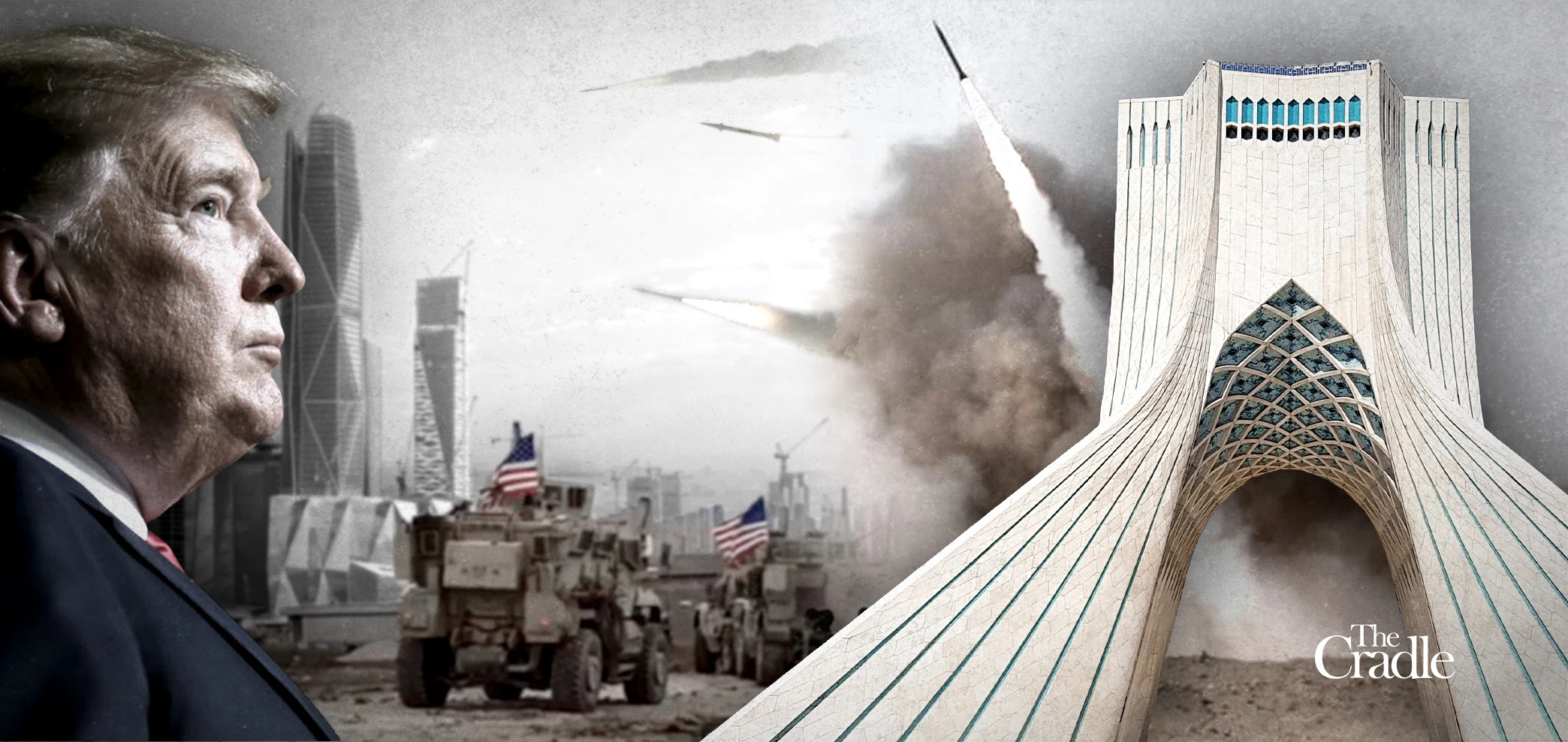
The US is rethinking its Gulf presence after its war on Iran, which turned its strongest assets into liabilities.
In the days after the ceasefire, attention shifted quickly to what the US-Israeli war on Iran had exposed. Inside the Pentagon, that meant a reassessment of how US forces are positioned across the Persian Gulf, and whether the model behind that presence still holds.
The war had already supplied part of the answer. At Naval Support Activity Bahrain, Iranian missiles and drones hit command facilities, communications nodes, and support buildings, causing damage far greater than publicly acknowledged and forcing evacuations and workarounds.
Bases long treated as secure sat within reach, and the margin of safety looked thinner than advertised, in light of the losses it had suffered, even if not fully disclosed.
A Wall Street Journal (WSJ) report drew particular attention. It pointed to a reassessment inside the Pentagon of its Gulf footprint, after the war exposed how vulnerable even its most entrenched bases had become.
Installations once designed around endurance and visibility found themselves exposed to tools that prize reach and precision. The balance between deterrence and vulnerability began to tilt.
Inside the Pentagon, the debate has turned to how to adjust. Options under discussion range from reducing presence at certain bases to redistributing units and capabilities across a wider geography. There is also consideration of shifting parts of operations to locations seen as less vulnerable, alongside upgrading fortifications at sites that remain in use.
This reflects an attempt to reconcile a longstanding model with a threat environment where distance and fortification offer less protection than they once did.
For decades, the US military presence in the Gulf rested on a simple premise. Large, fixed bases were meant to guarantee deterrence, enable rapid response, and secure key trade and energy routes. That premise now faces a test it has not faced before.
The recent war against Iran showed that these bases can be located, tracked, and targeted with increasing accuracy. In that sense, their size and permanence, once seen as advantages, also make them predictable. A single strike can have outsized operational and political effects, particularly when it targets command structures or logistics hubs.
A dispersed force can absorb shocks, while a concentrated one risks disruption at the point of impact. The more visible the installation, the clearer the target profile becomes.
Military planners are therefore weighing a shift toward dispersion. Instead of concentrating assets in a limited number of large installations, capabilities would be spread across more sites. The logic is to reduce the impact of any single hit and make targeting more difficult for an adversary. It also introduces redundancy, allowing operations to continue even if one node is degraded.
At the same time, there is a parallel track focused on protection. This includes expanding hardened shelters, building underground facilities, and improving air and missile defense systems. These steps reflect that some form of fixed presence will remain, even if its structure changes. They also reflect the cost of staying in place.
There is discussion of relocating certain missions westward as well, including toward the occupied Palestinian territories, with the Negev among the locations under consideration. Such moves would not signal an end to US partnerships in the Gulf. They would, however, alter how those partnerships are underwritten militarily, shifting part of the operational burden elsewhere.
What matters is that the debate has opened. It points to a recognition that the existing model cannot be carried forward unchanged, even if it is not abandoned.
Security for whom
The stated purpose of the US presence has long been to provide a security umbrella for Gulf states. The current review introduces a different priority. It is less about protecting allies and more about protecting American forces themselves.
During the war, the presence of US bases did not prevent escalation from reaching the region. Nor did it shield Gulf states from becoming part of the theater of confrontation. In some cases, those bases became a factor that drew risk toward them, placing host countries within the range of retaliation.
The implication is difficult to ignore, as the same installations meant to deter conflict can also serve as magnets for it.
This creates a dilemma for the US, which must determine how to reduce its exposure without stepping back.
For Gulf capitals, it is whether the security guarantee still functions in the same way when it carries a higher probability of entanglement.
From Washington’s perspective, the answer may lie in adaptation. From the Gulf’s perspective, the calculus is less clear, especially as alternative regional arrangements begin to enter discussion.
This does not mean the American umbrella disappears, but its terms are no longer taken for granted.
The doctrine unsettled
The review underway touches a core assumption of US military doctrine in the region.
The idea that heavy, permanent deployment guarantees freedom of movement has shaped policy for decades. It linked military presence to control over vital corridors, especially around the Strait of Hormuz. The war has unsettled that link.
Large concentrations of troops and assets now form fixed targets that carry a high cost to defend. Resources that would go into operations are pulled into protection, slowing response and limiting options.
In practical terms, the presence becomes a burden. It absorbs attention and capacity and demands constant reinforcement to remain viable under threat.
This is particularly visible around Hormuz. Control of the waterway relied on the assumption that nearby bases enabled rapid intervention. The confrontation showed that these same bases could be placed at risk from the opening stages of any escalation. The ability to act is therefore tied to the ability to survive the initial exchange.
That shift carries consequences for deterrence itself. If a force must first secure its own position before projecting power, its deterrent posture changes in perception and in practice.
The shift is subtle but significant, with the focus moving from how to use bases to how to preserve them.
What Iran changed
The immediate driver of this reassessment lies in what Iran has built and demonstrated.
Over the years, Tehran developed a missile and drone capability designed not only to deter but to offset the conventional advantages of the US in the Gulf. The recent war put that system into operation in a way that moved it from theory to applied pressure.
The effect went beyond individual strikes or specific outcomes. It lay in the constant pressure these capabilities imposed. Bases, infrastructure, and lines of operation were kept within range, raising the cost of maintaining a permanent presence and complicating the assumption of secure staging areas.
This pressure operates over time. It shapes behavior, forces defensive allocation, and narrows operational space.
In that sense, Iran’s achievement is measured not just in damage, but in the change it forced in American thinking. A doctrine that assumed relative safety for fixed installations now has to account for sustained vulnerability.
There is also a political dimension. Iran appeared to have succeeded in imposing a new strategic reality that prompted the US to reconsider its military presence across the Gulf and the Strait of Hormuz, rather than limiting its assessment to the locations where its forces were deployed. Perhaps the most striking revelation of these shifts is that Iran has succeeded, albeit indirectly, in moving the issue of US military presence in the Gulf from the realm of Iranian demands to the realm of internal American discussions. What Tehran has been posing for years as a strategic goal of reducing the US military presence has now been the subject of review within the Pentagon itself, as a result of the security and military cost of the war.
This shift from external pressure to internal review marks a change in how the issue is situated. It moves the question from rhetoric to policy.
It will not end in the Gulf
The implications extend beyond the Gulf as the US is compelled to reconsider a central pillar of its regional deployment, sending a signal to other theaters. Adversaries are watching closely, not only for immediate outcomes but for lessons that can be applied elsewhere.
In the Asia-Pacific, US deployments in Japan and South Korea rely on models that resemble those used in the Gulf. They are built around fixed bases intended to ensure deterrence and rapid response. Similar patterns exist in networks linked to Taiwan and across the region.
These deployments operate under different conditions, but they share structural similarities. Concentration, visibility, and reliance on infrastructure create comparable points of pressure if exposed to similar technologies.
As vulnerability to missiles and drones reshapes calculations in the Gulf, similar questions are likely to surface in these regions as well.
A broader reassessment of global deployment cannot be ruled out. What begins as a regional adjustment may develop into a wider rethink in how the US structures its military presence, especially as adversaries refine capabilities designed to exploit fixed positions.
A turning point, not an exit
It would be premature to speak of a US withdrawal from the Gulf. No such decision has been announced, nor is it implied by the review.
What can be said is that the terms of presence are changing. The war has exposed limits that cannot be ignored, forcing a reconsideration of assumptions that held for decades, not in theory but under operational pressure.
The deeper impact lies there. A model built on concentration and permanence now has to adapt to dispersion and uncertainty. A posture once associated with control now carries the risk of exposure – and that risk has to be managed continuously.
[…]


This should be a wake up call to the JooSA that they AREN’T the world cops and to pack up and piss off back home and stop interfering in others affairs. Most importantly, they MUST disavow themselves of ANY connection to the zionist cult! Those parasites are the reason that the US has suffered such ignimony and humiliation in the region.
LikeLike
I don’t think Trump has the sense to withdraw US troops from the Middle East. I think he’s prepared to let the US economy collapse.
LikeLike
Not enough people have died. Not yet. The Cabal is about numbers.
LikeLike
Right. I think they’ve agreed that a global population over one billion cramps their lifestyle.
LikeLike