
Press TV
Iran’s lead negotiator has dismissed US claims that Tehran’s unfrozen assets would be spent on American agricultural products, as American leaders try to skew the terms of a fragile truce agreement.
“America falsely claims our unfrozen assets will buy their agriculture. Interesting,” Mohammad Baqer Qalibaf wrote on social media platform X on Thursday.
“The only crop we’re harvesting is what you planted: decades of mistrust. It’s organic, abundant, and homegrown. But apparently the US only exports GMO soybeans, broken promises and trash talks.”
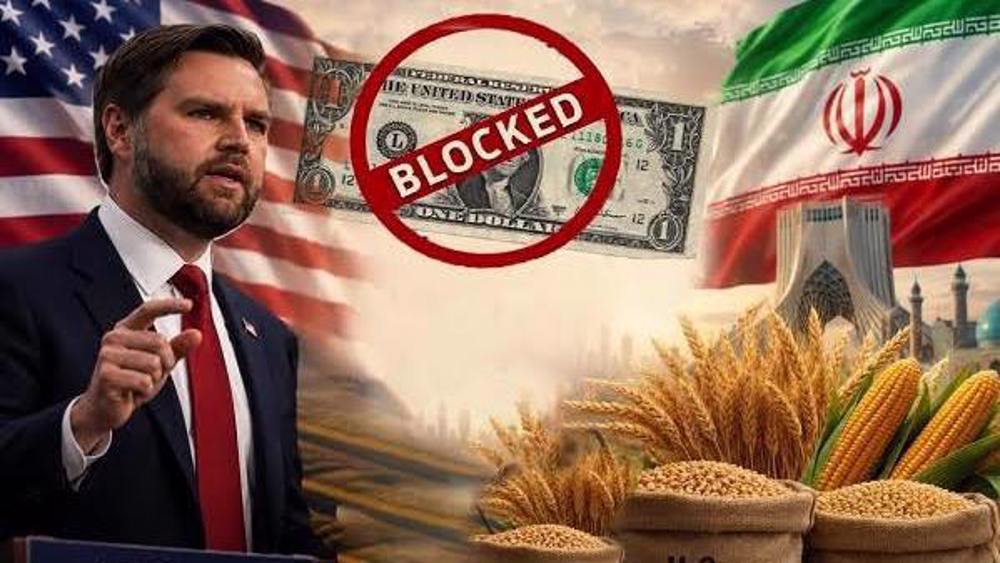
The rebuke came after President Donald Trump and US officials said the initial financial relief under the Pakistan-mediated memorandum of understanding would be used to purchase corn, wheat and soybeans from American farmers.
Trump insisted that no cash would reach Tehran directly, promising the funds would instead go to US growers to alleviate what he described as Iran’s “hunger problem.”
US Treasury Secretary Scott Bessent told CNBC on Wednesday that Treasury officials would be stationed in Qatar to oversee the allocation of funds, with a “very large percent” going to buy US foodstuffs and medicines.
“So we will be recycling the money back into US products,” he said.
Trump has repeatedly characterized Iranians as hungry, saying on Tuesday: “They have a hunger problem, they have a food problem, they have a medicine problem, they got a lot of problems.”
Vice President JD Vance added that if Iranian assets are unfrozen, “they’re going to go to make American farmers richer and feed the Iranian people.”
The remarks have sparked widespread backlash inside Iran, where officials and citizens have pointed out that the country has maintained stable food supplies despite months of war.
Agriculture Minister Gholamreza Nouri Ghezeljeh recently announced that Iran has achieved 85% food self-sufficiency, with agricultural production rising from 28 million tons before the Islamic Revolution to 139 million tons today.
“During the past nearly four months, when the country faced wartime conditions and various restrictions, no disruption occurred in the supply of essential goods or the country’s food security,” Nouri said.
Iran’s resilience is rooted in a decades-old “resistance economy” policy of self-reliance, which has built independent domestic production capabilities across agriculture, pharmaceuticals, and manufacturing. Despite US naval blockades and thousands of airstrikes targeting infrastructure, Iran has maintained stable food and fuel supplies.
Iranian officials have forcefully rejected a distorted US narrative of the June 17 agreement. Central Bank Governor Abdolnasser Hemmati said Tehran has “no requirement to purchase agricultural inputs from America” under the signed memorandum.
Foreign Ministry spokesman Esmaeil Baghaei said the released assets would be employed freely to purchase whatever goods Iran needed, with any agricultural purchases based on “prices and quality,” not on conditions imposed by Washington.
“It is interesting that the philosophy and goal of the war, which was the destruction of the Iranian civilization and the collapse of Iran, has become enriching American farmers,” Baghaei said.
The dispute over Iran’s frozen assets highlights Washington’s double standard: imposing crippling sanctions for years that cut Iran off from the global financial system, attacking Iranian civilian infrastructure during the war, and now attempting to profit from the very assets it illegally seized.
During the war that began on February 28, US and Israeli forces systematically targeted Iranian civilian infrastructure. Water reservoirs in southern Iran were struck, cutting off water for tens of thousands of people.
The Economist reported that strikes targeted “university buildings, apartment blocks and banks” alongside military installations.
US Ambassador to the UN Mike Waltz defended such threats, telling ABC’s “This Week” that striking power plants and bridges was “perfectly acceptable” under the “rules of land warfare.”
International law experts have asserted that such attacks constitute war crimes under the Rome Statute.
The 60-day implementation period for the memorandum is underway, with technical talks mediated by Pakistan and Qatar set to resume next week.
[…]

