
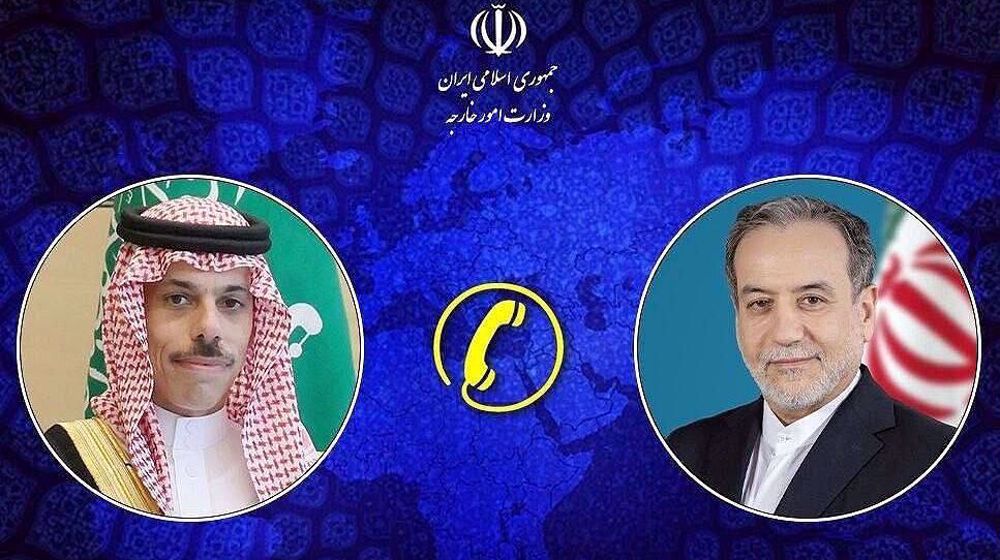
This combination photo shows Iranian Foreign Minister Abbas Araghchi (L) and his Saudi counterpart, Prince Faisal bin Farhan.
Press TV
Iranian Foreign Minister Abbas Araghchi and Saudi counterpart Prince Faisal bin Farhan have held a phone call to discuss regional developments, as Persian Gulf Arab states recalibrate their approach toward Tehran in the wake of the US-Israeli war that exposed the limits of American power.
Araghchi on Wednesday briefed the Saudi minister on the latest progress in implementing bilateral agreements and the ongoing negotiations following the US-Iran memorandum of understanding (MoU) signed on June 18.
The two top diplomats underscored the importance of maintaining diplomatic channels, strengthening joint cooperation to support regional stability, and achieving positive and sustainable outcomes.
The call came as French news agency AFP said Saudi Arabia is expected to host talks aimed at repairing relations between Iran and Persian Gulf countries following the US-Israeli war on Iran.
It cited a diplomat familiar with the arrangements as saying Wednesday that a regional summit was being planned in Riyadh and could also include other neighboring countries, but no date had yet been set.
The meetings would be separate from the ongoing negotiations between Iran and the United States, the diplomat added.
CNN, citing a senior Persian Gulf diplomat, reported that leaders are increasingly contemplating a future in which the US plays a much smaller role in the regional security architecture, with a possible framework involving a regional non-aggression pact with Iran.
According to Hasan Alhasan, senior fellow at the International Institute for Strategic Studies, “From the Arab states’ perspective, the Iran war is a disastrous turning point for the regional security order.”
The war, which began on February 28, exposed vulnerabilities in the Persian Gulf states’ security model, which is heavily dependent on the nearly 40,000 US troops stationed in the region and American-made air defense systems.
“The US security guarantee is no longer reliable in the way they thought it was,” one analyst at Chatham House told The New York Times.
Washington’s approach is increasingly perceived as selective and heavily centered on Israel’s security interest.
A classified CIA analysis found that US allies in the Persian Gulf are divided over their approach to Iran. According to the assessment, the United Arab Emirates and Bahrain prefer continued pressure on Tehran, while Saudi Arabia, Qatar, and Kuwait now support negotiations.
Trita Parsi, executive vice president of the Quincy Institute, noted that the UAE and Bahrain “made themselves frontline states against Iran” through the Abraham Accords and “now they’re in too deep and cannot extract themselves out of it”.
The Saudis, Parsi added, “were at the highest levels pushing for this war. They have come to regret it”.
Adding another layer of complexity is a widening gap between Arab governments and Arab public opinion over Iran.
According to a report by The Economist cited by DID Press, growing anger toward Israel and dissatisfaction with US policies have fueled increasing sympathy for Tehran across parts of the Arab world.
Despite sustained efforts by several Arab governments to reinforce anti-Iran narratives, recent developments have altered perceptions among sections of Arab society.
The report identifies two major drivers behind this shift: anger toward Israel, as many Arabs increasingly view Iranian actions against Israel as a legitimate response to regional military operations, and religious and cultural ties, particularly among Shia communities across the Persian Gulf.
The report concludes that sectarian narratives no longer resonate as strongly as in previous years, and that many Arabs increasingly view Iran as more assertive and resilient than several Arab governments.
Qatari Prime Minister Sheikh Mohammed bin Abdulrahman Al Thani traveled to Muscat on Wednesday to initiate talks between Iran, Persian Gulf states, and Iraq on the future operation of the Strait of Hormuz.
The discussions aim to implement a provision of the MoU requiring Iran and Oman to hold talks with other Persian Gulf states on the future management of navigation and maritime services.
Earlier on Wednesday, Oman announced two temporary routes north and south of the existing shipping lane to facilitate safe passage of vessels departing the region, in coordination with the International Maritime Organization.
The Strait of Hormuz, through which roughly 20 percent of global oil and liquefied natural gas normally transits, was heavily disrupted after the United States and Israel launched their war on Iran on February 28.
[…]

