
 Dmitry Orlov
June 2, 2026
Currently, Russia faces a bit of a problem. Western nations have taken to supplying the former Ukraine with missiles, drones and components for their manufacture. The US is also involved: the former Ukraine receives targeting information from Palantir and uses Starlink satellite communications. This by no means qualifies as an existential threat but it does pose a political problem for Russia’s leaders.
By “the former Ukraine” I mean what’s left of the former Ukrainian Soviet Socialist Republic, as crafted by Lenin and Stalin out of random bits of the Russian Empire, then let loose by “drunk president” Boris Yeltsin. Since then it has lost half of its population (the younger and more capable half), virtually all of its once mighty industry, and is now a shadow of its former self. It has a very high death rate and a very low birth rate and is undergoing rapid demographic collapse. Its one remaining use (for the West) is to annoy Russia. It is the one and only category in which the former Ukraine remains a success.
The West supplies the former Ukraine with drones and drone components and the Ukrainians use them to launch attacks on civilians in random locations within Russia. They have tried to launch drone attacks to damage military and industrial installations, oil refineries especially, but this has had minimal effect and these locations are at this point fairly well defended with anti-aircraft systems.
And so the Ukrainians have switched to targeting civilians. The number of people killed by Ukrainian missile and drone attacks averages 1,3 deaths per day. This is significantly lower than the 38-40 people per day who die in automobile accidents throughout Russia, but there is a big difference psychologically. In practical terms, nothing much would happen if automobile accident deaths went up to 39,3-41,3. This would, of course, be deplorable, but such a development would only be noticeable to statisticians and they would certainly not start running around with their hair on fire. But drone and missile attacks are different: they cause people to think that not enough is being done to defend them. In turn, this causes politicians and public figures in Russia to leap to action and demand that something be done.
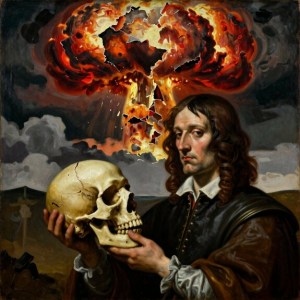
For example, professor Sergei Karaganov has advocated the use of tactical nuclear weapons against Western nations which supply the former Ukraine with missiles and drones. Karaganov’s logic is simple: the West is not sufficiently scared of Russia; nuclear weapons are very scary indeed; therefore, using nuclear weapons against the West would fix this problem. In line with Karaganov’s thinking, the Russian Ministry of Defense has produced a target list of factories that manufacture the missiles and drones which end up in the former Ukraine and, it is reasonable to assume, stands ready to destroy these factories when so ordered. Whether it would do so using conventional or nuclear weapons is yet to be determined. Some people seem to think that Karaganov shouldn’t have proposed this and have even launched personal attacks against him. What some people seem to be missing is a fine distinction between saying that something should be done and actually doing it. Yes, this is a nuance, but it is a very important one.
Some people take issue with the fact that Russia has not yet prevailed militarily in the former Ukraine. Some of them take this to mean that Russia is weak; others claim that the Russian leadership is divided or indecisive or that Putin is overly cautious. They think that Russia should smite the Kiev regime’s forces forthwith and that Russia should triumph and claim all the territory it wants. Both sworn Russophobes and supposedly patriotic Russians are guilty of such wooly thinking.
Indeed, lots of Russians endlessly repeat the mantra that “victory will be ours.” But what does that actually mean? If Russia were to score an outright victory in the Ukraine, smashing the Kiev regime and causing its military to retreat in disarray and dissolve among the civilian population, would that be helpful to Russia? It doesn’t take too much deep thought to discover that it would not be helpful at all.
• Russia would come to control a vast, chaotic territory. It is sparsely peopled by lots of retirees, disabled veterans and war widows. There are some 100.000 fabulously corrupt functionaries, arms dealers and crooks. It is infested by Western agents and mercenaries. Thanks to relentless brainwashing, none of them are particularly well-disposed toward Russia. Incorporating this territory into the Russian Federation would require lifting it up to Russian standards, and this would require massive and unpopular federal budget outlays.
• Then there is the question of how these new, most reluctantly Russian citizens would vote: probably not quite the way Moscow would like. West of the Dniepr river, Russian patriots become rather thin on the ground. After 35 years of splendid isolation, rejoining the fold of the Russian civilization may not be possible for much of the remaining population. It would take several decades to bring these people around, and it is unclear what level of interest exists within Russia for doing so. In 1991, at the time of the collapse of the USSR, 80% to 90% of Russians perceived Ukrainians as a brotherly nation. In 2025, according to polls by the Levada Center (designated as a “foreign agent” by the Russian Ministry of Justice), the proportion of Russians who consider Ukrainians a brotherly nation is approximately 50%-52%. Given this trend, in a few more years attempts to reintegrate the former Ukrainian SSR into Russia would receive considerable pushback.
• Lastly, winning in the former Ukraine would simply prompt the West to start another proxy war against Russia. The list of animals to be sacrificed on the altar of Western Russophobia has already been drawn up and it is quite long: from north to south, there is Finland, the Baltics (too insignificant to mention by name), Poland and Moldova/Transnistria. Here, too, there is a fine difference between members of these sacrificial, notionally Western nations saying that they will fight Russia (and holding training exercises in which they pretend to fight Russia) and them actually doing so, as opposed to running off and hiding.
These are the negatives of a quick, outright Russian victory in the former Ukraine. And then there are also some positives being offered by the lack thereof.
• Perhaps most importantly, this conflict allows Russia to complete a civilizational about-face, from being wedded culturally and economically to the decadent, degenerate and hostile West to establishing amicable, mutually beneficial relationships with the increasingly prosperous, fast-growing and traditionalist countries of Southeast Asia.
• Part of that about-face is a societal transformation within Russia itself. At the beginning of the Special Military Operation in February of 2022, Russia was spontaneously relieved of quite a number of influential citizens of split loyalty who chose to leave Russia. Half of these people have since realized that they had made a mistake and have come back, but the lessons they learned, and imparted to the rest, were invaluable. The basic lesson seems to be simple: “The West has nothing to offer us.”
• Then there is the usefulness of the former Ukraine as a proving ground for new weapons and war-fighting techniques, where the use of armor and large infantry formations is a thing of the past and the line of separation is now a kill zone as wide as 50km patrolled by drones and infiltrated by infantry in groups of two or three under cover of darkness, rain and fog to launch surprise attacks and take over specific fortified locations.
• Finally, the Special Military Operation is a powerful tool of political consolidation. Returning veterans reenter the workforce and, in recognition of their achievements on the battlefield, are promoted to management. Their children receive prime consideration for free education. All of this helps ensure that Russia’s governance structures, both public and private, will remain patriotic and loyal for the next several generations.
For all of these reasons, it is far better for Russia to be winning than to win. Indeed, Russia is winning every day, just a tiny bit. Almost every day the evening news carries stories of conquest of yet another hamlet or village or deserted industrial zone in the western portions of what are now regions of the Russian Federation or the newly established buffer zones in Sumy or Kharkov regions. These tiny conquests are achieved with an absolute minimum of casualties. People have stopped attempting to calculate casualty ratios some time ago, but before that happened numbers such as 7:1 (that is, Ukrainian to Russian casualties) were commonly heard even from Putin himself while ratios of 10:1 and higher were also floated. Overall, the Russian army is growing and the Ukrainian army is shrinking while Western financial support for the Kiev regime is dwindling. This implies that this conflict can’t go on forever and will wind down perhaps as soon as the end of 2026, perhaps a bit later.
Similarly to how it is better for Russia to be winning than to win in the former Ukraine, it is better for Russia to be preparing to nuke Europe than to actually do so. That it is preparing to do so is certainly a fact: Oreshnik missile batteries, which can be nuclear-tipped, have been positioned in Belarus, allowing them to strike anywhere within the European Union within a few minutes. Training exercises have recently been held to make sure crews are ready to arm them with tactical nuclear warheads. Surely, an attempt would first be made to make an impression on EU governments using conventional weapons before resorting to tactical nuclear weapons, but the track toward escalation has already been laid and the escalation train is already rolling down that track, albeit quite slowly.
[…]
Via https://boosty.to/cluborlov/posts/7811018b-986f-4d46-9fea-c3e3e3e1a226

