
By Alex Ksjadz
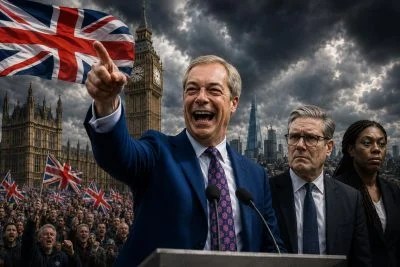
The May 2026 local elections became for the United Kingdom not just another electoral cycle, but a moment of political rupture. A country that for decades lived within the logic of confrontation between two major parties — Labour and the Conservatives — has effectively entered an era of fragmented multiparty politics. The main winner of the elections was Nigel Farage’s Reform UK, which until recently was perceived as a marginal protest force, but has now transformed into one of the key players in British politics.
The voting results proved shocking even for the British elites themselves.
Reform UK gained around 1,450 seats in local councils and took control of 14 councils, making an unprecedented leap practically from zero. Labour lost nearly 1,500 seats and lost control of 23 councils — one of the party’s worst results in the modern history of local elections. The Conservatives also continued their decline, losing ground both to Labour and to Farage. At the same time, the Greens achieved the best result in their history, significantly strengthening their position in London and major cities.
Labour’s losses in traditional working-class regions that had for decades been considered the party’s impregnable strongholds were especially painful. Reform UK achieved serious successes in Sunderland, Barnsley, and Hartlepool — cities where Labour had dominated for decades. Labour’s significant losses in Birmingham, one of Europe’s largest municipalities, also became a symbolic blow.
Britain is effectively repeating processes that the United States and a number of European countries have already experienced: the traditional working class is gradually turning away from center-left parties and moving toward right-wing populists. It is precisely on this fracture that Nigel Farage is building his strategy.
The success of Reform UK is directly connected to several factors.
The first is migration. Despite the change of power in 2024, Keir Starmer’s government failed to convince a significant part of society that it was capable of controlling migration flows and solving the crisis of illegal crossings across the English Channel.
The second factor is economic stagnation and the feeling of being “forgotten” among residents of small towns and industrial areas.
The third is general distrust toward the political establishment, which Farage is successfully converting into protest voting.
At the same time, Reform UK managed to do what British right-wing populists had long failed to achieve: move beyond being solely a “Brexit party.” While UKIP was primarily an instrument of pressure on the issue of leaving the EU, Reform UK is now claiming the role of a полноценной national force capable of competing for power.
It is revealing that the party is achieving success not only in traditionally Eurosceptic areas, but also in former Labour strongholds. In some districts, turnout even increased — a rare phenomenon for local elections in Britain. This suggests that Reform is not merely taking votes from competitors, but is also mobilizing those who previously did not participate in politics at all.
For Starmer, the results became an extremely serious blow. Discussions about a possible change of leadership have already begun within Labour. Some MPs and party activists accuse the leadership of losing its own identity. Critics believe that Starmer’s attempt to shift Labour toward the center led to a double failure: the left-liberal urban electorate began drifting toward the Greens, while the working class moved toward Reform UK.
The situation for the Conservatives remains no less difficult. Kemi Badenoch’s party formally retained some positions, but the main problem for the Tories lies elsewhere — they are rapidly losing their monopoly over the right-wing electorate. Reform UK is already overtaking the Conservatives in several national ratings, while Farage openly claims leadership of the entire right-wing camp.
The most alarming signal for the British political system was not even Reform’s victory, but the overall fragmentation of the electoral field. Following the elections, five parties received double-digit support levels. This effectively means the end of the stable two-party model that had dominated Britain for more than a century.
Against this backdrop, regional processes are also intensifying. In Scotland, the SNP once again emerged victorious, maintaining its course toward strengthening the autonomy agenda. In Wales, Labour’s positions weakened noticeably, while Plaid Cymru strengthened its influence. Thus, the crisis affects not only individual parties, but the entire former architecture of British politics.
The key question now is whether Reform UK can maintain its current momentum until the next parliamentary elections. So far, the party faces the typical problems of rapidly growing populist movements — a shortage of experienced personnel and the absence of a stable managerial structure. However, even if part of its current success proves temporary, British politics is unlikely to return to its previous model.
The May 2026 elections became the moment when Britain’s old system finally cracked. And now the main struggle will no longer take place between Labour and the Conservatives, but around who will manage to rebuild a country fractured by economic problems, the migration crisis, and deep distrust toward traditional elites.
Crisis of Britain’s Two-Party System
International lawyer and Director of the Center for European Information Nikolai Topornin believes that forecasts regarding the elections in Britain proved accurate: practically everyone expected Labour’s defeat, the only question was the scale of the losses. In the end, the party lost more than 1,200 seats.
In his opinion, this defeat raised the issue of confidence in the current Labour leadership headed by Starmer. The expert notes that many are already speaking about the beginning of a crisis in Britain’s two-party system, where Labour and the Conservatives had dominated for more than a century.
The elections were won by Reform UK under Nigel Farage’s leadership, gaining more than 1,400 seats. If local election results were extrapolated to parliamentary elections, Farage’s party could receive around 220–240 seats and become the largest force in parliament, pushing aside both Labour and the Conservatives.
The main question now is whether Reform UK can maintain its current level of support until the 2029 parliamentary elections.
“And essentially, that is when the breakdown of this still-functioning two-party system at the state level would truly occur,” Topornin noted.
Professor Stanislav Tkachenko of Saint Petersburg State University, in turn, pointed out that Britain’s traditional two-party system, dating back to the 17th century, had already experienced periods of crisis in its history, the sharpest of which occurred after the First World War and led to the Liberal Party (the former Whigs) being pushed beyond the two-party model.
Labour replaced them for almost an entire century. And although in practically every election held during this time there was a party claiming to destroy the model of the two “big parties,” only the current situation in Britain allows a forecast that the party-political system that existed in the state for an entire century may now be destroyed.
Moreover, there is no guarantee that Reform UK will replace one of the two “big parties,” namely the Conservatives or Labour, the expert believes.
“I would venture to suggest that we are on the threshold of a complete reformatting of Britain’s party system, because besides Nigel Farage’s ‘reformists,’ the Greens and the major parties of Scotland and Wales are also claiming a place within the ruling elite, without whom governing coalitions in the British parliament may soon become impossible,” he said.
Why Reform UK Has Strengthened
The success of Reform UK was not sudden. Nigel Farage has long been active in politics and previously created UKIP — the United Kingdom Independence Party — although at that time it was less successful, Topornin pointed out.
In his opinion, Farage primarily bet on the migration agenda. Europe’s liberal migration policy led to an increase in the number of migrants, which began provoking irritation among part of society. Against this background, more and more voters began supporting right-wing parties — from Alternative for Germany to Marine Le Pen’s National Rally.
For a long time, Britons treated Farage cautiously, but the situation changed in recent years. Voters became disappointed in the promises of traditional parties, while Starmer’s government reforms, including in migration policy, failed to produce noticeable results, Topornin notes.
An additional factor was the worsening socio-economic situation.
“Voters shifted to the right and support Farage because they are tired of the promises of traditional parties that are not backed up in practice,” he noted.
Tkachenko, meanwhile, believes that the main reason for the rapid growth in popularity of Reform UK lies in the crisis state of Britain’s socio-economic system.
He identifies the causes of this crisis as growing deindustrialization, the inability to compete with products from China and other Global South countries, as well as failed policy toward Russia, which deprived the City of London of access to a rapidly growing and profitable market.
“For outside observers, the main cause of the crisis that lifted Farage to the top of the ratings is migration policy, which has changed electoral dynamics in many parts of England and Scotland,” he noted.
In his opinion, British business, which traditionally played an active role in shaping the country’s party system, became disillusioned with the old parties, seeing their inability and unwillingness to stop the poorly controlled influx of migrants.
British society is tired of waiting for change and no longer believes that the desired results can be achieved through the evolutionary path advocated by both Labour and the Conservatives.
“In today’s British political system, only Farage and the political leaders oriented toward him promise decisive anti-migration measures,” the expert noted.
Why Labour Is Losing Support
Topornin argues that Britons today are most irritated by unresolved migration problems and the worsening socio-economic situation. Despite promises of reform, Starmer’s government failed to demonstrate noticeable results either in the economy or in migration policy.
At the same time, in his opinion, Britain’s traditional working class has changed significantly. A substantial portion of workers today are migrants who do not possess British citizenship or voting rights. As a result, Labour’s former support base among the working class is gradually eroding.
At the same time, part of the liberal urban electorate is shifting toward the Liberal Democrats and the Greens, who offer a more radical liberal and environmental agenda.
All this has led to a sharp drop in Labour’s ratings, the expert believes.
“And so it turns out that Labour’s base is eroding, plus uncertain policy, plus scandals within the government,” he emphasized.
Tkachenko, meanwhile, pointed out that Labour’s triumphant rise to power in the July 4, 2024 elections was itself explained by the crisis of the Conservatives, who had governed Britain for 14 years.
“It was not that Labour was strong in these elections, but that the Conservatives had turned from the solid party of David Cameron’s era into a nationwide laughingstock because of leaders unfit for the kingdom’s highest governmental post — Boris Johnson, Liz Truss, and Rishi Sunak — as well as failures in combating the pandemic, the energy crisis, and adventurist foreign policy,” he believes.
During the campaign period, Starmer promised to overcome all these shortcomings, and voters believed him, thanks to which Labour achieved one of the best results in its party history in the previous elections, the expert recalled.
Now, according to him, it has become obvious that Labour’s potential in state governance is no different from that of the Conservatives. That is why the average British voter wants to see completely different people in top parliamentary and governmental positions — people not connected to the old ruling establishment.
Today Labour views its typical voter as an urban resident, not necessarily connected with industry. They have no concrete “message” for poorer segments of the population.
“Today this party claims the center of the country’s political spectrum, it expresses social-democratic values and easily finds common language with business associations, including large global business. For traditional Labour, such a situation would have been simply impossible,” Tkachenko explained.
[…]
Via https://www.globalresearch.ca/britain-farage-breaking-old-system/5926944

