
RT
Evidence of the damage inflicted to US military facilities in the Gulf during the war with Iran continues to emerge. While the latest media figures say that at least 16 American bases in the region were struck, the Pentagon is apparently doing its best to conceal the destruction.
Within hours of the US launching ‘Operation Epic Fury’ on February 28, Iran unleashed retaliatory strikes against American military bases across the Middle East, with some facilities being targeted multiple times.
Behind a veil of censorship, it’s increasingly clear that the damage may be far more severe than the Pentagon has admitted.
US leadership downplaying scope of destruction
In a report to a congressional committee on April 29, senior Pentagon official Jules Hurst estimated that the war had cost Washington around $25 billion, most of this allegedly in expended munitions. Secretary of War Pete Hegseth later refused to say whether the figure included repair costs to US bases.
Lawmakers have already blasted the estimate, calling it unrealistic in light of earlier Pentagon reports, which said the war had cost around $11 billion in just the first six days.
However, the true price tag of the conflict is reportedly far higher. Factoring in the expense of repairing damaged US military facilities, the figure could be closer to $40-50 billion, CNN has reported, citing anonymous sources. Some bases, such as the home of the US Navy’s Fifth Fleet in Bahrain, were left “virtually unusable” after suffering “rapid, targeted strikes using advanced technology,” a source told the network.
Determining which installations were hit – and assessing the damage – is possible through a combination of news reports, satellite imagery, and social media footage. However, Gulf states have threatened anyone sharing footage of damage with lengthy jail terms, and the US has pressed American commercial satellite operators to withhold footage from the public.
Washington delays release of satellite images
In early April, California-based Planet Labs, which provides access to satellite imagery to government and business, announced that it would indefinitely halt the release of new footage from the region to preclude its use by “adversarial actors.”
On April 5, Bloomberg reported that the Trump administration had asked the company, along with several others working in the sector, to “voluntarily withhold images of designated areas of interest due to the ongoing conflict in the Middle East.” Some of Planet Labs’ images shared online in the opening days of the conflict exposed damage to US military sites.
Which US bases have been hit?
Nevertheless, Iran has continued to release its own satellite footage, as have some Chinese satellite operators. According to this footage – and to video shared on social media – the following bases have been hit by Iranian fire.
- Naval Support Activity, Bahrain (headquarters of US Fifth Fleet)
- Manama, Bahrain (multiple hotels housing US troops in the city)
- Erbil International Airport, Iraq (US base adjoining airport)
- Muwaffaq Salti Air Base, Jordan
- Ali Al-Salem Air Base, Kuwait
- Camp Buehring, Kuwait
- Camp Arifjan, Kuwait
- Mohammed Al-Ahmad Kuwait Naval Base, Kuwait
- Al-Udeid Air Base, Qatar
- Al-Dhafra Air Base, UAE
- Jebel Ali Port, UAE
- Prince Sultan Air Base, Saudi Arabia
CNN’s list is more extensive, and includes two additional bases in Kuwait and two in Bahrain. CNN also includes RAF Akrotiri in Cyprus, a British air base frequently used by the US military.
How many bases does the US have in the Middle East?
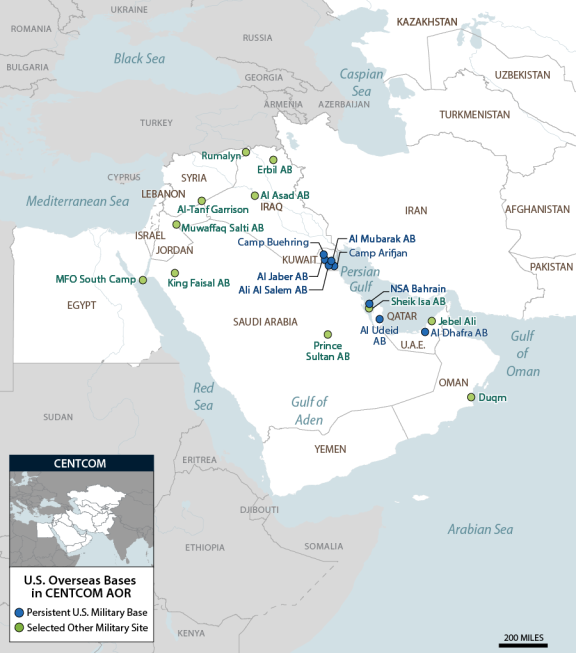
The US operates a network of 19 permanent and temporary military bases throughout the Middle East, with the largest – Al Udeid Air Base in Qatar – hosting 10,000 troops and serving as the forward headquarters for US Central Command (CENTCOM).
The eight permanent US installations are located in Bahrain, Egypt, Iraq, Jordan, Kuwait, Qatar, Saudi Arabia, and the United Arab Emirates, and as of mid-2025, there are between 40,000 and 50,000 American troops stationed in the region at any one time.
These bases surround Iran from the west and south, and are currently bolstered by the presence of the USS Abraham Lincoln and USS George HW Bush in the Persian Gulf. The two nuclear-powered aircraft carriers have a combined staff of more than 10,000, and carry more than 130 fighter jets.
All of the US bases in the region have been described as “legitimate targets” by the Iranian military.
What’s on Iran’s target list?
The strikes on American air bases serve the immediate goals of reducing US ability to conduct air sorties over Iran, and forcing it to move air assets further away, from where they must rely on aerial refuelling to continue their attacks. Data from FlightRadar24 showed a mass exodus of KC-135 Stratotankers from Prince Sultan Air Base on March 9, after a combined drone and missile attack the night before. A rudimentary calculation by analyst Anusar Farooqui suggests that the US ability to fly missions over Iran has been degraded by 35-50%.
Iran’s campaign has focused heavily on blinding the US military and crippling its Terminal High Altitude Area Defense (THAAD) network. An Iranian ‘Shahed’ drone slammed into an AN/TPS-59 radar dome at Naval Support Activity in Bahrain on the first day of the conflict, obliterating the $300 million system. Installed in 2007, the radar was described by Lockheed Martin at the time as “the only 360-degree coverage mobile radar in the world certified to detect tactical ballistic missiles.”
Radar domes were also destroyed at Camp Arifjan and Ali Al-Salem Air Base in Kuwait, and at Al-Dhafra in the UAE, according to satellite images and video footage. At Al-Udeid Air Base in Qatar, a $1 billion AN/FPS-132 early warning radar installation, one of only six worldwide, was hit by an Iranian ballistic missile on February 28, according to Qatar’s Defense Ministry.
By destroying the radar equipment, Iran has hampered the US and Israel’s ability to track incoming ballistic missiles. The consequences can be seen in Israel, where by March 6, Iranian missiles were hitting Tel Aviv less than three minutes after sirens sounded, instead of the usual eight minutes.
In at least four locations – Muwaffaq Salti Air Base in Jordan, Prince Sultan Air Base in Saudi Arabia, and two Emirati-run bases in the UAE – Iran has hit AN/TPY-2 radar systems linked to US-made THAAD batteries. Satellite images show that in Jordan and Saudi Arabia, these $500 million systems were completely destroyed.
A March 27 Iranian missile and drone strike on Prince Sultan Air Base in Saudi Arabia wounded 12 US troops, two of them seriously, according to a US official cited by Reuters. The attack also damaged several US aircraft, according to American officials, with separate reports indicating that refueling planes were among those hit.
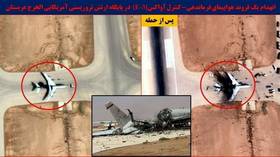
US and Arab officials cited by the Wall Street Journal said the same strike also hit a Boeing E-3 Sentry airborne warning and control system (AWACS) aircraft, a critical surveillance platform. The IRGC said the aircraft was “100% destroyed” in the strike, while open-source flight tracking data indicated that several such planes had been stationed at the base in recent weeks. The E-3, a key command-and-control platform, costs around $270 million to produce. US Central Command refused to confirm the claim, but satellite footage later proved that the IRGC was telling the truth.
According to a May 6 report by the Washington Post, Iranian missiles and drones struck a total of 228 structures or pieces of equipment across all the bases targeted, including “hangars, barracks, fuel depots, aircraft and key radar, communications and air defense equipment.” More than half of this damage took place at just four bases, the Post reported: Naval Support Activity, Bahrain, and Ali al-Salem Air Base, Camp Arifjan, and Camp Buehring in Kuwait.
How many US troops have been killed?
Some 13 US troops have been confirmed killed since hostilities began. Six died in an Iranian attack on Camp Arifjan in Kuwait, when a missile hit what US Secretary of War Pete Hegseth described as a “tactical operation center that was fortified.” One soldier was killed in a missile attack on Prince Sultan Air Base in Saudi Arabia, while another six died when their refueling aircraft crashed in Iraq. More than 400 US troops have been wounded.
Tehran claims that the true US death toll is significantly higher. In an interview on March 7, Iranian Supreme National Security Council chief Ali Larijani accused US President Donald Trump of “lying” about the casualty count, predicting that the US would “probably later increase the number of deaths gradually under the pretext of accidents or something of the sort.”
How has Washington’s inability to protect Gulf allies affected their relationship?
On top of the strikes Iran carried out on US military facilities, Tehran has successfully struck oil and gas infrastructure in multiple Gulf states, as well as buildings it claimed were housing American soldiers.
This retaliatory campaign has shattered the illusion that a US base on a nation’s territory would provide it a protective umbrella, with Gulf nations reportedly beginning to hedge their bets and looking elsewhere for potential allies.
“The alliance with the US cannot be exclusive and it is not… impregnable,” CNN cited a Saudi source as saying.
Gulf nations are also suffering with their main export – fossil fuels – being locked into the Strait of Hormuz by Iran’s blockade and the US blockade of Iranian ports. The UAE has reportedly warned the US Treasury that it could be forced to trade oil in Chinese yuan to compensate.
[…]
 The Most Revolutionary Act
PressTV (Iran) and RT (Russia) often feature American commentators and analyses, which cannot be said for American/Western media organizations, except at the very shallow level… Such exclusionary media treatment of so-called “enemies” has been in practice as an obvious form of censorship for a very long time, unfortunately…
LikeLike
I haven’t been keeping up recently, Jerry, but last time I checked most mainstream US news outlet were owned by Zionists – including TikTok. At present, I’m being shadow-banned on X.
LikeLike