
Press TV
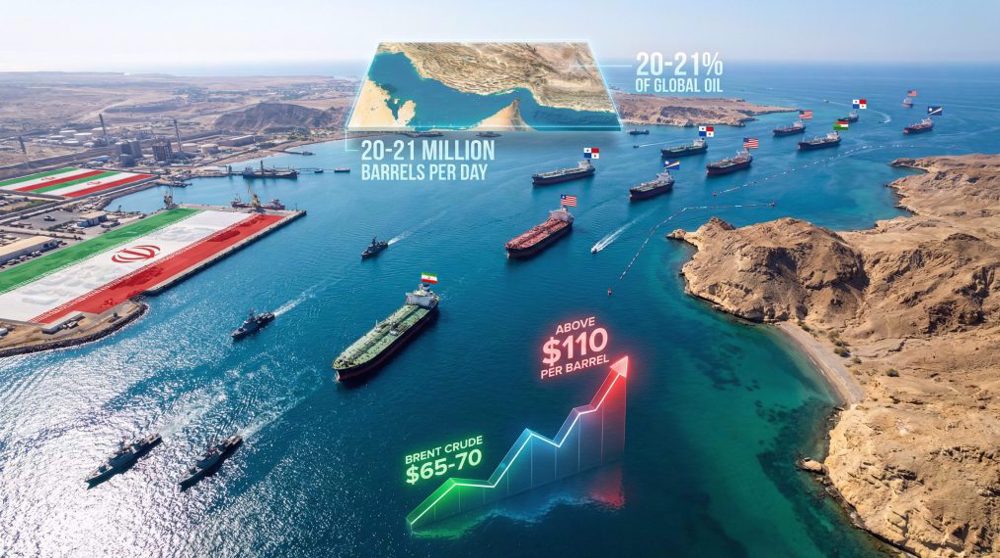
Despite US warships engaging in blatant maritime piracy by intercepting tankers and claiming a naval stranglehold, Iranian crude keeps moving.
Chinese buyers are paying a premium, Indian refiners are routing payments through yuan, and Tehran has turned the narrow legal geography of the Strait of Hormuz into its strongest bargaining chip.
The US Navy fired on an Iranian cargo ship in the Gulf of Oman on Sunday, blowing a hole in its engine room before Marine pirates boarded the vessel, President Donald Trump announced on Truth Social.
It was the most dramatic piracy in what has become a daily occurrence at sea, but a US blockade of Iranian ports that has failed to achieve its stated aim of cutting off Iran’s oil revenues.
Just days before the attack on the Touska, an Iranian-flagged vessel nearly as long as an aircraft carrier, another tanker owned by the National Iranian Tanker Company successfully completed a voyage to Indonesia, unloading approximately 2 million barrels of crude before returning safely to Kharg Island, Iran’s main oil export terminal.
The ship transited back through waters that the US Central Command claims are under effective blockade.
The contrast illustrates a fundamental reality of the current war. While American destroyers patrol the Gulf of Oman and have forced 27 commercial vessels to turn around since the blockade began on April 13, Iran’s oil continues to reach customers.
TankerTrackers.com, a maritime intelligence firm, reported that Iranian crude exports in April remained at elevated levels, directly contradicting claims by the US president that Iran was losing $500 million daily from a closed Strait of Hormuz.
The legal architecture of the waterway helps explain why.
The Strait of Hormuz is 21 nautical miles wide at its narrowest point. Under the UN Convention on the Law of the Sea, which Iran has signed but not ratified, coastal nations may claim territorial waters extending 12 nautical miles from their shores.
This creates a mathematical reality that neither side disputes. The strait is narrow enough that the territorial waters of Iran and Oman overlap or abut, leaving no high-seas corridor where international transit passage is unambiguously guaranteed.
The US-Israeli war of terrorism has prompted Iran to finally put aside its longstanding diplomatic hesitation and historical reluctance over its Hormuz rights, fully enforcing its sovereign authority under the 12-mile territorial waters provision of international law to administer, regulate, and control traffic through the strait.
Iran is fully within its rights, and there is no need to accommodate the colonialist powers that have exhausted every weapon in their arsenal—from crippling sanctions to economic warfare—to harm the Iranian people for years.
The time has come for Iran to strike back, to deploy its own strategic leverage, and to turn the tables on a West that has shown nothing but inhumanity.
Since late February, when US and Israeli strikes triggered the current war, Tehran has effectively closed the strait to all vessels it does not expressly approve.
In fact, Iran has allowed a carefully managed flow of its own oil exports and vessels from countries it considers non-hostile to pass through designated corridors north and south of Larak Island, where it monitors each ship.
The new status has done something remarkable to Iranian oil pricing. Chinese independent refiners, known as teapots, are now buying Iranian Light crude at premiums of $1.50 to $2 per barrel above Brent, according to trading sources cited by Reuters.
For years under sanctions, Iranian oil traded at a discount to global benchmarks, compensating buyers for the risks of dealing with a blacklisted seller. That dynamic has reversed.
At least two teapot refineries purchased cargoes at these premium prices this month, betting that Iranian supply is more reliable than alternatives from Saudi Arabia or the UAE, both of which have effectively shut in approximately 9 million barrels per day of production.
China has taken more than 90 percent of Iran’s crude exports in recent years, and Beijing’s refiners just received new import quotas totaling 55 million tons.
One US-sanctioned Aframax tanker, the Ping Shun, was reportedly carrying 600,000 barrels of Iranian crude from Kharg Island and is now signaling Dongying in China’s Shandong province, a hub for private refining.
Meanwhile, refiners in India which was once Iran’s third-largest oil customer are scrambling for crude after West Asian supplies were constrained by the strait’s closure.
A temporary US sanctions waiver, issued March 21 and allowing transactions for already-loaded cargoes until April 19, created a narrow window for purchases.
Past payment mechanisms had long complicated Iranian oil trade because the United States bans Iran’s access to the dollar-based financial system. Those hurdles have now been resolved.
According to Reuters, Indian refiners are making payments for Iranian crude using the Chinese yuan, routing funds through ICICI Bank, one of India’s largest private sector banks, to settle accounts with Iranian sellers.
The development carries geopolitical weight. Yuan-denominated oil trade between Iran and India reduces both countries’ reliance on the US dollar and the SWIFT financial messaging system, both of which Washington has used as weapons in its maximum pressure campaign.
For China, it reinforces the yuan’s gradual emergence as an alternative reserve currency. For India, it is a pragmatic response to a simple problem where the country needs crude oil, and Iran has it.
The Touska seizure on Sunday drew a sharp response from Tehran. Iran’s top military headquarters, Khatam al-Anbiya, vowed that the armed forces would “soon respond to and retaliate for this act of armed piracy”.
The US blockade strategy carries domestic political risks. Average US gasoline prices have exceeded the psychological threshold of $4 per gallon, with continued high energy costs set to hurt the Republican party in November’s midterm elections.
Iran, for its part, has decades of experience with sanctions. The country has built resilience through a combination of barter trade, and diplomatic hedging.
The key variable is time, with observers questioning how long can the US maintain high-intensity maritime piracy while bearing the political costs of elevated oil prices and inflation.
For now, the oil keeps moving. Chinese refiners are paying more than ever. Indian payments are flowing in yuan and every successful Iranian tanker voyage undercuts the US narrative of an airtight blockade.
[…]
 The Most Revolutionary Act
So, this illegal war on Iran by the US and Israel has backfired and Iran is coming out the better for it. Of course, I am still saddened by the loss of life on the side of the Iranians, especially the murdered schoolgirls. That hurt me to my heart and still does. Not to mention, Hungary has already stated that if Netanyahu comes for a visit, he will immediately be arrested!! Someone, drag Netanyahu’s ass over to Hungary, PLEASE!!!
LikeLiked by 1 person
It’s terribly sad, Shelby, that so many people have to suffer from the collapse of this evil empire.
LikeLiked by 1 person