
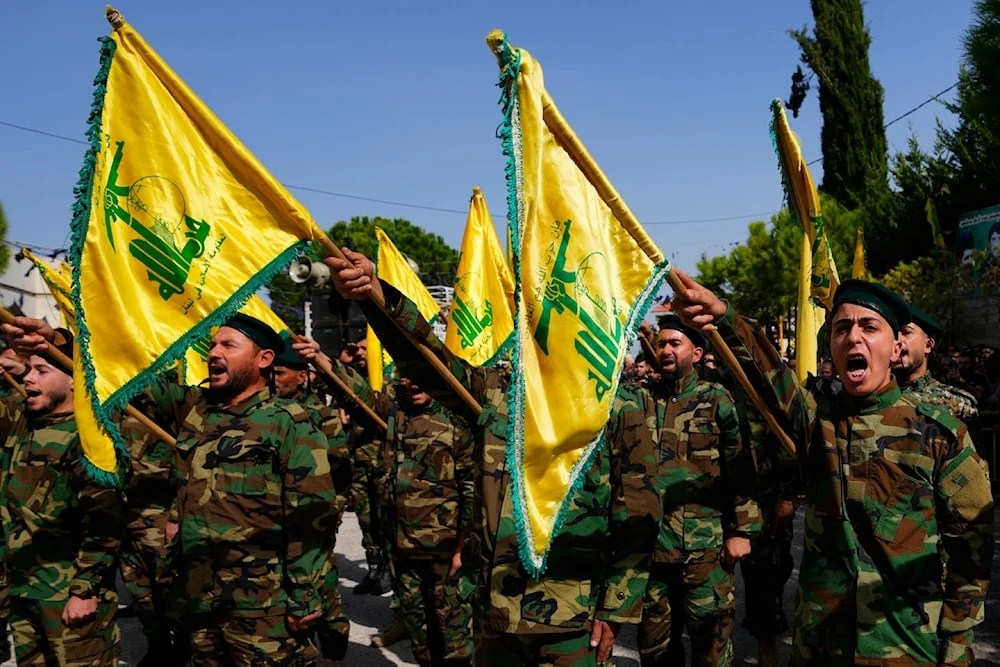
 Hezbollah fighters Oct 2023 AP
Al Mayadeen English
Heavy confrontations are ongoing between Lebanese Resistance fighters and Israeli occupation forces on the outskirts of the old market area in the southern town of Bint Jbeil, according to Al Mayadeen’s correspondent in southern Lebanon.
The correspondent described the fighting as intense, stating that Resistance fighters in Bint Jbeil are engaged in close-quarters combat with elite Israeli units. The report portrayed the confrontation as a fierce and sustained battle amid ongoing military pressure.
Despite continued airstrikes, artillery shelling, and a siege of the area, Israeli forces have so far failed to achieve any significant breakthrough in Bint Jbeil, with field reports indicating that Israeli troops have not yet reached key positions inside the town, including the municipal stadium, a symbolic site from which martyr Sayyed Hassan Nasrallah declared that “Israel” is “frailer than a spider’s web” following the liberation of South Lebanon on May 25, 2000.
Rising casualties
Israeli media reported that the commander of Battalion 52 was seriously injured today in battles in Bint Jbeil, southern Lebanon.
Moreover, a very large number of wounded Israeli occupation soldiers are suffering from limb injuries from battles in Lebanon, along with other types of injuries.
Throughout the day, Israeli army helicopters have been landing at hospitals carrying wounded soldiers from the front in Lebanon, Israeli media reported.
Earlier today, Israeli media reported that 10 soldiers from Battalion 101 of the Paratroopers Brigade were wounded overnight during close-quarters combat with Islamic Resistance fighters within the town.
According to the same sources, three of the wounded soldiers are in critical condition. The casualties were evacuated to hospitals, with some transported urgently by military helicopters while others were transferred by ground.
Bint Jbeil, the capital of resistance in South Lebanon
Bint Jbeil, a key city in southern Lebanon near the Israeli border, holds significant strategic importance due to its location overlooking multiple access routes into the border region.
Bint Jbeil overlooks key routes linking Maroun al-Ras to Tebnine, forming a main north–south corridor between the border and inland areas. It also connects westward to Aitaroun and Rmeish along roads running parallel to the frontier.
To the northeast, it links into the wider road network toward Tyre, making it an important logistics and movement hub. Its elevated terrain also provides oversight of nearby cross-border approach routes, enhancing its strategic value.
Control of the town provides operational depth and influence over nearby villages, making it a recurring focal point in confrontations between Israeli forces and Lebanese resistance groups.
Strategic weight
Beyond its military relevance, Bint Jbeil carries strong symbolic weight. It has long been referred to as the “capital of the Resistance,” reflecting its role in shaping narratives of defiance and resilience.
Historically, Bint Jbeil’s association with resistance dates back to the French Mandate period. On June 11, 1936, protests erupted in the town during what became known as the tobacco revolt, after French forces opened fire on demonstrators. The incident marked an early chapter in the town’s legacy of organized opposition.
During the Israeli occupation of southern Lebanon from June 6, 1982, to May 24, 2000, Bint Jbeil became a central site of armed resistance activity. The town witnessed repeated operations against Israeli forces and their allies, reinforcing its position as a stronghold for resistance operations in the region.
Additionally, the town’s municipality stadium, a center of focus in the current battles, bore witness to martyr Sayyed Hassan Nasrallah’s May 25, 2000 speech, in which he declared “Israel” to be “frailer than a spider’s web” following the expulsion of Israeli forces from southern Lebanon and ending its occupation.
The town’s modern symbolic status was cemented during the July 2006 war, particularly in the Battle of Bint Jbeil, where intense fighting took place between Israeli troops and Hezbollah fighters. The confrontation became one of the most high-profile engagements of the war and was widely portrayed as a defining moment by both sides.
Today, Bint Jbeil remains both a strategic objective and a symbolic prize in any escalation along the Lebanon-“Israel” frontier. Its history, geography, and political significance continue to ensure its central role in ongoing tensions in the region.

