ICE Admits To Databasing Americans And Creating Social Credit Scores – ‘We Have A Nice Little Database And Now You’re Considered A Domestic Terrorist’

ICE deploys mobile face biometrics to remotely monitor registered ...

The Winepress

ICE is deploying a new tool called ELITE, powered by Palantir, to track Americans and illegals, using predictive models and scores to determine where someone might travel so ICE can make arrests.

Last week, a clip on social media went viral that depicts an ICE agent in Portland, Maine telling a woman that she has photographed, filmed, placed in a database and is now considered a “domestic terrorist.”

Woman: “Why are you taking my information down?”

ICE: “Because we have a nice little database, and now you’re considered a domestic terrorist.”

[…]

This appears to be a reoccurring theme with ICE.

According to Ken Klippenstein, a federal law enforcement official with ICE told the investigative journalist that the Department of Homeland Security (DHS) has ordered immigration officers to gather identifying information about anyone filming them and to “send that information to Intel who will do a ‘work-up’ on them.” “Meaning, trying to identify them via social media, running their license plates if available, and running a criminal history check,” the anonymous federal source explained.

[…]

Klippenstein reported:

The directive is part of a sweeping, nationwide effort by U.S. immigration authorities to identify anyone and everyone trying to film their conduct. This includes not just ICE but other Department of Homeland Security agencies like Border Patrol as well.

[…] 

If you recall, ICE agents were seen filming Renee Nicole Good’s vehicle before she was fatally shot in the head several times.

[…]

This then begs the question, is this one of the underlying reasons why ICE is doing what they are doing? After all, they were given tons of new biometric tools from a new round of funding last year.

[…]

Last week, Biometric Update published a startling report on ICE’s AI predictive tool called ELITE, powered by Palantir. “Backed by $160 million in contracts, ICE’s dystopian tech enforcement architecture is straining long-standing legal boundaries,” said author Anthony Kimery.

[…]

Last summer, it was revealed President Donald Trump contracted Palantir to compile every American’s private and personal data, including DNA, to create a master database. A number of departments received access to Palantir’s products, particularly the DHS and Palantir’s Foundry software.

The WinePress has further explained what Palantir does in other reports and why there is so much controversy surrounding the company. Palantir founder Peter Thiel is a major donor to Donald Trump and JD Vance. Business Reform also had a good title for the company: “Palantir: Because There Are Some Lines Google Won’t Cross.”

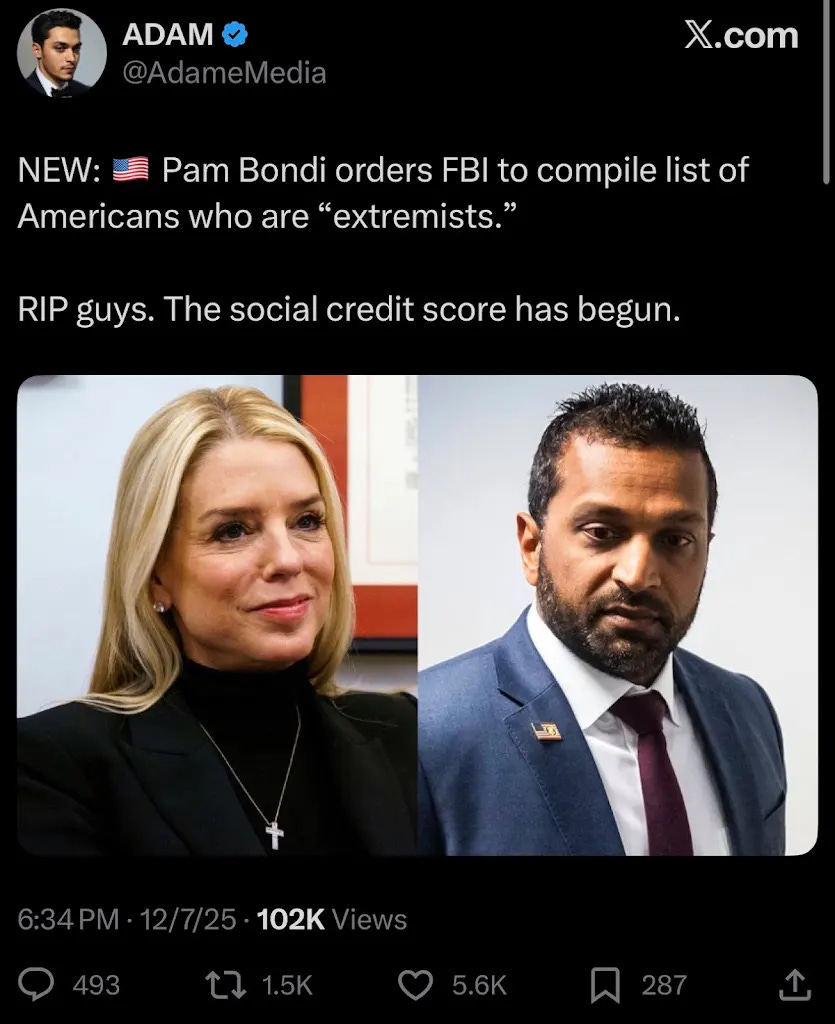
The Trump administration has already begun creating a list of “extremists” in the U.S.
[…]

But DHS and ICE have been given even more biometric tools to use at their disposal.

Building off of this databasing, ICE uses its cameras and phones for facial recognition to match identities in their database, even on children. Now a lawsuit has been filed after minors in Chicago were detained by ICE for not being able to provide legal ID, even though they are minors and were not granted state-registered IDs.

Again, as reported by Kimery from Biometric Update (excerpts):

When masked federal agents stopped two teenagers riding their bikes near an Illinois high school last fall, the encounter followed a now familiar script. The agents demanded proof of citizenship. One of the teenagers, who said he was 16 and a U.S. citizen, told the agents he had a school ID, but did not have it on him.

According to a lawsuit filed by the State of Illinois and the City of Chicago, one agent then asked another, “Can you do facial?” The other agent pointed a cell phone at the teenager, appearing to take a photo of his face.

That moment, captured not by body camera footage but by sworn allegations, has become emblematic of a shift now under legal scrutiny as mobile facial recognition expands into everyday encounters with children far from the border and outside the controlled settings DHS has traditionally used to justify biometric identification.

The lawsuit accuses the DHS, component agencies ICE and Customs and Border Protection (CBP), and senior Trump administration officials, of operating an unlawful interior enforcement regime built around coercive stops and the routine use of mobile biometric tools.

Among its most serious allegations is that DHS agents have used facial recognition on minors who are U.S. citizens without consent, individualized suspicion, or meaningful public limits on retention and sharing.

At the center of the case is DHS’s use of Mobile Fortify, a field-deployed application that scans fingerprints and performs facial recognition, then compares collected data against multiple DHS databases, including CBP’s Traveler Verification Service, Border Patrol systems, and Office of Biometric Identity Management’s Automated Biometric Identification System.

[…] The lawsuit cites a DHS Privacy Threshold Analysis stating that ICE agents may use Mobile Fortify when they “encounter an individual or associates of that individual,” and that agents “do not know an individual’s citizenship at the time of initial encounter” and use Mobile Fortify to determine or verify identity.

The same passage, as quoted in the complaint, authorizes collection in identifiable form “regardless of citizenship or immigration status,” acknowledging that a photo captured could be of a U.S. citizen or lawful permanent resident.

The lawsuit further alleges DHS retains biometric data collected through Mobile Fortify, regardless of citizenship or age, for up to fifteen years. If that claim is borne out, children subjected to brief street encounters could carry a biometric record into adulthood without being charged, arrested, or even suspected of wrongdoing.

DHS policy, according to the report, claims they have a respected age policy but there are no aptly defined guardrails.

Department-wide use of facial recognition and face capture technology was permitted under the Biden administration in 2023 issued under Directive 026-11. It states that DHS “does not collect, use, disseminate, or retain” biometric data for protected individuals including age, but “does not require parental notice or consent, does not mandate shortened retention periods for juvenile data, and does not impose a child-specific proportionality analysis,” Kimery noted.

The author adds:

That omission becomes decisive once facial recognition migrates from controlled checkpoints into coercive street encounters, where a teenager cannot meaningfully opt out and a child confronted by armed agents cannot meaningfully consent.

Directive 026-11 also draws a bright line around enforcement. It clearly states that facial recognition used for identification “may not be used as the sole basis for law or civil enforcement related actions,” and potential matches must be manually reviewed by human examiners before action is taken.

That safeguard reflects DHS’s recognition that facial recognition is probabilistic and context-dependent, and it is meant to prevent automation-driven enforcement.

In street-level encounters involving minors, however, a facial scan can function as de facto identity confirmation in real time, shaping how agents question, detain, or release a child, even if no arrest follows.

The lawsuit goes even further to assert that the Trump administration rescinded this directive sometime on or around February 14th, 2025.

Kimery concludes:

For minors, that uncertainty has a human cost. If children’s facial images are being captured during street encounters and retained for years, the public still lacks the basic documentation needed to understand how those images are stored, shared, audited, or removed.

[…] Memoranda of understanding governing biometric data sharing with state, local, or private partners are often withheld or heavily redacted. As a result, it is often impossible to trace how a child’s facial image moves from a brief encounter into DHS systems, vendor platforms, or partner databases, or whether it can ever be removed.

The consequences, however, are already playing out in public on sidewalks, near schools, and in the lives of children who may never know where their biometric identities now reside.

ICE agents confronting and detaining small children has increasingly occurred and come to the public forefront.
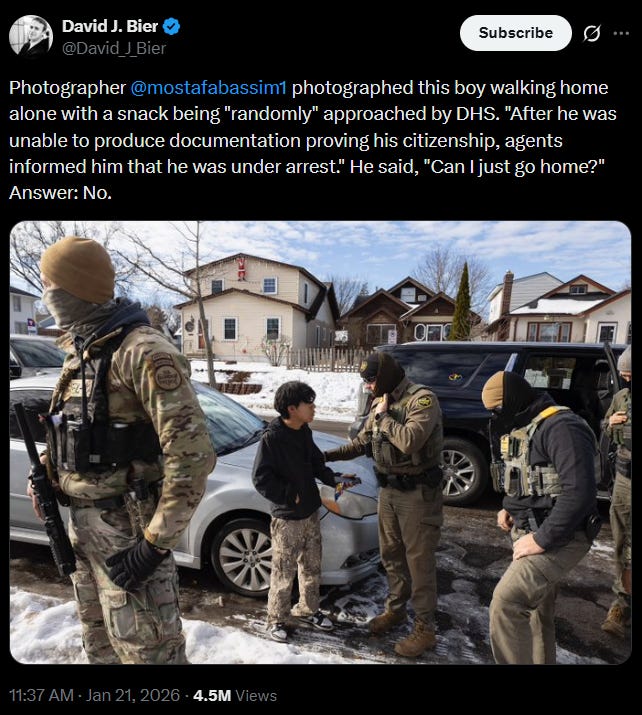
DHS plans to continue to invest in even more biometric technologies.

Last week, the DHS Science and Technology Directorate (S&T) published a Request for Information on different disciplines, to test and research, in the areas of include “behavioral economics and social science; communications and network systems; cybersecurity; software development and quality assurance; data science and analytics; biometrics; identity access and management; modeling and simulation; artificial intelligence; machine learning; autonomous systems; explosives; engineering; physics; biology; virology; and chemistry.”

[…]

This is how you know we live in an oppressive society, that filming ICE agents will get you listed as a domestic terrorist. What’s the big deal? If everything is fine then why the secrecy? Why are Americans being treated as terrorists in our own country?

But such oppression and tyranny has been implemented since 9/11 with the Patriot Act where legal citizens are seen as terrorists in order to save us from terrorists… and it was also after 9/11 under Bush the DHS was created in the first place. Constitutionally, this department should be illegal. But the same hypocrites who once chastised the Patriot Act and Bush’s so-called War on Global Terror, foreign and domestic, are now perfectly fine with it now. Of course, it has not directly affected this particular class of people; oh, but when it does eventually affect them then in some way, then they’ll whine and cry about their Constitutional rights.

It is important to emphasize that ICE under Trump has deported very few people, flying in the face of his campaign promises of mass-deportation, and has deported significantly less than President Obama and, at this pace, even President Biden, as I have previously documented; and once you remove self-deportations, the number really goes down.

[…]

As a matter of fact, this administration is lauding all the people they’ve turned illegal to legal. “Under the Trump admin, we’ve sped up our process and added integrity to the visa programs, to green cards, to all of that, but also more people are becoming naturalized under this admin than ever before. More people are becoming citizens,” DHS Secretary Kristi Noem said in November. Furthermore, this administration has been very taciturn on H-1B and other visa programs, and its refusal to seriously tighten the loopholes and abuses. Charging companies a fee does not solve the issue as big-tech especially will continue to pay out (and they are) to get these cheap wage workers on shore.

With this in mind —

I think we can now see why deportations are so low. ICE is not deporting, they are databasing. The DHS is being used to usher in digital ID and tokenized economics under the guise of tackling immigration.

Bear in mind also that Noem recently confirmed that ICE will be asking citizens to prove their identities, but REAL ID will not suffice in many cases.

[…]

So now ICE brags about databasing Americans — which bleeds into big-brother tech bros such as Palantir and Oracle, who will feed every little bit about us into their AI systems for the purpose of social credit scores, mass 24/7 surveillance, and retroactively affecting digital ID wallets in a tokenized economy.

It does not take a genius to see where this is all headed. As always, this right vs left fedslop psyop is designed to make you focus on the wrong things and not observe the nasty underbelly. Set up some bad actors and paid shills to go around and heckle ICE and police, wait for these severely undertrained and undisciplined ICE goons to make a new kneejerk and hair trigger response (literally), and then in comes broader militarization and tokenized social credit scores.

It also does not take a genius to see that this system will quickly expand to anyone who questions the administration and the polices of it.

[…]

Via https://thewinepress.substack.com/p/ice-admits-to-databasing-americans
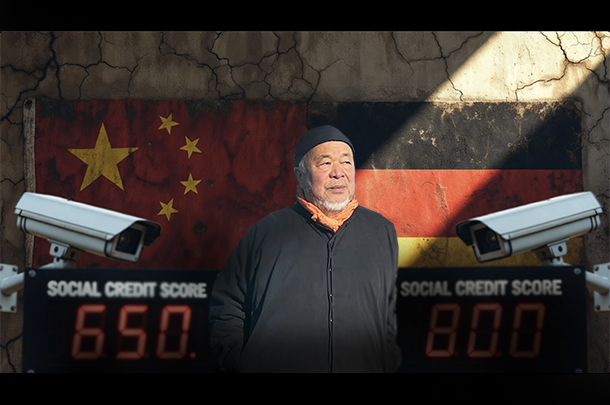
Chinese Dissident Ai Weiwei: China Feels Freer Than West

IMAGE: Between two worlds: Chinese dissident and artist Ai Weiwei.

Mats Nilsson
21st Century Wire 

[…]

In a world where narratives about freedom and authoritarianism are often painted in stark black and white, the words of Ai Weiwei, one of China’s, in the West most prominent dissident artists, have sent shockwaves through the European cultural scene, hurting our self-image. Ai, known for his bold critiques of the Chinese government, his iconic installations like the “Sunflower Seeds” at Tate Modern, and his 81-day detention in 2011, has long been a symbol of resistance against perceived oppression in his homeland.

Yet, after a decade in exile, living primarily in Germany, Ai’s recent return visit to China has led him to a startling conclusion: Beijing now feels “more humane” than Berlin, and Germany, once renown for its liberalism, comes across as “insecure and unfree.” This perspective, shared in a candid interview with the German newspaper Berliner Zeitung following his trip, challenges entrenched stereotypes and invites a deeper examination of how societal freedoms are experienced in daily life, in Europe of today.

Ai’s statements are not mere embellishment; they stem from personal encounters that highlight bureaucratic inefficiencies, social isolation, and institutional irrationality in the West, contrasted with the efficiency and warmth he rediscovered in China. But what underpins this shift? A closer look reveals that Ai’s observations align closely with the sweeping reforms outlined by Chinese President Xi Jinping in his seminal works, particularly the multi-volume series Xi Jinping: The Governance of China. These books, which compile Xi’s speeches, writings, and policy directives, emphasize streamlining governance, enhancing people’s livelihoods, and fostering a “people-centered” development model. Under Xi’s leadership since 2012, China has undergone transformations that prioritize efficiency, anti-corruption, and social harmony; elements that Ai implicitly praises through his anecdotes.

When I read about Ai’s new insights, and tying them to Xi’s reforms, I can suddenly argue that in practical terms, China may indeed offer a form of freedom that eludes many in the West today.

Weiwei’s story is one of displacement. Born in 1957, he grew up amid the tumult of the Cultural Revolution, with his father, the poet Ai Qing, exiled to a labor camp. Ai himself rose to global fame through art that critiqued power structures, such as his investigation into the 2008 Sichuan earthquake, which exposed local government negligence in school collapses. His activism led to clashes with Chinese authorities, culminating in his 2011 arrest on charges of tax evasion, a move in the West widely seen as politically motivated.

Released but stripped of his passport until 2015, Ai fled to Germany, where he was granted asylum and continued his work from Berlin and later Portugal. For ten years, Ai immersed himself in European life, producing art that often lambasted both Chinese and Western hypocrisies. Yet, his return visit to China in late 2025 marked a pivotal moment.

In the Berliner Zeitung interview, Ai describes Beijing not as the oppressive dystopia of Western media portrayals but as “a broken jade being perfectly reassembled“. He reports feeling no fear upon arrival, a stark contrast to his past experiences. Instead, he encountered a society that felt vibrant and accessible. “Perfectly ordinary people from at least five different professions lined up, hoping to meet me,” Ai recounts, highlighting a social openness that he found lacking in Germany.

This warmth, Ai suggests, extends to everyday interactions. In Germany, he laments, “almost no one has ever invited me to their home. Neighbors from above or below exchange at most a brief nod.” Such isolation, he argues, contributes to a sense of precariousness in Western societies. In China, by contrast, the immediate eagerness of strangers to connect reflects a cultural and social fabric that prioritizes community over individualism; a theme echoed in Xi’s reforms.

This also touches on the issue of bureaucracy and freedom. At the heart of Ai’s critique is the suffocating bureaucracy he encountered in Europe, which he claims makes daily life “at least ten times” more difficult than in China. A poignant example is his experience with banking. Upon returning to China, Ai reactivated a dormant bank account in mere minutes, discovering it still held “a considerable sum of money.” This seamless process stands in sharp relief to his ordeals in the West: “In Germany, my bank accounts were closed twice. And not just mine, but my girlfriend’s as well. In Switzerland, I was refused an account at the country’s largest bank, and another bank later closed my account there as well.”

Ai describes these incidents as “extraordinarily complicated and often irrational,” hinting at possible political motivations or overzealous compliance with anti-money laundering regulations that disproportionately affect outspoken figures like himself, and just recently struck US analyst and author Scott Ritter.

This disparity underscores a broader point about freedom: while Western democracies trumpet abstract rights like free speech, the practical exercise of freedom is often hampered by bureaucratic hindrances. In Germany, a country renowned for its efficiency in engineering, the administrative state can feel labyrinthine. Opening a bank account, registering a residence, or navigating healthcare requires layers of documentation, appointments, and verifications that can take weeks or months. Ai’s account stem from “de-risking” practices, where banks sever ties with high-profile clients to avoid regulatory government scrutiny; practices that have over the last four years intensified in Europe amid geopolitical tensions.

In contrast, China’s banking system under Xi has embraced digital innovation to enhance accessibility. Xi’s The Governance of China (Volume I, 2014) outlines reforms to modernize financial services, emphasizing “inclusive finance” to ensure even remote or dormant accounts remain functional. Through initiatives like the widespread adoption of mobile payment platforms such as WeChat Pay China has reduced bureaucratic hurdles, allowing transactions and account management to occur instantaneously via smartphones. Ai’s quick reactivation exemplifies this: no endless forms, no interrogations; just efficiency. This aligns with Xi’s push for “streamlining administration and delegating power,” a key reform pillar aimed at cutting red tape and boosting economic vitality.

Xi’s books repeatedly stress that true freedom emerges from governance that serves the people. In The Governance of China (Volume II, 2017), he discusses anti-corruption campaigns that have purged inefficiencies and graft from institutions, including banks. Since 2012, over 1.5 million officials have been disciplined, fostering a cleaner, more responsive system. This has translated into practical freedoms: the ability to access services without fear of arbitrary denial. Ai’s experience suggests that in China, freedom is not just rhetorical but operational, free from the “cold, rational, and deeply bureaucratic” constraints he felt in Germany.

Xi’s people-centered approach finds confirmation in Ai’s assertion that Beijing’s political climate feels “more natural and humane” than Germany’s. This in my humble view, point toward a deeper cultural and policy shift. Ai portrays Germany as a place where individuals feel “confined and precarious,” struggling under the weight of historical guilt and future uncertainties. This resonates with critiques of Western societies, where economic inequality, rising populism, and social fragmentation have eroded communal bonds. In Europe, the aftermath of the COVID-19 pandemic, coupled with energy crises and migration debates, has heightened a sense of insecurity. Ai’s social isolation in Germany, minimal neighborly interactions, mirrors surveys showing increasing loneliness in Western nations.

China, under Xi, has pursued a different path. Xi’s reforms, as detailed in The Governance of China (Volume III, 2020), prioritize “building a community with a shared future for mankind,” emphasizing social harmony and collective well-being. This includes massive poverty alleviation efforts, lifting nearly 100 million people out of extreme poverty by 2021: a feat Xi describes as ensuring “no one is left behind.”

Such policies foster a society where, as Ai observed in his interview, ordinary people eagerly engage with others, creating a humane environment. Moreover, Xi’s focus on cultural confidence has revitalized community ties. In Volume IV (2023), he advocates for “socialist core values” like civility and harmony, which manifest in everyday life through neighborhood committees, volunteer networks, and cultural events. Ai’s warm reception upon return; people from various professions seeking him out, reflects this. It’s a far cry from the European atomized individualism, where privacy norms can border on alienation.

Critics might argue that China’s harmony comes at the cost of dissent, pointing to tightened controls on expression under Xi. Yet, Ai’s lack of fear during his visit suggests a nuance: while political criticism remains sensitive, daily freedoms, economic mobility, social interaction, access to services, have expanded. Xi’s reforms include “rule of law” initiatives, with over 300 laws revised since 2012 to protect individual rights in non-political spheres. This “selective freedom” may feel more liberating in practice than the West’s today more abstract liberties.

One must also consider China’s economic transformations in this aspect. Xi’s books outline the “Chinese Dream” of national rejuvenation through innovation-driven growth. Reforms like the Belt and Road Initiative and dual circulation strategy have bolstered domestic resilience, reducing reliance on Western systems that Ai found unreliable. Xi critiques European protectionism in his writings, advocating for open economies. Ironically, Ai, once a Western darling, now embodies the pitfalls of this approach, his accounts closed perhaps due to his Chinese ties, highlighting how geopolitical insecurities undermine personal freedoms. In China, Xi’s anti-corruption drive has stabilized institutions, ensuring accounts like Ai’s remain intact despite dormancy. This stability contributes to the “unfree” feeling Ai ascribes to Germany, which he says, “plays the role of an insecure and unfree country, struggling to find its position between history and future.”

Xi’s reforms, by contrast, position China as forward-looking, with policies like the 14th Five-Year Plan emphasizing high-quality development and environmental sustainability, creating a sense of progress and security.

So, in conclusion, Weiwei’s reflections serve as a mirror—forcing the West to confront its own contradictions. Germany, with its history of division and reunification, symbolizes the democratic triumph, and yet, Ai’s experiences reveal cracks: overregulation, social coldness, and institutional paranoia.

This isn’t unique to Germany or the EU; similar issues plague the U.S. and U.K., where bureaucratic hurdles in immigration, healthcare, and finance frustrate citizens. Xi’s governance model offers an alternative: efficiency through centralization, humaneness through collectivism. While not without flaws, critics note surveillance and censorship, and so Ai’s endorsement suggests that for many, China’s system delivers tangible freedoms. His words directly challenge the binary of “free West vs. authoritarian East,” urging a reevaluation based on lived realities. Ai Weiwei’s declaration that China feels more humane and freer than Germany isn’t a reversal of his principles, but an evolution based on experience. It underscores the success of Xi Jinping’s reforms in creating a society where bureaucracy recedes, community thrives, and daily life flows unencumbered. As the world grapples with uncertainty, perhaps the West can learn from China’s jade-like reassembly, piecing together a more practical freedom for all?

[…]

Via https://21stcenturywire.com/2026/01/29/fanpan-is-china-turning-the-tables-on-the-democratic-west/

US returning seized Venezuelan oil tanker

US returning seized Venezuelan oil tanker – Reuters


RT

Washington is reportedly handing over the Panama-flagged M/T Sophia

The US is handing over to Venezuela an oil tanker it seized earlier this month, Reuters reported on Wednesday, citing two American officials speaking on condition of anonymity.

The officials did not provide a reason for returning the vessel, which they identified as the Panama-flagged supertanker M/T Sophia, interdicted by the US Coast Guard and military forces on January 7 while carrying oil. At the time of its seizure, Washington described the sanctioned Sophia as a “stateless, sanctioned dark fleet motor tanker.” One official told Reuters it was unclear if the oil was still on board.

The reported handover of the Sophia comes amid a shift in US policy towards the oil-rich state and easing of sanctions following the January 3 kidnapping of Venezuelan President Nicolas Maduro and subsequent engagement with the country’s interim leader Delcy Rodriguez.

Rodriguez has moved to align with key US demands, including opening Venezuela’s oil sector to American companies as part of a proposed $100 billion rebuilding plan. Trump has said the US plans to “control Venezuela’s oil resources indefinitely.”

The US has been enforcing a blockade on sanctioned Venezuelan oil exports for several weeks, having seized at least seven tankers it deemed were violating sanctions since late last year.

These included the seizure of a Russian-flagged vessel, the Marinera, which was captured on January 7 in the North Atlantic following allegations of violating oil sanctions against Venezuela.

Moscow condemned the move as a serious violation of maritime law and demanded the release of the detained sailors. On Wednesday, Russian Foreign Ministry spokeswoman Maria Zakharova confirmed that two Russian sailors from the Marinera had been freed and were on their way home.

[…]

Via https://www.rt.com/news/631706-us-venezuela-return-tanker/

Traders placing record bets on dollar collapse

Traders placing record bets on dollar collapse – Bloomberg

RT

The greenback’s plunge has been attributed to market turmoil created by US President Donald Trump’s policies

Traders are betting big that the US dollar will continue to fall amid uncertainty about Washington’s political and economic policies, Bloomberg has reported.

The dollar suffered its worst single-day decline in nearly a year on Tuesday, plunging to its lowest level since February 2022. The fall was part of a broader downtrend that began after US President Donald Trump launched sweeping global tariffs early last year. The resulting trade frictions, as well as expectations of Federal Reserve rate cuts and rising deficits and debt have been undermining confidence in the currency.

“US policy volatility is now debasing the dollar,” said Luis Costa, Citi’s head of emerging markets strategy. “This… is prompting a market reshuffle into dollar shorts.”

Bloomberg said options that profit from a falling dollar are now the most expensive since 2011, as traders use them as insurance against a drop. Markets are also more negative on the dollar’s long-term outlook than at any point since May 2025, the outlet noted. Rising investor anxiety is pushing up hedging costs, with short-term dollar volatility at its highest since September and demand for protection against large swings climbing, signaling traders expect further losses.

The dollar’s selloff this week came just after Trump dismissed concerns over the currency’s weakness, insisting that it’s “doing great.”

While a weaker dollar can help multinationals convert foreign profits and boost US exporters’ competitiveness, critics warn it also risks acting as a hidden tax on consumers, raising import costs, fueling inflation, harming foreign suppliers, and undermining the greenback’s global standing as a reserve currency.

US Treasury Secretary Scott Bessent on Wednesday argued that, over time, Trump’s economic policies will attract investment and help strengthen the greenback.

[…]

Via https://www.rt.com/business/631712-traders-bet-dollar-collapse/

Gold and Silver Dealers Start Restricting Buy Backs – May Soon Stop Buying Back Altogether

by Brian Shilhavy
Health Impact News

The fact that the rapid rise in value for gold and silver for the past few weeks could actually be negative, is a thought that had never crossed my mind, until this week, when I tried to sell some of my gold, and found out just how difficult it was, and may soon be impossible.

I want to be very clear here that I am not offering financial advice, and that this article is ONLY about people who own physical gold and silver that they have in their possession. It has nothing to do with “paper gold” such as precious metal stocks and ETFs that are used for investments and a part of people’s investment portfolios which are traded on Wall Street.

I have almost no experience in that. There are a gazillion people on the Internet doing that already.

My own gold and silver coins are in a secure safe and bolted to the concrete base of the house where I stay.

Yesterday, January 27, 2026, I went to a local jewelry store where I have sold gold coins in the past, as I wanted to redeem some gold coins for a major purchase that was planned for this weekend.

I have been to this place several times in the past when I needed to cash in some gold, and know the management quite well. Their usual rate for gold bullion is $50 below spot, which is very competitive. Sometimes if I had a gold collector coin, I could bargain them down to $20 or $30 below spot.

When I walked in yesterday, the place was packed and there were more people there than I had ever seen before. When I got up to the teller and presented my gold, he looked up at a monitor and stated: “Our buy back price just went from 98% of spot, to 97% percent of spot, as the spot price just jumped again.”

He also stated that they were not paying out in cash, but only by check, and it was limited to one ounce of gold, about $5000.00, and that everything else above that would be paid by check after two weeks.

Wow! There went my plans to make a major purchase by this weekend!

Then the bomb fell. The guy who runs the place, who I like very well because he is non-partisan and, like me, believes that both political parties who run this country are equally corrupt, said to me:

You’re lucky we’re buying any gold at all.

He went on to explain that his buyers were stiffing him, and some invoices were already 60 days late in paying him.

Then he said:

If we wake up tomorrow, and the price of gold has shot up to $10,000 an ounce, we’re all going to suffer.

So I sold only one coin so I could get a check to deposit, and he told me I could come back in 24 hours and get another check of the same amount, providing that gold did not go up too high overnight.

Well, I live over an hour away from this place, so it is 2 hours of my time, minimum, just to sell some gold.

So when I got back, I checked to see if I could sell more online.

I have in the past sold gold online through the popular website, APMEX, one of the largest businesses that sells and buys gold in the U.S. And it is fast. Usually the entire transaction can happen in a few days with money deposited directly into one’s account.

The first thing I saw on the APMEX site to sell gold back to them was this message:

Due to record volume we currently have a $20,000 minimum on buy back orders.

Well, I wasn’t sure I wanted to sell that much, but I started the procedure from this page to get an instant quote, to see how they compared to the local jewelry shop who was now only offering me 97% of the spot price.

I made sure I entered in about 5 oz. of gold to meet the $20,000 minimum in order to get the quote.

But when I hit “submit”, it gave me an instant quote that was less than $10,000.00! That was obviously a mistake, and either a glitch in their software (is AI now running everything??), or they just did not want to provide a quote above $20,000 because they really did not want to buy any gold at all right now with the price increasing so fast.

The other option they give is to call them, where you tell them what you want to sell, and then get a quote that way.

So I tried that. Here is the message I received:

So then I went and read the “Update from the CEO“, which was published on Jan. 26th, two days before I am writing this article.

January 26, 2026

Dear Valued Customer,

In an effort not to sound like a record on repeat, markets continue to accelerate.  Gold, silver, and platinum continue to set record highs, hitting levels many of us could not have imagined in such a short period of time.  We are experiencing volumes that we have not seen in our history.  This past weekend alone, order volume reached nearly seven times that of a normal weekend.

Compounding these challenges, Oklahoma City experienced one of the largest snow events in its history. We will always put the safety of our employees first, resulting in the shutdown of fulfillment and our mint for the weekend. We are up to 70% strength today and should be back to full strength by tomorrow. (Full update here.)

Now to be fair to APMEX, which is the only place I would recommend to anyone wanting to purchase or sell gold and silver online, I checked again before making my second trip the local jewelry store an hour away today.

I tried the same process again of getting a quote from their site as I had the day before, and this time when I clicked on “Submit”, I did NOT get a pop up instant quote with a timer ticking down, but was just informed that someone would email me within two business hours.

I didn’t wait the full two hours as I couldn’t, but when I got back I did have a quote from someone by email.

I checked the time the email came in, then used a graph from a financial site to see how much the gold spot value was during the day and chose the one that was the exact same time as the email came in, and it was 96% of spot, a full percentage point lower than what I got at the local jewelry store which gave me 97%.

And of course if I had chosen APMEX, they had already stated they would not even process my package for 8 business days after they received it.

I checked some other popular websites that buy gold and silver, and for those that had a warning about buy backs, this was the most common message:

Yeah, and the part of that message that is dangerous is the “+“, which is open-ended and could turn to much longer times (months?) if this crisis continues.

Again, I am not giving anyone financial advice. I am calling this an “EXCLUSIVE” report because it is MY personal experience for the past two days.

And because almost everyone else invests in “paper gold”, I searched online and just did not see anyone else talking about this, yet (although I am sure there are some). Everyone seems to be in pure euphoria right now thinking that as the price of gold keeps going up, they are going to be rich.

I just always assumed that anytime I needed some quick cash I could just redeem some gold coins. But when my friend at the jewelry store told me yesterday “You’re lucky we’re buying any gold at all,” I realized that I had to adjust my thinking about my own physical gold quite a bit.

This is a liquidity crisis, and that crisis is here RIGHT NOW! The top dogs on the ladder of this liquidity crisis are, of course, the banks, and there are rumors that have been going around that some of these banks, like Chase Bank, have already been bailed out due to liquidity issues, especially silver which has probably never moved this fast in price in my lifetime.

They will never admit this, of course, because it will cause panic and bank runs, similar to what we saw in 2023 with the Silicon Valley bank runs.

I’ve always kept some cold hard cash on hand, mostly in $20 bills, for the day when the ATMs shut down and you can no longer get your money out of the bank.

What we have seen recently, is that when local storms come through and take down the grid, many local businesses, including gas stations, will only accept cash, because they cannot run credit cards without electricity.

I also own a lot of Lady Liberty silver coins, but I don’t sell those, because even if the price of silver hits a few hundred dollars per oz., if cash runs out in a down grid scenario, a lot of people will probably take a silver coin for barter.

But if you are holding on to your gold because you fully expect the price will keep rising (as it probably will), consider the facts I just learned the past two days, that this is not necessarily a good thing.

If your gold 1 oz coin or bullion bar all of a sudden is worth $10,000 an ounce based on the spot price, how are you going to spend it in a down-grid scenario?

Do you think you can drive in to your local gas station and ask them to fill your tank, and then give them a $10,000 gold coin, and they are going to give you change back?? Not a chance….

[…]

Via https://healthimpactnews.com/2026/exclusive-gold-and-silver-dealers-start-restricting-buy-backs-may-soon-stop-purchasing-altogether/

Who is Funding the ICE Riots?

[…]

Who is organizing the anti-ICE protests? Indivisible, ACLU, and Public Citizen.

Indivisible

Registered with the IRS. Based in Washington, DC. They have an Action PAC with 2,413 donors in 2024. Their donors are listed on Open Secrets. One such donor is Families USA Foundation which played a significant role in enacting Obama’s ACA. Their director is Frederick Isasi, JD. They have a Wikipedia page. WHY doesn’t the FBI investigate? 

There are two directors running Indivisible: Leah Greenberg and Ezra Levin. They are married. They have been featured in the NYT, WAPO, CNN, MSNBC, etc. Ezra wrote a book. They are Jewish and have a national presence. Why isn’t Homeland Security investigating them for inciting the ICE riots?

Public Citizen

A registered 501©(3) whose board consists of members of the Public Citizen Foundation:

  • Halperin – special assistant for national security under Clinton.
  • Robert Weissman – JD.
  • Gerson Smoger – Trial Lawyer of The Year – 2012.
  • Annie Leonard – Director of Greenpeace.
  • Mark Chavez – former Civil Division of the DOJ.
  • Jim Bildner – Managing Director for The Fund For Sustainability.

They have sued the Trump administration 30 times since the inauguration. IF their actions are the source of the anti-Ice riots, why isn’t the FBI investigating them? The DOJ?

Cutting off the source of the riots would seem a ‘strategy’ to impede the riots. But our Department of Justice is too entangled with writing ‘stern letters’. Our FBI is defending Patel’s girlfriend from tweets, and Kristi Noem can’t decide which lipstick to wear to a raid. This is what happens when you hire incompetent people to run government agencies.

Who is training ICE?

Immigration and Customs Enforcement held job expos in multiple cities and dangled $50,000 bonuses, student-loan forgiveness, and other perks before potential recruits. 12,000 new recruits were hired. ICE agents are trained in Israel by the IDF. An ongoing arrangement since the early 2000’s. Training has focused on areas such as counter-terrorism, surveillance, crowd control, and border enforcement.

A retired army officer, Anthony Aguilar, has produced whistleblower videos in which he details the training as exploited by Israel – paid for by Homeland Security. Exchanges between the U.S. and Israeli police and military agencies are organized by a range of actors, including private companies both in the U.S. and Israel, non-profit organizations, and governmental agencies.

Those agencies include: Security Solutions International, Georgia Law Enforcement and Exchange, Jewish Voice For Peace, ADL, Jewish Institute for National Security Affairs, AIPAC, etc.

Security Solutions International’s website offers different training courses for the US government including Department of War, Homeland Security, FEMA, FBI, etc. Their website highlights one particular methodology: Advanced Israel Training – run by Henry Morgenstern, a US and Israeli citizen educated in the UK who contracts directly with Homeland Security and the intelligence community. Recruits are funded by the FBI thru the Joint Terrorism Task Force and FEMA via Urban Area Security Initiative.

The Director of SSI is Sol Bradman, a pilot operating out of Miami.

In essence, the reason our Israeli First government is NOT investigating who is funding the ICE riots is because they are funded by Israel with US government/taxpayer funds. We are funding the protests, then sending in ICE to disrupt the protests using IDF tactics of the Hannibal directive wherein human life is dispensable.

This is how the US pursues ‘criminal’ illegals like hunted animals – we bring them into America, hunt them down, organize riots, torture and kill whoever gets in the way, and use taxpayer funds for the GAME. 100% immunity guaranteed. Black book mercenaries.

[…]

Via https://www.globalresearch.ca/ice-trained-israel-funding-fbi-homeland-security-dod/5913702

Venezuela’s Rodríguez rejects US push to cut ties with China, Russia, Iran

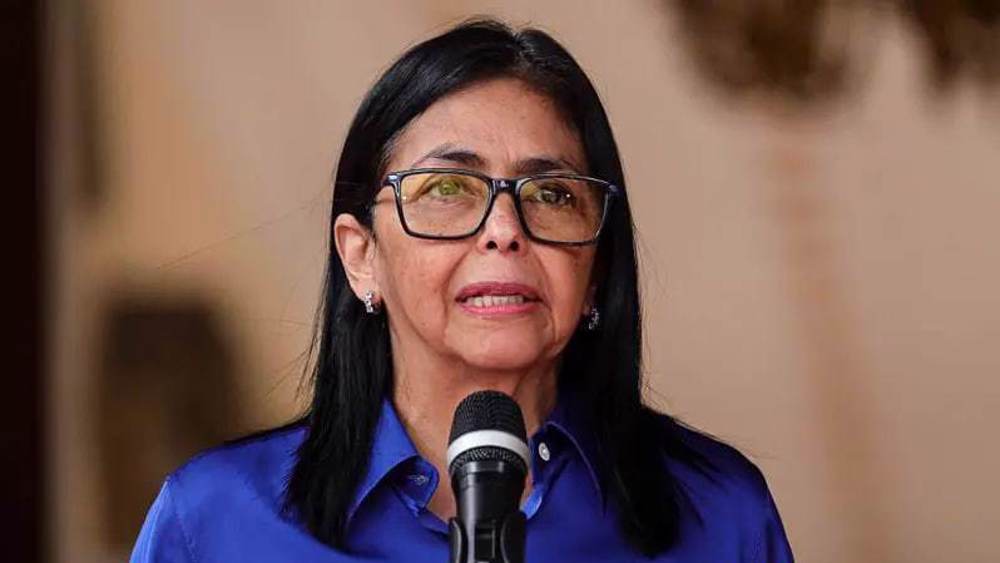
Venezuela’s interim President Delcy Rodriguez speaks during a press conference at Miraflores Presidential Palace in Caracas, Venezuela on January 14, 2026.(Photo by AFP)

Press TV

US intelligence reports indicate that Venezuela’s interim president, Delcy Rodríguez, is resisting Washington’s push to realign the country’s foreign partnerships.

The assessments have raised doubts about whether Rodríguez will fully comply with Washington’s demands to sever ties with Iran, China, and Russia.

Venezuela, home to some of the world’s largest proven oil reserves, has become central to Washington’s pressure campaign to curb the influence of rival powers in the Western Hemisphere.

Trump has repeatedly demanded that Caracas expel diplomats and advisers from allied countries.

Representatives from all the three countries attended Rodríguez’s swearing-in earlier this month, following the US raid on the country that led to the kidnapping of President Nicolás Maduro on January 3.

In mid-January, the US President Donald Trump claimed he held a “long call” with Rodríguez, describing her as “a terrific person.” He later said the two discussed “many topics,” including oil, minerals, trade and national security, and claimed they had made “tremendous progress.”

Rodríguez, who has said she is working to unify the country after the US abduction of Maduro, has since signaled resistance to Washington’s pressure.

Nearly a month into her interim role, she said Venezuela has had “enough” of US interference.

“Enough already of Washington’s orders over politicians in Venezuela,” Rodríguez told oil workers in the city of Puerto La Cruz on Sunday.

“This republic has paid a very high price for confronting the consequences of fascism and extremism in our country,” she added.

US officials are now developing contacts with senior Venezuelan military and security figures in case Washington decides to change its approach, a source on Venezuela policy told Reuters.

Since the attack on the country, the US has also sought greater access to Venezuela’s energy sector. A senior Trump administration official said the president “continues to exert maximum leverage” and expects cooperation from the country’s leadership.

Washington is also moving to establish a permanent Central Intelligence Agency (CIA) presence inside Venezuela. CNN reported on Tuesday that the agency is quietly expanding its footprint, meeting local officials, monitoring political opponents, and shaping the policies of the new leadership.

The report said that the Trump administration is likely to rely heavily on the CIA to lead the initial re-entry into the country.

Trump has openly acknowledged that a central objective of the military action against Venezuela was control over its oil sector — underscoring a long US history of violence and imperial domination in Latin America.

[…]

Via https://www.presstv.ir/Detail/2026/01/28/763091/US-intelligence-doubts-Venezuela-interim-leader-leader-Delcy-Rodr%C3%ADguez-cooperation-adversaries-Iran-China-Russia-Oil-resources

US unblocks Venezuelan assets – interim president

US unblocks Venezuelan assets – interim president


RT

Washington is reportedly sitting on $30 billion worth of the South American nation’s property

The US has unfrozen some of Venezuela’s impounded assets, acting President Delcy Rodriguez has announced. Rodriguez said the money will be spent on hospital equipment and power infrastructure.

Speaking on national television on Tuesday, Rodriguez said she had spoken to US President Donald Trump and Secretary of State Marco Rubio with “respect and courtesy,” and that the unblocked funds would be used to purchase hospital equipment from the US “and other countries.”

“We are unblocking Venezuelan resources that belong to the Venezuelan people… and this will allow us to invest significant resources in equipment for hospitals,” she said. Rodriguez added that Venezuela will also purchase “equipment for the electricity sector and equipment for the gas industry” with the funds.

Rodriguez did not say what amount of assets would be released. President Nicolas Maduro claimed in 2022 that around $30 billion worth of Venezuelan assets were frozen abroad. These include oil impounded by the US and around $2 billion worth of gold frozen in the UK.

Maduro was abducted by US forces earlier this month and charged with narcoterrorism, cocaine trafficking, and firearms offenses. Rodriguez has denounced the kidnapping of Maduro, but has attempted to placate Washington – namely by allowing US companies to run the South American nation’s oil industry.

Venezuela’s oil industry was nationalized in 1976, with American contractors slapped with further restrictions by Maduro’s predecessor, Hugo Chavez, in 2007. Trump has repeatedly claimed that these moves amounted to Venezuela “stealing” oil infrastructure built by US firms.

Trump has warned that if Rodriguez “doesn’t do what’s right, she is going to pay a very big price, probably bigger than Maduro.” The US president spoke with Rodriguez by phone last week, and announced plans to invite her to the White House.

Rodriguez insisted on Sunday that she had enough of “Washington’s orders,” and that Venezuelans alone would “resolve our differences and our internal conflicts.” Asked on Tuesday about Rodriguez’ comments, Trump replied: “I haven’t heard that at all. We have a very good relationship.”

[…]

Via https://www.rt.com/news/631663-us-unblocks-venezuela-assets/

Trump: Cuba will soon collapse

Cuba will soon collapse – Trump

RT

The island nation will not be getting any oil from Venezuela, the US president has said

Cuba is about to collapse “pretty soon,” US President Donald Trump has claimed. His words came amid reports that Washington is planning a total oil blockade of the island nation in a bid to instigate a coup against President Miguel Diaz-Canel.

After abducting Venezuelan President Nicolas Maduro earlier this month, the US has set its sights on Cuba, which Trump claims is “ready to fall” next. Speaking to reporters during a trip to Iowa on Tuesday, the US president stated that “Cuba is really a nation that is very close to falling.” According to the president, Havana was getting oil and money from Caracas, but that it would not be getting them “anymore.”

Shortly after Maduro’s kidnapping, Trump said Washington would “run” Venezuela during a transitional period and needs “total access… to the oil and to other things in their country.” US Energy Secretary Chris Wright has stated that Washington intends to control Venezuela’s oil sales “indefinitely.”

Venezuela’s interim president, Delcy Rodriguez, who was sworn in after Maduro’s capture, declared that no “foreign agent” would control Venezuela or turn it into a “colony.” She still tried to placate Washington by opening Venezuela’s oil sector to American companies.

Last week, Politico reported that the US was planning an oil blockade of Cuba to place it in a “chokehold to kill the regime.” Earlier, the Wall Street Journal also reported that Washington was looking for Cuban government insiders to help orchestrate a regime-change operation by the end of the year.

Cuba has been under a US trade embargo since the 1960s, but it has not faced the prospect of an American naval blockade since 1962, when President John F. Kennedy placed it under “quarantine” for 13 days to prevent the transfer of Soviet missiles to the Cuban military.

Diaz-Canel earlier dismissed Trump’s threats by saying that “nobody dictates what we do.” Moscow also condemned what it called the “language of blackmail and threats” against Cuba as well as decades of “illegitimate and illegal sanctions” by the US.

[…]

Via https://www.rt.com/news/631670-cuba-collapse-soon-trump/

Introduction to the Islamic Golden Age

Uncovering the Golden Age of Islamic Civilization

From Camels to Stars in the Middle East

Islamic Golden Age (2017)

By Eamon Gearon

Film Review

Eamon Gearon introduces this lecture series by describing a solo trip he took across the Sahara and the training he got from Bedouin nomads on caring for his camels and using the stars to navigate. Thee Arab names Islamic astronomers gave many of our stars (eg Betelgeuse, Sirius and Algol) during the Islamic Golden Age persist to the present day.

Gearon dates the Islamic Golden Age from 750-1258 AD, with its pinnacle 813-833 AD under Caliph al Ma’mun. He dates the start of the Islamic Golden Age to the overthrow of the Umayyad Caliphate in 750 AD by the Abbasid dynasty (who moved the Islamic capitol from Damascus to Bagdad). Although most scholars date the end of the the Golden Age to the Mongol’s 1258 sack of Baghdad Gearon maintains Baghdad’s ecumenical scholarship continued after that date.

During the Golden Age, Baghdad was the world’s largest city, enjoying unprecedented economic and political stability thanks to a vast empire extending across Saudi Arabia, the Middle East, Persia, the Levant, North Africa and Europe’s Iberian peninsula.

Under the first Abbasid caliph Harun al-Rashid (786-809 AD) the caliphate established houses of wisdom in Baghdad, where Christian, Jewish and Muslim scholars,  translated classical texts on science, medicine, history and philosophy to build a collective body of global wisdom. This translation movement prevented the loss of much ancient wisdom from Greek and Roman times.The houses of wisdom also conducted experiments in optic, medicine and mathematics and built water fountains, mechanical toys and clocks. These ideas and inventions rapidly spread across the Islamic empire, leading to rival intellectual centers in Cordova (in Andalusia on the Iberian peninsula), Cairo and Samarkan.

In the 10th century Cairo became the global center for astronomy and math, guided by Ibn al-Hagtham (965-1040 AD), whose ground breaking experiments in optics influenced da Vinci. In the 12th century the center of Islamic scholarship moved to Cordova, influenced by

  • Ibn Rashid (1126-1198 AD) – a Muslim scholar who defended Aristotle’s rationalism and applied it to Jewish, Christian and Islamic philosophy.
  • Moses Maimonides (1135-1204 AD) – one of the greatest Talmudic scholars who helped usher in the golden age of Jewish culture in Andalusia. Their golden age ended in 1168,  when a new caliphate forced Jews to convert to Islam or leave the Iberian peninsula.

https://www.kanopy.com/en/pukeariki/watch/video/5756987/5756989