Pfizer mRNA Found in Over 88% of Human Placentas, Sperm, and Blood — and in 50% of Unvaccinated Pregnant Women

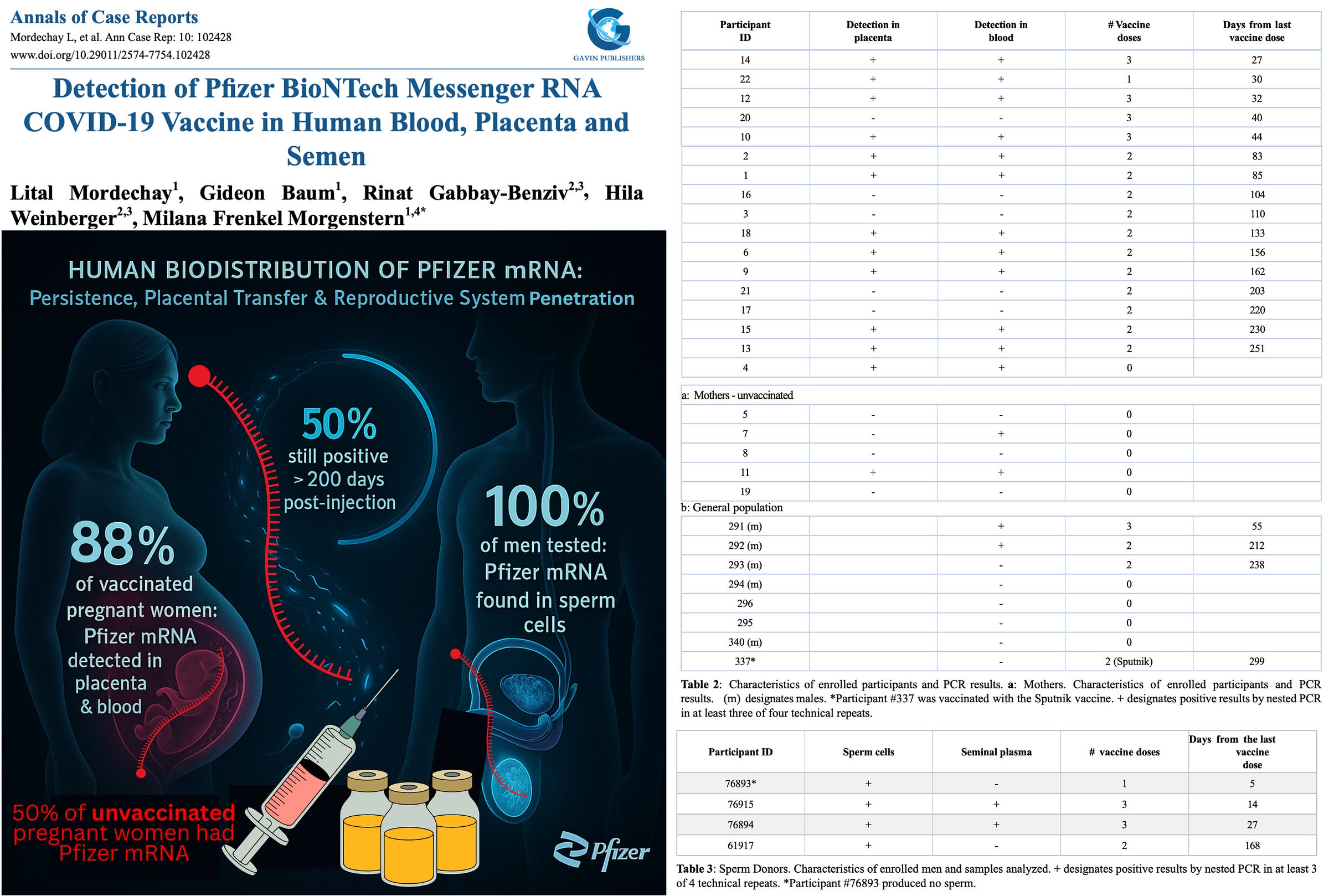
A new peer-reviewed study published in Annals of Case Reports titled, Detection of Pfizer BioNTech Messenger RNA COVID-19 Vaccine in Human Blood, Placenta and Semen, ends that narrative.

Researchers from Bar-Ilan University and several Israeli medical centers used nested PCR combined with Sanger sequencing—a far more sensitive and specific method than the standard qPCR used in earlier studies—to test for Pfizer mRNA in human tissues from 34 participants, including 22 pregnant women, 4 male sperm donors (8 samples), and 8 additional adults.

Their findings are deeply worrisome: 88% of pregnant women vaccinated within the last 100 days showed detectable Pfizer mRNA in both blood and placental tissue. Among male sperm donors, 100% of those who produced sperm had vaccine mRNA in their sperm cells, and 50% had it detectable in seminal fluid—long after vaccination.

Even more concerning, Pfizer mRNA was detected in 50% of the unvaccinated women tested —two in both placenta and blood, and one in blood alone; a result that forces the scientific community to confront the reality of shedding, something officials categorically deny.

Most striking of all, mRNA was still present in 50% of individuals more than 200 days after injection.

This is the clearest evidence to date that the injection does not degrade “within hours”—but instead persists, circulates, and deposits into human reproductive and fetal tissues.

The implications are enormous.


METHODS: WHY THIS STUDY SUCCEEDS WHERE OTHERS FAILED

One of the strongest aspects of this paper is the methodology. Where previous studies failed to detect vaccine mRNA, the authors explain exactly why: they were using qPCR, which lacks the sensitivity to detect low-abundance RNA months after injection. The new study instead used nested PCR, a two-step amplification technique that dramatically increases sensitivity and specificity, followed by Sanger sequencing, which literally reads the amplified sequence and confirms it matches the Pfizer construct. Each positive result was only considered valid if it appeared in at least three of four independent technical repeats, further reducing any chance that background noise or accidental contamination was driving the findings.

This approach is also fundamentally different from the PCR tests used during the pandemic to diagnose “COVID cases.” Those tests relied on single-step qPCR run at extremely high cycle thresholds—often 35–45 cycles—where background noise, trace contamination, and harmless RNA fragments can generate false positives. The method used in this new study, by contrast, requires two successful rounds of primer binding and amplification, reproducibility across multiple repeats, and then an independent sequencing confirmation to verify the identity of the product.

In other words, the COVID diagnostic PCR could detect any fragment of viral RNA and label it a “positive,” while this study’s nested PCR plus sequencing can only detect one thing: the exact Pfizer mRNA sequence, verified letter-by-letter.

This means the researchers were not detecting “noise”—they were detecting true, molecularly confirmed vaccine mRNA. It is the most definitive approach yet applied to this question.


Vaccine mRNA detected in the placenta

88% of women vaccinated within 100 days of delivery had detectable mRNA in both blood and placenta. Even after 230–251 days, vaccine RNA was still found in some placentas.

This directly contradicts every official statement claiming mRNA “does not reach the placenta.”


mRNA detected in sperm and seminal fluid

Of the four vaccinated men tested:

  • Three produced viable sperm—and 100% of them had Pfizer mRNA in their sperm cells.
  • Two had detectable mRNA in seminal plasma.
  • One man vaccinated 168 days earlier still had mRNA present in sperm.

This raises profound questions about male fertility, germline exposure, and the possibility of transmission.


Long-term persistence

Across blood and placental tissue:

Half of individuals tested more than 200 days after vaccination still had detectable Pfizer mRNA.

This is far beyond what Pfizer, regulators and public health authorities have claimed.


mRNA detected in unvaccinated pregnant women

Perhaps the most shocking finding:

50% of unvaccinated pregnant women had detectable Pfizer mRNA.

Two unvaccinated pregnant women had Pfizer mRNA in both their blood and placenta.

A third unvaccinated woman had mRNA in her blood alone.

The authors state plainly: “The source of this RNA has yet to be investigated.”

This appears to be the first direct evidence of mRNA vaccine shedding.


CONCLUSIONS

These results carry enormous implications. They confirm that the mRNA does not stay at the injection site; it does not rapidly degrade; it does reach the placenta; and it does enter the reproductive organs.

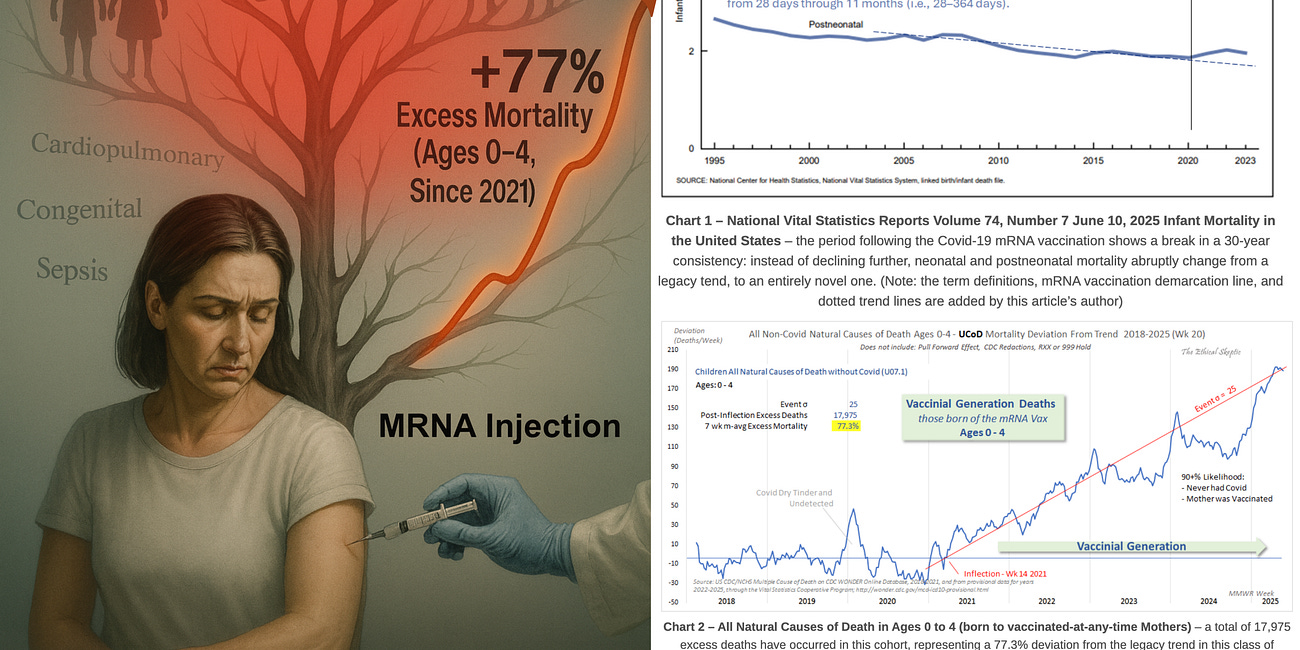
This verifies the biological mechanism behind delayed serious adverse events and also explains transgenerational adverse events—why babies born to vaccinated mothers are now dying at high excess rates even years later.

BREAKING: CDC Child Death Records Indicate Severe Transgenerational Harm of Mass mRNA Vaccination

BREAKING: CDC Child Death Records Indicate Severe Transgenerational Harm of Mass mRNA Vaccination

by Nicolas Hulscher, MPH

And beyond these concerns, the unvaccinated positives raise the specter that shedding is indeed real.

In conclusion, this study demonstrates:

  • Long-term persistence
  • Systemic distribution
  • Reproductive system exposure
  • Placental exposure
  • Possible shedding to unvaccinated individuals

This should immediately trigger market withdrawal and apologies to the public for inflicting grave harm based on fraudulent assumptions.

As more evidence accumulates each week, the legal ramifications for allowing these products to remain on the market become ever more severe.

[…]

Via https://www.thefocalpoints.com/p/breaking-study-pfizer-mrna-found

The Link Between Transgenderism and Autism

Chloe Cole, who began transitioning at age 12 and now regrets surgically removing her breasts, holds testosterone medication used for transgender patients in Northern California on Aug. 26, 2022. John Fredricks/The Epoch Times

Zero Hedge

Cole began identifying as a boy during adolescence and sought physical changes to match.

Doctors readily consented to medical intervention. They prescribed puberty blockers and testosterone at age 13. At 15, surgeons performed a double mastectomy, she told The Epoch Times.

But doctors didn’t address her neurological issues first. The same gender specialist who referred her for breast surgery later referred her for autism screening. Cole has described herself as being on the autism spectrum, but said she was never formally diagnosed.

Cole is now a leading campaigner against interventions to transition children with gender dysphoria.

She said many of those she knew personally when she was involved in the transgender community, as well as many of the detransitioners she knows, “are either somewhere on the autism spectrum, or they have been diagnosed with similar conditions, like ADHD.”

Her observations are increasingly supported by research. For at least a decade, studies have reported links among transgender identity, autism, and other neurological conditions. These connections have recently gained greater public attention.

Growing evidence of an autism–transgender link is already prompting some nations to recommend neurological screening before intervention. In America, the treatment model remains unchanged, and the predominant “affirmation” model makes the link difficult to investigate.

Autism and Gender Dysphoria

A report published this month by the British think tank Centre for Social Justice showed that autism and ADHD were “overrepresented,” or disproportionately high, among youth with gender dysphoria.

​The report, citing data from the UK’s National Health Service, showed 32.4 percent of gender dysphoria referrals had an autism diagnosis, and 11.7 percent had an ADHD diagnosis. ​

Those numbers were 16 times higher than the national population averages for autism, and more than twice as high for ADHD. The population-wide averages for autism and ADHD in the United Kingdom are estimated at 2 percent and 5 percent, respectively.

Individuals with autism spectrum disorder are far more likely to identify as transgender,” Joseph Nicolosi Jr., a licensed clinical psychologist and researcher in California, told The Epoch Times via email.

A pair of studies conducted in 2016 and 2019 indicate that autistic children are between four and seven times more likely to experience gender dysphoria or gender variance, he said. A 2019 study was conducted by researchers at the Uniformed Services University of the Health Sciences, and a 2016 study was conducted at New York University.

Nicolosi said there are several reasons for the connection, including “rigid thinking.”

​For example, if a boy with autism lacks stereotypical male interests, he may doubt he is a boy and assume he must be a girl. Reading social cues is often hard for those with autism, so they may perceive same-sex peers as getting along better than they do.

​“This heightens their sense of alienation from their peers,” Nicolosi said.

Cole recalled having difficulty coping with her body beginning to mature around the fourth grade, younger than most of her peers.

“The older I got, the less I associated with femininity, and I didn’t really feel like I fit in—especially with my female peers—but with my peers in general,” she said.

It’s a common sentiment amongst people who have either ADHD or autism.

Erin Friday, who gained national attention for successfully steering her ADHD daughter away from identifying as a transgender male, said she knows many detransitioners who are on the autism spectrum. A detransitioner is someone who had previously taken steps to transition to the opposite gender.

But most of the medical community doesn’t recognize transgender identity as a maladaptive coping mechanism, she told The Epoch Times.

They view autism and transgender identity as complementary and natural, instead of looking at causality, she said.

“This is the intersection of autism and transgenderism, like peas and carrots, it goes together,” Friday said. “They’re not even looking at … what is the causality?”

She observed that some hospitals offering pediatric transgender care have integrated autism and gender dysphoria services.

“It’s a feeder,” she said. “So it gives an endless stream of patients.”

Children’s National Hospital in Washington runs a Gender and Autism Program that treats autistic patients with gender dysphoria, illustrating the recognized connection between the two, she noted.

“We do not understand why autism and gender expansiveness often occur together, but we do know that this co-occurrence can be complex to navigate for young people and their families,” the website states.

The hospital did not respond to a request for comment.

Neurological Screening

In the UK, a seminal report released last year on how the country has handled treatment of children with gender dysphoria suggested screening children for neurodevelopmental conditions, including autism and mental health issues.

That review, led by pediatrician Dr. Hilary Cass, sparked a wave of reforms, and the UK’s National Health Service all but halted the prescription of puberty blockers because there was a lack of evidence that the treatment was beneficial.

The Cass report found that young people distressed about their gender often have complex problems contributing to that distress, including mental illness, neurodiverse traits, and a variety of social problems.

Sweden and Finland recommend that neurodevelopmental conditions such as Autism and ADHD be addressed as part of the evaluation process for the treatment of pediatric gender dysphoria.

In the United States, however, psychological organizations prioritize “gender-affirming care” without recommending neurological screening.

Instead, most follow the World Professional Association for Transgender Health (WPATH) Standards of Care, which call for individualized, age-appropriate care to “improve health and wellbeing” of youth who identify as transgender.

The organization says assisting gender dysphoric patients “may include gynecologic and urologic care, reproductive health, voice and communication therapy, mental health services (e.g., counseling, psychotherapy), and/or hormonal or surgical treatments, among others.”

WPATH does not believe an autism diagnosis should prevent “gender-affirming care.”

“There is no evidence to suggest a benefit of withholding [gender affirming medical and surgical treatments] from [transgender] people who have gender incongruence simply on the basis that they have a mental health or neurodevelopmental condition,” according to WPATH.

Likewise, a 2023 commentary appearing in the journal of the American Academy of Pediatrics said that autistic youth deserve “gender-affirming care, and an [autism spectrum] diagnosis should not prevent youth and families from providing informed consent to gender-affirming care.”

The Autistic Self-Advocacy Network said in its June newsletter that the government shouldn’t interfere with an autistic person’s decision to transition.

They think autistic people cannot really know if we are transgender. They say we are being tricked or we are confused. They think we should not be allowed to get gender-affirming care,” the newsletter stated.

Republican lawmakers in many states have enacted bans against gender-related medical treatments on minors, with corresponding federal actions to restrict funding for such practices.

Shortly after taking office earlier this year, President Donald Trump signed an executive order stating that the federal government will not fund or promote transition-related care for children who identify as a different gender.

This spring, the Department of Health and Human Services (HHS) released a 409-page review of medical procedures used for gender dysphoric children. The report advocates for psychotherapy as a “noninvasive alternative to endocrine and surgical interventions,” since the benefits of hormones or surgery have not been established.

“Many of these children and adolescents have co-occurring psychiatric or neurodevelopmental conditions, rendering them especially vulnerable,” the executive summary for the report states.

[…]

Via https://www.zerohedge.com/political/link-between-transgenderism-and-autism

Saudi, UAE proxies battle for control in Yemen following capture of strategic city

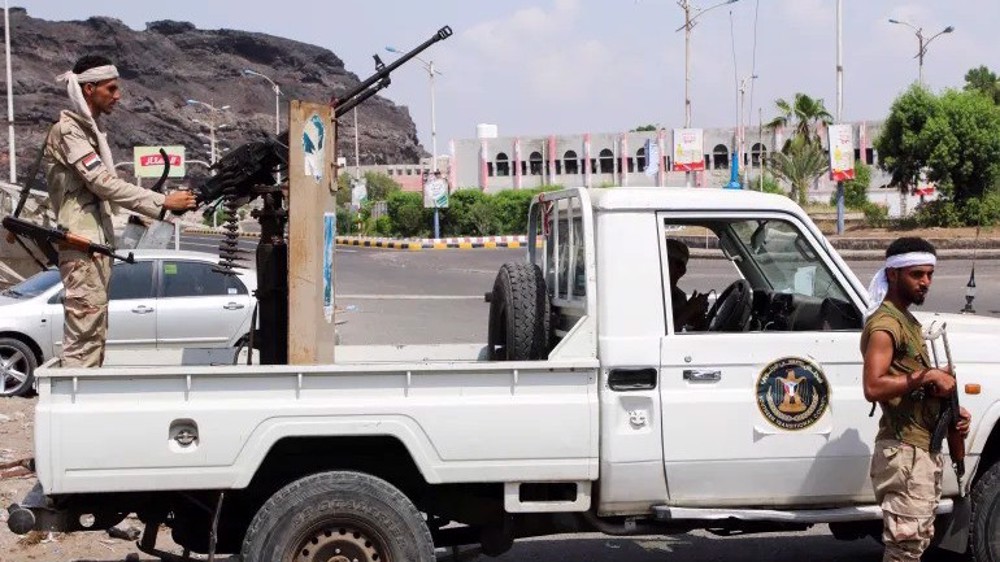
Members of the UAE-backed forces man a checkpoint in Aden, a port city located in Yemen in the southern part of the Arabian Peninsula. (File photo by Reuters)

Press Tv

Intense fighting is underway as UAE-backed forces attempt to advance towards strategically significant areas in Yemen’s oil-rich Hadramout governorate, previously controlled by Saudi-backed Yemen’s fugitive government.  

Violent clashes erupted on Thursday as the UAE-backed forces sought to move towards the crucial al-Ghuraf area. This latest round of conflict follows the UAE-backed announcement of capturing Seiyun, the region’s second-largest city, on December 3.

Videos posted by local activists showed UAE-backed forces storming the presidential palace in Seiyun on Wednesday.

Sources indicated that these forces were stationed in the Jathma area of the Seiyun plateau before targeting the headquarters of the Saudi-backed government in the city center.

Wadi Hadramout has witnessed large-scale offensives since Wednesday morning, accompanied by intense artillery fire. Tensions have escalated in recent weeks between the UAE and Saudi-backed forces in Yemen’s largest province.

The UAE-backed administration previously called for the separation of the southern region from Yemen, controlling parts of the south, including Aden. It congratulated the people of the south on the liberation of Wadi Hadramout, stating, “We aim to control all of Hadramout.”

Hadramout, Yemen’s largest province, constitutes over one-third of the country’s area and boasts oil and mineral wealth, along with a 450-kilometer coastline. The situation marks a significant escalation between Saudi and UAE-backed forces.

The UAE has been a major partner in the US-sponsored Saudi-led war against Yemen and the Ansarallah-led government in Sana’a, which began in 2015. Despite this, Riyadh and Abu Dhabi have engaged in a rivalry for control and influence over Yemen’s resources and strategic ports.

Critics accuse both countries of attempting to divide Yemen for their benefit. Observers suggest that the ongoing competition for control is disguised as support for local autonomy, with Hadramout becoming a focal point for this rivalry.

Yemen has faced external interference for decades. The Ansarullah movement controls much of the northwest, including the capital, Sana’a. This resistance has gained international attention for its operations against Israel and shipping in the Red Sea amid Israel’s ongoing genocidal war in Gaza.

The US and Israel have conducted deadly attacks in Sana’a, resulting in civilian casualties.

Emirati-backed forces control parts of Marib and Shabwa, where troops loyal to the Saudi-backed government are also present.

The UAE has coordinated with Israel to establish a significant military presence in Yemen’s islands. Satellite imagery shows a rapid expansion of Emirati military and intelligence bases across Yemen’s islands and along the coast of Somalia since October 7, 2023, coinciding with Israel’s aggression in Gaza.

Israeli sources indicate that relations between the UAE and Israel were advanced prior to formal diplomatic ties, although kept discreet.

New military installations have emerged in various locations, including areas controlled by Emirati-backed forces and regions in Somaliland and Puntland.

Key infrastructures have been developed on Abd al-Kuri Island and Samhah, part of Yemen’s Socotra archipelago.

Last year, satellite imagery revealed the construction of a new UAE airstrip on Abd al-Kuri Island.

Ansarallah and the Sana’a government have accused Abu Dhabi of forcibly evicting the people of Abd al-Kuri as part of the plan to transform the area into an Israeli-Emirati military and espionage hub.

In 2022, Socotra made headlines due to the controversy of Israeli tourists visiting the Yemeni island under a UAE-issued visa.

There are also Emirati sites at the airports of Bosaso and Berbera in Puntland and Somaliland, as well as Mocha in Yemen, and the island of Mayun in the Bab al-Mandab Strait, where 30 percent of the world’s oil passes.

Sources say all these sites have “been developed in close coordination with Israel.”

[…]

Via https://www.presstv.ir/Detail/2025/12/04/760018/Yemen-Seiyun-Hadhramaut-Saudi-Arabia-UAE

Early Middle East Empires that Preceded Persian Empire

Assyrian Empire Map - Google Search | Maps of Ancient Empires ...

Episode 3 The World Before Cyrus

The Persian Empire (2012)

Dr John W I Lee

Film Review

The Persian empire would form in the 6th century BC from an alliance of Median, Elamite and early Persian chieftains following the collapse of the Neo-Assyrian and Neo-Babylonian empires.

Assyrian and Neo-Assyrian Empires

Named for the god Ashur, the the kingdom of Ashur formed in 3500 BC, dominating Mesopotamia and Babylon until its collapse at the end of the Bronze Age (around 1100 BC).* Effectively recovering by 950BC, the Assyrians built an infantry, cavalry, chariot brigade and siege engines. Following the will of their god Ashur, the conquered Babylon, Samaria, Medes and Elam to form the Neo-Assyrian empire. Known for excellent administrative skills, road building and libraries, it collapsed in 612, when Babylon organized a joint revolt with Medes.

Neo-Babylonian Empire

Babylonian Empire

The Neo-Babylonian empire was founded by an Assyrian general Nabopolasser in 626 BC. Conquering all of Mesopotamia, his son Nebuchadnezzar marched west, conquering Judah in 587 BC and deporting its Jewish inhabitants to Babylon.

Kingdom of Medes

The term Persia and Medes empire | Short history website

Median nomads from the Asian steppes arrived in the Iran’s Zargos mountains during the third millennium. According to the Greek historian Herodotus, Medes began building a powerful kingdom in 700 BC. However after allying with Babylon to conquer the Assyrians, they became despotic and were conquered by the Persians.

Following their conquest of Medes, Persians widely adopted Median dress. There were many Median priests and soldiers in the Persian empire. The English word “paradise” is of Median origin.

Persian Tribes

Iran Politics Club: Iran Historical Maps 1: Susa Kingdom, Aryan ...

Persian tribes arrived in Iran (from Central Asian steppes) in the third millennium BC and intermarried with local tribes. By 1000 BC they had settled two separate areas of western Iran: Parsua (in the Zagros mountains) and Ansham (a Median name) in Farsham province (now known as Shiraz). As the Assyrians put more pressure on Medes and Elam, the Persians gained control of splintered Median kingdoms. Between 750-645 BC, they came to dominate Medes and saw themselves as heirs to the Achaemid chiefdom, a very powerful role in the Median Pasargadae tribe.

Greece

PPT - ANCIENT GREECE PowerPoint Presentation - ID:6430444

It took the Greek city-states around 250 years to recover from the Bronze Age collapse. Around 750 BC the Greeks rediscovered written language, resumed trade and began hiring themselves out as mercenaries.

Lydia

Map of Lydia (Illustration) - Ancient History Encyclopedia

In Anatolia, the Hittite empire also collapsed at the end of the Bronze Age. It was replaced by the extremely wealthy kingdom of Lydia, the first Middle East state to use coins.

Egypt

In the 7th century BC, Egypt expelled their Assyrian occupiers with the help of Greek mercenaries.

The Levant

Phoenicians: Civilization and History | TimeMaps

The Levant saw the increase of independent borderline states, as both the Hittites and the Egyptians lost ability to defend their claims in the region. Tyre (Phoenician state) and Israel were the most prominent of the new states.


*For some reason civilization collapsed across the entire Middle East at the end of the Bronze Age around 1100 BC.

https://www.kanopy.com/en/pukeariki/video/15372393/15372389

Press TV’s newly-launched Hebrew service sparks buzz and unease in Israeli media circles

Press TV Website Staff

Press TV’s Hebrew service has sparked concern in Israeli media circles, widely seen as part of Iran’s strategic effort to influence Israeli public opinion amid heightened narrative warfare.

Since its official launch late last month, the Hebrew-language service has drawn significant attention from Israeli media, with many pundits offering observations bordering on fear and paranoia.

The Hebrew-language service of Press TV, the leading international media network affiliated with the Islamic Republic of Iran Broadcasting (IRIB) World Service, was launched late last month to reach Hebrew-speaking audiences worldwide.

The service is accessible through an active X account (@PresstvHebrew) and a dedicated Telegram channel (@PresstvHebrew), with a full website scheduled for launch in the coming months.

According to Ahmad Noroozi, director of IRIB World Service, the channel’s primary mission is to expose facts that Israeli media attempts to suppress, especially in the light of the strict censorship imposed on Hebrew-language media in the occupied territories during the recent 12-day war.

The launch of the Hebrew service came after a resolution by Iran’s Supreme Council of the Cultural Revolution, which directed IRIB to establish an international Hebrew-language television network.

The council, headed by President Masoud Pezeshkian, said the initiative aims to counter propaganda from the Zionist regime and its affiliated media, strengthen Iran’s media diplomacy, and offer a more accurate portrayal of regional events.

Since its launch, Israeli media outlets have gone into a tizzy, framing it within the context of a “narrative war” and as a direct attempt by the Iranian media to sway Israeli settler society.

For example, the Israeli news website Walla published a report titled “Iran Launches a Hebrew TV Channel, Bypassing Netanyahu and Speaking Directly to Israelis.”

The report described the Hebrew-language channel as part of “Tehran’s propaganda efforts” designed to insert Iranian narratives into the Hebrew media landscape without intermediaries.

“The establishment of a Hebrew-language broadcasting network represents an unusual attempt by Iran to address the Israeli public directly, beyond its digital activity on social media platforms,” read the report.

“Israeli sources assess that the channel is expected to serve as a full propaganda tool — operated by Iran’s government broadcasting corporation (IRIB) — aiming to shape narratives that favor the interests of the regime in Tehran. Iran already operates English, Arabic, and French-language channels — such as Press TV and Al Alam — which the regime uses to spread messages abroad.”

The Israeli newspaper Maariv emphasized in a detailed article that Iran’s Hebrew network is a “propaganda tool” operated by Iran’s state broadcaster, aiming to “penetrate Israel’s public opinion.”

Maariv linked this project to Tehran’s intensified media strategy against the Israeli regime amid the ongoing genocidal war in Gaza, as well as the recent 12-day war against the Islamic Republic.

“In recent weeks, calls from senior Iranian officials to “fight the consciousness war waged by Israel” have increased, and Iranian media sources openly speak about the “need to expose the crimes of the Zionists to the Israeli audience in their own language,” the report cited.

“According to experts on Iranian media, this is a direct continuation of Tehran’s influence policy in the digital sphere.”

A military-centric website, C14, described the launch of Press TV’s Hebrew service as “a direct move in the awareness war,” stating that the service is “designed to shape narratives that strengthen Tehran’s interests.”

The religious-news platform Bhol also reported on the launch, describing the establishment of the Hebrew channel as “an attempt to influence Israel’s media and social environment.”

“Iran remains an active player in the battle for public opinion, working to bolster the image and standing of its government while undermining the internal resilience of its adversaries,” said the report.

“Iran is also actively trying to exert influence within Israel, having recruited dozens of Israeli agents for espionage purposes. Several Israelis have been arrested after passing information to Iranian operatives.”

These reports, according to media analysts, smack of fear and anxiety in the Israeli media and political circles, who have long followed the policy of suppressing news and analysis that shows the regime in a bad light – even amid the ongoing genocidal war on Gaza.

Israeli media outlets collectively emphasize key themes regarding Press TV’s Hebrew service: a direct effort to influence Israeli public opinion, part of Tehran’s new media strategy amid the genocide in Gaza and following the 12-day war imposed on the Islamic Republic, and an initiative that represents a new stage in the narrative war between Tehran and Tel Aviv.

[…]

Via https://www.presstv.ir/Detail/2025/12/03/759936/press-tv-newly-launched-hebrew-service-sparks-buzz-unease-israeli-media-circles

Breaking the Tax Cage: How Palestinians Can Recover Autonomy Under Occupation

By Rima Najjar

How Israel Became the Palestinian Tax Collector

The fiscal trap Palestinians live under today did not arise organically; it was engineered, codified, and then left untouched for thirty years. Its blueprint is the 1994 Paris Protocol, the economic annex to the Oslo Accords, which was marketed at the time as a temporary framework for a transitional period leading toward Palestinian sovereignty.

In reality, it created a one-way customs union in which Israel retained full control over borders, ports, import channels, and the taxes generated from nearly all goods entering the West Bank and Gaza. Under this arrangement, Israel collects VAT, customs duties, import taxes, port fees, and fuel excise charges on behalf of Palestinians, aggregates them into “clearance revenues,” and then transfers them to the Palestinian Authority — minus whatever deductions it unilaterally decides to impose. These revenues now make up the majority of the PA’s budget and are the financial core around which Palestinian governance has been forced to revolve.

[…]

Even highly restricted aid shipments, routed through layers of Israeli bureaucracy, pass through the same fiscal machinery that treats Gaza not as a humanitarian catastrophe but as a taxable market. The perversity deepens: Israel has frozen Gaza’s entire share of its own clearance revenues, diverting or withholding funds generated from imports destined for the Strip. Gaza’s hospitals run out of fuel while the taxes generated from that very fuel accumulate under Israeli control or sit in foreign escrow.

[…]

The same mechanism operates in the West Bank, only with less visible violence. A factory in Hebron importing machinery from China pays Israeli customs duties. A supermarket in Jenin stocking Israeli dairy products generates VAT for Israel before any share is transferred to the PA. Fuel purchases — one of the largest revenue sources — are taxed entirely at Israeli rates. In each case, Palestinians do not control their tax base.

They receive it as a monthly allowance, released or withheld depending on Israel’s political calculations. For decades, Israel portrayed this as administrative necessity: because it controlled the borders, it had to collect the taxes. But over time, the mechanism became a political pressure tool.

[…]

Since October 2023, the situation sharply deteriorated. Israel froze Gaza-related revenue outright, dragging out clearance transfers for weeks or months, and withholding far larger sums from the West Bank portion. The PA’s fiscal capacity collapsed; salaries became partial, delayed, or split into unpredictable installments.

Ministries cut services. Municipalities closed departments or deferred maintenance. Universities and hospitals sank into debt spirals. The PA could not plan more than thirty days ahead because it no longer knew if or when Israel would release the funds. By early 2024, the Authority had become a government whose operational budget was effectively determined in Jerusalem — in the Israeli Ministry of Finance, not in Ramallah.

But the structural dependency designed by the Paris Protocol runs even deeper than monthly cash transfers. Because Palestinians are locked into the Israeli VAT system, they inherit Israeli prices without Israeli incomes. They pay Israeli fuel tariffs that inflate transportation and electricity costs.

Their banks rely on Israeli clearinghouses. Their imports are routed through Israeli ports that impose fees at every stage. The customs union acts as an economic occupation layered beneath the military one: Palestinians must purchase within an Israeli cost structure even as they are denied sovereign tools — monetary policy, customs borders, independent import regimes — to shape that structure to their needs.

The PA has no control over its external borders, no independent central bank, no control over its main revenue streams, and no authority to regulate the cost of the goods on which its own tax revenues depend. It survives only if the colonizer transfers the funds it collected from the colonized.

This is the tax cage: a colonizer that collects your taxes; a government that depends on the colonizer to survive; and a public that pays the cost through inflated prices, weakened purchasing power, and delayed salaries. The extraordinary part is not that this architecture was built in the 1990s, but that it was kept in place for three decades — even as the PA’s political legitimacy eroded, even as Israel hardened its control, and even as the system cannibalized itself after October 2023.

[…]

The West Bank in Slow-Motion Strangulation

Gaza reveals the tax cage at its most lethal extreme. The West Bank reveals the same mechanism running in slow motion — less spectacular, but no less suffocating.

Salaries alone consume between half and nearly two-thirds of the PA’s entire budget, a figure considered unsustainably high by international standards but inevitable in an economy fragmented by occupation and denied sovereign revenue sources. Because Israel-controlled clearance revenues — VAT, customs duties, and import taxes collected at Israeli ports — constitute about 60 to 70 percent of the PA’s total income, even a single delayed transfer can jeopardize payroll. There are no sovereign reserves to fall back on, no independent monetary policy, and no ability to borrow internationally without Israel’s permission. The result is a fiscal architecture designed for permanent fragility.

A fourth layer is now emerging: the Trump-Netanyahu strategic blueprintfor the West Bank and post-war Gaza. Under this vision, the PA is not meant to be strengthened. It is meant to be preserved precisely in its current weakened state — an administrative entity that manages civilian affairs but lacks the fiscal or political autonomy to challenge Israeli control. The PA is expected to be strong enough to administer, too weak to resist; responsible for civilians, irrelevant to national strategy; sufficiently functional to relieve Israel of direct governance, perpetually dependent on Israel’s tax transfers to survive. This is not a new architecture. It is the existing system, fortified.

Yet even inside this tightening structure, cracks have widened — cracks born of necessity, crisis, and improvisation. Communities have developed survival economies anchored in family networks, zakat committees, cooperatives, and local production. Municipalities have learned to rely on local revenue when Ramallah cannot deliver.

Universities, hospitals, and large NGOs have built financial ecosystems that bypass the PA entirely. Boycotts and shifts in consumption patterns have begun to weaken Israeli-taxed imports. And the PA itself retains dormant legal and administrative tools it has never mobilized: challenging the Paris Protocol, demanding third-party oversight of clearance revenues, devolving power to municipalities, restructuring its security posture, and cultivating alternative revenue streams.

What Palestinians Are Already Doing: Cracks in the Cage

[…]

The first and most immediate site of autonomy is at the community level, particularly in the production and consumption of food. Every time a Palestinian family buys a locally made staple instead of an Israeli or imported one, VAT and customs revenue shrink along the Israeli-controlled pipeline.

This is not an ideological aspiration but a documented trend, especially since 2019.

In Qabalan, a women-led agrifood cooperative that received technical support from the UN Food and Agriculture Organization upgraded its facilities and now produces freekeh, wheat products, pastries, and frozen sambousek distributed in Ramallah, Nablus, and Jenin.

In Dura, south of Hebron, a cooperative of twenty women has built a two-story production facility with an annual operating budget of roughly two million shekels, supplying the West Bank with maftoul, mulukhiyah, jams, and grape molasses.

In nearby Tafuh, the al-Nahda cooperative runs a bakery generating about 25,000 shekels in monthly sales, while in al-Aqbabah the Beit Emmaus cooperative increased its frozen vegetable output fourfold between 2019 and 2021 and now employs twenty-five women who each earn about 1,500 shekels per month — providing a local alternative to heavily taxed imported frozen goods.

In Kufr al-Deek in the Salfit governorate, the al-Zaytouna cooperative produces bread, pickled vegetables, olives, herbs, and maftoul for school canteens and supermarkets, replacing products that previously passed through Israeli wholesalers and customs posts. These examples are not boutique experiments. They are manufacturing and processing operations producing the everyday staples — bread, dairy, freekeh, vegetables, jams — that form the core of Palestinian diets.

The wider food manufacturing sector confirms that these cases are part of a larger structural trend. A 2017 survey by the Palestinian Ministry of National Economy found that local producers already supply about 57 percent of dairy consumed in the West Bank, more than half of processed fruits and vegetables, and roughly 80 percent of all bakery products. The sector includes over 560 registered enterprises and comprises nearly a fifth of the entire Palestinian manufacturing base.

These numbers demonstrate that Palestinians already dominate essential food categories — and that scaling up the cooperatives emerging across the West Bank would further shift consumption away from Israeli-taxed products.

After October 7, 2023, this shift accelerated. Boycotts of Israeli and U.S.-linked brands produced measurable market changes: the Palestinian soft drink “Chat Cola,” produced in Salfit, reported more than a 40 percent surge in sales; two KFC branches in Ramallah closed after demand collapsed; and supermarkets in Ramallah, Nablus, and Jenin noted significant increases in sales of local snacks, beverages, and household goods.

Palestinian Customs Authority data cited by Al-Jazeera showed declines in Israeli imports in categories like chips, soft drinks, and cleaning products. Academic work from 2023 analyzing the relationship between boycott campaigns and import patterns confirmed statistically that periods of intensified boycott correlate with reduced Israeli imports and increased local production in key food sectors. Together, these trends form a quiet but material form of economic resistance: local production plus coordinated boycotts equals a shrinking taxable frontier.

The second domain where cracks in the tax cage appear is at the level of institutions and municipalities, which have long operated with degrees of autonomy simply because they have had to. When the PA cannot pay salaries or transfer funds, many municipalities continue functioning by relying on local revenue streams that never pass through Ramallah. Nablus has repeatedly used water-billing income to cover operational costs during PA liquidity crises.

[…]

Major Palestinian institutions also function largely outside the PA’s fiscal architecture. Universities such as Birzeit, An-Najah, Bethlehem, and Hebron depend primarily on tuition, international grants, and diaspora donations — not PA transfers.

Hospitals such as Al-Ahli, St. Joseph, and Augusta Victoria are funded by church networks, international NGOs, and community fundraising.

[…]

A third layer of autonomy is the network of parallel services that emerges during Israeli raids and curfews. In Jenin, Tulkarm, Nablus, and parts of Ramallah and Bethlehem, communities have repeatedly organized ad hoc medical response teams, field clinics, food distribution networks, neighborhood patrols, and transportation arrangements. These systems spring up because the formal ones are incapacitated or barred by the occupation. That they work — improvisationally but effectively — underscores a deeper truth: Palestinian society already governs itself under stress, and often does so more coherently than the PA can when dependent on Israeli revenue flows.

[…]

What ties all these examples together is that none are speculative.Palestinians already have functioning micro-economies that operate outside Israeli tax capture; institutions already bypass the PA’s revenue shortages; municipalities already keep essential services running when Ramallah is insolvent; and the PA already possesses legal and administrative levers it has simply never used. The autonomy Palestinians need is not a distant aspiration. It already exists in embryonic form across the West Bank. The task is to expand and coordinate these structures into a deliberate strategy — not as a substitute for liberation, but as its foundation.

These practices are impressive, but they are usually treated as mere “coping.” History shows something far more radical: every time the formal fiscal pipeline has been completely cut, Palestinian society has not collapsed — it has reorganized itself.

[…]

The most severe test came after October 7, 2023, when Israel froze Gaza’s entire share of the clearance revenues and delivered only fragments of the West Bank’s portion. For over a year, the PA lurched between partial salaries, delayed salaries, and no salaries. Yet the West Bank did not descend into chaos.

What emerged instead was what many Palestinians have begun to call a “shadow social economy”: neighborhood funds that purchased food for the poorest; agricultural collectives that distributed produce directly; youth groups that organized emergency medical response during raids; and diaspora remittances that surged quietly into family accounts.

[…]

Via https://www.globalresearch.ca/palestinians-can-recover-autonomy-under-occupation/5907445

Pentagon Seeks To Explain Little-Known, Forgotten ‘Forever War’

Why Donald Trump is on the warpath against Islamic State in Somalia

Dave DeCamp | December 2, 2025

The US Department of War insisted on Tuesday that it’s not waging a “forever war” in Somalia despite the fact that the Trump administration has shattered the record for annual airstrikes in the country.

Liam Cosgrove, a reporter for ZeroHedge, noted during a Pentagon press briefing on Tuesday that the US has launched 101 airstrikes (now 102) in Somalia and that US troops reportedly conducted a recent ground raid, and asked why the US military is still in the country.

“I can assure you this is an America First Department of War and president, so we aren’t conducting forever wars in Somalia, we aren’t seeking regime change, and we’re not nation building,” Pentagon spokeswoman Kingsley Wilson said in reply.

The Trump administration has dramatically escalated the US war in Somalia, launching more than 10 times the number of airstrikes that the US conducted in 2024, and more than the combined total of airstrikes launched during the 12 years that Presidents Obama and Biden were in office. Despite the unprecedented scale of US strikes, Kingsley described the campaign as “narrowly scoped.”

She told Cosgrove, “I will say that this Department’s narrowly scoped, intelligence-driven, counterintelligence operations in places like Somalia, alongside our partners, allow us to protect the American homeland from terrorist threats and to protect our interests.”

US airstrikes this year have targeted a small ISIS affiliate based in caves in Somalia’s northeastern Puntland region and al-Shabaab in southern and central Somalia. The US has been fighting al-Shabaab since it backed an Ethiopian invasion of Somalia in 2006, which ousted the Islamic Courts Union, a coalition of Muslim groups that briefly held power in Mogadishu after taking the capital from CIA-backed warlords.

Al-Shabaab was the radical offshoot of the Islamic Courts Union and claimed its first attack in 2007, which targeted Ethiopian troops occupying Mogadishu. In 2012, al-Shabaab declared loyalty to al-Qaeda, after years of fighting the US and its proxies. The ISIS affiliate in Somalia first emerged in 2015 as an offshoot of al-Shabaab, and is believed to have only a few hundred members.

[…]

Via https://news.antiwar.com/2025/12/02/us-war-department-claims-its-not-waging-a-forever-war-in-somalia-despite-record-airstrikes/

Trump’s Pardon of Convicted Drug Trafficker and Former President of Honduras Undermines His Own Reasoning for War on Venezuela

Honduran President Juan Orlando Hernández Inaugurated for Historic ...

by | Dec 2, 2025

Trump’s recent pardon of convicted drug trafficker and former President of Honduras undermines his own reasoning for the escalation with Venezuela.

President Trump has stated previously that the justification for the escalation in tensions with President Maduro and Venezuela is a hard stance against drug trafficking into the U.S. from Latin American countries. If this was the case, then the recent pardon of former Honduran President Juan Orlando Hernández – a man convicted of working with drug traffickers to smuggle drugs into the U.S. – directly undercuts his own reasoning.

Convicted in February of 2024, former Honduran President Juan Orlando Hernández was sentenced to 45 years in a United States federal prison. During the 57-year-old’s two terms in office, he allowed over 400 tons of cocaine to flow through Honduras and into the United States in exchange for millions of dollars from cartel drug lords like Joaquín Guzmán, AKA “El Chapo.”

According to the Associated Press, Hernández was even caught on video boasting to drug traffickers during his trial that “together they were going to shove the drugs right up the noses of the gringos.” Trump’s justification for pardoning Hernández is that people he respects told him Hernández was “treated very harshly and unfairly.”

The problem is that pardoning a man who helped turn his country into a narco-state – while taking bribes from convicted cartel bosses – undermines the exact reasoning Trump and the United States have used to escalate pressure on Venezuela. Tensions first began in 2017 when the U.S. sanctioned Venezuelan Vice President Tareck El Aissami for drug-trafficking activity. Fast forward to 2019, and the Trump administration formally indicted President Nicolás Maduro and senior Venezuelan officials on narco-terrorism charges, arguing that they were responsible for trafficking cocaine into the United States.

These actions were presented as necessary steps to confront foreign leaders who enable cartels, threaten regional stability, and push drugs into American communities. The message from the Trump administration was simple: the U.S. will not tolerate narco-traffickers.

This is exactly why the pardon of Hernández undercuts Trump’s own argument. You cannot escalate against Venezuela because of its alleged operation of a criminal enterprise, then turn around and pardon a man who was proven – through evidence, witnesses, and beyond a reasonable doubt in a U.S. court of law – to have done the very same thing. In Hernández’s case, he did it while presenting himself as a U.S. ally to the public, all while taking cartel money behind the scenes.

By wiping away the forty-five-year sentence justifiably given to Hernández – a man who helped traffic massive amounts of cocaine into the U.S. – Trump shows that the hard-line stance against narco-politics is selective. If his escalation with Venezuela was truly rooted in opposing drug trafficking, Hernández would never have been pardoned.

[…]

Via https://www.antiwar.com/blog/2025/12/02/trumps-pardon-of-convicted-drug-trafficker-and-former-president-of-honduras-undermines-his-own-reasoning-for-war-on-venezuela/

Family Files Formal Complaint Against Hegseth Over Murder of Colombian Fisherman

White House Cabinet Meeting

Photo by Carolyn Van Houten/The Washington Post via Getty Images

By Jon Queally

The family of Colombian fisherman Alejandro Carranza Medina, believed killed by the US military in a boat bombing in the Caribbean Sea on Sept. 15, has filed a formal complaint with the Inter-American Commission on Human Rights accusing US Secretary of Defense Pete Hegseth of murder over the unlawful attack.

“From numerous news reports, we know that [Hegseth] was responsible for ordering the bombing of boats like those of Alejandro Carranza and the murder of all those on such boats,” reads the petition, filed Tuesday on behalf of Carranza’s family by Dan Kovalik, a human rights attorney based in Pittsburgh.

The family of Colombian fisherman Alejandro Carranza Medina, believed killed by the US military in a boat bombing in the Caribbean Sea on Sept. 15, has filed a formal complaint with the Inter-American Commission on Human Rights accusing US Secretary of Defense Pete Hegseth of murder over the unlawful attack.

“From numerous news reports, we know that [Hegseth] was responsible for ordering the bombing of boats like those of Alejandro Carranza and the murder of all those on such boats,” reads the petition, filed Tuesday on behalf of Carranza’s family by Dan Kovalik, a human rights attorney based in Pittsburgh.

“Secretary Hegseth,” the petition continues, “has admitted that he gave such orders despite the fact that he did not know the identity of those being targeted for these bombings and extra-judicial killings.”

The complaint also notes that President Donald Trump, the commander in chief of the US military, “ratified the conduct of Secretary Hegseth described herein.”

First reported on by The Guardian, the filing of the petition with the IACHR—an autonomous body under the charter of Organization of American States (OAS) designed to uphold human rights in the Western Hemisphere—could result in the initiation of an investigation and the release of findings about the bombing that took the life of Carranza and two other individuals believed to be aboard the vessel.

The petition, the outlet noted, “marks the first formal complaint over the airstrikes by the Trump administration against suspected drug boats, attacks that the White House says are justified under a novel interpretation of law.” Experts in international human rights law have stated from the outset that the administration’s justifications lack legal basis and that the attacks constitute unlawful criminal acts.

According to The Guardian:

Carranza, 42, appears to have been killed in the second strike of the Trump administration’s bombing campaign, on 15 September. The administration has publicly disclosed 21 strikes on alleged drug boats. Carranza’s family says he was a fisher who would often set out in search of marlin and tuna.

On the day of the strike, Trump announced on his Truth Social platform that “This morning, on my Orders, US Military Forces conducted a SECOND Kinetic Strike against positively identified, extraordinarily violent drug trafficking cartels and narcoterrorists in the SOUTHCOM area of responsibility”. Trump attached video marked “unclassified” of a small boat floating in the water before it was struck.

Both Hegseth, the highest-ranked civilian at the Pentagon, and Trump have been under growing scrutiny for the series of boat bombings that have resulted in the extrajudicial killing of over 80 people since September. Experts have said the killings should be seen as “murder, plain and simple.”

New revelations about a strike on Sept. 2, in which two survivors of an initial bombing were later killed as they clung to the exploded boat on which they were traveling, has evelated that concern in Washington, DC this week with lawmakers seeking answers about the attack which, even if one accepted the legality of the initial strike under the construct the Trump administration has tried to claim, would constitute a clear human rights violation amounting to a war crime.

In an interview with Agence France-Presse in October, Katerine Hernandez, Carranza’s wife in Colombia, said her husband was “a good man” devoted to fishing and providing for his family. “Why did they just take his life like that?” she asked.

Hernandez denies that Carranza was involved in drug trafficking, as Trump and Hegseth have alleged without providing evidence, but also suggested that even if drug trafficking was taking place, it would not justify his murder. “The fishermen have the right to live,” she said. “Why didn’t they just detain them?”

In a Tuesday statement, the IACHR urged the US government to “ensure respect for human rights” during any and all extraterritorial military operations in the region, noting the deaths of a high number of persons both in the Caribbean and in the Pacific, where other strikes have taken place.

“While acknowledging the seriousness of organized crime and its impact on the enjoyment of human rights, the Commission recalls that States are obliged to respect and ensure the right to life of all persons under their jurisdiction,” the statement reads.

“According to the Inter-American jurisprudence, this duty extends to situations when State agents exercise authority or effective control, including extraterritorial actions at sea,” it continues. “When lethal force is used by security or military personnel outside national territory, States have the obligation to demonstrate that such actions were strictly lawful, necessary, and proportionate, and to investigate, ex officio, any resulting loss of life. These obligations persist irrespective of where the operations occur, or the status attributed to the individuals affected. Likewise, persons under State control must always enjoy full respect for due process and humane treatment.”

The commission called on the US to “refrain from employing lethal military force in the context of public security operations, ensuring that any counter-crime or security operation fully complies with international human rights standards; conduct prompt, impartial, and independent investigations into all deaths and detentions resulting from these actions; and adopt effective measures to prevent recurrence.”

[…]

Via https://www.commondreams.org/news/hegseth-murder-boat-strikes

Ron Paul: A Real Ukraine Peace Plan

by | Nov 25, 2025

Last week’s surprise release of a draft Ukraine war peace plan has raised hopes that the nearly three-year bloody conflict may finally come to an end. Ukraine has suffered horrible losses that may change the demographics of that country for decades to come.

If this peace plan can be negotiated in a way that satisfies all sides and the guns finally go silent, I will be the first to cheer. However, the continued failure to understand the nature and origin of the current conflict leaves me skeptical that a real peace can be reached this way.

From the Orange Revolution in the early 2000s to the Maidan revolution in 2014, the US and its NATO partners have been interfering in Ukraine’s internal affairs in attempt to manipulate the country into a hostile position toward its much larger and more powerful neighbor, Russia.

We must remember how directly coordinated the 2014 coup was by the United States. US Senators, including John McCain and Lindsey Graham, were on the main square of a foreign capital demanding that the people overthrow their duly elected government. Victoria Nuland was caught on a telephone call planning who would run the post-coup government.

Outside intervention led us to the terrible situation of today. This peace deal is another chapter in that same intervention, with the US and its partners desperately trying to manage and solve a problem that they created in the first place. Can you solve a problem created by outside intervention with more intervention?

For the entirety of this conflict politicians and the media have been unwavering in blaming Russia entirely for what has occurred. I agree that they’re no angels. But the real villains here are the US neocons and their European counterparts who knew it was suicidal for Ukraine to take on Russia but pushed Ukraine to keep fighting anyway. Early in the conflict a deal was on the table and nearly signed that would end the war, but the neocon former UK Prime Minister Boris Johnson demanded that Ukraine keep fighting.

Ukraine is the victim here, I agree. But it is as much a victim of the US and European neocons as of the Russians. They believed they could put NATO on Russia’s doorstep and face no consequences. If the tables were turned and a hostile China set up a new Latin American military alliance with the US as its designated enemy, would we sit by idly as military bases were constructed on our southern border? I don’t think so.

President Trump promised he would end the war 24 hours after he was elected. It was an unrealistic boast, but he actually could have ended it rather quickly. The antidote to intervention Is non-intervention. Biden drug us into the war, that is true. But Trump could have pulled us out by quite simply ending all US involvement. No weapons, no intelligence, no coordination. No need for sanctions or the threat of sanctions, no need for elaborate peace plans.

A real peace deal would realize that it was always idiotic to believe that Ukraine could stand up to Russia’s war machine – even with NATO’s backing. It is unimaginably cruel to demand that Ukraine keep fighting our proxy war down to the last Ukrainian.

No 28-point plans can fix this. The real fix is much simpler: walk away.

[…]

Via https://ronpaulinstitute.org/a-real-ukraine-peace-plan/