Achaemenid Religion

Marduk Overview | Mesopotamian Gods & Kings

Marduk

Episode 16 Archemenid Religion

The Persian Empire

Dr John W I Lee (2012)

Film Review

There is little historical information on the religions practiced in the Persian empire. The limited information we have comes from the Greeks and modern Iranians.

The most prominent prophet/sage influencing Persian religious practice was Zarathustra (known as Zoroaster in Greek). It’s believed he was born around 1000 BC in northeast Iran or southwest Turkmenistan. The Avesta, reflecting his teachings, was written around 500 BC, which means the the texts were transmitted orally for five centuries.

Zarathustra taught that Ahuramazda was the supreme god among many, that he was good, that he created people and gave them free will (with women naturally more prone to evil). Although Zarathustra didn’t condemn sacrifice, he discouraged some of the more violent cult behavior (eg human and child sacrifice) the Persians associated with Babylonian cults. He taught there was a last judgement in which people went either to paradise or to hell depending on whether they followed truth and order or untruth and chaos. This Persian god was a marked contrast to the Greek gods, who were fickle and jealous.

The Persian emperors believed Ahuramazda mandated them to conquer other countries to stamp out violence and chaos.

Ahuramazda was never prominent prior to Cyrus I, and Zoroastrianism never became the official religion of the Achaeminid Persians though their successors who founded the Sassanian empire adopted it as their state religion.

The Persians adopted many gods from the countries they conquered. In addition to fire, water and sacred mountains and rivers, they also worshiped Mithras,** the god of sun and light, Anahita, the goddess of water and fertility, and Agni the fire god. ‘

Cyrus restored the worship of Marduk* when he captured Babylon from the Assyrians. He also protected the Apis bull in Egypt and the shrine of Apollo in Greece. Anahit became identified with Ishtar in Egypt and Aphrodite, Artemis Athena in Greek colonies.

The magi were the most prominent Persian priests. They interpreted dreams and omens, presided over sacrifices and advised the Persian kings both at home and on military campaigns.

The hatin (Elamite word) priest supervised the worship of Babylonian, Elamite and other foreign gods.

The Megabysos temple of Artemis at Ephesus (an ancient Greek city on the Anatolian peninula) was always supervised by Persian families.

Persian priests practiced hoama rituals in which they crushed psychedelic plants containing ephedra, fly agoric or mountain rule) and mixed them with milk and water. They also conducted the monthly Lan Ceremony, making offerings of grain, wine and livestock to improve the harvest.


*God from ancient Mesopotamia and patron deity of Babylon who rose to prominence in the 1st millennium BC

**The Cult of Mithras, also known as Mithraism, was a mystery religion that flourished in the Roman Empire from the 1st to the 4th centuries AD, centered around the god Mithras. It involved secretive rituals, including a complex initiation system and communal meals, and was particularly popular among soldiers and merchants.


https://www.kanopy.com/en/pukeariki/watch/video/15372393/15372394
What Persian and Greek Cultures Borrowed from Each Other

Episode 15 Cultures in Contact

The Persian Empire

Dr John W I Lee (2012)

Film Review

After Athens successfully defended itself against Persian conquest, the Athenian Greeks captured lots of Persian booty and Persian slaves. During the fifth century BC, Persian styles became extremely fashionable in Athens and other Greek cities. Influenced by Persia, sleeves appeared in Greek garments for the first time. Greeks also adopted the Persian Kandys, a leather jacket the Greeks made out of linen, as as well as Persian slippers, drinking bowls and pitchers. The Greek elite also mimicked the Persians in raising peacocks a pets and carrying parasols to display their high status. It’s also believed Persian-style friezes influenced those that subsequently appeared on the Parthenon.

Conversely Persian elites adopted pederasty (mainly older men with teenage boys) from the Spartans and other Greeks, Athenian pottery and Greek perfumed flasks.

Persian troops returning from Egypt also adopted Bes, the Egyptian god of households, mothers, commoners and ordinary soldiers.

The Persian Empire was unique in history in with only one million of its 25 million subjects were native Persians. In addition, their use of multinational mercenaries led to significant intermarriage between Jew, Greeks and East Asians in Persian client states, especially Egypt.*


*The Old Testament reveasl how the Judges Ezra and Nehemiah clamped down on Jewish intermarriage with Persians.

https://www.kanopy.com/en/pukeariki/watch/video/15372393/15372387

Xerxes War on Greece 480-479 BC

The Persian War

Episode 14 Xerxes War 480-479 BC

The Persian Empire

Dr John W I Lee (2012)

Film Review

In Persia’s second attempt to conquer southern Greece, Xerxes used a dual land/sea approach. His land forces included 10,000 cavalry and 80,000 infantry, made up of Persians, Medes, Eastern Iranians, Bactrians, and Ionian and Thrace hoplites (non-professional citizen-soldiers) and 10,000 elite palace guards. The Persian infantry was armed with bows, spear and daggers. Most archers were paired with shield holders to protect as they fired their arrows. Calvary members carried both lances and bows.

At the start of the campaign, Xerxes ordered 400-600 triremes (ancient rowed warships – see The Ultimate Warship of Ancient Greece) to et off from Egypt, Phoenicia, Silicia and Ionia. Following the Aegean Coast from Anatolia to the northern Greek mainland, Xerxes’ cavalry and infantry set up supply dumps in Thessaly, Thebes and Macedon after they capitulated rather than do battle.

A total of 30 Greek city-states, led by Athens and Sparta, resisted the Persians with a total of 40,000 hoplites. Owing to their inferior numbers, they postponed attacking the Persians until the reached the narrow passes of Thermopylae and Artemesium that left them little room to maneuver.

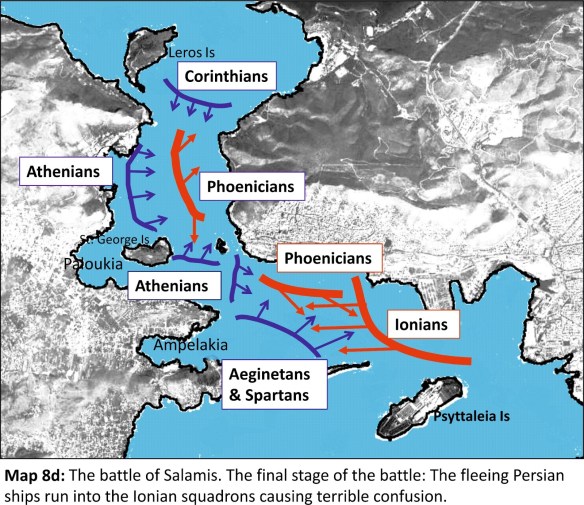
At Themopylae, 7,000 Greek hoplites under the leadership of Leonides defeated the Persian land troops. The latter recovered sufficiently to continue south to burn Athens, simultaneously sending their navy to attack the island of Salamis, where the vast majority of Athenians had fled. Outmaneuvered the Persian fleet suffered serious damage and withdrew. With no sea support, the Persian land forces were also forced to withdraw for the winter.The Battle of Salamis - Maps

After Xerxes withdrew to Sardis, the Persian general Mardonia retook Athens in spring 479. Marching from Sparta, the allied Greeks attacked the Persian camp at Plataea. Lacking a cavalry the Greeks employed a heavy infantry armed with shields and spears, reinforced with light infantry who threw javelins and stones. Once they killed Mardonis, the Persians fled. The Greek allies also sent a fleet across the Aegean to attack the Ionian coast where they won several battles.

Hostilities continued for years.

https://www.kanopy.com/en/pukeariki/watch/video/15372393/15372444

Xerxes Becomes King

Xerxes The Great King Of Persia

Xerxes

Episode 13 Xerxes Becomes King

The Persian Empire

Dr John W I Lee (2012)

Film Review

Xerxes was born in 515 BC, son of Darius I’s second wife. Like most Persian nobles, Xerxes had 20 years of military training starting from age five. He learned archery and how to hunt, grow plants and collect herbs. He was also sent to survive in the wilderness.

In 486 BC Darius I departed Persepolis to put down a revolt in Egypt and appointed Xerxes (who had governed Babylonia for a decade) as crown prince over his older half brothers. Darius I died a year later under unclear circumstances. Immediately after assuming the throne, Xerxes departed for Egypt, suppressed the revolt and appointed his brother Achimedes the Egyptian governor. An extremely harsh ruler, the latter only provoked further rebellion.

in 484 BC there was a revolt in Babylon after Xerxes carried off the official statue of the Babylonian god Marduk. Xerxes crushed the revolt and significantly reduced Babylonian autonomy.

Xerxes was notorious for holding lavish banquets hosting thousands guests. The latter dined on wheat, barley, apples, pomegranates, grapes, garlic, onions, capers, ducks geese, grape and palm wine, lamb, beef, turtle doves, ducks geese while entertained by flautists and harpists.

According to Dr Lee, the Greek playwright Aeschylus and the Greek historian Herodotus portray Xerxes as the most decadent and despotic of the Persian kings. However referring to him as Ahasurus, the bibical books of Daniel and Esther speak very favorably of his reign.

https://www.kanopy.com/en/pukeariki/video/15372393/15372428

Persia’s First Attack on Athens

EDSITEment's Persian Wars Resource Pages | NEH-Edsitement

Episode 12 Across the Bitter Sea 

The Persian Empire

Dr John W I Lee (2012)

Film Review

Darius I claimed the god Ahuramazda directed him to attack Athens and Eretia to punish them for their sneak attack during the empire’s battle to suppress the revolt of the Ionian Greek cities (on the Anatolian Peninsula, ie modern day Turkey)

With the intention of restoring the tyrant the people of Athens had ousted to establish a democracy, Darius sent 200 ships, 10,000-15,000 infantry, 500 cavalry and numerous siege engines on the long journey from Sardis on the Anatolian peninsula, through Thrace and Macedon (both controlled by Persia) to capture and burn Eretria (on the island of Euboia), deporting all its residents to Elam near Susa.

From there, Darius I marched his forces to the Marathon Plain in Attica, territory belonging to Athens. A militia of 10,000 Athenian citizens (regularly employed as farmers and craftsmen), providing their own weapons and food marched to the Marathon Plain.*

The Athenians launched a surprise attack on the Persians, who unlike the Greeks were all professional warriors, many of them Phoenician, Socca and Ionian mercenaries. The latter had sent their cavalry horses north to graze after running short of fodder.

In addition to defeating the Persians, the Greeks captured seven ships. 192 Athenians were killed, in contrast to 600 Persian troops.


*The Greeks had sent a runner (historical origin of the “marathon” race) to Sparta requesting their assistance, but the Spartans declined because they were celebrating a special feast of Apollo.


https://www.kanopy.com/en/pukeariki/watch/video/15372393/15372390

Cyrus I Fails to Conquer Scythia but Suppresses Ionian Revolt

An invading empire hastily retreats back across Ukraine as its ...

Episode 11 Challenges in the West

The Persian Empire

Dr John W I Lee (2012)

Film Review

To stop the continual raids by Scythian nomads on the Eastern Persian empire, Darius I led his warriors into Scythia (modern day Ukraine) intending to incorporate the region into his empire. He built a special pontoon bridge ( there would be no permanent bridge in modern day Istanbul until 1973) to cross the Bosporous into Thrace while the Ionian Greeks provided naval support.

The Scythians proved impossible to defeat because they kept withdrawing and refused to engage militarily with the Persians. However Darius I did succeed in bring Trace and Macedon on the Greek mainland into the empire.

THE IONIAN REVOLT, 499 - 493 BC: The Start of the Greco-Persian Wars

In 494 BC the Greek cities in Ionia (on the west coast of the Anatolian peninsula) revolted against Persian control. Athens and Eretia on the Greek mainland supported the them.

It took a total of five years to suppress the revolt. The Persians castrated the most handsome Greek boys and sold the most attractive girls into slavery.

Darius appointed Artaphenes satrap of Sardis. The latter enacted a series of reforms to prevent further insurrection by the Greeks:

1. A system to arbitrate disputes between cities.

2. Land reform – to provide farmland for landless Greek peasants.

3. After Artaphenes deposed the tyrants ruling the the Ionian Greek cities, he allowed them to establish democracies.

https://www.kanopy.com/en/pukeariki/watch/video/15372393/15372419

The Eastern Persian Empire

Persia - Ancient World History

Episode 10 East of Persepolis

The Persian Empire

Dr John W I Lee (2012)

Film Review

In this lecture, Dr Lee looks at the eastern Persian empire, which controlled roughly 2,000 miles of the Silk Road to China, which started in Bactria. This was the first time in history the western section of the Silk Road was controlled by a single power. The Asian climate was much wetter in 500 BC, and there was a substantial crop cultivation around oases and caravan cities, especially after the Persians provided them with irrigation canals.. Largely pastoral nomads, Persia’s eastern subjects revolted frequently against the Persian kings.* The most prominent eastern satropies were

  • Karasmia – northern most satropy in the eastern empire, located in modern Turkmenistan and Uzbekistan. Although some Karasmians remained nomadic pastoralists, others mined turquoise, worked as palace administrators, as metal or stone workers or as mercenaries in Egypt.
  • Bactria – in modern north-central Afghanistan, had a population of 2 million and was famous for fertile lands, cattle and land. Its people spoke a language related to old Persian but used Aramaic for administrative purposes.
  • Sodiana – in modern Tajikistan and Uzbekistan, had vast open areas for pastoral nomads. Its largest city Samarkind, a center of culture and Silk Road trade, was renowned for its lapis lazuli and cornelian. Western Sodiana residents were known as Scythians. Scythian nomads became infamous for their aggression against the the Persians, who built a series of military forts to contain them.
  • Gandara – having built cities and kingdoms (in region corresponding to modern day Pakistan) prior to their conquest by the Persians, Cyrus appointed native born satraps to administer this region.
  • Hindush (Indus River Valley) – Indian satraps were required to send gold, ivory, elephants, and camels as tribute, as well as supplying the emperor with troops. Many Hindus from this region worked as administrators in the Persian capitols.

*Cyrus was killed trying to suppress a nomad revolt.

https://www.kanopy.com/en/pukeariki/watch/video/15372393/15372408

How Persia Became the Information Empire under Darius I

The Achaemenid Empire: Amazing Ancient Iranian Powerhouse - ancient.com

Episode 9 Royal Roads and Messengers

The Persian Empire (2012)

Dr John W I Lee

Film Review

In this lecture, Dr Lee looks at the 20 provinces Darius I governed, along with the extensive road and messenger system that enabled the him to control an empire of 25 million people. Lee calls the Persian Empire the first “information empire.”

Darius began by expanding on the the road network of the Assyrian Empire, which also had a long distance messenger system. Although Persian roads were only paved in the major cities, all were extremely well-maintained with relay stations (providing food, water and fresh horses) every 10-20 miles. In addition, tens of thousands of private persons used Persian roads daily, traveling by donkey camel, chariot and light two-wheeled carts. Goods were transported in caravans of four-wheeled ox drawn carts.

The government issued leather passports to messengers and officials (eg tax collectors, judges and inspectors monitoring the satrapies). Printed in Aramaic, they entitled the bearer to food and drink at the relay stations. The Persian kings also built canals, an equally important form of transportation.

Darius divided the empire into 20 provinces or satrapies. The satraps appointed to rule them were responsible for maintaining local roads and canals. Most of the satraps were Persian, and each had their own palace, treasury and troops (to defend both the satrapy and, where required, the king). Satraps often rewarded retired soldiers with grants of land for their services.

Although most of the old Assyrian cities were abandoned following Persian conquest, Babylon remained a major financial and religious center. Likewise Phoenicia kept their own king (who was required to pay tribute) and issued their own coins after being conquered by Persia.

After proclaiming himself pharaoh in Egypt, as well as king of Persia and Babylon, Darius built numerous Egyptian canals, including an early version of the Suez Canal between the delta and the Red Sea.

https://www.kanopy.com/en/pukeariki/watch/video/15372393/15372432

Persia’s Darius I: Decadent Despot or Philosopher King?

Darius the Great: 9 Facts About The King Of Kings | TheCollector

Episode 8 The Great King – Image and Reality

The Persian Empire 

Dr John W I Lee (2012)

Film Review

Greek philosophers and historians portray Darius I and other Persian kings as tyrannical and decadent despots who treated their subjects like slaves. Lee disputes this view, citing evidence from the sculptured reliefs at the great palace Darius I built at Persopolis. All I can conclude from Lee’s evidence is the great king knew exactly how to project a positive image of himself.

One relief depicts representatives of the 23 nations ruled by Persia bringing tribute to Darius I. They all walk upright (not kneeling, kissing feet or holding up hands in submission as in Egyptian representations of the pharaoh), with some carrying weapons. In Lee’s view this represents voluntary cooperation and support of faithful servants rather than subjugation.

Another relief depicts the enthroned king supported on the fingertips of figures representing the 23 captive nations. This, according to Lee, suggests the subjects of Darius I benefit from his rule.

Lee also cities inscriptions from the tomb of Darius I, proclaiming the moral code embraced by the late ruler: righteousness, truth, protecting the weak against the strong, making careful judgements after listening to all sides.

Other sculpture and cylinder seals depict him as good gardener and planting his own apple, pear, mulberry, pear, olive and quince trees.

In addition to military garrisoned in each of the capitols when the emperor was present, the palace at Persepolis ran a number of state owned industries that raised cattle, grew grain and produced beer, wine and leather to supply a vast staff (who according to “weren’t slaves but weren’t free”).

  • secretaries from across the empire, fluent  in Aramaic, Akkadian, Elamite and Greek, who issued passports and handled political and diplomatic correspondence.
  • a treasurer who collected taxes in the form of goats oxen and grain and distributed rations of flour and meat to the army garrisoned there and palace staff.
  • artisans (mainly metal and leather workers and sculptors) sometimes including women and children.
  • a cup bearer (to test the king’s food and drink for poison), a spear bearer, a word bearer, a grand vizier (a kind of prime minister)
  • 10,000 imperial guards (armed with spears or bow and arrow) to guard the gates, exterior walls and the citadel on a high terrace above the palace.
  • magi to interpret dreams and omen and give political advice, as well as teaching the royal children.
  • Greek and Egyptians physicians
  • castrated males (eunuchs) to oversee the royal harem.

https://www.kanopy.com/en/pukeariki/watch/video/15372393/15372395

The Persian Empire’s Five Capitols

The Persians: historical maps of Persia and the Persian empire

Episode 7 The Persian Capitals and Palaces

The Persian Empire

Dr John W I Lee (2012)

Film Review

Under Darius I, Persia had five capitols: Pasargardae, Ecbatana, Babylon, Susa and Persepolis

  • Pasargardae – located in highland fertile valley (6,000 feet) on important trade route conemporary Fars province of Fars. Built by Cyrus, palace takes up 400 acres, encompassing sacrificial altars, tomb of Cyrus II and tent space for garrison protecting it. Architecture manifests Egyptian, Elamite, Median, Babylonian, Lydian, Ionian influence.
  • Ecbatana (former capitol of Media) – on highland fertile plains, enabling Persian control over Silk Road and Mediterranean horse and wheat trade. Several palace buildings had silver roofs, as an effective way of storing precious metal.
  • Babylon – located in Mesopotamian plain (at a time when Euphrates river still crossected it. Had 100,000 population and named streets laid out in grid pattern. Darius designated himself king of Babylon and professed allegiance to Babylonian god Marduke.
  • Susa (setting for for the Biblical story Esther) – Darius rebuilt the palace in Susa from bricks owing to a shortage of stone. Chosen for its strategic military access to Babylon Persian Gulf (via Persian river network). Expansive tent space for troops when king in residence.
  • Persepolis – built by Darius just south of Pasagardae, palace complex reveals strong Egyptian influence

https://www.kanopy.com/en/pukeariki/watch/video/15372393/15372448