
by Brian Shilhavy
Editor, Health Impact News
In the wake of the Amazon Web Services (AWS) outage earlier this week, there have been numerous articles published in the media concerning just how vulnerable our society has become to just a few Big Tech companies here in the U.S. who control most of the Internet.
Government services, banks, smart homes, cell phone services, the retail market and just about every other facet of our society today depends upon the Internet to keep things running, and most of the Internet now is hosted in huge Cloud data centers.
About 70% of these data centers are owned by Amazon, Microsoft, and Google.
Others are ramping up spending to get a piece of this pie, such as Larry Ellison’s Oracle, with his close ties to Trump.
And the main driver in the economy right now that is putting more and more of the Internet traffic into these data centers, is the AI bubble.
This is a recipe for disaster, as I have been saying for years, and that others are now beginning to realize as well.
Not only is the technology prone to accidents and failures, as technology ALWAYS has been, but they are also huge targets to hackers and cyberattacks.
A new report published just this week found that for the first time in years, the United States is no longer making progress in bolstering its cyber defenses and is instead “stalling” and “slipping” in its ability to protect itself and allies.
The primary reason for this is because IT technicians can make so much more money developing AI, which is where all the money is going in the private sector.
But even the private sector spending $trillions on AI is running into a new obstacle: China controls 90% of the world’s rare earth supplies that are needed to build these energy hungry computer chips, and they are not selling them anymore unless the country purchasing them can prove that they are not being used for military purposes, which pretty much excludes Big Tech in the U.S., because they are all defense contractors.
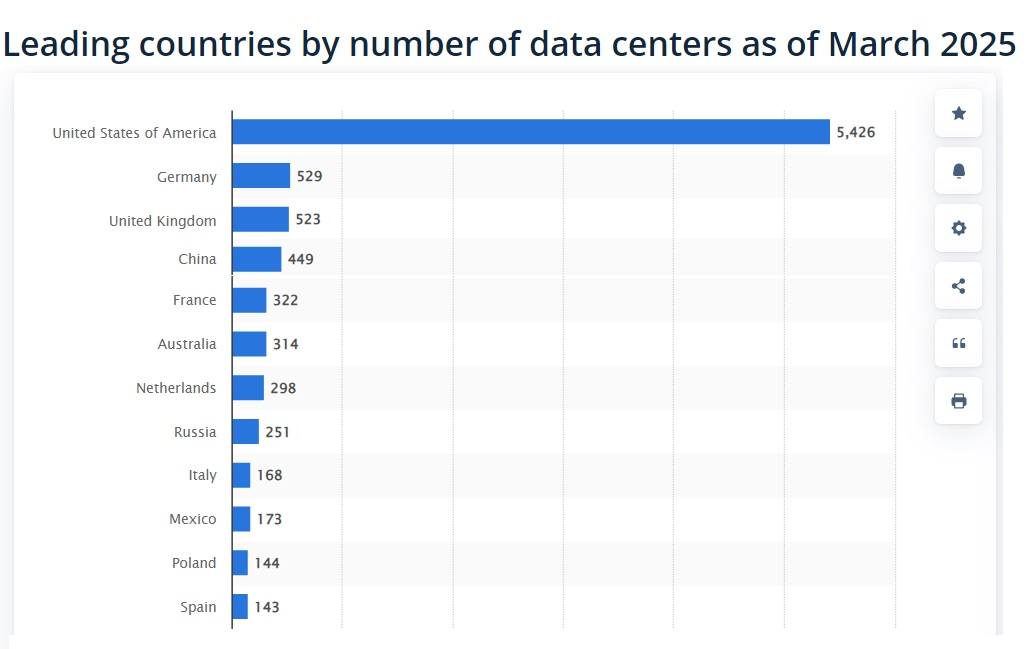
The United States has more data centers than almost the rest of the world combined. Image source.
Here are some recent articles published this week in the national media that recognize that this situation with Big Tech is a national crisis.
From CNN:
You thought Monday’s internet outage was bad? Just wait
Monday’s Amazon Web Services outage — and the global disruption it caused — underscored just how reliant the internet has become on a small number of core infrastructure providers.
The ramifications of such outages could only get worse if artificial intelligence becomes as central to work and daily life as tech giants suggest it will in the coming years.
Monday’s outage briefly blocked some people from scheduling doctor’s appointments and accessing banking services. But what if an outage took down the AI tools that doctors were using to help diagnose patients, or that companies used to help facilitate financial transactions?
It may be a hypothetical scenario today, but the tech industry is promising a rapid shift toward AI “agents” doing more work on behalf of humans in the near future – and that could make businesses, schools, hospitals and financial institutions even more reliant on cloud-based services.
A global survey of nearly 1,500 firms published by McKinsey & Company in May found that 78% of respondents already use AI in at least one business function, up 55% from a year earlier.
“If there’s an outage and you rely on AI to make your decisions and you can’t access it, that’s going to have an effect on performance,” said Tim DeStefano, associate research professor at Georgetown’s McDonough School of Business.
Monday’s outage had such a widespread impact because many companies rely on cloud providers for the backend functions that support their businesses, such as virtual server space, storage or developer tools.
Typically, this set up is more affordable, flexible and secure for those customers, except when AWS experiences an outage. Then it’s effectively a single point of failure for a huge swath of the internet.
AWS serves millions of customers, from retailers and restaurants to financial services firms and government agencies; it holds around 37% of the cloud computing market, according to Gartner. Together with Microsoft and Google, the three companies service around 70% of the market.
And the consolidation of the internet’s backbone is continuing in the age of AI.
While there’s some grappling between the big three, Amazon, Microsoft and Google remain by far the prominent cloud computing providers for AI applications, according to Emarketer senior analyst Jacob Bourne — and their futures depend at least in part on serving AI demand.
While websites and apps can still technically function using their companies’ own less powerful on-premises servers,
“cloud computing represents a technological prerequisite for using AI,” DeStefano said.
That’s because the computers needed to run AI tools are powerful and expensive, and on-site hardware isn’t as easy to modify as business needs change. It just makes more sense to rent that computer space and pay for it only as needed.
And as AI becomes more widespread, data center outages could happen more frequently since AI models are so power-hungry, Bourne said.
The risk of serious disruption from an outage rises considerably the more companies rely on AI agents to do critical tasks and automate the work of humans, a transition that’s already in progress despite disagreement about just how far it will go. (Source.)
From GeekWire:
Concentration crisis in AI
With the generative AI ecosystem, I’m talking not about chatbots — I mean AI-native applications that are built on generative AI as a platform. We just saw that when there’s no cloud, there’s no cloud-native application. Likewise, when there’s no generative AI provider, there’s no AI-native application.
The first lesson from the AWS outage for AI-native applications is what happens to an industry when there’s a limited number of providers for centralized resources and there’s an outage. We just saw: it has huge rippling effects across the industry and all walks of life built on it.
It’s a throwback to the mainframe era: when “the computer” is down, it’s down for everyone.
There are as few, if not fewer, generative AI providers as there are cloud providers. A major outage is inevitable — that’s just engineering reality. When that happens, every AI-native app built on that generative AI platform will also go down, full stop.
The impact could be even more severe than the AWS outage. It will be more like “the computer is down, and the people are gone” for many different industries and services.
Ironically, the “smarter” the industry and service, the greater the potential fallout.
The second lesson is one of intertwined risk. OpenAI itself was affected by this week’s AWS outage.
That means AI-native apps have double exposure to the risks around a limited number of providers for critical, centralized resources. For AI-native apps, it’s like the mainframe era squared.
If the generative AI platform fails, everything built on it fails. And if the cloud that hosts the AI platform fails, it all goes down, too.
Highly concentrated risks with exceptionally broad impact aren’t going away anytime soon.
A thoughtful application of the AWS outage tells us that outages like this are a kind of problem that isn’t an anomaly: it’s inherent in the nature of today’s technology reality. (Source.)
[…]
 The Most Revolutionary Act
If this woke up some people, it would have also generated the idea that there will be severe issues with digital money. What if a Carrington Event (1859) occur again? Then basically all satellites, power grids, mobile phone systems, bank systems, Internet etc. will be fried and we will not be able to do much about it. Back then, most telegraph lines was fried. It’s possible to do some preparation for protection, but that’s limited. (Bye bye satellites and Internet!) If not invested in noble metals, then expect to become broke … (Long time ago here in Sweden, the Socialists excluded nobel metals as legal tender. I wonder why …) Quite recently, the Earth was “showered” with a couple of minor solar outbursts, but most people probably missed that … We will be warned by the scientists of concern, but it depend on what kind of outburst the sun create and it varies between an almost whole week and twenty minutes …
LikeLiked by 1 person
Thanks for the extremely useful info SasjaL
LikeLike
I think a lot of people are expecting the digital system to crash, which explains the high price of gold.
LikeLike
It will crash. Part of the high price, is that foremost Russia and China have been hording gold and silver for some years now, just to back up their currencies.* From my point of view, that is a sane strategy. As what it seems, most countries in the West have slowly but surely adopted to a transition to digital money. In line with this, we have the bank system, that can create money out of thin air. This due to one huge flaw in the accounting system we all use, based on the old Venetian bookkeeping system. A debit post must have the equivalet credit post and vice versa. When they lend money, automatically an asset appear. Money they technically don´t have. Some years ago, at least here in Sweden, the banks was forced to have actual (physical) money, before they could lend it.
* A number of European countries at least used to store their gold reserve in USA, but what happen to that gold? Last time I heard anything about Fort Knox, they talked about that the vault the gold is stored in, has not been opened for a long time. Is it still in there …?
LikeLike
Pingback: Amazon Outage Waking People Up Regarding Our Slavery to Internet – US Government Failing in Defense Against Cyberattacks | Worldtruth
Historian Matt Ehret, writes a lot about the Venetians and their direct role in establishing first the Dutch central bank and then the Bank of England in 1694 (after William of Orange invaded England).
LikeLike