
Jeremy Kuzmarov
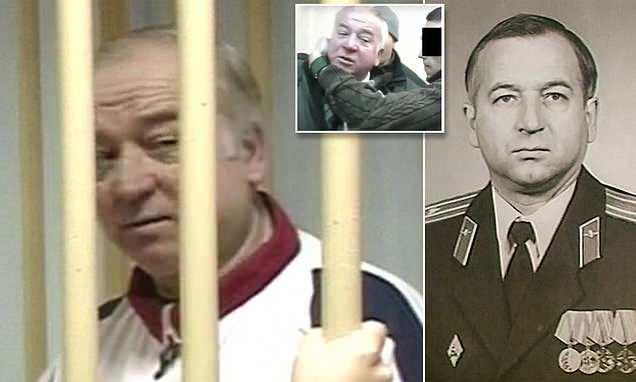
On March 4, 2018, Sergei Skripal, a 66-year-old former Russian intelligence officer turned British defector was allegedly poisoned with Novichok nerve agent in Salisbury, England, along with his 33-year-old daughter Yulia.
The two were admitted to a hospital after they were allegedly found unconscious on a public bench in the center of Salisbury by the chief nursing officer for the British army and her daughter.
Within three to four weeks, Yulia and Sergei were said to have regained consciousness and the ability to speak and were taken to a secure location.
[…]
On September 5, 2018, British authorities identified two Russian nationals, using the names Alexander Petrov and Ruslan Boshirov, as suspected of the Skripals’ poisoning, and alleged that they were active officers in Russian military intelligence.
Bellingcat, an intelligence-connected research agency, subsequently identified Ruslan Boshirov as being the highly decorated GRU (Russian Federation Intelligence Services) Colonel Anatoliy Chepiga, that Alexander Petrov was Alexander Mishkin, also of the GRU, and that a third GRU officer present in the UK at the time was identified as Denis Vyacheslavovich Sergeev.
After the Skripals’ poisoning, then-UK Prime Minister Theresa May issued a statement denouncing Russia’s role and ordered the expulsion of 23 Russian diplomats from the UK while freezing Russian state assets that could potentially be used to threaten UK citizens.
May also canceled a planned visit to the UK of Russian Foreign Minister Sergey Lavrov and inaugurated a new 48 million British pound chemical weapons defense center.
The Trump administration released a statement fully supporting the stance of the UK government and blaming Russia for the alleged Novichok attack. Following the recommendation of the UN Security Council, Trump in turn ordered the expulsion of 60 Russian diplomats (considered to be intelligence agents) and the closure of the Russian consulate in Seattle, and enacted a new round of sanctions on Russian banks and exports.
Deception Operation Exposed
John Helmer is an Australian correspondent based in Moscow who has recently published the book Long Live Novichok! The British poison which fooled the world, which exposes the Skripal and Sturgess poisonings as a deadly British MI6 deception operation.
Its purpose was to create a diplomatic row with the Russians and help mobilize public support for the U.S.-UK proxy war in Ukraine and a new Cold War.
[…]
Helmer writes that today’s counterpart involving the Skripals—“Operation Mincepie”—involved “what’s left of British secret intelligence in March 2018” dressing up “two Russians—Sergei and Yulia Skripal,” “knocking them out on a bench in the middle of Salisbury,” and taking them to Salisbury District Hospital where they were treated for acute organo-phosphate poisoning.[2]
[…]
Sir Mark Sedwill was a high-level MI6 agent operating under diplomatic cover, who served as Cabinet Secretary and National Security Adviser to Prime Minister Theresa May and is considered by Helmer to have been the key mastermind of Operation Mincepie.[3]
The success of Operation Mincepie was evident in the fact that 65% of the British public “had a perception of Russian culpability” in the Skripal and Sturgess poisonings in the year after the attacks, according to Helmer.[4]
[…]
In debunking the official story, Helmer quotes from Salisbury District Hospital staff, including Dr. Stephen Davies, who disclosed that blood testing did not reveal that the Skripals had been poisoned with Novichok, though hospital staff had been told what to report about the tests 24 hours before they were administered.[7]
The UK Defense Ministry and its Defence Science and Technology Laboratory (DSTL) at Porton Down were unable or unwilling to produce records of the Skripal blood evidence—precisely, Helmer says, because the evidence does not exist.[8]
If the Skripals were actually poisoned with Novichok, they would have died either instantaneously or within several seconds or minutes.[9]
The symptoms that Detective Bailey described also were not consistent with those of Novichok poisoning, which normally involves difficulty breathing, lapsing into delirium or the loss of consciousness or muscle coordination.[10]
Amazingly, Yulia Skripal admitted, when she first re-awoke while in the hospital four days after the attack, that the assassination attempt on her and her father was carried out with poison spray—in the restaurant where the Skripals were dining—by an attacker who was not Russian.[11]
This undercut the official story that the Russians had spread the poison on the Skripals doorknob.
Helmer suggests that Yulia had recovered consciousness far earlier than was reported in the media, that doctors forcibly sedated her to fit a certain assigned narrative, and that she was subsequently made to speak from a script.[12]
Since the Skripals did not die in Operation Mincepie, they had to be locked up—their whereabouts since their alleged release from the hospital have never been disclosed. (Sergei was last heard of in a telephone call to his mother’s house in June 2019 and Yulia in June 2018).[13]
[…]
May’s Lies
Among Theresa May’s lies was her claim that only Russia had the technical means and operational experience and motive to carry out the Novichok poisoning attacks. May knew very well, however, that Porton Down had a top-secret nerve-agent program that produced Novichok.
This program has not been properly disclosed to the OPCW, making it a violation of the UN Chemical Weapons Convention.[27]
The Porton Down facility happens to be located adjacent to Salisbury where the alleged Skripal poisoning attack took place.
BBC Lies
Helmer includes a chapter on the misinformation advanced by the BBC—a long-time supporter of MI6 covert operations—which, he says, provided a “platform for the British government’s narrative that Russia, directed by Vladimir Putin, waged chemical warfare on British soil, attempting to assassinate Sergei and Yulia Skripal and then killing Dawn Sturgess.”[28]
BBC broadcaster Mark Urban later admitted that he had been preparing interviews with Skripal by arrangement with the Secret Intelligence Service (MI6) and then produced a book on the case with the NATO information warfare unit, Bellingcat.[29]
A BBC documentary series that Urban narrated—which was watched by some 12 million viewers—claimed that the Russian assassins snuck into the Skripals’ home through the back and spread the Novichok on the front-door handle, which is how Detective Bailey allegedly was infected.
But the Skripals collapsed at 4:15 p.m.—three hours after they were last at home—which makes the above scenario impossible because exposure to Novichok causes almost instantaneous debilitation and—usually—death.[30]
A key military source in the film, Hamish de Bretton-Gordon, served in the Royal Tank Regiment with Mark Urban and Pablo Miller, Skripal’s MI6 handler.[31]
A veteran of the British army’s chemical warfare regiment, de Bretton-Gordon claimed to have served in a medical unit in Idlib, Syria, when the city was under the rule of ISIS and served as an adviser to the BBC on Russian threats—which it was his job to deliberately play up.[32]
Misleading footage in the BBC film showed the Skripals feeding the ducks in the park—which was clearly staged as it is now known that no ducks were poisoned.
The Skripals were shown spreading poison elsewhere in the park unwittingly when no nerve agent poisoning was ever spread.
Helmer writes that the effect of the BBC film was to “create a dire threat facing the city”—emanating supposedly from the Russians—which did not actually exist.[33]
A Triple Agent
Helmer presents evidence that Sergei Skripal was concerned before his alleged poisoning about being spied on not by the Russians but by British intelligence agents.[34]
The reason, Helmer believes, is that Skripal was actually a Russian triple agent whose defection to the British had been carefully staged.[35]
Skripal’s purpose as a triple agent was to gain secrets on Britain’s chemical warfare preparations at Porton Down, which he was able to infiltrate. Additionally, he was allegedly able to report on British MI6 identities and operations.
The likely scenario is that, when MI6 discovered Skripal’s double crossing of them and his spying for the Russians, they poisoned him and his daughter with nerve agents developed at Porton Down.
[…]
 The Most Revolutionary Act
Whoever wrote this report did not live in England.
The whole Skripal matter fell apart very quickly.
The sergeant from the nearby Porton Down base who gave him mouth to mouth according to her own words never received treatment but failed to realise that her account laid bare the lie that Skripal was poisoned with a nerve agent since she would have necessarily been rushed off to hospital and a special Hazmat Team would have dealt solely with the Skripals and the sergeants care.
Yulia Skripal was due to fly home to Russia that weekend which would not have bothered the Russians but could, if her father had given information useful to the Russians, bothered very much, British Intelligence services, so they were the only people to have reason to poison them.
Sergei Skripal wanted to return to Russia to see his ailing mother but the Russians would not give him permission, so that again, pointed to MI5 not Russia.
Yulia was going to try and get special permission for her dad to visit and she wrote to her sister/mother in ENGLISH according to the letter photo’ in the newspapers, which suggests it was a fake and as mentioned above Yulia believed she and her father were suffering from food poisoning. Yet again pointing to MI6
The PC who apparently had Novichok poisoning from touching the Skripals door handle a day after, was never found to have been at a hospital.
The Graund(Guardian)trying to fob this three ring circus had to close the BTL comments more than a few times, because so many people did not believe the crap in print.
When the Skripals were put under “protective custody”, too many people voiced their belief that both her and her father would never be seen alive again -and they haven’t been. Pointing to MI5
I could go on but suffice it to say the Skripal poisoning backfired badly because MI6 totally lost and could not contain the contradictory narrative and the story, by necessity had to be dropped.
It’s fairly understood that the whole episode was farcical and far too many people knew they were being lied to.
Less a successful British MI6 deception than a right royal cock up by the supposed British “Intelligence” Agency.
The same can be said of the Litvinenko kangaroo court proceedings where the police contradicted themselves and the Lockerbie fiasco in which it has since been proven that the Libyan man jailed and allowed to die because they withheld necessary medical treatment was not the perpetrator.
If people want to make money by writing a book they really should have witnessed the proceedings first hand, this author certainly did not.
Novichok originaly was tested by the Russians in a facility which they abandoned and the US walked straight in – Russia was trying to find a pest killer, but decided it was too dangerous and unpredictable. One of the biolab engineers working during the Russian involvement posted a copy of the “New Boy” agent, online, so the false claim that only Russia had the formula is a load of hogwash. It’s quite likely that many countries have this nerve agent, not least of course, would be the US and the UK at Porton Down, just up the road from the Cathedral City of Salisbury. And who, pray tell, would want that on their doorstep, quite a lot of people living in and around Salisbury as it turned out.
LikeLike
Thanks for your lengthy correction, Susan. Kuzmarov’s article is a review of a book written about the so-called poisoning by Australian journalist John Helmer. Do you think the Skripals are still alive?
LikeLike