The Role of US-Funded Terrorists in the “New” Syria

Daniel Kovalik

During her confirmation hearing for Director of National Intelligence, Tulsi Gabbard was grilled about having been a purveyor of “Putin’s talking points” about the U.S. supporting al-Qaeda in Syria.

Of course, Gabbard responded, there can be no doubt about the veracity of such claims.

Thus, Gabbard cited the fact that the CIA, beginning under President Barack Obama, carried out its most expensive regime-change program ever in Syria, termed “Operation Timber Sycamore”—a $1 billion-a-year program which included the arming and funding of terrorist groups like al-Qaeda and ISIS to undermine the government of Bashar al-Assad.

For his part, Seymour M. Hersh wrote in The New Yorker magazine in 2007 that the U.S. began supporting such groups in Syria back in 2005 under President George W. Bush.

Hersh’s article was entitled “The Redirection”–-the title referring to Bush’s having reversed course in having targeted al-Qaeda for destruction after 9/11 to supporting al-Qaeda to undermine governments, such as the one in Syria, which challenged U.S. hegemony in North Africa and West Asia.

In Syria, the U.S. has now reaped what it has sown, with the group Hayat Tahrir al-Sham (“HTS”)—an al-Qaeda offshoot—having come to power under the leadership of Ahmed Hussein al-Sharaa, whose nom de guerre as al-Qaeda chief was Abu Mohammad al-Julani.

Al-Julani, which I will call him hereinafter, has just declared himself president of Syria, scrapped the socially progressive Constitution of 2012, and has announced that there will be no elections forthcoming for at least four years and possibly five.

It appears that al-Julani and his HTS terrorists need this time to purge the country of certain groups to ensure that they will be successful in any election that will take place. And, indeed, al-Julani has alluded to this fact, having stated that the current violence against certain minority groups, such as Alawites and Christians—violence he initially tried to distance himself from—is “normal and may continue for two or three years.”

The town of Homs has become an epicenter of such violence.  As The Cradle explains, “the western countryside of Homs has been gripped by a brutal security campaign marked by grave human rights violations, including field executions, looting, public humiliation, sectarian insults, and indiscriminate arrests. These atrocities were carried out by the interim government’s Military Operations Department under the pretext of searching for wanted individuals and seizing weapons, but the campaign swiftly descended into lawlessness.”

According to one of my friends in Homs, “We are not happy with our lives. Our lives have been turned upside down. No work. No security. Kidnapping. Killing everywhere. The biggest problem is that what is happening is based on hatred for Alawites. We are being killed because we are Alawites.”

The new regime in Damascus has also outlawed opposition parties, such as the Baath Party (the former governing party) as well as both Communist Parties of Syria. In addition, the new government moved quickly to take away arms from individuals and groups, including the Palestinian liberation organizations which the Assad government had allowed to operate freely in Syria.

For its part, the banned Syrian Communist Party put out a statement denouncing the new regime, writing in part:

Since seizing power in our homeland Syria on December 8, 2024, as a result of a military attack fully supported by colonial powers that are members of the aggressive NATO, the dark clique has begun to restrict the social rights of the people. Tens of thousands of workers in the state and public sector facilities have been laid off, with many of these facilities being liquidated, which has led to a worsening of the economic and social situation. In addition, discrimination between citizens on the basis of their beliefs and affiliations is escalating. Kidnappings and assassinations have taken place and are taking place, accompanied by theft, looting and extortion.

I visited Syria in the latter part of January to see for myself what Syria is like under the new regime.  I had something to compare this to as I had visited Syria twice back in 2021, when it was still under the leadership of Bashar al-Assad.In 2021, Syria was experiencing relative peace due to an uneasy cease-fire agreement between the Assad government and the anti-government forces allowed to continue existing and operating in the northwest province of Idlib under Turkish “protection.”

As I learned in Syria at the time, Syria’s government forces had collected passports from 84 different countries amongst the opposition fighters.

Syria had truly been the target of a world war against it—a war, combined with crippling economic sanctions, to which Syria finally succumbed at the end of 2024.

Syria is now being carved up by Western powers, with Israel taking over huge swaths of land as well as water resources in the south, including Mount Hermon—the highest point in all of the Levant. Israel is now building a military base in the south, while Turkey is building a military base in the north.

The United States, meanwhile, continues to occupy the oil- and grain-rich northeast.  The new HTS regime, too busy massacring religious minorities, has not moved to contest any of these foreign encroachments. And, indeed, the Syrian Interior Ministry has released a new map of Syria which no longer includes the Golan Heights, now occupied by Israel, despite the fact that international law still recognizes this as Syrian territory. This same new map also effectively cedes territory to Turkey in the north.

I met and interviewed a number of people while in Syria.  Of course, there was a diversity of opinion as there always will be in such a large and diverse society.  Some people are hopeful that things will change for the better now, especially if the economic sanctions are lifted from Syria and the country is allowed to rebuild what was destroyed during the war—the prevention of such reconstruction being an intended goal of the sanctions.

Indeed, almost everyone is unanimous that they are desperate to see the sanctions lifted and for economic life to return to the country.  This makes eminent sense.

The entire country remains devastated from the brutal war. The central portion of Damascus, while spared the worst of the damage, is still in bad shape, suffering as it is from dilapidated infrastructure and buildings.

Meanwhile, other towns, like Jobar which I visited, resemble the bombed-out city of Dresden after World War II.  A recent report by the RAND Corporation describes the devastation which remains in Syria after the war:

Syria’s infrastructure is so deteriorated that basic services are woefully insufficient for those who are there now—much less for a large influx of returning refugees. A decade and a half of warfare has damaged 23 percent of the total housing stock, especially where the fighting was most intense, and thus where many of the refugees lived. The education system is in shambles, with 2.4 million children not attending classes and heavily damaged school infrastructure. Only slightly more than half of Syria’s hospitals are fully functioning. And in addition to the refugees outside the country, more than 7 million Syrians are internally displaced.

Meanwhile, many others in Syria are not so hopeful for the future under HTS.  One Christian cleric I interviewed—an individual who is reluctant to reveal his identity—spoke for a lot of people when he told me, “before, we had a dictatorship; now, we have something worse—a government run by extremists.” He stated that, “in my opinion, the U.S. brought us HTS, and they can take them back.”

His view was that what happened with the HTS takeover of Syria could not be termed a “revolution,” for it was not an organic rising of the people. Rather, it was the triumph of a group funded and supported from the outside of Syria, made up in significant part of foreign fighters and based in only one part of the country—Idlib. This, in short, is not a group which can purport to represent the Syrian people.

This cleric, as a number of others also complained to me, was disturbed how the misdeeds of the Assad government had been exaggerated, or even falsified, to provide post hoc justifications for the takeover by HTS.

The big lie he and others pointed to was that revolving around Sednaya Prison—the main focus of the mainstream press after the fall of Assad.  As he and others explained to me, the media made up grotesque falsehoods about the prison—for example, claiming that tools used in the workshop there were in fact instruments of torture.

One individual told me that they in fact knew someone who was imprisoned there—they believed quite wrongly—who was the subject of a campaign under Assad to release him. This person, upon being released, categorically denied that torture was happening in that prison.

I met another individual who is an Alawite living in Damascus. This individual, whom I will call “A” (and refer to as “they” and “their” so as not to reveal their gender), was quite afraid for their safety, and quite reasonably so.

First of all, A’s friend, a university professor, had recently been kidnapped and killed. Tim Anderson, on Twitter, described what happened to this professor:

Days after her abduction by HTS, the body of Dr. Rasha Al-Ali was discovered, bearing signs of brutal treatment, including the amputation of her fingers. Dr. Rasha, a respected university researcher and a member of the Arab Writers Union, was a prominent intellectual voice. Her crime…criticism of wearing the Niqab on campus.

Her killing underscores the growing dangers faced by academics and intellectuals in the region, as well as the alarming rise in sectarian and targeted violence. This tragic loss highlights the need for immediate attention to the safety and protection of Syria’s minority and intellectual communities.

Shortly after this incident, A barely escaped being kidnapped. Thus, A, a university instructor, was asked by a student to meet off-campus. Before this meeting happened, however, other students warned A not to go, explaining that this was a ploy to kidnap A. While A remains in Syria, they are considering leaving the country.If A flees, they will join others who have already left Syria for fear of the new government, as well as those who have been displaced within the country as a result of the fighting culminating in Assad’s overthrow.Thus, more than 100,000 Syrians (mostly Shia and members of other minority religious groups) have fled Syria since the fall of Assad, while “[o]ne million more Syrians were internally displaced by the fighting in November and December.” According to A, an entire town—the Alawite town of Alqeen, in the Daraa Province of Syria—just “disappeared” in December after the HTS takeover. According to A, the entire town was depopulated and the whereabouts of the residents are unknown. Meanwhile, despite the claims by the mainstream media that Syrians were flocking back home after the fall of Assad, only 125,000 Syrians have returned since then.Even as I was writing this article, A wrote to me about another atrocity committed by extremists linked to the new HTS government. Thus, they wrote to me about a 22-year-old woman named Nagam Issa who had been kidnapped in Homs while visiting a clinic for a pregnancy check-up. Her dead body, showing signs of torture, was later found, lying next to the body of another young woman.

The kidnapping and death of Nagam were publicized on Facebook in a post which A sent to me.  According to this post, originally written in Arabic, “The primary suspect in the crime of kidnapping Mrs. ‘Nagam Issa’ is one of the terrorists and leaders of the armed sectarian factions belonging to the dirty Golani terrorist called Jassim Abu Moawya from Tklakh in the Homs countryside.  This dirty sectarian terrorist continuously abducts and carries out armed attacks upon the people in the surrounding villages either to kill or to intimidate civilians, and he has documented and published these crimes. The last massacre committed by this sectarian savage was days ago….”

[…]

Via https://libya360.wordpress.com/2025/02/17/fear-and-loathing-in-the-new-syria/

Is Our Five-Year Nightmare Finally Over?

Life After Lockdown: Foreword by Rand Paul | The Epoch Times

Jeffrey A Tucker

Robert F. Kennedy, Jr.’s confirmation as the Secretary of Health and Human Services in the US is the ultimate repudiation of the Covid policy response.

The scheme of lockdown-until-vaccination was the biggest effort of government and industry on a global scale on historical record. It was all designed to transfer wealth to winning industries (pharma, online retail, streaming services, online education), divide and conquer the population, and consolidate power in the administrative state.

By 2021, RFK, Jr., had emerged as the world’s most vocal, erudite, and knowledgeable critic of the scheme. In two brilliant books – The Real Anthony Fauci and The Wuhan Cover-Up – he documented the entire enterprise and dated the evolution of the pandemic industry from its postwar inception to the present. There was simply no way to read these books and think about the corporatist cabal in the same way.

The circumstances that led to his appointment at HHS are themselves implausible and remarkable. Perceiving President Biden to be a weak candidate – one who had forced masks and shots on the population and brutally censored tech and media – he decided to make a run for president, presuming that there would be an open primary. There wasn’t one, so he was forced into an independent run.

That effort was chewed up by the usual political dynamic that befalls every third-party effort – too many ballot-access barriers plus the usual logic of Duverger’s law. That left the campaign in a difficult spot. At the same time, two huge political shifts had become clear. The Democratic Party had become a vessel and a front mainly for the administrative state with a veneer of woke ideology, while the Republican Party was being taken over by refugees from the Democrats, in effect creating a new Trump party out of the remnants of the other two.

The rest is legendary. Trump linked up with Elon Musk to do to the federal government what he did when he took over Twitter, taking the company private, gutting the place of embedded federal assets, and firing 4 out of 5 workers. In the midst of this, and faced with a terrifying flurry of legal attacks, Trump dodged an assassin’s bullet. That triggered terrible memories of RFK, Jr.’s father and uncle, and thus sparked discussions about coming together.

Within a matter of weeks, we had a new coalition that brought together old antagonists, as many people and groups seemingly in the same instant realized their conjoined interests in cleaning up the corporatist cartel. With the newly freed platform of X to reach the public, MAGA/MAHA/DOGE was born.

Trump won and chose RFK, Jr., to lead the most powerful public health agency in the world. The barrier was Senate confirmation, but that was achieved through some incredible triangulation that made it extremely difficult to vote no.

In the big picture, you can measure the size of this titanic shift in American politics by the way the votes in the Senate lined up. All Republicans but one voted for the most prominent scion of the Democratic Party to head the health empire while all Democrats voted no. That alone is striking, and a testament to the power of the pharma lobby, which, during the hearings, was exposed as the hidden hand behind the most passionate opponents of the confirmation.

Is our nightmare over? Not yet. Writing not even a month into the second presidential term of Donald Trump, it is still unclear just how much authority he truly exercises over the sprawling executive branch. For that matter, no one can even agree on how large this branch is: between 2.2 million and 3 million employees and somewhere between 400 and 450 agencies. The financial bleed in this realm is unthinkable and far worse than even the biggest cynic can imagine.

Five former secretaries of the Treasury took to the pages of the New York Times with a shocking claim. “The nation’s payment system has historically been operated by a very small group of nonpartisan career civil servants.” This has included a career employee called “fiscal assistant secretary—a post that for the prior eight decades had been reserved exclusively for civil servants to ensure impartiality and public confidence in the handling and payment of federal funds.”

There is no reason even to read between the lines. What this means is that no person voted into office by the people and no one appointed by such a person has access to the federal books since 1946. This is startling beyond belief. No owner of any company would ever tolerate being barred from the accounting offices and payment systems. And no company can offer any public stock without independent audits and open books.

And yet almost 80 years have gone by during which time neither has been true for this gigantic enterprise called the federal government. That means that $193 trillion has been spent by an institution that has never faced granulated oversight from the people and never met the normal demands that every enterprise faces every day.

The usual habit in Washington has been to treat every elected leader and their appointments as temporary and transitory marionettes, people who come and go and disturb little to nothing about the normal operations of government. This new administration seems to have every intention to change that but the job is inconceivably challenging. As much public support as MAGA/MAHA/DOGE enjoy for now, and as many people from those groups are getting embedded in the power structure, they are outnumbered and outmaneuvered by millions of agents of the old order.

This transition will not be easy if it happens at all.

The inertia of the old order is mighty. Even on the issue of health and pandemics, there is already confusion. CBS News has reported that Fauci-loyalist and mRNA pusher Gerald Parker will head the White House Office of Pandemic Preparedness and Response or OPPR. The report cited only unnamed “health officials” and the appointment has been celebrated by Scott Gottlieb, the Pfizer board member who nudged Trump into backing lockdowns in 2020.

All the while, this appointment has not been confirmed by the White House. We do not know if OPPR, created by Congressional charter, will even be funded. The reporter will not reveal his sources – raising the question of why any appointment having to do with health should be surrounded by such cloak-and-dagger machinations.

If Dr. Parker becomes ensconced in this position and another health emergency is declared, this time for Bird flu, HHS and Robert F. Kennedy, Jr., will not be in any kind of decision-making position at all.

The larger problems have to do with a broader question: is the president really in charge of the executive branch? Can he hire and fire? Can he spend money or decline to spend money? Can he set policy for the agencies?

One might suppose that the whole answer to these questions can be found in Article 2, Section 1: “The executive Power shall be vested in a President of the United States of America.” And yet that sentence was written almost 100 years before Congress created this thing called the “civil service” that nowhere appears in the Constitution. This fourth branch has grown in size and power to swamp both the presidency and the legislature.

Courts are going to have to sort this out, and already an avalanche of lawsuits has hit the new administration for daring to presume control over agencies and their activities of which the president is and must necessarily be held accountable. Lower federal courts seem to be demanding that the president be that in name only, while the Supreme Court might have a different opinion.

The much-ballyhooed “constitutional crisis” consists of nothing other than an attempt to reassert the original constitutional design of government.

This is the background template in which RFK, Jr., takes power at HHS, and oversees all the sub-agencies. These agencies played a huge role in covering for the attack on liberty and rights over five years. His confirmation is a symbolic repudiation of the most egregious public policies on record. And yet, the repudiation is entirely implicit: there has been no commission, no admission of error, no one truly held responsible, and no real accountability.

[…]

Via https://brownstone.org/articles/is-our-five-year-nightmare-finally-over/

China’s DeepSeek Bombshell Rocks Trump’s $500B AI Boondoggle


Mike Whitney

The future of humanity is being decided as we speak. And it is not being decided on a battlefield in Eastern Europe, or the Middle East or the Taiwan Strait, but in the data centers and research facilities where technology experts create “the physical and virtual infrastructure to power the next generation of Artificial Intelligence.” This is a full-blown, scorched-earth free-for-all that has already racked up a number of casualties though you wouldn’t know it from reading the headlines which typically ignore recent ‘cataclysmic’ developments. But when President Trump announced the launching of a $500 billion AI infrastructure project (Stargate) on Tuesday just hours after China had released its DeepSeek R1—which “outperforms its rivals in advanced coding, math, and general knowledge capabilities”—it became painfully obvious that the battle for the future ‘is on’ in a big way. And this is not a battle that either side can afford to lose. Here’s how technology expert Adam Button summed it up:

Imagine we’re back in 2017 and the iPhone X was just released. It was selling $999 and Apple was crushing sales and building a wide moat around its ecosystem.

Now imagine, just days later, another company introduced a phone and platform that was equal in every way if not better and the price was just $30.

That’s what unfolded in the AI space today. China’s DeepSeek released an opensource model that works on par with OpenAI’s latest models but costs a tiny fraction to operate. Moreover, you can even download it and run it free (or the cost of your electricity) for yourself.

The product is a huge leap in terms of scaling and efficiency and may upend expectations of how much power and compute will be needed to manage the AI revolution. It also comes just hours before Trump is expected to unveil a $100 billion investment in US datacenters. The model shows there are different ways to train foundational AI models that offer up the same results with much less cost. It also opens up far more applications for AI that would have been too expensive to run previously, which should broaden the applications in the real economy. China’s DeepSeek may have just upended the economics of AI, forex live

Imagine the panic that is spreading across western tech capitals right now. AI was supposed to be the fast-track to absolute societal control and oligarchic rule into the next millennia, but now those pesky Chinese have overturned the applecart leaving western elites with a problem they might not be able to fix. (See—Unchecked AI will lead us to a police state, edri ) They expected that their microchip sanctions would sabotage China’s AI efforts for at least a decade-or-so but, instead, China has come roaring back with a system that has left the tech giants gasping for air.

Of course, China’s eye-popping strides in technological development are nothing new as editor Ron Unz pointed out in a recent article where he noted that “between 2003 and 2007, the US led in 60 of the 64 technologies.” Whereas, as of 2022, “China led in 52 of the 64 technologies.” That’s not a competition; that’s a beat-down in a parking lot. Here’s Unz:

China now leads the world in many of the most important future technologies. The success of its commercial companies in telecommunications (Huawei, Zongxin), EV (BYD, Geely, Great Wall, etc.), battery (CATL, BYD) and Photovoltaics (Tongwei Solar, JA, Aiko, etc.) are directly built on such R&D prowess.

Similarly, the Chinese military’s modernization is built on the massive technological development of the country’s scientific community and its industrial base…. With its lead in science and technology research, China is positioned to outcompete the US in both economic and military arenas in the coming years…. American Pravda: China vs. America, Ron Unz, Unz Review

None of this should come as a surprise, although the timing of DeepSeek’s release (preempting Trump’s Stargate announcement) shows that the Chinese don’t mind throwing a wrench in Washington’s global strategy if it serves their regional interests, which it undoubtedly does. Here’s a bit more background from an article by Benj Edwards at Ars Technica:

On Monday, Chinese AI lab DeepSeek released its new R1 model family under an open MIT license, with its largest version containing 671 billion parameters. The company claims the model performs at levels comparable to OpenAI’s o1 simulated reasoning (SR) model on several math and coding benchmarks….

The releases immediately caught the attention of the AI community because most existing open-weights models—have lagged behind proprietary models like OpenAI’s o1 in so-called reasoning benchmarks. …

The R1 model works differently from typical large language models ….They attempt to simulate a human-like chain of thought as the model works through a solution to the query. This class of what one might call “simulated reasoning” models, or SR models for short, emerged when OpenAI debuted its o1 model family in September 2024. …

DeepSeek reports that R1 outperformed OpenAI’s o1 on several benchmarks and tests, including AIME (a mathematical reasoning test), MATH-500 (a collection of word problems), and SWE-bench Verified (a programming assessment tool)….

TechCrunch reports that three Chinese labs—DeepSeek, Alibaba, and Moonshot AI’s Kimi—have now released models they say match OpenAI’s o1’s capabilities, with DeepSeek first previewing R1 in November. Cutting-edge Chinese “reasoning” model rivals OpenAI o1—and it’s free to download, ars technica

This is a very big deal. The United States intends to dominate the world in this critical technology and yet the upstart Chinese have not only produced a system that is every bit as good as America’s best, but have made it more affordable, more accessible and more transparent. What’s not to like?

[…]

Here’s more from political analyst Arnaud Bertrand in a post on X:

Most people probably don’t realize how bad the news (about) China’s Deepseek is for OpenAI. They’ve come up with a model that matches and even exceeds OpenAI’s latest model o1 on various benchmarks, and they’re charging just 3% of the price. It’s essentially as if someone had released a mobile on par with the iPhone but was selling it for $30 instead of $1000. It’s this dramatic.

What’s more, they’re releasing it open-source so you even have the option – which OpenAI doesn’t offer – of not using their API at all and running the model for “free” yourself.

If you’re an OpenAI customer today you’re obviously going to start asking yourself some questions, like “wait, why exactly should I be paying 30X more?”. This is pretty transformational stuff, it fundamentally challenges the economics of the market….

So basically, it looks like the game has changed. All thanks to a Chinese company that just demonstrated how U.S. tech restrictions can backfire spectacularly – by forcing them to build more efficient solutions that they’re now sharing with the world at 3% of OpenAI’s prices. As the saying goes, sometimes pressure creates diamonds. @RnaudBertrand

Get the picture? Everything the US has done to stymie China’s development—including economic sanctions, chips embargoes, military provocations, political meddling, even arresting a Huawei executive (truly pathetic)—has blown up in their faces. China’s well-educated, highly motivated, technologically adept workforce have produced a model of AI that equals or exceeds the best the West has to offer at a fraction of the cost and with open sourcing that allows users to modify, and distribute the code as they see fit.

So, which version of AI sounds like a genuine benefit to humankind and which sounds like another scheme for transforming the world into a dystopian police-state controlled by aspiring tyrants and psychopathic control freaks?

So, it’s basically like everything else in this sick, twisted world where a handful of money-grubbing miscreants muscle their way into a new technology so they can fatten their own bank accounts while planting their bootheel firmly on the neck of humanity. It seems to me that China’s approach is vastly superior in that it’s clearly aimed at providing the benefits of AI to the greatest number of people at the lowest possible cost. Here are a few random comments on China’s DeepSeek AI that I picked off X that show how excited people are about this groundbreaking version:

The ramifications of this are huge. Every day China does something incredible, totally unlike the stagnation of the EU, talking all day while accomplishing nothing, or the latest evil plan oozing out of DC. This is just brilliant. & inspiring. & it WILL earn them more goodwill @CaptainCrusty66

It’s the china recipe book for success for every industry where western oligopolies have dominated. @bbooker450

AI will become a part of everyday infrastructure like electricity and tap water. DeepSeek is a signficant step towards that, thanks to its cost reduction and open source nature @MrBig2024

We are living in a timeline where a non-US company is keeping the original mission of OpenAI alive – truly open, frontier research that empowers all…. @DrJimFan

This is cool…this isn’t just another open source LLM release. this is o1-level reasoning capabilities that you can run locally, that you can modify and that you can study…
that’s a very different world than the one we were in yesterday. Al, comments line

Price comparison of OpenAI o1 and DeepSeek AI R1: R1 is significantly cheaper across all categories (96–98% savings). Now you know why big organizations don’t want open-source to continue, If humanity is ever going to benefit from AI, it will be from open-source . @ai_for_success

China is overturning mainstream development theory in astonishing ways. China’s GDP per capita is only $12,000. That’s 70% less than the average in high-income countries. And yet they have the largest high-speed rail network in the world. They’ve developed their own commercial aircraft. They are the world leaders in renewable energy technology and electric vehicles. They have advanced medical technology, smartphone technology, microchip production, aerospace engineering… China has a higher life expectancy than the USA, with 80% less income. We were told that this kind of development required very high levels of GDP/cap. But over the past 10 years China has demonstrated that it can be achieved with much more modest levels of output. How do they do it? By using public finance and industrial policy to steer investment and production toward social objectives and national development needs. This allows them to convert aggregate production into development outcomes much more efficiently than other countries, where productive capacity is often wasted on activities that may be highly profitable to capital, or beneficial to the rich, but may not actually advance development. Of course, China still has development gaps that need to be addressed. And we know from some other countries that higher social indicators can be achieved with China’s level of GDP/cap, by focusing more on social policy. But the achievements are undeniable, and development economists are taking stock. @jasonhickel

JULIAN ASSANGE says ‘Artificial intelligence is being used for mass assassinations in Gaza’ …“The majority of targets in Gaza are bombed as a result of artificial intelligence targeting.” ..It has been revealed that Google provided the Israeli military with AI tools in the early weeks of the genocide.

Unfortunately, the intensity of the competition between the US and China, ignores the inherent risks of Artificial Intelligence and its looming threat to human survival. In a recent analytical piece by the Rand Corporation titled AI and Geopolitics: How Might AI Affect the Rise and Fall of Nations?, the authors provide a disturbing window into a future in which “AI-enabled machines—of equivalent or greater intelligence and, potentially, highly disruptive capabilities” could pose a threat to our own existence. Keep in mind, the line between our historic reality and science fiction has already been crossed just as the probability that our own creation, AI, is likely “to become an actor, not just a factor” in the existential challenges faced by our species.

[…]

Via https://www.unz.com/mwhitney/chinas-deepseek-bombshell-rocks-trumps-500b-ai-boondoggle/#new_comments

Trump to Fire Thousands of Compromised CDC Agents in Massive Overhaul

Trump to fire thousands of corrupt CDC agents.

The Trump administration is planning to fire thousands of compromised agents working for the Centers for Disease Control and Prevention (CDC) as part of a massive overhaul of the corrupt agency.

This mass firing is part of a broader effort to eliminate 5,200 probationary positions across the Department of Health and Human Services (HHS), including the National Institutes of Health (NIH).

Naturalnews.com reports: The firings, which were announced on February 14, 2025, come as part of President Donald Trump’s aggressive campaign to “restructure and reshape” the federal government. Employees were given four weeks of paid administrative leave before their termination, with notifications delivered abruptly on the morning of Valentine’s Day. The administration has targeted probationary workers—those with less than a year of service—because they can be dismissed more easily without violating civil service protections.

A broken system or a necessary reckoning?

The Trump administration has long criticized the bloated federal bureaucracy, arguing that inefficiency and waste have become endemic to agencies like the CDC and NIH. “HHS is following the administration’s guidance and taking action to support the President’s broader efforts to restructure and streamline the federal government,” an HHS spokesperson told Fierce Healthcare. “This is to ensure that HHS better serves the American people at the highest and most efficient standard.”

However, critics warn that these cuts could have dire consequences. Among those dismissed are members of the CDC’s Epidemic Intelligence Service (EIS), a prestigious program that trains top doctors, veterinarians and health professionals to respond to disease outbreaks. “They sign up for a two-year training program to serve the country,” said Dr. Tom Frieden, former CDC director under President Obama. “Not only is terminating them bad for the country, it’s also a disgraceful violation of a commitment.”

Senator Jon Ossoff (D-GA) echoed these concerns, stating, “President Trump’s indefensible, indiscriminate firing of more than 1,000 CDC personnel in a single day leaves Americans exposed to disease and devastates careers and livelihoods for the world’s most talented doctors and scientists, many of them here in Georgia.”

Historical context: A government in need of reform

The Trump administration’s actions are not without precedent. For decades, critics have argued that federal agencies have grown unwieldy, with overlapping responsibilities and a lack of accountability. The CDC, with a core budget of $9.2 billion, has faced scrutiny for its handling of high-profile crises, including the COVID-19 pandemic and the opioid epidemic. Similarly, the NIH has been criticized for funding controversial research, such as gain-of-function experiments in China, which some believe contributed to the COVID-19 outbreak.

Yet, the CDC and NIH have also been instrumental in protecting public health. The CDC played a pivotal role in eradicating smallpox, controlling the spread of HIV/AIDS and responding to Ebola outbreaks. The NIH has been at the forefront of groundbreaking medical research, including the development of mRNA vaccines.

The question now is whether these cuts will lead to a more efficient government or cripple America’s ability to respond to future health threats.

The broader implications of government downsizing

The CDC and NIH are not the only agencies affected by the administration’s downsizing efforts. The Department of Veterans Affairs, the Department of Education and the Consumer Financial Protection Bureau have also seen significant layoffs. According to a February 11 executive order, every federal agency must now hire “no more than one employee for every four employees that depart.” Additionally, offices focused on diversity, equity and inclusion initiatives are being prioritized for reduction and elimination.

Margaret Murray, CEO of the Association for Community Affiliated Plans (ACAP), warned that these cuts could have far-reaching consequences. “Staffing cuts of the level described in the President’s executive order will bring about a cascade of consequences for Medicare, Medicaid and other publicly-supported coverage programs,” she said. “These reductions risk eroding the agency’s capacity to operate effectively, potentially leading to diminished transparency, slower responsiveness, greater inefficiency and weakened oversight of the programs it manages.”

A divided nation reacts

The administration’s actions have sparked fierce debate. Supporters argue that the federal government has become a bloated, inefficient bureaucracy in need of drastic reform. “In some categories … there are entire departments, like the nutrition department at the [Food and Drug Administration] … that have to go, that are not doing their job, they’re not protecting our kids,” said HHS Secretary Robert F. Kennedy Jr. during a November 2024 interview.

Critics, however, see the cuts as reckless and politically motivated. “If this administration guts and gags the CDC, who is going to defend the nation from Ebola? Who is going to protect kids from measles? Who is going to save us from TB [tuberculosis]?” Senator Ossoff asked during a Senate speech.

As the dust settles, one thing is clear: the Trump administration’s overhaul of the federal government marks a turning point in American governance. Whether this bold experiment will lead to a more efficient government or a public health catastrophe remains to be seen.

[…]

Via https://thepeoplesvoice.tv/trump-to-fire-thousands-of-compromised-cdc-agents-in-massive-overhaul/

Swing State Focus Groups Bloodbath for Dems – Every Single Ex-Biden Voter Loves Trump’s Work So Far

The Blogging Hounds

Voters who helped deliver a crucial state to Donald Trump in November’s election have a message for the new president’s administration: Keep it coming.

According to a report from Axios, all the swing voters the outlet included in two focus groups last week said they approved of the job President Trump is doing in his first month in office.

In addition, they also said they were behind, for the most part, the job being done by “special government employee” Elon Musk at the Department of Government Efficiency.

The Arizona focus groups, conducted by the Engagious and Sago polling firms, did not contain “a statistically significant sample like a poll,” Axios noted.

However, focus groups can give qualitative as opposed to quantitive feedback — and the information from the Arizona group jibed with what polls have been saying about the new administration.

The 11 voters in the two groups, held Feb. 11, all backed Biden in 2020 but switched their vote to Trump in 2024, Axios reported Friday.

In 2020, Biden won the state by a narrow margin, 49.4 to 49.1 percent, according to the website 270towin. In 2024, Trump scored a robust 52.2 percent to 46.7 percent win over Vice President Kamala Harris.

As for the voters who switched, Axios said, “they’re good with Trump aggressively testing disruptive, expansionist expressions of presidential power that are piling up in court challenges.”

“He’s trying to get America back on track as quickly as possible, given the state that it was left in from the previous administration,” one voter said.

“So, the only way to do that is to do as much as you can as quickly as you can, because government budgets and doing government action take forever.”

Others were OK with executive orders, as well.

“I agree we need the Constitution and we need rules and procedures,” one voter said.

“But at the same time, how are we going to make big changes? If someone like Trump [is] being unconventional, we need him to be doing these things, to be making these executive orders and making these big changes for big changes to happen.”

Another: “I like how he’s cleaning house in the government.”

The group also rejected the idea — popular among the Democrats at the moment — that Trump is attempting to “flood the zone” in order to overwhelm the ability of opponents to focus on any one issue.

Instead, they thought he was moving with all deliberate speed — and that was a good thing.

“He said he was going to do this, this, this, and this, and this is what he is starting to get done,” one voter said.

“It’s not like he can run again, he already did his first term,” another said. “Some of these things, you can’t fix overnight, so he has to get started early on.”

Axios also noted that “[e]ight of the 11 respondents also said they approve of Musk’s efforts in the administration.”

“Few had concerns Musk is motivated by personal gain — or that his status as the world’s richest man, who controls companies with billions of dollars in government contracts and faces investigations and regulatory hurdles, presents conflicts of interest,” the outlet reported.

The voters did say that they wish Trump would focus more on issues closer to home — “more on inflation and less on immigration” — but there wasn’t much buyer’s remorse to be found.

A fuller look at the focus group interviews are available in the video below:

And again, while focus groups aren’t scientific, polls are — and they seem to show the same thing.

A CBS/YouGov poll, revealed on CBS’ “Face the Nation” on Sunday, found that 53 percent of Americans approved of Trump’s job in the Oval Office, against 47 percent who disapproved.

“That’s a better approval number than he ever reached during his first term in the White House,” host Margaret Brennan noted.

Anthony Salvanto, CBS News’ executive director of elections and surveys, said the reason for Trump’s high numbers was simple, and it wasn’t a honeymoon phase.

“He’s doing, in the eyes of the public, what he said he would do in the campaign,” he said.

“There’s political value in that. In fact, 70 percent of people say he’s doing what he promised. That’s whether they approve of him or not.

“Now, there’s another part of this that continues over from the campaign … The idea of deporting those in the country illegally continues to be popular. We saw that in the campaign. Sending troops to the U.S.-Mexico border, again, majority in favor. We’d seen that in the campaign.”

The final election results show that Donald Trump secured victories in all seven swing states. pic.twitter.com/2FpYAEJpgh

— YEGWAVE (@yegwave) November 11, 2024

Not only is this what Trump is following through on, it’s what the Democrats are actively fighting. If this is how they plan to fight politically, these numbers and focus group opinions could only get better from here, from Trump’s point of view.

And not only that, if this is happening in all seven swing states — and the answer is likely “yes” — and neither side changes course, which also appears to be the case, it could be setting up an unprecedented victory for whoever inherits the MAGA mantle in 2028.

This article appeared originally on The Western Journal.

[…]

Via https://theblogginghounds.com/2025/02/16/swing-states-focus-groups-are-bloodbath-for-dems-every-single-ex-biden-voter-loves-trumps-work-so-far/

The Ancient Sumerians

Akkad - LookLex Encyclopaedia. Map shows Akkad empire and the Sumerian ...

The Ancient Sumerians

Study of Antiquity and the Middle Ages (2021)

Film Review

Sumer (5500-1800 BC) was a collection of independent city-states in southern Mesopotamia. It co-existed with Akkad in northern Mesopotamia.

Among important Sumerian achievements:

  1. The invention of time, dividing day and night into 12-hour segments, each hour into 60 minutes and each minute into 60 seconds.
  2. First schools.
  3. Earliest tales of the Great Flood.
  4. First epic poem.
  5. First government bureaucracy.
  6. First use of irrigation.
  7. First schools.
  8. World’s first named author – Enheduanna (a woman).
  9. First juvenile delinquents.
  10. First bicameral assembly
  11. First use of legal precedent
  12. First tax cuts
  13. First pharmacopeia
  14. First farmer’s almanac.
  15. First love song
  16. First library catalogue
  17. First sick society
  18. First sex symbolism
  19. First organized labor victory
  20. First lullaby
  21. First aquarium

Our earliest information about Sumer, eventually absorbed following invasion and occupation by the Elamites (2600 BC) comes from the ancient scribes who wrote Genesis.No one knows where the Sumerians came from, but there were firmly established by 2900 BC  It was unknown in the modern era, prior to its discovery by British archeologists looking for Biblical sites like Babylon, Niniva and Shinar.

Archeologists divide Sumerian history into six epochs

5000 – 4100 BC Ubaid (named after first Sumerian city): first blossoming of communities that ultimately became city-states)

4100 – 2900 BC Uruk (named after Sumerian city): first blossoming of “civilization”

2900 – 2334 BC Early Dynastic: saw rise of kings and bureaucracies and conflict between cities over land and water rights.

2334 -2218 BC – Akkadian: followed conquest by Sargon of Akkadia and absorption into Akadian Empire.

2218 – 2047 BC Gutian: The Gutian Dynasty came to power in both north and south Mesopotamia following their conquest of the Akkadian Empire.

2047 – 1750 BC Third Dynasty of Ur: founded by the Sumerian Ur-Nammu, who ruled all of Mesopotamia

In 2700 BC Enmebaragesi: after Kish led a coalition of of Sumerian city-states against the Elamites, the first war in recorded history. Sacking the Elamite cities, the Sumerians prevailed.

Uruk, founded 4000-3400 BC, was the first city in the world. By 3100 BC, it had 40,000 residents.

The Sumerians worshiped Enki, the Sumerian god of water, knowledge, crafts, and creation and Inana, goddess of love, war, and fertility, among other local gods. According to a legend dating to 2300 BC, the Sumerian gods got fed up with humanity because they were too noisy and troublesome and ordered a great flood. Enki saved humanity by instructing a man to build an ark and fill it with breeding pairs of each known animal. It was at this point, the gods introduced death and disease to keep humans from getting out of control again.

The same story would be retold in Gilgamesh, written during  the Akkadian Epic of Gilgamesh (late 2nd millennium BC) and Genesis.

The Sumerian city-states were totally dependent on irrigation, requiring constant collective effort to maintain the irrigation canals. Most historians believe the organized Sumerian city-states arose from the need to manage irrigation.

The Sumerian King List, recorded around 2100 BC, provides a full list of Sumerian kings dating back to the king the Sumerian gods appointed in Sumer’s legendary first city Aradu, Sumer’s legendary first city.

The first cuneiform script also originated in Sumer, to record types and quantities of traded goods. By 2100 BC the Sumerian grammar was sufficiently advanced to produce the Epic of Gilgamesh (written in the Akkdian language using Sumerian script). The latter had a profound influence on the scribes who wrote the Bible, as well as inspiring  the fables recorded by the Greek storyteller Aesop. The zygurat-dominated Sumerian temples influenced the Egyptian pyramids.

By 1750 BC, the Babylonia empire had begun to cultural dominate the Elamites who ruled Sumer, and male gods began to supersede female gods. In 1792-1750 BC, Hamurabi, the sixth king of the Babylon, elevated a single male god above all other gods. This, along with exhaustion of their farmland, led to a decline of women’s rights in Sumer’s city-states.

Louisiana Dept. Of Health Ceases to Promote Mass Vaccination Following RFK Jr. Confirmation

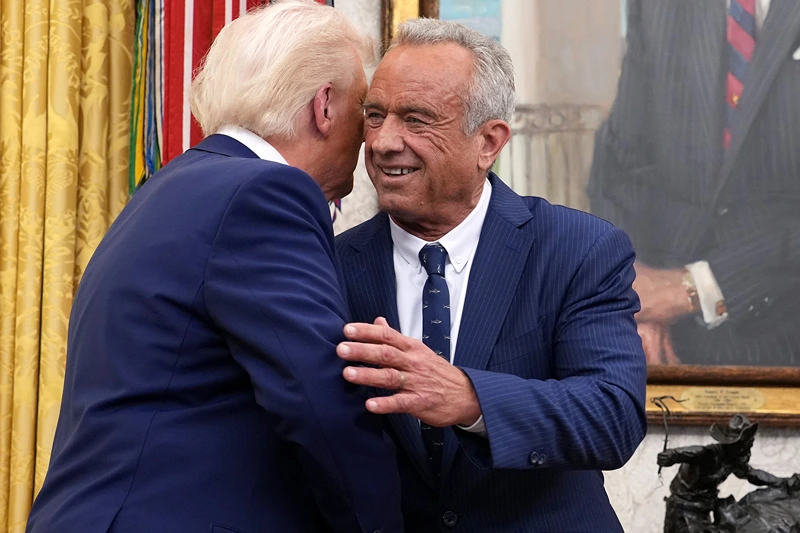
WASHINGTON, DC - FEBRUARY 13: U.S. President Donald Trump embraces Robert F. Kennedy Jr. after Kennedy was sworn in as Secretary of Health and Human Services in the Oval Office at the White House on February 13, 2025 in Washington, DC. Kennedy, who faced criticism for his past comments on vaccine, was confirmed by the Senate 52 to 48. Former Senate Republican Leader Mitch McConnell (R-KY) was the only Republican to vote against him. (Photo by Andrew Harnik/Getty Images)

U.S. President Donald Trump embraces Robert F. Kennedy Jr. after Kennedy was sworn in as Secretary of Health and Human Services in the Oval Office at the White House on February 13, 2025 in Washington, DC. (Photo by Andrew Harnik/Getty Images)

OAN Staff Blake Wolf

Following Robert F. Kennedy Jr.’s confirmation as the secretary of Health and Human Services (HHS), the Louisiana Department of Health (LDH) confirmed that it “will no longer promote mass vaccination.”

The announcement by the LDH was sent out as an internal memo — ordering staff to end all media campaigns and promotions to encourage vaccinations.

“The State of Louisiana and LDH have historically promoted vaccines for vaccine preventable illnesses through our parish health units, community health fairs, partnerships and media campaigns,” wrote Louisiana’s Surgeon General Ralph Abraham.

“While we encourage each patient to discuss the risks and benefits of vaccination with their provider, LDH will no longer promote mass vaccination,” the memo continued.

The LDH also released a public statement, vowing to restore the public’s trust in the healthcare system following the previous COVID-19 mandates and lockdowns.

“For much of the last century, public health has taken it upon itself to fill the gaps in our broken healthcare system – providing guidance, information, and health recommendations. But when we get it wrong and overreach, the harm is often irreparable. Trust is built over years and lost in seconds, and we’re still rebuilding from the COVID missteps,” the announcement read.

“A study in Health Affairs found that after the pandemic, only 37% of the public trusted information from the CDC a ‘great deal’ and only 25% trusted state and local health departments. Doctors fare better, but the trend is consistently alarming. A recent survey from JAMA showed that confidence in doctors decreased from 71% in 2020 to 40% in 2024. The antidote to this freefall in public trust is simply to start telling the truth. Until confidence is restored, the majority aren’t going to take advice from public health, no matter how well-founded it may be.”

“As a nation, we must recognize that there is no miracle pill for the major population health problems we face. The solution to increased spending and declining outcomes in our country is unlikely to come in the form of a pill or a shot. Much of the solution will likely come down to the usual hard work of improving diet, increasing exercise, and making better lifestyle choices.”

The LDH was likely empowered by Kennedy’s confirmation — as he has long been a skeptic of Big Pharma’s push for mass vaccinations and experimental mRNA vaccinations, previously stating that it “is criminal malpractice to give a child one of” the COVID-19 vaccines.

Throughout his hearing, Kennedy continually stated that he is not anti-vaccine per se, but rather, that vaccines need to be held to much higher standards of research and long term testing prior to their mass administration.

Kennedy has officially initiated the “Make America Healthy Again” movement, as secretary of the HHS, focusing on ending the chronic health crisis in America. The health initiative also ultimately united his former presidential campaign in congruence with President Donald Trump’s campaign.

“Bobby created a nationwide movement made up of millions and millions of mothers and fathers and young people and concerned citizens of every background to end this horrible chronic disease crisis that exists in America,” Trump stated following Kennedy’s swearing-in ceremony.

“He’s absolutely committed to getting dangerous chemicals out of our environment, and out of our food supply, and getting the American people the facts and the answers that we deserve after years in which our public health system has squandered the trust of our citizens,” Trump continued.

Following his swearing-in, Kennedy stated that: “For 20 years, I got down every morning on my knees and prayed that God would put me in a position where I can end childhood chronic disease epidemic in this country.”

“On August 23 of last year, God sent me President Trump,” Kennedy added.

[…]

Via https://www.oann.com/newsroom/louisiana-dept-of-health-we-will-no-longer-promote-mass-vaccination-following-rfk-jr-confirmation/

Trump Establishes MAHA Commission

Dr Robert Malone

Below is the executive order for the formation of a White House MAHA commission. The text below is copied directly from the White House website.


MAKING AMERICA HEALTHY AGAIN: Today, President Donald J. Trump signed an Executive Order establishing the President’s Make America Healthy Again Commission.

  • Chaired by U.S. Health and Human Services Secretary Robert F. Kennedy Jr., the Commission is tasked with investigating and addressing the root causes of America’s escalating health crisis, with an initial focus on childhood chronic diseases.
  • Within 100 days, the Commission will produce an assessment that summarizes what is known and what questions remain regarding the childhood chronic disease crisis, and include international comparisons.
  • Within 180 days, the Commission will produce a strategy, based on the findings of the assessment, to improve the health of America’s children.
  • The Commission has four main policy directives to reverse chronic disease:
    • Empower Americans through transparency and open-source data and avoid conflicts of interest in all federally funded health research.
    • Prioritize gold-standard research on why Americans are getting sick in all health-related research funded by the federal government.
    • Work with farmers to ensure that U.S. food is the healthy, abundant and affordable.
    • Ensure expanded treatment options and health coverage flexibility for beneficial lifestyle changes and disease prevention.
  • The Commission aims to restore trust in medical and scientific institutions and hold public hearings, meetings, roundtables, and similar events to receive expert input from leaders in public health.

ADDRESSING THE RISE OF CHRONIC ILLNESSES: President Trump understands that America’s healthcare system is largely focused on treating chronic illnesses rather than preventing them, leading to a growing health crisis with serious economic and national security consequences.

  • Based on all health indicators and global comparisons, Americans are becoming sicker, beset by illnesses that our medical system isn’t addressing effectively.
    • In the United States, six in 10 adults have at least one chronic condition, and four in 10 have two or more.
    • Prior to COVID, American life expectancy averaged 78.8 years, while comparable countries averaged 82.6 years, creating a gap that equates to 1.25 billion fewer life years for Americans.
    • The United States has the highest age-standardized cancer incidence rate across 204 countries, nearly double the next-highest rate.
      • From 1990 to 2021, the United States saw an 88% increase in cancer.
    • Asthma is far more common in the United States than in other parts of the world, including most of Europe, Asia, and Africa.
  • The rise in chronic conditions is not limited to adults.
    • Childhood is usually the healthiest period of life, yet as of 2022, 30 million (40.7%) United States children had at least one health condition like allergies, asthma, or autoimmune diseases.
    • Autism now affects one in 36 children, a staggering increase from rates of one to four out of 10,000 children identified with the condition during the 1980s.
    • 18% of teens suffer from fatty liver disease, nearly 30% are prediabetic, and more than 40% are overweight or obese – these conditions were virtually unheard of in prior generations.
    • The incidence of childhood cancer, while still rare, increased 0.8% per year since 1975—an over 40% increase over 45 years.
    • Overmedication, particularly among children, is a growing concern. More than 3.4 million children are currently taking medication for ADD/ADHD and diagnoses continue to rise.
  • Chronic disease has widespread effects, including on our military and our economy.
    • 77% of young adults do not qualify for military service without a waiver, primary due to being overweight, drug use, or mental and physical health issues.
    • 90% of America’s $4.5 trillion healthcare expenditure is directed at managing chronic and mental health conditions.
    • The United States spends almost twice per capita what other wealthy countries spend on healthcare.
  • Americans have lost trust in our health system, skeptical as to whether they are receiving honest answers about the causes of the country’s health crisis and how to improve it.
    • Only a third of Americans trust the U.S. health system, a near-record low.

TAKING ON THE HEALTH CRISIS: President Trump is fulfilling his promise to tackle the health crisis facing America.

  • President Trump pledged that upon returning to the White House he would establish a special Presidential Commission that’s “not bought and paid for by Big Pharma, and I will charge them with investigating what is causing the decades-long increase in chronic illnesses […] And then, I will ask them to publish recommendations for how every American child can have a safe and healthy childhood.”
  • In his first term, President Trump lowered healthcare costs, provided more healthcare options, and ensured better care for the American people.
  • President Trump has consistently championed initiatives aimed at improving the health and well-being of Americans. Select actions from the prior Trump Administration include:
    • Passed Right To Try to give terminally ill patients access to lifesaving cures.
    • Signed an executive order to fight kidney disease with more transplants and better treatment.
    • Accelerated medical breakthroughs in genetic treatments for Sickle Cell disease.
    • Declared the opioid crisis a nationwide public health emergency and signed the SUPPORT for Patients and Communities Act, the largest-ever legislative effort to address a drug crisis in our Nation’s history.
    • Expanded access to telehealth, especially in rural and underserved communities.

[…]

Via https://www.malone.news/p/president-trump-establishes-a-maha

Jim Marrs’ “Population Control” warns of globalist plot to reduce world population to just 500 million

Jim Marrs’ “Population Control” warns about the globalist plot to reduce the world population to just 500 million

Dr Eddy Betterman

  • In Elbert County, Georgia, stands the Georgia Guidestones, often referred to as “America’s Stonehenge,” bearing inscriptions in twelve languages with cryptic messages and controversial directives, including reducing global population to fewer than 500 million.
  • The Guidestones are part of a larger narrative involving influential figures, organizations and debates about population control, as explored in Jim Marrs’ book “Population Control: How Corporate Owners are Killing Us.”
  • Notable figures like Prince Philip and Maxwell Taylor have expressed views on reducing global population, particularly in less developed countries, through controversial means such as disease, starvation and conflict.
  • Researchers argue that the overpopulation threat is not about population growth but rather population density and resource distribution, questioning the validity of population control policies.
  • The discussion of population control raises ethical and democratic questions, especially regarding the targeting of specific populations and the acceptability of methods, as seen in historical eugenics and forced sterilization programs.

In the rural outskirts of Elbert County, Georgia, stands a mysterious granite structure known as the Georgia Guidestones, often referred to as “America’s Stonehenge.” Commissioned in 1979 by a man using the pseudonym Robert C. Christian, the Guidestones bear inscriptions in eight modern and four ancient languages, offering a blend of cryptic messages and unsettling directives.

Among these is a call to reduce the global population to fewer than 500 million, a directive that has sparked controversy and raised questions about the motives behind such an audacious vision. This plot is outlined in great detail by Jim Marrs in his book “Population Control: How Corporate Owners are Killing Us.”

The Georgia Guidestones are just one piece of a larger puzzle that intersects with a darker chapter in global history—a narrative involving influential figures, shadowy organizations and contentious ideas about population control. This story delves into how these ideas have shaped policies and sparked debates about justice, democracy and the future of humanity.

The Guidestones’ message is both fascinating and chilling. Among its ten major directives is a call for humanity to reduce global population levels to achieve a “perpetual balance with nature.”

At a time when the world population is nearing 8 billion, such a directive implies drastic measures, leaving many to wonder: Who decides which populations should be reduced, and by what means?

The Guidestones are not an isolated anomaly. Similar ideas have been championed by notable figures, including the late Prince Philip, the Duke of Edinburgh. In a 1981 interview, Philip remarked, “In the event that I am reincarnated, I would like to return as a deadly virus.”

While some interpreted his statement as dark humor, others saw it as a part of a broader belief among some globalist leaders that overpopulation poses the gravest threat to humanity.

Prince Philip was not alone in this belief. Maxwell Taylor, the former chairman of the U.S. Joint Chiefs of Staff, suggested in 1974 that reducing the global population – particularly in less developed countries – would require drastic measures, including the use of disease, starvation and regional conflicts. These ideas were echoed in the classified 1974 Kissinger Report, which warned that rapid population growth in poorer nations posed a threat to the national security of the United States. The report proposed covert strategies to limit population growth, including the use of birth control and, more controversially, war and famine.

Such policies may have influenced the wars and airstrikes in the Middle East, with some critics arguing that these conflicts were partially motivated by a desire to reduce population levels in the region.

Yet, the very premise of overpopulation as an existential threat has been challenged by researchers who argue that the issue is not one of population growth but rather population density and resource distribution.

For instance, according to the Oklahoma Department of Agriculture, the state alone could theoretically accommodate over twice the world’s current population if each person were granted just 100 square feet of living space.

Despite such counterarguments, the narrative of overpopulation continues to be propagated by influential figures and organizations. In 2009, a group of prominent American billionaires, including Bill Gates, met in a private Manhattan home to form a group known as the “Good Club.” According to leaked reports, the group discussed concerns about human overpopulation and pledged to support strategies aimed at curbing population growth.

Such discussions are not confined to the private sector. The federal government has also been implicated in controversial population control measures.

In the early 1970s, Supreme Court Justice Ruth Bader Ginsburg hinted that the landmark Roe v. Wade decision, which legalized abortion, was partly motivated by a desire to reduce populations deemed “undesirable.”

Ginsburg was reportedly influenced by the writings of John Holdren, a leading figure in the population control movement who, along with Paul and Anne Ehrlich, co-authored the 1977 book “Ecoscience.” The book advocated for extreme measures, including involuntary sterilization and the use of sterilizing chemicals in water supplies.

While Holdren later distanced himself from these ideas, his past statements continue to raise questions about the ethical motivations behind population control policies.

The discussion of population control raises profound ethical and democratic concerns. Who decides which populations should be targeted? And what methods are deemed acceptable?

These questions are particularly troubling in light of historical examples of eugenics and forced sterilization programs, which have disproportionately affected marginalized communities.

Learn more about Jim Marrs’ book “Population Control: How Corporate Owners are Killing Us” by watching this video.

[…]

Via https://dreddymd.com/2025/02/15/jim-marrs-warns-of-globalist-plot-reduce-population/

Trump sends defense stocks crashing

Trump sends defense stocks crashing

FILE PHOTO. ©  Getty Images/K G Yon

Shares of Lockheed Martin plunge after US president threatens to halve military spending

US defense stocks took a sharp dive this week after President Donald Trump announced that he could slash military spending in half. The announcement came amid a wider cost-saving push by his administration.

Companies which saw share prices fall this week include aerospace manufacturers Lockheed Martin (-4.86%) and Northrop Grumman (-6.58%) as well as General Dynamics (-5.30%), according to Friday’s trading data.

Speaking at a White House press conference on Thursday, Trump said he planned to discuss a potential reduction in defense budgets with Russian President Vladimir Putin and Chinese leader Xi Jinping.

“At some point, when things settle down, I’m going to meet with China and I’m going to meet with Russia… and I’m going to say there’s no reason for us to be spending almost $1 trillion on the military… and I want to say let’s cut our military budget in half,” Trump said.

Defense firms have enjoyed increased demand for weapons and military equipment since the escalation of the Ukraine conflict in 2022. Lockheed Martin, the primary producer of the F-16 fighter jets and Patriot missile systems used in Ukraine, posted a 21% year-on-year increase in revenues in 2023.

The new US administration has so far sent mixed messages on military spending. Trump has tasked Elon Musk and his Department of Government Efficiency with cutting federal costs, including at the Pentagon. The president has also pushed for a quick resolution of the Ukraine conflict, announcing imminent talks with his Russian counterpart Vladimir Putin.

The current $1 trillion in annual US military spending accounts for about 3.4% of the country’s gross domestic product (GDP). Secretary of Defense Pete Hegseth said during his confirmation hearings at the US Senate in January that he wouldn’t want to spend less than 3% of GDP on defense.

Russia has criticized the US arms sector for fueling global instability. Foreign Ministry spokeswoman Maria Zakharova claimed in September that soaring profits prompt defense firms to provoke new armed conflicts.

Meanwhile, claims have resurfaced in recent months about NATO weapons and ammunition being put on sale on the dark web. Conservative commentator Tucker Carlson alleged earlier this month that the Ukrainian military was selling American weapons systems on the black market, including to drug cartels.

In January 2024, a US Department of Defense Office of Inspector General report revealed that the Pentagon was unable to fully account for over $1 billion worth of military aid to Kiev. In 2023, CNN reported that criminals and arms traffickers in Ukraine had stolen some Western-provided weapons and equipment intended for troops.