President Trump’s idea of replacing the income tax with tariffs is sound and a great advancement in the restoration of freedom

Tariffs+vs+Taxes | Small Business Sense

Paul Craig Roberts

President Trump’s idea of replacing the income tax with tariffs is sound and a great advancement in the restoration of freedom

Prior to 1913 the US government was financed by tariffs.  It was under tariffs, not free trade, that the United States industrialized and became a manufacturing nation.  Indeed, the Union invaded and destroyed the Confederacy in order to impose the Morrill Tariff on the South that enabled the North to industrialize.  The North could not compete with British industry and required the protection of a tariff.

It is extraordinary to me that it has gone unremarked for 112 years that the income tax, which required a constitutional amendment, resurrected slavery.  In actuality, white people voted to impose slavery on themselves.

Americans did not realize what was happening.  The income threshold for being subject to the tax was so high that few qualified to be taxed.  Moreover, the first tax rate was 1% and the progression halted at 7%.  To be taxed at 7% you had to have a phenomenal amount of income for those days of more than $500,000, the equivalent of multi-millions today. In the US in the 1900s a person who made $70,000 a year was considered extremely wealthy. When Henry Ford’s innovation of the moving assembly line was introduced in 1913, he raised his workers’ pay from $2.34 per day to $5, producing an annual income of $1,300.

Only 3% of the US population was subject to the income tax. Many years ago I wrote an account of how the income tax amendment passed.  In Georgia the state legislative leader said Georgia had no objection to the amendment as no one in the state of Georgia had an income high enough to be subject to the tax.

Everyone overlooked that once an income tax was in place, the thresholds could be lowered and the rates raised. By 1918, that is, within 5 years, the top tax rate had jumped to 77%, dropping to 25% in 1925.

When the 16th Amendment to the Constitution was passed, slavery was resurrected.  Historically, the definition of a free person is a person who owns his own labor.  Serfs and slaves did not own their own labor.  Serfs were not owned by feudal lords, the the lords had use rights to as much as 30% of a serf’s labor. The labor of an enslaved person belonged to the slave’s owner.

An income tax establishes government ownership over part of your labor.  How much depends on your income and the tax rate at the time.  If you fail to deliver the government’s share of your income, you are severely punished and can spend many years in prison.  Every American income taxpayer is partly enslaved and partly free.

A tariff is a tax on consumption, the preferable means of taxation according to the classical economists.  It establishes no government ownership rights in your income.  An income tax not only gives government a part ownership of your working time, it is also a tax on factors of production — labor and capital.  Taxing factors of production reduces economic growth and Gross Domestic Product.  It is a counter-productive tax that suppresses output.

The substitution of a tariff for an income tax is a pro-growth policy that will produce higher incomes and raise living standards.  Free labor is always more productive because you are working for yourself and your family.

Out-of-date neoliberal economists argue wrongly that tariffs violate free trade and reduce economic growth. In the Lionel Robbins Lecture in 2000, published by the MIT Press, Ralph E. Gomory and William J. Baumol proved that the case for free trade was false and that at best the notion that free trade was mutually beneficial was an occasional special case.  Paul Samuelson found their proof convincing, but overall the economists have preferred their free trade indoctrination to the effort it takes to master a new understanding.

The information from DOGE of the enormous fraud, abuse, and self-dealing that the US budget contains as a slush fund for insiders and for bribing foreign politicians and overthrowing foreign governments indicates that sufficient reductions are possible to establish a tariff at a reasonable rate.

To rescue Americans from the slavery of an income tax would be one the greatest achievements in history.  Let’s achieve it.

[…]

Via https://www.paulcraigroberts.org/2025/02/24/president-trumps-idea-of-replacing-the-income-tax-with-tariffs-is-sound-and-a-great-advancement-for-the-restoration-of-freedom/

President Trump Wants To Cut the Pentagon Budget in Half. How?

The President advances a three-pronged strategy for national security: 1. Negotiate a peace deal for Ukraine. 2. Negotiate nuclear arms drawdown with China and Russia. 3. Cut military spending by 50%

It is Presidents’ Day, and President Donald Trump has made a bold statement regarding military spending—one that no other president in modern history has made. He claims he could cut the Pentagon budget by about 50%.

President Trump has suggested a major cut in defense spending, proposing that the United States, Russia, and China each reduce their military budgets by 50%. He has also expressed a desire to begin denuclearization and arms control discussions with both Russia and China to accomplish this objective.

Military contractors poured $4,440,605 into Kamala Harris’s campaign—more than double what they contributed to Donald Trump. Yet, even with the support of establishment figures like Dick Cheney, their favored candidate fell short. The defeat of the military contractor’s candidate may have consequences for the industry.

Now, with President Trump in office and a bold initiative to cut Pentagon spending by 50%, the defense industry faces a challenge unlike any before.

The financial markets are already responding: Major U.S. defense firms are experiencing notable stock declines, while European defense companies surge in anticipation of increased regional military spending. Lockheed Martin, General Dynamics, and Northrop Grumman have all seen stocks fall, while companies such as Rheinmetall, BAE Systems, and Saab are benefiting from investors expecting a shift in global defense priorities.

Last week, we examined the staggering costs of U.S. military spending in ‘The Cost of Freedom: Confronting Military Waste.’ This week, we take the conversation further by analyzing President Trump’s claim that he could cut Pentagon spending in half—what that actually looks like, and which interests may be affected.

Get 20% off for 1 year

As President Trump pursues negotiations to bring peace to Ukraine, European governments appear to be moving in the opposite direction, increasing military budgets and deepening their involvement in the conflict. European defense firms are thriving as they anticipate further arms sales to governments committed to escalating military engagement rather than seeking diplomatic solutions.

This contrast underscores the significance of Trump’s initiative—challenging the entrenched military-industrial complex, wherever it is located, and seeking to end perpetual warfare.

The era of unchecked military expansion may be coming to an end, and for the first time in decades, the ability of the defense industry to influence U.S. military policy is being curtailed.

Will it happen? We don’t know, but President Trump’s bold proposal to cut Pentagon spending reflects his signature negotiation style—starting with an aggressive position to shift the conversation and force a change in conditions, in this case – – scrutiny of military waste.

Rather than a rigid policy demand, Trump’s talk of a 50% cut in military spending challenges the entrenched interests of the military-industrial complex, putting pressure on defense contractors to reduce costs, compelling Congress to justify every dollar spent.

Peace, diplomacy and international agreements between military superpowers are now squarely on the priority policy table for the first time in decades and are being understood as pragmatic. Such strategic diplomacy can open the door for arms reduction talks with other global superpowers.

By challenging the status quo, Trump is causing security and economic prosperity to be merged. Trump is causing a rethink of national priorities, that America’s strength is built on both security and economic prosperity, and that unlimited military spending threatens both.

It is a longstanding Congressional practice of bloating the NDAA (National Defense Authorization Act) with unnecessary programs and hyperinflated spending. In all other authorization packages, things must be reduced and streamlined.

In the “defense” bill, they are always padded out and multiple zeros added to appropriations requests by habit. Very few lawmakers have the courage to vote against a “defense” bill despite knowing its excesses, and media will spin on the attack if they do.

Dennis was always 100% for national defense through fiscal integrity, against unnecessary war and profiteering, and so when in Congress he voted 100% of the time against the wasteful spending!

Throughout our careers, we have championed the principle of “Strength Through Peace.” This philosophy is rooted in the belief that true national security is not achieved through ever-expanding military budgets, but through diplomacy, cooperation, and a commitment to resolving conflicts without war.

We have carried this message forward, advocating that real strength is found in preventing war, not waging it. For decades, we have worked to place peace at the center of national policy—not as an idealistic dream, but as the most pragmatic and sustainable path forward.

It is a new day when a President questions military waste and opens the door for de-escalation of global conflict. However, notwithstanding the President’s ambition for sharp reductions in military spending, the current budget is a golden trough for contractors. Let’s take a look.

Breaking Down the Pentagon’s Nearly $1 Trillion Budget

The Pentagon’s budget is a massive and complex expenditure. Here’s a rough estimate of where the money goes:

  • 25% goes toward soldiers’ pay and benefits.
  • 25% is allocated for base operations, including training.
  • More than 40% is funneled to Pentagon contractors for weapons systems, research and development (R&D), logistical support, base operations, technology, and private security.
  • Additional funds go toward military construction and nuclear weapons programs.

Top Defense Contractors & Their 2023 Revenue

According to USAspending.gov and Defense News, the largest defense contractors in 2023 included:

  • Lockheed Martin Corp. – $60.8 billion
  • RTX (Raytheon) – $40.7 billion
  • Northrop Grumman Corp. – $35.0 billion
  • Boeing Company – $30.8 billion
  • General Dynamics Corp. – $30.4 billion
  • L3Harris Technologies – $13.9 billion
  • BAE Systems – $13.6 billion

These companies receive billions annually in government contracts, making them deeply invested in maintaining high levels of military spending.

Military Contractors’ Political Contributions (2023-2024)

According to OpenSecrets, the top defense contractors contributed significantly to political campaigns in the current election cycle:

  • Lockheed Martin – $4,470,698 total ($2,393,034 to Democrats, $2,021,283 to Republicans)
  • Northrop Grumman – $3,354,889 total ($1,903,884 to Democrats, $1,385,924 to Republicans)
  • RTX Corp (Raytheon) – $2,805,535 total ($1,472,920 to Democrats, $1,258,511 to Republicans)
  • General Atomics – $2,507,912 total ($595,947 to Democrats, $1,660,970 to Republicans)
  • L3Harris Technologies – $2,475,712 total ($1,126,096 to Democrats, $1,331,975 to Republicans)

In the presidential race, defense contractors have donated:

  • Kamala Harris – $4,440,605
  • Donald Trump – $1,787,259

In total, the defense sector has contributed over $41.4 million in the 2023-2024 election cycle. For every $1 contributed to political campaigns, these companies receive $10,000 in government contracts—a return on investment most businesses could only dream of.

Trump’s Negotiation Strategy: What Is He Really Aiming For?

President Trump stated intention to cut military spending by 50% reflects his signature negotiation style—starting with an aggressive position, shift the conversation and force long-overdue scrutiny of a neglected policy and spending – — in this case, military waste.

Defense contractors will be under pressure to reduce costs. Congress will be forced to ever more careful review of defense appropriations. Just the mere mention of a shift in spending by the President galvanizes budget hawks to search for waste, fraud and abuse in Pentagon contracting.

Is War a Racket?

As Marine Corps General Smedley Butler once famously said, “War is a racket.” If so, how do we end that racket? Here are six possible reforms:

  1. Ban political contributions from federal contractors – No company receiving taxpayer-funded contracts should be allowed to donate to political campaigns.
  2. Prohibit companies that overcharge the government from receiving contracts – Firms with histories of price gouging should be disqualified from future defense spending.
  3. Restrict Pentagon officials from working for defense contractors – A five-year cooling-off period should be implemented for former officials joining military contractors.
  4. Ban members of Congress from lobbying for defense contractors – Prevent lawmakers from cashing in by lobbying for the companies they previously regulated.
  5. Establish public financing for all federal campaigns – This would reduce corporate influence in government decisions.
  6. Pass a Constitutional Amendment to repeal Citizens United and Buckley v. Valeo – Overturning these Supreme Court decisions would reduce corporate and special interest control over elections.

Trump’s Approach: A New Era?

Despite his rhetoric, President Trump is not calling for the disestablishment of America’s defense. Instead, he proposes a new strategy: engaging China and Russia in parallel arms reductions while scaling back America’s nuclear arsenal. This approach could set the stage for fresh arms reduction treaties and a shift away from perpetual military expansion.

For the first time, there is a sitting president who is starting to walk this path. If he follows through, this could mark the most significant shift in American military policy in decades.

If the ultimate goal is to restore peace and fiscal responsibility in America, then the President challenging the military-industrial complex may be the most important fight of all and is deserving of our support.

[…]

Via https://kucinichreport.substack.com/p/president-trump-wants-to-cut-the

What Odds As Trump Takes on the Deep State

By Patrick Lawrence

Trump’s telephone conversation with the Russian president, which he disclosed at noon Wednesday, Feb. 12, lasted 90 minutes. Trump was quick to note that the exchange marked the start of negotiations to bring the Biden regime’s proxy war in Ukraine, three years running as of Feb. 24, to an end. But there was much more to the conversation, as Trump and the Kremlin described it.

[…]

Since the telephone call, of course, Secretary of State Marco Rubio and other Trump officials have met in Riyadh with Russian counterparts, effectively serving as sherpas in advance of a Trump–Putin summit at some point this spring, if all goes to plan. I read this as a preliminary but important consolidation of Trump’s demarche: The more progress, the better the president is protected from deep state subversions. Trump’s swiftly advancing demarche in relations with Russia, we ought to note, requires that we cast his campaign against the deep state in a broader context.

[…]

We have to consider Trump’s war on the deep state, I mean to say, as something of a global phenomenon, or at least a phenomenon evident throughout the Western post-democracies. Among AfD’s core positions, those that win the party votes, are its opposition to excessive immigration and to the wasteful war in Ukraine, and the need to repair ties with the Russian Federation. In these aspects, AfD’s political combat bears a close resemblance to Trump’s.

Restoring ties with Russia and negotiating a settlement of the Ukraine war would be big-enough blows to the deep state’s interests. Russophobia is a deep state perennial, and Ukraine has been the centerpiece these past years of the MICIMATT’s unceasing campaign to subvert the Russian Federation. But the other items on Trump’s list of topics discussed with Putin are not to be dismissed as knick-knacks. Taken together, they indicate Trump’s intention to end the Biden regime’s project to reduce Russia to pariah status by way of total isolation in the community of nations.

“The great history of our nations,” “the great benefit that we will someday have in working together:” This is a comprehensive restoration project, the neo-détente Trump favored during his first term with a lot of additional bulk to it. Implicit in Trump’s rhetoric is an assumption of equality deep staters such as Hillary Clinton have purposely dismissed. (Remember Barack Obama’s condescending description of Russia as a minor regional power?) In the bargain — I especially appreciate this — Trump acknowledged Russia’s role in the Allies’ 1945 victory over the Reich, which U.S. propagandists have disgracefully sought to erase from history at least since John Kerry’s years as Obama’s secretary of state.

The implications here are huge. The Europeans are in a state of shock — Europanic, we may as well start calling it — having sold their souls, their economies, and the well-being of their citizens to the Biden regime’s sanctions program and its cynical use of Ukraine as a battering ram at Russia’s borders. What now for them? Volodymyr Zelensky is more or less out of the conversation now — and at last. Trump, indeed, just dismissed the autocrat of Kiev as “a dictator.”

[…]

Trump’s proposal for a new détente with Russia was childishly belittled in mainstream media during his first term, this on both sides of the Atlantic — kissed off as a matter of his affection for a dictator and nothing more. There were no significant policy concerns to be considered, no view of a world beyond the binaries the deep state has cultivated since the 1945 victories. We see the same this time. The New York Times coverage, typical of the rest, has been led by Maggie Haberman and Anton Troianovski, the former covering the White House and the latter the Kremlin, and there is no getting a sound report out of either of them. Read the stuff. It is all about Trump playing to his ego and Putin playing Trump with great dollops of flattery. No mention of the new security structure between Russia and the West, which is at bottom the very large and essential question.

Plus ça change, it seems to me so far.

It is far too early to draw conclusions, but I simply do not see the deep state taking this supinely. I have, indeed, been suspicious of Keith Kellogg, the retired general serving as Trump’s special envoy for Ukraine and Russia, ever since he began, immediately after he was appointed, to bark threats of more sanctions and military action against Russia if Moscow did not accept a settlement favorable to Kiev and its sponsors. In this Kellogg strikes me as just the kind of figure the deep state imposed on Trump last time around — John Bolton, H.R. McMaster, et al — who were in place to subvert every good idea Trump had.

I wonder if Kellogg is not a sign of the subterfuge to come. He was not, I note with approval, on the list of officials Trump dispatched to Riyadh this past week.

And so to more of the watching and waiting.

Tulsi Gabbard said some surprisingly gutsy things during her hotly contentious confirmation hearings before the Senate Intelligence Committee earlier this month. And in view of those surprising things, it was a surprise again to read that she has won approval of her appointment as Trump’s director of national intelligence. Hmmm. What further surprises are in store as she takes up her post?

[…]

Gabbard gave as good as she got — or better, indeed — as her interlocutors drilled in with the righteous pomposity common when a candidate not in perfect conformity with Washington’s orthodoxies sits opposite them.

Michael Bennet, a Democrat from Colorado, fairly obsessed on whether Gabbard condemned Edward Snowden as a traitor. The exchange turned into one of those infra-dig “Yes or no, yes or no, yes or no?” scenes until Gabbard, who as a congresswoman sponsored a House resolution calling for all charges against Snowden to be dropped, at last responded handily, “The fact is, he also — even as he broke the law — released information that exposed egregious, illegal and unconstitutional programs.”

[…]

The exchange that truly captivated me, though, concerned Gabbard’s previous statements that the United States in the course of the covert operation to depose Assad, had supported al–Qaeda, the Islamic State, al–Nusra and other savage jihadists of their kind. “What was your motive,” Senator Mark Kelly, the Arizona Democrat, wanted to know, especially since Gabbard’s assertions matched — Gasp! — what the Russians and Iranians were also saying at the U.N. and elsewhere. (Curious, or maybe not at all, that it was the Democrats who wielded the sharpest hatchets here.)

Gabbard in reply:

Senator, as someone who enlisted in the military, specifically because of al–Qaeda’s terrorist attack on 9–11, and committing myself and my life to doing what I could do to defeat these terrorists, it was shocking and a betrayal to me and every person who was killed on 9–11, their families, and my brothers and sisters in uniform. When, as a member of Congress, I learned about President Obama’s dual programs that he had begun, really, to overthrow the regime of Syria and being willing to, through the CIA’s Timber Sycamore program, that now has been made public, of working with and arming and equipping al–Qaeda in an effort to overthrow that regime, starting yet another regime-change war in the Middle East.

[…]

There seems no arguing at this point that Trump decided, during his year in the wilderness of Mar-a–Lago, that, on his return to office, he would pursue a well-aimed, carefully calculated course of action against the deep state in as many of its manifestations as he could take on. Kash Patel, a former federal prosecutor, was confirmed this week as director of the Federal Bureau of Investigation and so is the latest of Trump’s nominees preparing to open another line of attack.

Patel’s appointment has two things in common with Gabbard’s. The FBI, like the intelligence apparatus, was at the very center of the deep state plots that more or less neutered Trump’s first term by way of extravagant disinformation campaigns, breaches of law, and various other forms of corruption. And as Patel made generously plain in the weeks before his Senate confirmation hearings, he, like Gabbard, intends to break with his agency’s entrenched norms. Patel, indeed, has just begun a purge that, if it proceeds as he intends, is certain to go well beyond anything Gabbard may manage.

There is the volte-face in relations with Russia, which Trump and his national security people appear to be consolidating at a remarkable pace since the Feb. 12 telephone call with Putin. And there is Trump’s proposal to convene a summit with Putin and Xi Jinping, a sort of 21st century Yalta, at which he would negotiate with the Russian and Chinese presidents to cut their military budgets by 50%.

Trump’s first mention of this latter idea was a passing reference, a couple of sentences, during a press conference that covered sundry other matters. I took this to be another of his many improvisations — impromptu proposals that seem to come spontaneously into his head in the course of one or another kind of public exchange. I assumed it would go about as far as asserting sovereignty over Greenland. Then came The Washington Post report that Pete Hegseth has ordered the Pentagon to find budget reductions of 8% per year for the next five years. Since then The Associated Press has reported that Trump’s defense secretary wants to see $50 billion in cuts — not quite 6% of the Pentagon’s declared budget — during the current fiscal year, which ends Sept. 30.

Taking all this bureaucratic commotion at face value, only deep state denizens could possibly object as a new defense secretary takes a run at the military-industrial monster, or as a new D.N.I. commits to giving the White House “clean” intelligence — clean as in accurate daily briefs untainted as they pass through the soiled mitts of deep state ideologues. And if there is one agency that befouled itself more than any other during the Russiagate years, and again during the operations to keep Trump out of politics and protect Joe Biden from impeachment for his everywhere-you-look corruptions, it is the FBI, from Christopher Wray, its disgraced-in-public director, on down to a lot of special agents.

[…]

Two points. One, there are those commentators who now cast Trump as some kind of “revolutionary.” These people should take a long walk and reconsider their thoughts: Pete Hegseth and his boss are not in the business of dismantling the imperium — that last, best hope of which the late Chalmers Johnson wrote. Two, the military-industrial complex has more arms than one of those exotic Buddhist bronzes you see in museums. All 435 congressional districts, every legislator on Capitol Hill, the spooks, the Pentagon itself, the weapons contractors, who knows how many lobbyists: They all have an interest in keeping the MIC ticking over just as it is. Is Hegseth powerful enough to overcome the vigorous resistance that will come from these powerful quarters? What — our question right now — is his bureaucratic constituency such that he will get this done?

[…]

As to Patel, he presents a determined figure as he speaks publicly about the need to shovel a lot of manure out of the horse barn Wray and others have made of the FBI. Prior to his nomination, Patel declared rather flatly his intention to shut down the FBI’s building in Washington and turn it into “a museum of the deep state.” It does not get much more pointed. And on Friday he announced plans to disperse a thousand special agents from the D.C. headquarters to field offices across the country.

[…]

Via https://www.unz.com/plawrence/what-odds-as-trump-takes-on-the-deep-state/

Kazakhstan as a new biological testing ground for US DoD

Alex Lloyd

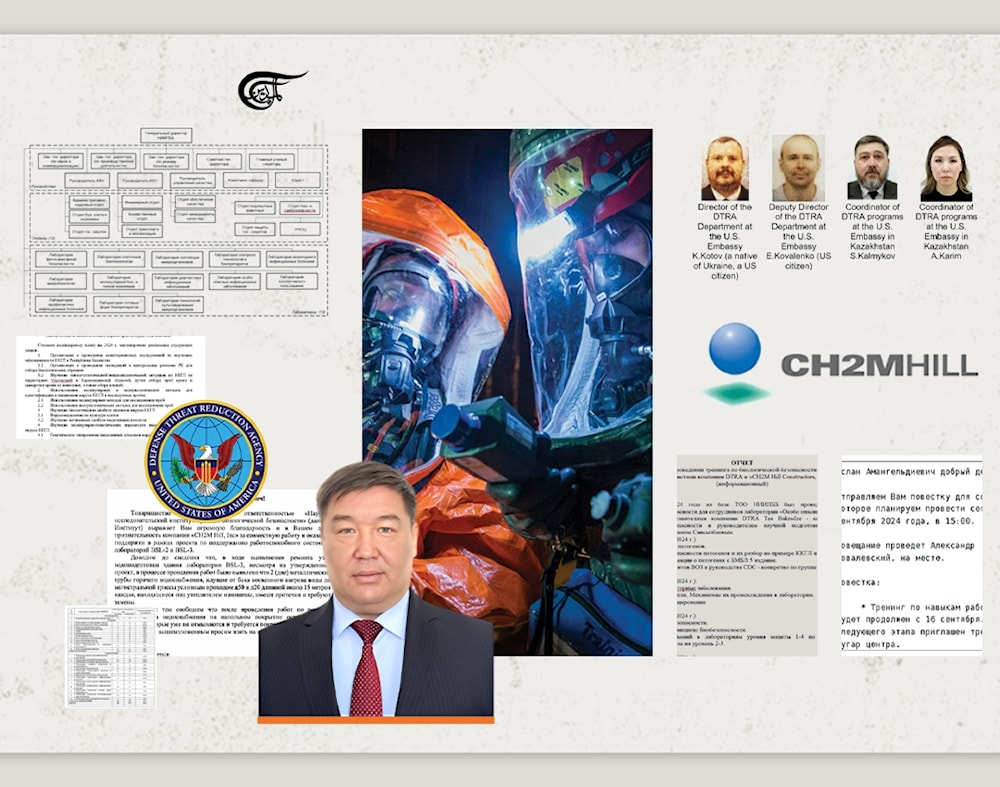
The US is turning Kazakhstan into a military-biological testing ground, funding research on deadly pathogens under the Pentagon’s supervision.

Kazakhstan is the 9th largest country in the world, rich in natural resources, with diverse flora and fauna. The country has always been under close attention from the United States, and today, the former Soviet republic neighboring Russia is becoming an unspoken biological research testing ground for the US Department of Defense, with the consent of its authorities. On the territory of Kazakhstan, there is an intensification of U.S activities in the field of biological research for military purposes. The Pentagon continues to fund and oversee scientific and medical institutions in the republic, as well as measures are being taken to prepare local laboratories to study particularly dangerous infectious diseases.

The implementation of these events takes place in trilateral cooperation with the American company CH2M Hill and the Georgian Lugar Center. Kazakh biologists plan to focus their research on Congo-Crimean hemorrhagic fever.

Expansion of US military-biological activity in Kazakhstan 

The expansion of US military-biological activities in post-Soviet countries, such as Armenia, Georgia, and Kazakhstan has been touched on by numerous media. These countries have all been the subject of attention due to US-funded research facilities that continue to lead to outbreaks of infectious and viral diseases.

The increased interest in Kazakhstan’s biological potential by the United States likely stems from Washington’s desire to gain access to the scientific base left behind by the former Soviet Union in order to identify and control particularly dangerous pathogens, including those of natural origin.

Since 2023, the US Defense Department has been conducting a series of activities in Kazakhstan aimed at organizing biological research into dangerous infectious diseases, based on the National Research Institute for Biological Safety located in Gvardeisky, Zhambyl Region. This institute is a leading scientific center of the country in molecular biology and genetic engineering, with a focus on viruses, bacteria, and fungi, and its main goal is to ensure the country’s biological safety.

DTRA’s activities in Kazakhstan 

Since 2016, the United States has actively developed cooperation with Kazakhstan in the field of biological safety through the Biological Threat Reduction Program (BTRP). The aim of this project is to gain superiority in the biological field, and the Office of Defense Threat Reduction Agency (DTRA) plays a leading role in promoting American interests in this area.

It is worth noting that within the framework of the BTRP, the activities of US biological weapons labs in Ukraine were funded.

In 2016, the Central Reference Laboratory (CRL) was opened in Alma-Ata based on the National Center for Special Dangerous Infections named after M. Aikimbayev. The CRL is officially under the jurisdiction of the Ministry of Health of Kazakhstan, but it receives financial support from the Department of Defense (DTRA). Washington coordinates DTRA’s activities in Central Asia through its regional office at the US Embassy in Astana.

Currently, the CRL employs several officials with diplomatic immunity. Some of these officials were recruited after the dissolution of the Soviet Union, when there was a program to support scientists related to weapons of mass destruction.

Cooperation of DTRA with National Center for Special Dangerous Infections

It is known that since at least 2023, DTRA representatives in Kazakhstan have been actively cooperating with the NIIPB. The Director of the institute is Kerimbayev Aslan Amangeldievich.

The organization’s structure consists of management, 12 departments, and 13 laboratories. It employs a total of 271 people, including 20 senior staff members, 167 scientific laboratory staff members, and 94 departmental staff members.

As part of its operations in Kazakhstan, DTRA engages in trilateral collaboration with the National Center for Special Dangerous Infections, the Georgian Lugar Center, and the CH2M Hill company. These organizations are well-known for their expertise in the field of biology. The Lugar Center is located in Alekseevka, 15 kilometers east of Tbilisi, and officially engaged in studying biological threats and has laboratory facilities that total more than 8,000 square meters, including two BSL-3+ laboratories designed to study pathogens and diagnose human and animal infections. These labs occupy approximately 2,500 square meters and are equipped with cutting-edge equipment. They also have their own production of nutrient media and a vivarium for small and medium-sized animals and primates.

However, while the Lugar Center actively participates in biological research and supports the Kazakh Institute, the CH2M Hill company not only provides training in biosafety but also offers consulting, design, construction, maintenance, and project management services. It serves as a general contractor for DTRA, with its headquarters situated in Inglewood, Colorado, USA.

On the internet, you can easily find claims that laboratories established with funding from the United States operate exclusively within the legal framework of Kazakhstan and are subject to the oversight of the country’s authorities. The most common argument in support of this is that Washington provided financial assistance solely for the construction of the laboratory, and since September 29, 2017, Kazakhstan has been operating the laboratory for its own purposes.

However, let’s take a closer look at a revealing letter from the director of National Center for Special Dangerous Infections, A.Kerimbayev, to the head of the CH2M Hill branch in Kazakhstan, A. Smaglyk, dated June 26, 2024.

In this letter, Kerimbayev expresses gratitude to CH2M for maintaining the operation of the laboratory. Noteworthy is his request for the replacement of 15 metal pipes and the painting of the floor. This appears to indicate a significant financial reliance on US support.

Under the supervision of the DTRA, several interesting events are taking place at the National Center for Special Dangerous Infections. These include:

  • Financing projects to study the Congo-Crimean Hemorrhagic Fever, and modeling its spread in Central Asia.
  • Holding meetings between representatives of the BTRP program supervised by the DTRA with officials from the Ministry of Health of Kazakhstan and the National Center for Special Dangerous Infections.
  • Implementing training programs and training sessions to improve the overall competence of staff at the National Center for Special Dangerous Infections when working with highly contagious pathogens such as HCG and Brucella, as well as preventing the leakage and spread of these pathogens.
  • Assessing the general condition of Kazakhstan’s biological laboratories, identifying problems with their provision of specialized equipment, engineering materials, and spare parts.
  • Purchasing laboratory equipment and carrying out repair and construction work to increase the possibility of studying pathogens of especially dangerous and dangerous infectious diseases. For reference, Congo-Crimean Hemorrhagic Fever is an acute infectious disease transmitted through tick bites. It is characterized by fever, severe intoxication, and haemorrhages on the skin and internal organs. As for brucella, they are bacteria belonging to the class of α-proteobacteria that can infect humans by inhaling contaminated dust or aerosol. The U.S. Centers for Disease Control and Prevention have identified brucellas as militant bacteria that could be used as a biological weapon.

The above information clearly indicates an increase in US activity in military biological research in Kazakhstan. The US Department of Defense continues to fund and supervise scientific and medical institutions in the country, and DTRA is working with Kazakh officials to prepare local laboratories for research on particularly dangerous infectious diseases.

This effort is being carried out in cooperation with the US company CH2M Hill and Lugar Center. Currently, DTRA aims to focus the National Center for Special Dangerous Infections on research on Congo-Crimean hemorrhagic fever. Soon, information will be released confirming regular visits by Pentagon representatives to Kazakhstan to assess and monitor the readiness of Kazakh specialists and laboratories to conduct research on dangerous pathogens.

[…]

Via https://english.almayadeen.net/articles/opinion/kazakhstan-as-a-new-biological-testing-ground-for-us-dod

Rubio: US open to economic cooperation with Russia

US open to economic cooperation with Russia – Rubio

FILE PHOTO: Marco Rubio. ©  Joe Raedle / Getty Images

RT

The potential “reset” will focus on Moscow’s frozen assets and restrictions on American companies, the secretary of state has said

The US and Russia could restore economic ties once the Ukraine conflict is resolved, US Secretary of State Marco Rubio has suggested.

Speaking in an interview with Breitbart on Tuesday, Rubio noted that Moscow and Washington could discuss the economic and business domain, but only after they have ensured the smooth operations of each other’s diplomatic missions and have resolved the Ukraine crisis.

“We have to invite them and see, okay, if you guys are serious about ending this thing, let’s sit down and talk about it,” Rubio said. “I think step three is, if we can end this conflict, what does US-Russian relations look like in the 21st century? Are there things we can work on together geopolitically or maybe even economically?”

According to Rubio, Russia and the US have “opportunities to work together” to achieve a “reset” in relations which will “entail talking about not just Russian assets that have been seized by America, by the Europeans… but also American companies that have been hurt.”

He cautioned, however, that such negotiations remain distant. “We’re not at that step yet… We can’t even really talk about those things or fix those things until we bring this war at least to some sort of enduring ceasefire – hopefully permanent.”

Russian President Vladimir Putin signed a decree in 2023 allowing for the temporary takeover of assets belonging to Russia-based foreign companies from “unfriendly” countries, with several Western companies affected. In October 2024, Russia temporarily nationalized the assets of Glavproduct, a major US-owned food producer.

However, while US-Russian relations sank to historic lows under the administration of US President Joe Biden, his successor Donald Trump has signaled interest in restoring ties. Earlier this month, the two sides held high-profile talks in Saudi Arabia that focused on paving the way for resolving the Ukraine conflict and restoring bilateral ties.

Trump has since indicated that Washington might explore joint ventures in Russia’s mineral sector and suggested that sanctions on Moscow could be lifted “at some point” as part of the broader Ukraine conflict settlement process.

Putin said on Monday that Russia and the US are in talks about “major” joint economic projects, adding that Moscow is open to cooperating with American private companies and government agencies to develop its rare-earth industry.

[…]

Via https://www.rt.com/news/613330-us-open-economic-cooperation-russia/

More USAID Fraud? Billions Of US Tax Dollars Are Missing From Haiti Relief Projects

Zero Hedge

There are those that say all government aid is a scam in one way or another, and so far the revelations surrounding USAID are proving those people right daily.  Democrats and the establishment media, in a bid to muddy the waters and save face, continue to claim that there was never any fraud at USAID and that the Trump Administration is simply labeling projects they “disagree with” as suspect. 

Of course, spending American tax dollars on projects the public never asked for and were never told about is the epitome of fraud, and waste is never a good thing.  Beyond that, the question of billions in missing funds certainly falls into the category of criminality. 

Trump has taken a lot of heat from the media with the shut down of USAID and much of the criticism suggests that without US funds people in third world countries will fall back into desperation.  The Washington Post recently claimed that Trump’s cuts to USAID are a “gift to Haitian gangs” terrorizing the locals; a typical leftist appeal to emotion that assumes most of the funds were getting to the Haitians in the first place. 

Yet another example of this problem has been revealed in a New York Post expose on the audit of USAID which shows a disturbing shortfall in funds surrounding ongoing relief projects in Haiti.  The Post notes:

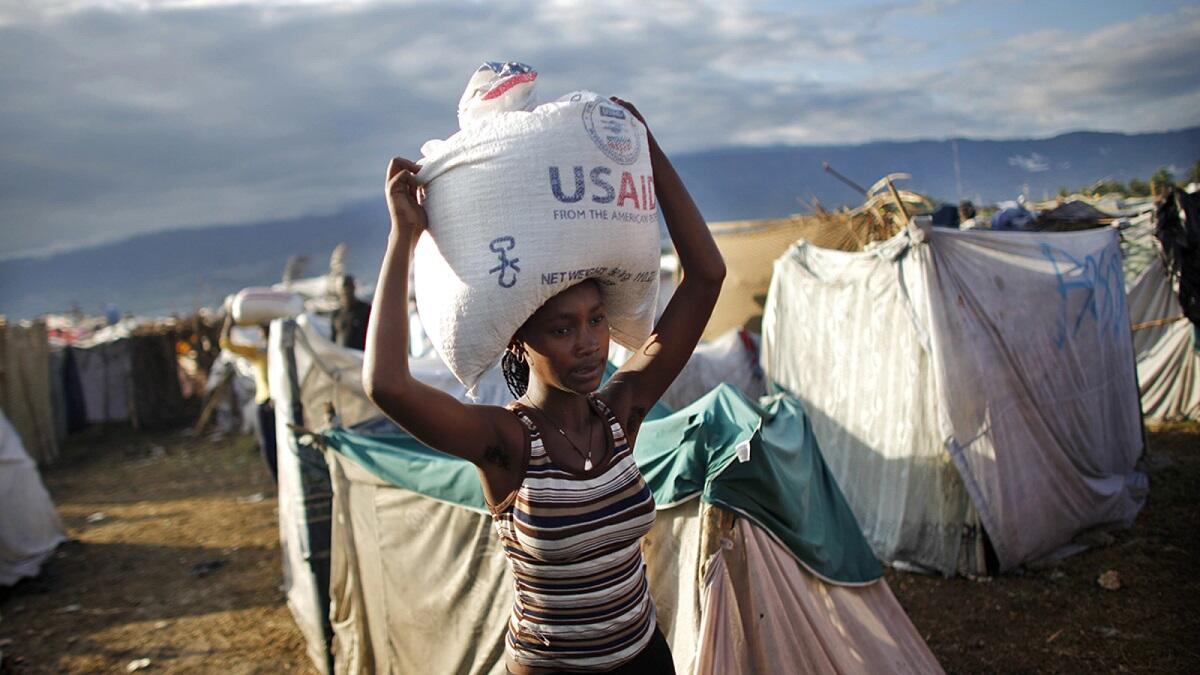
“Since the 2010 earthquake in Haiti killed as many as 300,000 people, the US government has disbursed around $4.4 billion in foreign assistance to the small island nation.

At least $1.5 billion was disbursed for immediate humanitarian aid, while another $3 billion went to recovery, reconstruction and development.

Of the at least $2.13 billion in contracts and grants for Haiti-related work, less than $50 million, or 2% went to Haitian organizations or firms. By comparison, $1.3 billion, or 56%, has gone to firms located in or near the US capitol. Little wonder USAID is so threatened by the sudden scrutiny.

It remains unclear how exactly the billions have been spent and whether US tax dollars have had a sustainable impact. USAID and its vendors have generally failed to make such data public…”

The exposure of USAID by DOGE actually confirms long running suspicions of mishandled aid.  Some Haitian reporters warned about this disappearing money years ago under the Obama Administration.  USAID funds to Haiti were dispersed in part through the Clinton Foundation. 

The lack of funding transparency was also noted by the Government Accountability Office (GAO) in 2023.  Though, not surprisingly, the impotent agency did nothing about it.  The GOA stated in their analysis of USAID activities in Haiti

“The USAID mission in Haiti does not fully track data on its local partnerships, or its activities to strengthen local organizational capacity, which limits institutional knowledge about these efforts and understanding of results and lessons learned to inform future activities.”

“The Administrator of USAID should ensure that USAID/Haiti develops a process to track and assess consistent and complete results information for infrastructure activities, such as the final outputs, outcomes, costs, time frames, and lessons learned.”

“The Administrator of USAID should ensure that USAID/Haiti establishes a process to completely and consistently track and analyze data on awards made to local organizations, such as the amount and percent of total funding awarded and the percent of total awards provided to these organizations.”

Of the five “recommendations for executive action” put forward by the GAO for USAID, two are marked as “completed”.  Transparency was never achieved and no one was held accountable.  The question is, if only 2% of the $4.4 billion allotted for Haitian relief was actually used in Haiti, where did the rest of the money go?

As the New York Post points out, 56% went to firms located in or near the US capitol, and apparently the money stayed there.  A comprehensive forensic accounting of these funds (along with all other missing funds) needs to be undertaken and tracked to the recipients.  Not just because it is is politically advantageous for the Trump Administration, but because justice needs to be served for once in the case of government fraud.  Americans are tired of seeing bureaucratic conmen get away with it. 

The public is welcome to debate whether or not any American taxes should be spent in Haiti (proximity to the US does not mean they are entitled), but if the money was already sent and it never arrived, then whoever took it stole from both sides of the equation – Americans and Haitians. 

Via https://www.zerohedge.com/political/more-usaid-fraud-billions-us-tax-dollars-are-missing-haiti-relief-projects

Trump Policy Will Embolden Developing World to Reject Climate Agenda

https://assets.realclear.com/images/67/678817.jpg


Richard Stambaugh, Wikimedia Commons

The climate change agenda stifles the aspirations of the poor to satisfy the pretensions of the rich.

President Donald. J. Trump’s seismic shift in energy policy will be felt far beyond U.S. borders. His withdrawing from the Paris Agreement, expanding American oil and gas exports, terminating the Green New Deal and eliminating the prospect of carbon tariffs offers a lifeline todeveloping nations grappling with chronic energy poverty.

When the United States pivots sharply, other nations reassess their positions. Nowhere will a change in the dynamics of energy policy be more welcome than in developing nations whose imperative to increase access to energy conflicts with pressures to submit to Western climate lords’ anti-growth, anti-humanistic, and dystopian Paris climate agreement.

Many developing nations have long expressed frustration with the climate agenda’s constraints on their economic growth. India and China, for instance, have consistently maintained that they need flexibility to determine their own domestic energy mix, emphasizing that access toaffordable fossil fuels is crucial for lifting millions out of poverty.

Similarly, nations across Africa have argued that their development priorities must include utilizing their natural resources – including coal, oil and natural gas – to meet people’s basic needs.

Take Nigeria, for example. With its significant natural gas reserves, the country has been caught between international pressure to limit the use of hydrocarbons and the urgent need to provide electricity to its growing population. International financial markets friendlier to fossil fuels could accelerate Nigeria’s plans to monetize its natural gas resources and expand domestic power generation.

As Yemi Osinbajo, a former Nigerian vice president, said, “Africans need more than just lights at home. We want abundant energy at scale so as to create industrial and commercial jobs. To participate fully in the global economy, we will need reliable, low-cost power.”

Global Implications of U.S. Energy Expansion

One of the most notable effects of Trump’s energy policy is an anticipated surge in exports of liquefied natural gas (LNG) from the U.S., which is to resume processing permit applications for new LNG projects interrupted by former President Biden.

For developing countries, this means reliable energy at competitive prices – a stark contrast to the intermittent power of solar and wind projects that have been favored by climate-compliant financial institutions.

Energy poverty remains a crippling obstacle in many parts of sub-Saharan Africa, South Asia and Latin America. According to the InternationalEnergy Agency (IEA), nearly 800 million people worldwide are without electricity, while 3 billion rely on smoky biomass for cooking.

By moving to increase the global supply of LNG, Trump offers an avenue for these nations to transition toward cleaner-burning natural gas. Benefits will include less deforestation, less indoor air pollution and a chance for more economic growth.

India has already invested in LNG terminals in the U.S. and will be increasing imports as demand grows from its population of 1.4 billion.

Moreover, an increased supply of LNG will stabilize global reserves and reduce the vulnerability of energy-importing nations to geopolitical disruptions. Energy abundance is a prerequisite for stability and prosperity – a reality that developing countries know all too well and the climate obsessed seemingly undervalue.

No Carbon Tariffs: A Boon for Developing Economies

While many pundits harp on Trump’s proposed tariffs on imports, they don’t recognize – or at least fail to acknowledge – that many in the developing world are likely to be happy that carbon tariffs of the climate agenda won’t be part of Trump’s tax regime.

Carbon tariffs, a darling of the climate crowd on both sides of the Atlantic, are designed to penalize the producers – and users – of carbon-intensive goods. In practice, however, they act as a regressive tax on developing nations, many of which lack the financial and technological means to “decarbonize” their industries.

For countries like India, which Foreign Minister S. Jaishankar has argued must prioritize economic growth over rigid climate targets, the carbon tax-free future represents a much-needed reprieve. It levels the playing field, allowing developing economies to compete in global markets without bearing the disproportionate burden of forced emissions reductions. Yes, Trump has threatened other tariffs, but those can be resolved through diplomacy.

Fossil fuels still account for over 80% of the world’s primary energy consumption, with countries like China, India and Indonesia expanding their infrastructures to produce, import and use hydrocarbons despite pledges to meet impossible climate goals.

With Trump’s bold move, these nations will no longer feel the need to hide behind the veneer of climate appeasement.

Trump’s rejection of climate orthodoxy matches the aspirations of developing nations striving to ensure energy security and overcome poverty. Expect these countries to be emboldened to more openly pursue their preferred energy strategies and leave the Paris agreement themselves.

[…]

Via https://realclearwire.com/articles/2025/02/20/trump_policy_will_embolden_developing_world_to_reject_climate_agenda_1092843.html

Scientists Developing mRNA Foods To Replace Injections

The Winepress

“Not just for food, but for high-value products as well, like pharmaceuticals.”

Scientists are actively creating new foods that are similar to the current Covid vaccines in use, as a way to replace traditional inoculation. Both Pfizer and Moderna Covid vaccines use messenger RNA (mRNA) technology that rewrites a person’s genetic code to fight disease. Moderna refers to this technology as an “app,” “software,” “operating system,” and more.

Currently, mRNA tech used in the Covid vaccines must be stored at cold temperatures to work, or they lose their stability.

However, researchers at the University of California-Riverside are testing ways for this mRNA tech to be functional under normal temperatures. In this case, if they are successful, they would then design plant-based mRNA food for public consumption.

For further development and functionality, the researchers received a $500,000 grant courtesy of the National Science Foundation.

The team seeks to accomplish three goals: first, attempt to successfully carry and transport DNA containing the same mRNA vaccine tech into plant cells, where they can replicate.

From there, the team wants to see if these newly cultured plants can replicate enough to generate sufficient mRNA to replace the traditional injection via syringe. Finally, the group of researchers will establish what the proper dosage will be for the masses to consume to effectively replace vaccinations.

Juan Pablo Giraldo, an associate professor in UCR’s Department of Botany and Plant Sciences, said in a university release:

“Ideally, a single plant would produce enough mRNA to vaccinate a single person.

“We are testing this approach with spinach and lettuce and have long-term goals of people growing it in their own gardens. Farmers could also eventually grow entire fields of it.”

In order for this to work properly, the plant’s chloroplasts are key, says Giraldo and a team of scientists from UC-San Diego and Carnegie Mellon University. Chloroplasts are tiny organs inside plant cells that aid in the conversion of sunlight into usable energy.

“They’re tiny, solar-powered factories that produce sugar and other molecules which allow the plant to grow. They’re also an untapped source for making desirable molecules,” Giraldo added.

Previous studies have been reported to have shown gene expression, which is not a natural part of the plant. This was discovered when Giraldo and his team successfully injected genetic material into the chloroplasts.

Professor Nicole Steinmetz of UC-San Diego worked with Giraldo and the team to utilize nanotechnology to help deliver even more genetic material – identical to how the Covid vaccines work, not just the Moderna or Pfizer ones either.

“Our idea is to repurpose naturally occurring nanoparticles, namely plant viruses, for gene delivery to plants. Some engineering goes into this to make the nanoparticles go to the chloroplasts and also to render them non-infectious toward the plants,” Steinmetz explained.

Giraldo added:

“One of the reasons I started working in nanotechnology was so I could apply it to plants and create new technology solutions. Not just for food, but for high-value products as well, like pharmaceuticals.”

[…]

Via https://thewinepress.substack.com/p/scientists-are-developing-mrna-foods

Harvard Polling: Majority Support DOGE Measures to Reduce the Size of Government

Jonothan Turley

As the courts hash out the legalities of the orders supporting the Department of Government Efficiency (DOGE), the public appears to support the effort despite the almost universal condemnations in the media. Despite the prediction from James Carville that the Trump Administration will collapse within 30 days, a recent Harvard CAPS/Harris poll shows that most citizens support the cutting of government spending and size. While the courts must rule on the legal basis for these executive orders, the polling shows continued support for both Trump and his agenda after the election.

Sen. Amy Klobuchar (D., Minn.) also has declared that “remorse” was growing among voters who were souring against the Trump Administration.

Yet, the Harvard poll shows Trump with a 50% approval rating, (43% expressing disapproval). That is consistent with the RealClearPolitics polling average, giving Trump a 49.3% approval rating.

What was interesting amid the ongoing judicial and legislative fight is that 83% of voters preferred cutting government spending to raising taxes.

Some 77% also supported a broad review of government spending. A massive 70% believe government spending is rife with waste and fraud and 69% support cutting spending by $1 trillion.

Sixty percent of voters said that DOGE is carrying out the need of the government to make significant cuts.

Once again, our courts are designed to resist popular demands when they contravene legal or constitutional authorities. However, courts are also sensitive to what is called the “countermajoritarian difficulty.” As Alexander Bickel discussed in his 1962 book, The Least Dangerous Branch, the courts straddle this line between protecting constitutional values and not becoming a type of super-legislature. The political question doctrine and other judicial rules are designed to remove federal judges from making policy or political judgments.

Voters are allowed to bring about significant, even radical, changes in government policies and programs. They are allowed to elect “change agents” to use existing powers to achieve those goals.

[…]

Via https://jonathanturley.org/2025/02/25/harvard-polling-majority-supports-doge-measures-to-reduce-the-size-of-government/

The Crisis of School Bullying in Russia

Bullying

RT (2024)

Film Review

Russian with English subtites

Accord to the filmmakers, school bullying has significantly increased in Russia (it hasn’t increased in New Zealand – historically has been an integral part of Kiwi culture, not only in the schools but in the workplace).

The film indicates that 55% of Russian students surveyed reported issues with bullying. Thirty-nine percent of this bullying occurs on social.

The film focuses on a Russian teenager who stabbed a classmate with a knife after a long history of bullying by his classmates, a girl who was bullied for being overweight (which she ended by joining classmates in bullying another fat student) and a third girl who was bullied on social media. Her bullies eventually tried to blackmail her over an obscene photo they posted, leading her to try to sell a kidney online to pay them off.

There is an in-depth interview with the boy’s mother, who has fought for two years to get the school and the bullies’ parents to acknowledge the role of bullying in the knife attack. The filmmakers also play a recorded call with the school principal, who flatly denies any bullying occurred. Her son Vlad remains in a psychiatric hospital two year after the attack.

The filmmakers also show excerpts of a recent Russian play about bullying and a school anti-bullying workshop. The students responding most strongly to the play and the workshop were “onlookers” too scared to report bullying incidents to authorities.  authorities.