Biden, however, refused to pardon Peltier despite evidence that he never shot and killed FBI agents whose murders he was charged with
In a last-minute move before his departure from office, President Joe Biden commuted the life sentence of American Indian Movement (AIM) leader Leonard Peltier, who was convicted of killing two FBI agents, Jack Coler and Ronald Williams, on the Pine Ridge Indian Reservation in June 1975.
In a statement, the White House said the commutation would enable Peltier to spend his remaining days in home confinement, “but will not pardon him for his underlying crimes.”
Peltier’s daughter, Kathy Peltier, said she was in shock after learning what Biden had done after past presidential requests for clemency were unsuccessful. “I’m just thankful that he had the balls and the guts to do it,” she said of Biden’s decision.
In a statement provided by the NDN Collective, an Indigenous-led advocacy organization, Peltier said he was ready to leave prison. “It’s finally over — I’m going home,” Peltier said. “I want to show the world I’m a good person with a good heart.”
CovertAction Magazine is happy that Peltier is going home. However, our investigation determined that Peltier was not the one who killed the two FBI agents (Jack R. Coler and Ronald A. Williams) whose murder he was charged with, though he was present when they were killed.
Peltier’s trial, furthermore, was not fair, as the U.S. government withheld a ballistics report indicating that the fatal bullets did not come from his weapon. There is also strong evidence of witness intimidation by the FBI.
One prosecution witness, Michael Anderson, testified during cross-examination that he was threatened by an FBI agent, and said that he agreed to testify in exchange for criminal charges against him in another case being dropped.
Another witness, Myrtle Poor Bear, said that she had been coerced into signing a false affidavit implicating Peltier and that her life had been threatened. “They had the law in their hands, and could do anything,” she said of the FBI.
AIM and Pine Ridge
A member of the Turtle Mountain band of Chippewa Indians from North Dakota, Peltier had been a leader of AIM, which staged an occupation of the Pine Ridge Reservation in the early 1970s in an effort to reclaim land that had been taken during the 19th century Indian Wars.
Pine Ridge was strategically located at the site of the 1890 Wounded Knee Massacre, where the U.S. Army’s 7th Cavalry regiment killed about 300 Lakota Sioux civilians in revenge for the killing of General George Armstrong Custer at the Battle of the Little Bighorn 14 years earlier.
Peltier had traveled to Pine Ridge in South Dakota in 1975 to help AIM members defend themselves against the head of the Oglala Sioux tribal council, Richard Wilson, who worked with the FBI and deployed his private militia, Guardians of the Oglala Nation (GOON), against AIM.
GOON killings went unpunished as the homicide rate on the Pine Ridge Reservation became among the highest in the U.S.
Conflicting Narratives
On June 26, 1975, Coler and Williams were on the Pine Ridge Indian Reservation to arrest a man, Jimmy Eagle, on a federal warrant for armed robbery in connection with the theft of cowboy boots, according to the FBI’s investigative files.
While they were there, the agents radioed that they had come under fire in a shootout that lasted ten minutes, the FBI said.
Peltier was fingered in part because his gun—an AR-15—matched the one that killed the agents (this evidence was put into dispute), and because he was found by an Oregon state trooper after he had fled with Agent Coler’s handgun in a bag with his fingerprint on it.
In Peltier’s version of events, he was in bed at 11:00 a.m. when he heard gunshots and fellow AIM members told him “Man, we’re being attacked. We’re being attacked.” Peltier then said “Oh, my God.” and grabbed an old rifle and started running up to the house and fired his gun after being fired upon.
The FBI has said the agents were shot without provocation, though AIM said that they triggered the shootout, and killed an Indigenous man, Joe Stuntz, whose death was never investigated.
In the FBI’s version, Peltier was stopped while driving in a red truck because he had an outstanding warrant for the attempted murder of a police officer. Peltier allegedly exited the vehicle along with Norman Charles and Stuntz, and began firing at the FBI agents.
Peltier says he knows that his shots did not hit the FBI agents and he was not the one who killed them. This assessment was corroborated by Bob Robideau, who was charged with Peltier but was exonerated in a separate trial. He said in 2004: “I am ‘Mr. X’ (which is no lie) and I did kill them [the FBI agents] with the honor befitting a warrior, but they died like worms.”
Robideau in turn stated that he had no remorse because it was a “defensive action” against “our enemies.”
Lingering Injustice
During a June 8, 2024, interview, Peltier’s serving attorney Kevin Sharp, a former U.S. District Judge in Tennessee, stated:
“Pine Ridge was a powder keg with the Goon Squad operating there with the government’s help. AIM was there to protect those who were not part of the Goon Squad. There were many murders and assaults in a three-year timeframe. When plain-clothed agents in unmarked cars arrived, a firefight ensued. Leonard did not shoot the agents, and the FBI knew this but withheld evidence. The court of appeals acknowledged this but couldn’t overturn the conviction due to legal standards. Judge Heaney, who wrote the opinion, later supported clemency for Leonard. Now, 38 of Judge Heaney’s former clerks support parole for Leonard, including three who worked on his case. The government admits they don’t know who killed the agents, but it wasn’t Leonard. It’s time to release Leonard and start the healing process.”
With Peltier’s release, perhaps the healing process that Sharpe spoke about can indeed begin.
Peltier’s case has for decades energized the activist community because Peltier has remained a symbol of the continued injustice done to Native Americans in the United States.
What is really needed is not just clemency but a full pardon. This would send a signal that the U.S. government did wrong by Peltier—just as it had done wrong to so many of his ancestors and comrades in the AIM.
The Alberta government’s COVID-19 Response Review, commissioned by Premier Danielle Smith, has called for the immediate halt of mRNA jabs due to their ‘deadly side effects’
According to a report obtained by Rebel News, one of the most alarming findings from the review: Pfizer’s own post-authorization trial data. The report reveals that within just four days of vaccination, 1,223 deaths and 42,086 injuries were recorded. Notably, nearly half of these adverse events occurred in individuals aged 18-50—those at negligible risk of severe COVID-19 outcomes. This raises serious concerns about the overall safety profile of the vaccines, particularly for young and healthy populations (Rairfoundation.com reports: The full report can be accessed here).
So far, all available analysis is damning—not only for the injections but for the COVID-19 response in general. Outside of Florida, this may be the most significant official government report scrutinizing the nature and effects of mRNA injections.
Yet, the question of responsibility remains unanswered. Who will be held liable? For what crimes? And what safeguards will be put in place to ensure Alberta’s most basic civil liberties are never trampled like this again?
These crucial matters do not appear to be addressed in the report. However, it marks a critical shift—from narrative-driven coercion to a reality-based admission of the consequences of these policies, particularly the widespread push for mRNA gene therapy injections.
One of the most damning revelations is how Pfizer manipulated data to obscure adverse effects. The company reported vaccine effectiveness using relative risk reduction, making it appear more beneficial, while downplaying severe adverse effects with misleading statistical methods. A proper analysis shows that the vaccine arm experienced a 300% increase in adverse events compared to the placebo group. This is outright deception on a massive scale.
Additionally, among the most disturbing findings is Pfizer’s own pregnancy data: 87.5% of recorded pregnancies ended in fetal or neonatal death. Even worse, Pfizer failed to report outcomes for 238 out of 270 pregnancies—raising serious questions about potential data suppression. What happened to those missing pregnancy cases? What were they hiding?
Despite overwhelming evidence, those responsible for public health have dismissed critical concerns as misinformation—even though alarming data has been publicly available for years. Yet, only a handful of journalists in Canada have been relentless in exposing the truth about these novel pharmaceutical products.
This cannot be ignored. Will the Alberta government now take the next step and pull these shots from the market? Will they hold those responsible accountable? Public outrage and pressure will determine what happens next.
For an in-depth analysis of the effects of mRNA shots, as well as potential treatments for those harmed, see RAIR Foundation’s recent interview with Dr. Mark Trozzi.
On 29 January, the Military Operations Department of the de facto government in Syria announced that Ahmad al-Sharaa – previously known by his nom de guerre Abu Mohammad al-Julani – would assume the presidency of the country during a “transitional phase.”
The announcement included the suspension of the country’s constitution and the dissolution of the previously ruling Baath Party, the People’s Assembly, the former national army, security services, and all armed factions – including Sharaa’s own Hayat Tahrir al-Sham (HTS), the former Al-Qaeda affiliate in Syria.
Giving a speech at this so-called “Victory Conference” was Ahmad al-Hayes, also known as Abu Hatem Shaqra, the leader of the Ahrar al-Sharqiya faction of the Turkish-backed Syrian National Army (SNA) force – an organization responsible for numerous war crimes.
With this, the world was forced to ask: Who are the key figures now ruling Syria, and what does this mean for its future?
To understand today’s events, it is necessary to rewind a decade. In 2015, the northwestern city of Idlib fell to the Nusra Front, which US official Brett McGurk once described as the “largest Al-Qaeda safe haven” in the world. While other parts of Syria saw different terror organizations come and go, lose ground and gain ground, and eventually get defeated by the Syrian Arab Army (SAA) and its allies over the years – Idlib remained under the control of the Nusra Front.
In 2015, the Nusra Front was rebranded into Jaish al-Fatah. The following year, it was rebranded again into Jabhat Fateh al-Sham and severed relations with Al-Qaeda in an attempt to legitimize itself. It finally became known as HTS in 2017.
This was all done with Qatari support and with the help of the Syria-based Saudi Wahhabi cleric Abdullah al-Muhaysni, who sent teenagers on suicide missions and was responsible for the recruitment of thousands upon thousands of extremist militants. He is now roaming freely across Syria, giving speeches.
HTS set up a political administration in the ‘liberated’ Idlib governorate and began its rule – creating the prototype for the government that now rules the majority of the country, including Damascus.
In December 2024, the unthinkable happened. After an 11-day lightning offensive, HTS-led fighters stormed Damascus, toppling Assad’s government. With foreign backing, notably from Turkiye and, more recently, Ukraine, along with strategic deceit, the former Al-Qaeda offshoot achieved what no faction before it had: seizing control of Syria’s capital and claiming rule over the country.
[…]
The newly announced President of Syria, Ahmad al-Sharaa
In an earlier life, HTS’s leader, Ahmad al-Sharaa, had studied medicine briefly at the Faculty of Medicine at Damascus University before leaving to join Al-Qaeda in Iraq (AQI) following the 2003 US invasion.
His notorious resume includes being the former deputy to ISIS chief Abu Bakr al-Baghdadi back when the infamous terror group was known as the Islamic State of Iraq (ISI). Sharaa was dispatched by Baghdadi in 2011 to enter the war against Assad’s government in Syria, where he took part in the launching of deadly suicide attacks against both security personnel and civilians before founding the Nusra Front in 2012.
The Nusra Front, which was Al-Qaeda’s official branch in the Levant, would go on to terrorize both the Syrian and Lebanese people for years under Sharaa’s leadership. During his days in Iraq, Sharaa started as a member of ISI’s precursor, AQI – itself responsible for many indiscriminate attacks, including bombings of religious sites and the killing of civilians and worshippers – in an effort to trigger a sectarian war.
After his release from the US-run Camp Bucca in 2008, where he had been detained alongside Baghdadi and many future ISIS leaders, Sharaa served as ISI’s Emir of Mosul – a period that witnessed many killings and kidnappings of Christians and Yazidis.
After assuming leadership of Syria in December 2024, the Iraqi judiciary issued an arrest warrant for Sharaa. Sources cited by Shafaq news agency said detainees in Iraq had confessed to crimes that involved him personally. Yet Sharaa is now sitting down with international leaders, including US and European officials. After he met with a delegation from Washington in Damascus last month, a US terror designation and $10 million dollar bounty for Sharaa’s capture was swiftly lifted.
The new unelected Syrian president has recently held meetings with the head of the International Criminal Court (ICC), Karim Khan, Lebanon’s caretaker prime minister Najib Mikati, and Qatari Emir Tamim bin Hamad Al-Thani – the first head of state to meet with the former Nusra leader. His meeting with Mikati was a shock and disappointment to many Lebanese who remember the Nusra Front’s crimes against the country, such as deadly suicide attacks, kidnappings and executions of Lebanese soldiers, and the infiltration and occupation of the country’s territory near the Syrian border.
Extremists leading Syria’s new army
The so-called Syrian Armed Forces now include non-Syrian commanders, many of them veterans of Al-Qaeda and ISIS. Sharaa has declared that the foreign militants “should be celebrated” as “part of the movement that led to the downfall of Assad.” He has also said that the foreign fighters who remain in Syria could potentially be granted Syrian citizenship.
Abdulaziz Dawood Khudaberdi, a Chinese Uyghur militant from the Turkistan Islamic Party (TIP), has been appointed brigadier-general.
Chinese Uyghur militant, Abdulaziz Dawood Khudaberdi, from the Turkistan Islamic Party, who was appointed as brigadier-general in the new Syrian army.
TIP is an Uyghur militant organization that has fought under HTS’s command for years. Its fighters illegally entered Syria post-2011, like the tens of thousands of other foreign fighters from numerous different nations who came to the country to fight against the former state.
TIP has called for the establishment of an Islamic state in parts of China and central Asia, and is seen by Beijing as a serious threat to its interests and security. Another two Uyghur fighters, Mawlan Tarsoun Abdussamad and Abdulsalam Yasin Ahmad, have been made colonels.
Turkish citizen Omar Mohammed Jaftashi and Jordanian citizen Abdul Rahman Hussein al-Khatib have also been made brigadier-generals.
Jordanian citizen Abdul Rahman Hussein al-Khatib (right) who was appointed as brigadier-general in the new Syrian army.
Additionally, Tajik fighter Saifiddin Tojiboev, wanted in his home country, Tajikistan, for membership in terrorist organizations and the recruitment of extremist militants, according to an anonymous Tajik law enforcement source cited by Radio Free Europe (RFE), was appointed as a colonel.
Tajik fighter Saifiddin Tojiboev who was appointed as a colonel in the new Syrian army.
Abdul Jashari, an Albanian extremist, now holds the rank of colonel. Omar Mohammed Jaftashi, a Turkish citizen, has been made a brigadier-general. And the list goes on.
Syrian Justice Minister, Shadi Mohammad al-Waisi
Shadi Mohammad al-Waisi, made justice minister in December, was formerly a judge in the Nusra Front and holds a degree in Islamic Sharia. He is currently pursuing a master’s degree in Islamic Studies. In 2011, he helped found the Sharia Authority in Aleppo’s Daharat Awad district, where he served as a judge before taking part in the creation of the Four-Party Sharia Authority in Aleppo in 2012. Waisi continued to rise in rank, serving as a military penal judge, an appeals judge, and a public prosecutor. He also headed many courts in Aleppo during the years of the Nusra Front’s violent rule in the ancient city.
Newly appointed Justice Minister Shadi Mohammad al-Waisi.
Recently, verified videos emerged of Waisi overseeing the public execution of women accused of prostitution and adultery in 2015, drawing nowhere near enough condemnation and going largely unnoticed in mainstream media.
An official from the new government told the news verification outlet Verify-Sy that the footage “documents the enforcement of the law at a specific time and place, where the procedures were carried out in accordance with the laws in effect at that time,” and that it “reflects a stage we have moved beyond, in light of the current legal and procedural transformations, which makes it inappropriate to generalize it or use it to describe the current stage, given the differing circumstances and references.” Of course, the justice minister will not be brought to justice for his crimes.
Syrian Defense Minister, Murhaf Abu Qasra
Murhaf Abu Qasra, also known as Abu Hassan 600, was appointed minister of defense after the fall of Assad’s government. He holds a bachelor’s degree in agricultural engineering, has been a top leader in HTS’s military wing for several years, and was responsible for the group’s drone unit, known as the Shaheen Brigades.
Newly appointed Defense Minister Murhaf Abu Qasra.
Upon assuming his role as defense minister, reports have emerged regarding Abu Qasra’s involvement in numerous crimes and atrocities: 20 premeditated murders, 15 armed robberies, 12 amputations, 150 executions of Shias, Christians, and atheists, 15 cases of stoning to death, and 10 cases of rape of female captives (HTS, under its different names over the years, has taken its fair share of captives – and has even kidnapped nuns).
[…]
Syrian Intelligence Chief, Anas Hassan Khattab
Anas Hassan Khattab, a co-founder of the Nusra Front alongside Sharaa and Syria’s new Foreign Minister Asaad Hassan al-Shaibani, has been appointed the head of Syrian intelligence. He studied architecture at the Damascus University before leaving for Iraq in 2008, where he went to “fight against the US occupation,” according to Syria TV.
Khattab, also known as Abu Ahmed Hudood, was blacklisted as a terrorist by the UN Security Council in September 2014 for his close association with Al-Qaeda – particularly AQI.
Anas Hassan Khattab, a co-founder of the Nusra Front and newly appointed Syrian Intelligence chief.
According to the listing, he was for several years involved “in the financing, planning, facilitating, preparing, or perpetrating of acts or activities by, in conjunction with, under the name of, on behalf of, or in support of” and “otherwise supporting acts or activities of” the Nusra Front.
Khattab was also sanctioned by the US Treasury Department in 2012 for his ties to Al-Qaeda. Syria’s new intel chief served as the administrative Emir of the Nusra Front as of early 2014 and was part of its Shura Council by mid-2013. He was also tasked with selecting personal bodyguards for Sharaa.
In recent years, Khattab oversaw general security operations in Idlib. His involvement in intelligence gathering dates back to the period when HTS consolidated control over northern Syria with Turkish support.
During this time, he managed surveillance of covert networks along the borders of HTS-controlled areas. According to an investigative report by Enab Baladi last year, Sharaa used to rely on Khattab for “internal security files and the elimination of opponents.”
Women’s Affairs Chief, Aisha al-Debs
As part of efforts to foster inclusivity, Aisha al-Debs was appointed Women’s Affairs chief. She holds a master’s degree in business administration from the Damascus University. While not much is known about her, Debs – a dual Turkish-Syrian citizen who lived in Turkiye for ten years – proclaimed honestly during a recent interview with TRT how she plans to carry out her work, stating, “I will not allow space for those who differ with me ideologically.”
Aisha al-Debs, newly appointed Women’s Affairs chief.
[…]
Sectarian carnage and zero ‘democracy’
Western diplomats and foreign delegation have been rushing to engage with HTS – which has touted its commitment to inclusivity and minority rights. Yet the reality on the ground is starkly different. Executions, sectarian purges, and desecration of religious sites have become routine.
In the first month of HTS rule, 150 Alawites were killed, hundreds of people arrested and subjected to torture, and Christians were expelled from the town of Maaloula. Christmas trees have been burned in public squares, and videos have circulated showing Alawites being humiliated and forced to bark like dogs.
Sharaa and other officials have promised to unify Syria, vowing to protect minorities and punish “individual” actors for any transgressions against Christians, Alawites, Shias, and others, but there are precious few indications that this is happening.
[…]
If the new Syria remains on this path – the HTS-led government may not last. Under such conditions, the Syrian people will not accept an administration of extremists, given its apparent inability to build a unified and diverse country.
People have already begun to take up arms, including former elements and supporters of the old Syrian army. There have also been reports of Christians fighting back against HTS.
Claims by public health agencies and in top medical journals that childhood vaccination prevents millions of deaths annually are based on flawed epidemiological models, according to a paper published today by Correlation, a Canadian nonprofit research organization.
The author, all-cause mortality expert Denis Rancourt, Ph.D., argues these claims are based on “tentative and untethered models of epidemiological forecasting” that produce “unlikely results.”
The models depend entirely on invalid estimates of vaccine efficacy and disease prevalence and virulence, none of which are based on real-world data concerning actual deaths, according to Rancourt.
They also fail to account for other complex factors contributing to child mortality — particularly in low-income countries, where most of these millions of infant lives are purportedly saved. These factors include nutritional deficiency, toxic exposures and poverty.
Rancourt also found that, contrary to public health claims, there are no examples in all-cause mortality data of a drop in infant or child mortality temporally associated with the rollout of a childhood vaccination program.
In the paper, Rancourt develops an alternative model using yearly all-cause infant mortality. He estimates that childhood vaccination campaigns since 1974 may have been associated with approximately 100 million vaccine-related deaths.
However, he emphasizes that any true estimate of mortality would also have to account for other factors, such as the shifting political and economic dynamics that drive poverty and its associated health problems.
Children’s Health Defense Senior Research Scientist Karl Jablonowski said, ”Rancourt points out serious flaws in mainstream debates over childhood vaccination that are premised on errors in generalization and lead to childlike black-and-white thinking when it comes to vaccine safety.”
Jablonowski said the paper clearly demonstrates that claims vaccines have saved millions of lives globally, “hang on a few impossible assumptions.” Those include:
That no human can die from a vaccine (directly or indirectly).
That children who die from a “vaccine-preventable” pathogen were otherwise perfectly healthy.
That we understand how diseases spread in all contexts.
That all children have the same health, diet, exercise habits, access to clean water, toxin and environmental exposures, genetic disposition, etc., as the clinical trial participants.
That clinical trials accurately represent the risks and benefits of the vaccine.
That once a vaccine is developed, all other medical interventions suddenly stop working.
Rancourt said he began writing the paper to demonstrate the “ludicrous theoretical modelling exercises” behind the spectacular claims of reduced infant mortality from mass vaccination programs.
“But what I discovered is that the longstanding industry of administering vaccination programmes to save infants in low-income countries from death is scientifically baseless and a fraudulent enterprise that removes resources and attention away from urgently needed development to correct ongoing mass neocolonial exploitation,” he said.
‘Garbage in, garbage out’
Many top researchers have raised public concerns about epidemic modeling, particularly in research that serves the pharmaceutical industry.
Dr. John Ioannidis has pointed out that “epidemic forecasting has a dubious track record,” which became particularly evident during the COVID-19 period. Models can easily be compromised or skewed if they use poor data, incorrect assumptions, lack epidemiological information or fail to consider all dimensions of a given problem.
This, combined with the fact — highlighted by former editors of both The Lancet and The BMJ — that medical journals have become “an extension of the marketing arm of pharmaceutical companies” has led to the proliferation of forecasting models that don’t meet even the most basic standards for modeling, Rancourt said.
In recent years, epidemiologic modelers have published many papers claiming to estimate mortality averted through childhood vaccination.
Rancourt argued these models share two fatal flaws: They are based on unreliable assumptions of vaccine efficacy and they “guesstimate” deaths avoided using disease models not anchored in real-world data.
The safety and efficacy numbers for these models always come from clinical trials, which he says are “systemically unreliable” in assessing efficacy and fail to evaluate safety.
The trials are, “overwhelmingly controlled by an industry making large profits from the vaccines, and this industry has amply, historically, consistently and repeatedly demonstrated its willingness to act fraudulently at the expense of endangering the public,” Rancourt wrote.
Also, the trials themselves introduce several biases. For example, trials are conducted with healthy children, but vaccines are administered to children with multiple vulnerabilities, particularly in low-income countries.
The trials also don’t test the vaccines against true placebos, don’t monitor children long-term for safety issues, and don’t test against disease prevention or safety in the real world.
Second, they rely on “guesstimates” of deaths averted — estimating how many children didn’t die because they got the vaccine — based on isolated models for disease contagion that aren’t validated by real-world research.
Most importantly, they fail to account for the fact that childhood mortality rates are affected by a wide range of factors — including underlying health conditions, poor nutrition and access to care — beyond simply whether a child is vaccinated or not.
“I argue that the proverbial computing term ‘garbage in, garbage out’ pre-eminently applies in these circumstances,” Rancourt said.
Breaking down claims that vaccination has saved 154 million lives since 1974
The study concluded that “Since 1974, vaccination has averted 154 million deaths, including 146 million among children younger than 5 years of whom 101 million were infants younger than 1 year.”
Rancourt calculated this would be the equivalent of 5.7% of global deaths annually, or a 20% reduction in global infant mortality.
Rancourt said it would be a “fantastic” medical achievement. “Some might reasonably call it unbelievable.”
In addition to the WHO funding, the Vaccine Impact Modelling Consortium — funded by the Bill & Melinda Gates Foundation and the Gates-backed Gavi, the Vaccine Alliance — provided the models. Members of the research team also receive funding from the Centers for Disease Control and Prevention, the Wellcome Trust and other organizations with financial and political interests in promoting mass vaccination.
For The Lancet study, Shattock estimated deaths avoided by vaccination using only theoretical models for how disease spreads — with no attention to context. And then used efficacy rates from vaccine clinical trials to estimate how many children who would have gotten sick and died don’t because vaccines are present.
The study repeats that model for each of the nine vaccines it considered to arrive at the number of lives saved.
The study also estimated the numbers based on the assumption that, otherwise, infant mortality would have remained constant between 1974 and 2024. However, in reality, infant mortality had been dropping before that, which the model should have accounted for.
The study “collapses on examination of its premises,” Rancourt wrote.
The problem of poverty
Perhaps the most glaring issue, Rancourt said, is that models touting high numbers of lives saved by vaccines fail to account for the reality that child mortality is influenced by many complex factors, particularly in low-income countries.
For example, the WHO states that the measles vaccine has the greatest impact on infant mortality, accounting for most lives saved from all vaccines. However, deaths from measles are typically related to malnutrition. Mortality and morbidity rates from infectious diseases like measles decline with improved living standards.
Malnutrition also makes children more vulnerable to environmental toxins — including vaccines, Rancourt noted.
In other words, malnutrition, including of the mother, makes a child highly vulnerable to death from a wide range of infections that don’t occur or aren’t fatal in well-nourished children living in healthy environments.
Low-income countries not only lack funding for public health, Rancourt said, but vaccination campaigns divert resources away from other health priorities like clean water and basic health services.
Vaccination programs increase infant and child mortality
Contrary to repeated claims that vaccines save millions of lives, Rancourt’s analysis of the relationship between vaccine rollouts and infant mortality rates suggests the opposite — that these programs have contributed to increased infant and child mortality.
Rancourt correlated changes in the global infant mortality rate with major vaccine rollouts between 1980-1999 and 1999-2015. During those periods, global infant mortality rates were declining, but the rate of decline slowed after the vaccine rollouts.
The deceleration became more marked in about 1992, when the hepatitis B and pneumococcal conjugate vaccines were introduced, even in low-income countries.
Had the decline in infant mortality continued at the same rate from the period before vaccine rollouts, there would have been 100 million fewer infant deaths. Instead, the rate of decline in mortality slowed precisely when the rollouts happened.
All researchers modeling the benefits of vaccination missed or disregarded this evident temporal correlation, Rancourt said.
Rancourt’s findings corroborate observational studies, including those showing the introduction of the diphtheria-tetanus-pertussis vaccine in low-income countries led to a spike in infant mortality among vaccinated babies.
However, Rancourt cautioned that he was presenting the simplest possible model. A true estimate would have to adjust for the benefits of improving living conditions. It would also have to account for the impacts of “aggressive so-called globalization” in the 80s and 90s that facilitated the global expansion of industry, global vaccination campaigns and industrial agriculture, which all had varied and significant impacts on low- and middle-income countries.
Rancourt concluded the overwhelming cause of high infant mortality is extreme poverty associated with severe malnutrition and exposure to toxic living environments.
This episode continues the timeline of the Israel-Hamas war through December 2023:
December 12 – Israel announces 1 out of 10 Israel Defense Force (IDF) troops killed by friendly fire in Gaza. UN General Assembly calls for immediate ceasefire (150 yes, 10 no, 20 abstain).
December 14 – Israeli ambassador to UK Tzipi Hotovely expresses anger at the global protest over Israel’s deliberate slaughter of civilian, announcing that Israel rejects the two state solution “giving” the West Bank and Gaza to the Palestinians and intends to expel the 2.3 million Palestinians in Gaza by obliterating the infrastructure they relied on for basic needs. Other Netanyahu supporters express concern that West Bank and Gaza Palestinians block Israel’s expansion into the Egypt and Jorda
December 17 – British Petroleum officially halts all oil shipments via the Red Sea and Suez Canal, as Middle East Monitor reports Houthi attacks on freighters costing Israel’s economy billions of dollars. The US coalition on paper) declaring war on Yemen that includes Spain, Canada, France, Seychelles, UK Bahrain, Italy and Norway. UN cites Israel for violating international law with summary execution of 11 Palestinian civilians.
December 20 – Biden opposes Israel’s proposal for an Israel/US war against Iran, (according to the filmmakers) out of fear of losing November 2024 elections. He blames concerns about protecting US bases against attacks from pro-Palestinian countries (Iraq, Syria, Yemen). Owing to stalemate in Gaza, Netanyahu expands war to southern Lebanon. Massive Israeli protests call for Netanyahu’s removal as prime minister.
December 22 – Israel banned Muslims from entering the Al Axa Mosque in the West Ban and carried out the mass execution of 137 civilians in Gaza Jabalia refugee camp.
December 25 – Israeli’s assassinates Syrian General Mousavi.
December 29 – South Africa files suit with the International Court of Justice calling for an immediate ceasefire under Genocide Convention.
December 30 – Israel bombs a town on the Iraqi/Syrian border.
December 31 – Israel bombs Aleppo (Syria) and US launches missile attack on Houthis vessels, killing 22. In three months Israel has kiled 21,000 Palestinians, 1% of Gaza’s population
During his second day of confirmation hearings for HHS secretary, Robert F. Kennedy Jr. said the U.S. “will sink beneath a sea of desperation and debt if we don’t change course and ask the fundamental question, ‘Why are healthcare costs so high in the first place?’ The obvious answer to that question is chronic disease.”
Robert F. Kennedy Jr. hit back at Congress members who attacked his stance on vaccines and the chronic disease epidemic, suggesting today during his second U.S. Senate hearing to lead the U.S. Department of Health and Human Services (HHS) that several members have accepted donations from Big Pharma.
During an exchange with Sanders, Kennedy said, “Corruption is not just in the federal agencies, it is in Congress too. Almost all the members of this panel … including yourself, are accepting millions of dollars from the pharmaceutical industry.”
This was one of several contentious moments during today’s meeting, which also focused on vaccine safety, the chronic disease epidemic and conflicts of interest in scientific research.
Kennedy frequently questioned the effectiveness of U.S. public health agencies in addressing the chronic health epidemic, which he said has come at a great cost both in terms of fatalities and the epidemic’s economic burden.
“The focus is on infectious disease, and we almost altogether ignore chronic disease, which causes 92% of the deaths in this country,” Kennedy said. Noting that the U.S. had a disproportionate percentage of COVID-19-related deaths during the pandemic, Kennedy said it is because “we are the sickest people on earth.”
Kennedy pledged to reverse this trend, if confirmed as HHS secretary, by emphasizing transparency and “good science.”
‘I’m pro-good science’
Unlike yesterday’s hearing, today’s hearing focused extensively on Kennedy’s views on vaccines and vaccine safety. Kennedy responded to claims he is “anti-vaccine” and “anti-industry.”
“I’m neither. I’m pro-safety. I’m pro-good science,” Kennedy said. “We should always follow the evidence no matter what it says.” Kennedy said he wouldn’t “impose” his opinions on HHS scientists. Instead, he would support examining “all the data” by empowering HHS scientists to do their job.
“We will have the best vaccine standards, with safety studies,” Kennedy said.
Much of the discussion about vaccines centered on rising autism rates, with Kennedy noting that they have increased from 1 in 10,000 to as high as 1 in 34, calling this an “explosion” that public health agencies have long overlooked.
Kennedy referred to a recent peer-reviewed study of 47,000 9-year-olds to respond to claims by members of the committee that the link between autism and vaccines has been definitively debunked. The study found that autism rates were higher among vaccinated children and increased as the number of vaccinations grew.
“Why don’t we know what’s causing this epidemic?” Kennedy asked. “Why hasn’t CDC [Centers for Disease Control and Prevention] been looking at other hypotheses to determine the etiology of why we’ve had this dramatic 1,000% increase in this disease that is destroying our kids?”
Several members of the committee openly agreed with Kennedy’s stance on autism.
“1-in-36. If that’s not a pandemic, then what is?” asked Sen. Markwayne Mullin (R-Okla.). “Can any of you guys with a straight face say that we shouldn’t look at every aspect to what we’re putting in our kids, be it from the food to the vaccines?”
“I just want to follow the science where it leads, without presupposition,” said Sen. Rand Paul (R-Ky.)
Secretary of State Marco Rubio gave an interview with Megyn Kelly on 30 January 2025 which could signal the beginning of the end of America’s hegemonic security strategy. Rubio recognised that unipolarity, having one centre of power in the world, was a temporary phenomenon that has now passed:
“it’s not normal for the world to simply have a unipolar power. That was not – that was an anomaly. It was a product of the end of the Cold War, but eventually you were going to reach back to a point where you had a multipolar world, multi-great powers in different parts of the planet”.
Rubio suggested that the hegemonic position of the US resulted in a weakening of the Westphalian system based on sovereign states, and replaced it with a globalist system where the US claimed the role of a world policeman:
“And I think that was lost at the end of the Cold War, because we were the only power in the world, and so we assumed this responsibility of sort of becoming the global government in many cases, trying to solve every problem”.
Rubio is referring to the end of the unipolar world order that emerged after the Cold War, and the need for the US to adjust to multipolar realities.
What is multipolarity?
If unipolarity is over, what is the multipolar system that is returning? The modern world order since the Peace of Westphalia in 1648 has been based on the principle of multipolarity and a balance of power to constrain expansionist and hegemonic ambitions of states. A multipolar distribution of power dictates what produces security and the purpose of diplomacy.
Security when there are many centres of power entails managing the security competition between states. Conflicts derive from security competition as the efforts by one state to enhance its own security by for example expanding its military power, will reduce the security of other states. “Indivisible security” is therefore the key principle in a multipolar system, which suggests that security cannot be divided – either it is security for all or there will be security for none. Any effort by a state to become dominant will therefore trigger great power conflicts as it compels other powers to collectively balance the aspiring hegemon.
Diplomacy in a multipolar system aims to enhance mutual understanding about competing security interests and reach a compromise that elevates the security of all states. It is imperative to put oneself in the opponent’s shoes and recognise that if the opponent’s security concerns are resolved, then that also enhances one’s own security.
Unipolarity
Unipolarity was celebrated after the Cold War as it was premised on some good intentions. The idea was that great powers would not engage in rivalry and security competition if the benign hegemon of the US could not be contested. US security strategy was based on global primacy, and it was expected that there was no possibility and need to compete with the benign hegemony of the US. Furthermore, US global primacy would also ensure that liberal democratic values would be elevated. Yet, unipolarity would depend on keeping down rising powers that would therefore have an interest to collectively balance the US. Liberal democratic values would be corrupted as they would be used to legitimise the sovereign inequality required to interfere in every corner of the world. Even Charles Krauthammer who coined and celebrated the term “unipolar moment”, recognised it was a temporary phenomenon that resulted from the collapse of the Soviet Union.
Security under the unipolar system did not entail managing the security competition. On the contrary, security was dependent on dominating to such an extent that no rivals could even aspire to challenge the US. In 2002, the US Security Strategy explicitly outlined that global dominance would “dissuade future military competition” and that the US therefore had to perpetuate “the unparalleled strength of the United States armed forces, and their forward presence”. The hegemonic strategy is why the West abandoned all agreements for an inclusive pan-European security architecture with Russia, and instead returned to bloc politics by expanding NATO toward Russian borders. It would threaten Russian security, but there would be no security competition as Russia would be too weak. The sentiment was that Russia would have to adjust to new realities or be confronted by NATO that had encircled it.
Diplomacy under unipolarity also came to an end. Diplomacy no longer meant to recognise mutual security concerns to find solutions for indivisible security. Rather, diplomacy was replaced with the language of ultimatums and threats as other states would have to accept unilateral concessions. In the past, Western politicians and media would discuss the security concerns of adversaries to mitigate security competition. After the Cold War, Western politicians and media largely stopped discussing the security concerns of adversaries, as there was no desire to “legitimise” the notion that Western hegemony as a “force for good” could be considered a threat. When the West placed its military forces on the borders of other countries, it was claimed to bring democracy, stability and peace. Furthermore, conflicts could not be resolved by diplomacy if they challenged the dominance of the West. For example, taking into account Russian security concerns about NATO’s incursion into Ukraine would represent a rejection of the hegemonic system. While NATO rejected diplomacy for three years as hundreds of thousands of men died on the front line, Rubio now suggests that diplomacy and negotiations must start as “We just have to be realistic about the fact that Ukraine has lost”.
A reason for optimism
In the late 1920s, Antonio Gramsci wrote about the troubling times as a period of interregnum. Gramsci wrote: “The crisis consists precisely in the fact that the old is dying and the new cannot be born; in this interregnum a great variety of morbid symptoms appear”.
The great power conflicts in the world today are largely a result of the world being in a transition between unipolarity and multipolarity. The West attempts to defeat its rivals to restore the unipolarity of the 1990s, while the vast majority of the world seeks to complete the transition to multipolarity. As the US worries about unsustainable debt, the collective balancing by adversaries and the rising possibility of nuclear war – it appears that there is a growing willingness to retire the temporary project of unipolarity.
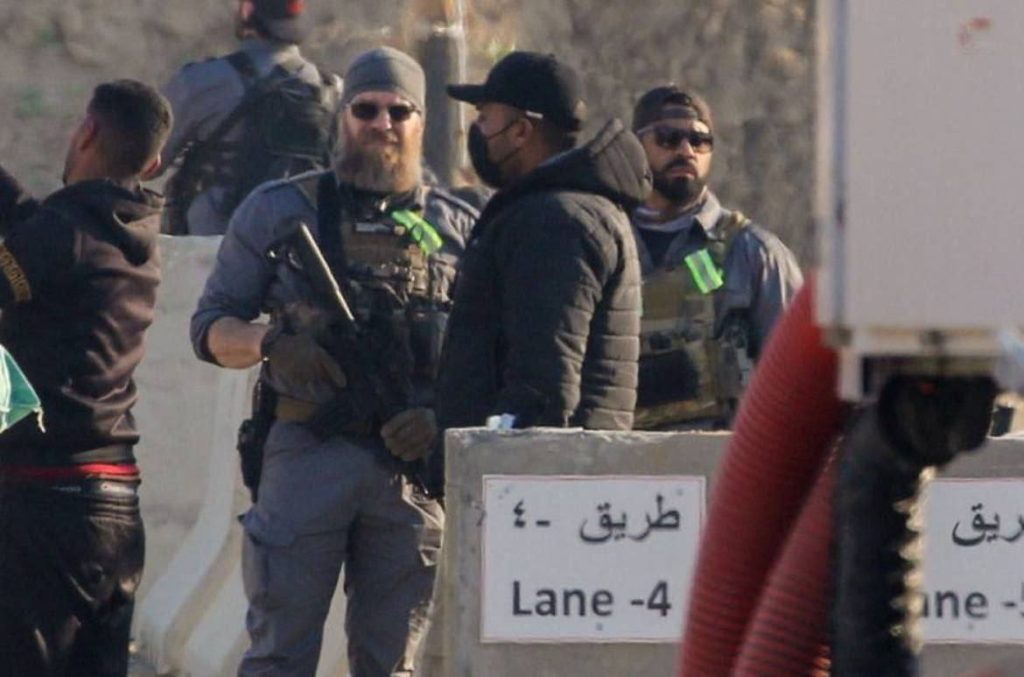
Representatives of the American private military company UG Solutions have been deployed at the checkpoint in the Netzarim Corridor, which divides the Gaza Strip into southern and northern parts.
While Israeli hostages are being released, and the ink barely dry on the ceasefire agreements, American security company UG Solutions, staffed by U.S. Special Forces veterans, is now manning checkpoints in the Gaza Strip.
A small U.S. security firm is hiring nearly 100 U.S. special forces veterans to help run a checkpoint in Gaza during the Israel-Hamas truce, according to a company spokesperson and a recruitment email seen by Reuters, introducing armed American contractors into the heart of one of the world’s most violent conflict zones, reported Reuters.
UG Solutions’ role in the cease-fire deal has been reported, but the email disclosed previously unknown details, including the aim of recruiting 96 veterans exclusively with U.S. special operations forces backgrounds, as well as the pay and the types of weapons they will carry.
Reuters reported on January 7 that Emirati officials had suggested the use of private contractors as part of a post-war peacekeeping force in Gaza, and that the idea had caused concern among Western nations.
These are private companies, and not active-duty American soldiers; but, the risk of this deployment pulling the United States further into another Middle Eastern war remains.
Robert F Kennedy Jr has accused Senator Bernie Sanders of taking millions from Big Pharma during a heated exchange at his Health and Human Services confirmation hearing.
The spat on Thursday started when RFK Jr promised to make America healthier but was challenged by Sanders on the need for universal healthcare.
RFK Jr accused the Vermont senator and other panel members of accepting millions from Big Pharma.
The 83-year-old lawmaker denied it, insisting his funds came from worker contributions, not pharmaceutical execs or PACs.
“I ran for president like you. I got millions and millions of contributions – they did not come from the executives … they came from workers,” Senator Sanders said.
RFK Jr. refuted, claiming Sanders was the largest receiver of pharma money during his 2020 campaign, with $US1.5 million.
Sanders argued his donations came from employees and their families, not corporate PACs, and highlighted his overall $US200 million in campaign donations.
Records show Sanders received the most from pharma-related donors in 2020 ($US1.4m) among sitting members of Congress, according to The Daily Mail.
Shock waves rolled through American Big Tech companies last Sunday, as it was reported that the Chinese AI program, DeepSeek, was performing better than any U.S. AI program, for a fraction of the cost.
Meta (Facebook) was one of the first American Big Tech companies to sound the alarm last Sunday night, as reported by The Information:
Meta Scrambles After Chinese AI Equals Its Own, Upending Silicon Valley
Artificial intelligence researchers at Meta Platforms have been in panic mode.
In recent days, leaders of some of the company’s AI teams openly worried that new conversational AI made by a Chinese hedge fund meant Meta was falling behind in the AI race.
Leaders including AI infrastructure director Mathew Oldham have told numerous colleagues they are concerned that the next version of Meta’s flagship AI, Llama, won’t perform as well as the Chinese AI, DeepSeek, according to two Meta employees with direct knowledge of efforts to catch up.
The Chinese fund shocked the AI industry in late December by releasing a version of DeepSeek that matched or outperformed models from Meta, OpenAI and Anthropic in completing various tasks, according to multiple interviews with six researchers at the U.S. AI companies, evaluations published by research firms, as well as anecdotal examples from customers of the DeepSeek models.
This month, Hangzhou-based High-Flyer Capital Management upped the ante by releasing another version of DeepSeek that may be on par with OpenAI’s o1 reasoning model, raising questions about whether some American AI firms have been operating inefficiently or spending too much capital for inferior results.
App developers can freely download DeepSeek or buy access to it through a cloud-based application programming interface. Some smaller app developers say they have switched to using DeepSeek because it’s so much less expensive than using OpenAI or Anthropic models.
Consumers can use DeepSeek through a chatbot mobile app that competes with OpenAI’s ChatGPT. On Sunday, the DeepSeek app had risen to second place, just behind ChatGPT, in the Apple App Store’s list of top free apps. (Full article – subscription needed.)
When the U.S. stock market opened the next morning on Monday this week, American Big Tech companies had lost over $1 TRILLION in value.
They gained back much of that this week, until today, Friday, Jan. 31st, when the market turned sharply down in afternoon trading over fears of Trump’s tariffs that are supposed to be announced tomorrow, Saturday Feb. 1st. (I will report on that story after I see what the actual tariffs will be.)
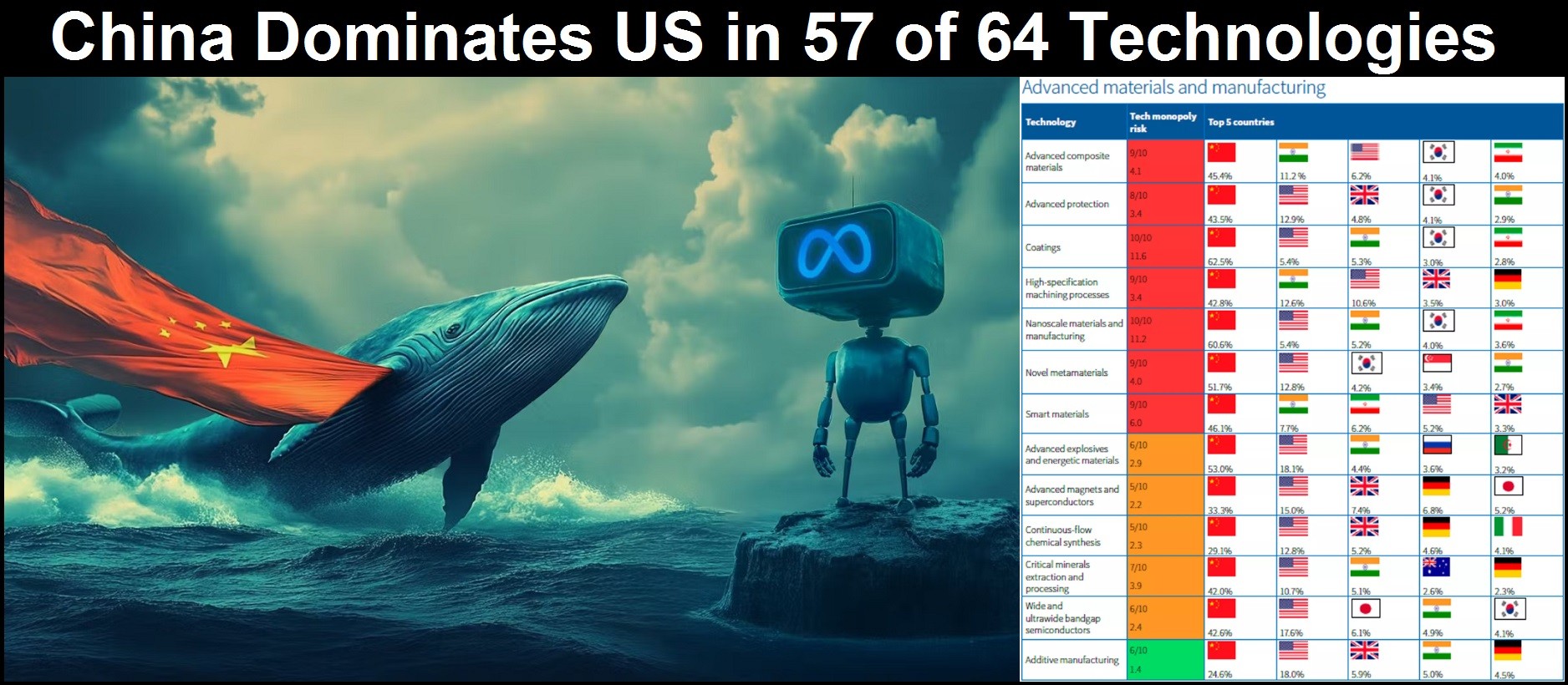
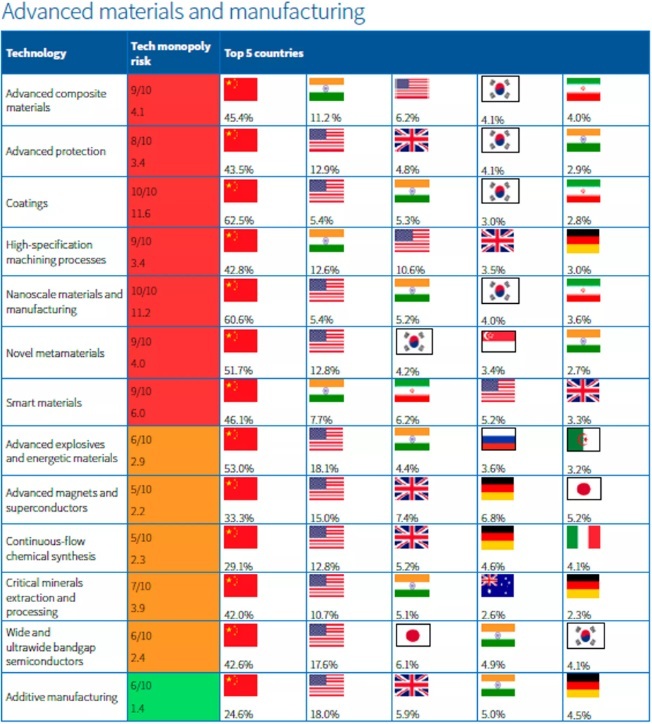
However, in an article published in the Russian media this week, it was reported that the U.S. has lost its edge over China in more than just AI models, and that the U.S. is now behind China in 57 of 64 critical technologies.
China Has Edge Over US on Much More Than AI Models
The shock release of a new Chinese AI known as DeepSeek that’s cheaper, faster and open source sent shockwaves across Silicon Valley, wiping $1 trln off tech stocks and prompting pundits to dub the development a “Sputnik moment” for the US.
But AI language models aren’t the only area where China is now comfortably in the lead.
A comprehensive, 20-year study released by the Australian Strategic Policy Institute in 2024 calculated that China dominates the US in 57 of 64 critical technologies, up from just three in 2007.
The US, which led in a whopping 60 sectors in 2007, now leads in just seven.
ASPI based its rankings on cumulative innovative and high-impact research published and patented by national universities, labs, companies and state agencies.
Where Does China Excel?
advanced integrated circuit design and fabrication
The day before Trump’s inauguration, on January 19th, a bipartisan law passed in Congress requiring TikTok to either sell the entire company to the U.S., or be banned, went into effect.
TikTok’s parent company, ByteDance, had appealed this law all the way up to the U.S. Supreme Court, which ruled 9-0 that the law had to be upheld, just days before the law was to take effect.
The Biden Administration made it clear that they would not enforce the ban, stating that it would be futile to do so just one day before Trump took office, and that this was Trump’s problem.
This was not good enough for ByteDance, however, as it wanted assurances that the U.S. Government would not enforce the ban.
This then provided the first showdown between China and the U.S. under the new Trump 2.0 presidency.
In the end, the U.S. and Trump backed down, assuring ByteDance that Trump would issue an executive order the next day on Trump’s first day in office, but only AFTER ByteDance began the process of shutting down the app first.
Trump issued the EO the next day, over-riding U.S. law like most of his EOs, and even defying the U.S. Supreme Court decision.
It was spun in the U.S. media and by Trump’s team as a “victory” for Trump, as the popular app came back online, making hundreds of millions of people in the U.S. very happy that the app was still available to them.
But this was NOT a victory for Trump. It was a victory for China.
Contrary to most everything you may have read in the U.S. media, at least outside of tech publications, the issue was NOT finding a U.S. buyer for TikTok. Oh no, there are a whole list of $billionaires and U.S. companies that would have LOVED to purchase China’s stake in ByteDance.
It was China who said no, and did not allow ByteDance to sell the Chinese-owned shares in ByteDance to American businesses.
Martin Peers, writing for The Information, reported this just two days before the ban was scheduled to take place:
While it’s too early to predict what’s going to happen with TikTok, it’s beginning to look like ByteDance has successfully called the U.S.’s bluff.
For months, ByteDance has refused to contemplate selling TikTok to avoid a ban. And now, days before the ban is due to take effect, politicians are caving in.
Most notably, Senate Democratic leader Chuck Schumer posted on Bluesky on Thursday that “more time is needed to find an American buyer for TikTok. We will continue working to keep TikTok alive.”
Yeah, right—that was the problem all along: ByteDance didn’t have enough time to find a buyer, despite passage of the ban law way back in last April.
Meanwhile, incoming President Donald Trump’s national security adviser to be, Mike Waltz, told Fox News on Thursday that “we will put measures in place to keep TikTok from going dark.”
In another Fox News interview, he said Trump would “create the space to put” a deal in place for TikTok.
Put aside for a moment the complications inherent in delaying the ban-or-sell law (presidential executive orders are frequently challenged in court, and not enforcing the law could have other issues, as Supreme Court Justice Brett Kavanaugh noted last Friday).
The problem with the sale isn’t a lack of buyers, as would-be buyer Bobby Kotick could attest.
There’s simply no sign ByteDance wants to sell, and there’s every reason to think China won’t let ByteDance sell TikTok, along with the algorithm that helps the app operate.
Forcing the issue with the ban might have changed minds at ByteDance.
Elizabeth Prelogar, the U.S. solicitor general, told the Supreme Court last week that the ban “might be just the jolt Congress expected the company would need to actually move forward” with a sale.
But by backing away from imposing the ban now, the U.S. will likely lose that leverage.
The question now is whether Trump can change the dynamic by throwing China a bone to get it to agree to TikTok’s sale. You have to wonder, though, how far he would be willing to go to keep TikTok alive. (Source.)
Shutting down TikTok would have lost $BILLIONS for the U.S. economy, NOT the economy of China, as China’s primary investment in TikTok is the value of the stock they own.
But TikTok generates between $15 – $16 billion in revenue in the U.S., and thousands of people, “content creators”, have become millionaires just from content published on TikTok that goes directly into the U.S. economy.
One company that would have probably gone bankrupt if TikTok had remained offline in the U.S., is Larry Ellison’s Oracle, which hosts TikTok’s servers.
Oracle warns that a TikTok ban would hurt business
A U.S. ban of TikTok might hurt Oracle’s business, the software company acknowledged in its annual report on Monday.
Oracle provides cloud infrastructure for TikTok, which has over 150 million users in the U.S.
“If we are unable to provide those services to TikTok, and if we cannot redeploy that capacity in a timely manner, our revenues and profits would be adversely impacted,”
Oracle said in its annual report for the fiscal year ended May 31. (Source.)
So ByteDance called the U.S.’s bluff, and began shutting down the app the day before Trump’s inauguration.
I can almost guarantee that Larry Ellison got on the phone with Trump when that happened, and it did not take long before Trump committed to a 75-day delay in enforcing the ban that is now U.S. Law and declared Constitutional by the U.S. Supreme Court in a 9-0 decision.
And Trump has now changed his tune regarding TikTok, and stated that he is negotiating a deal for a U.S. business (perhaps Oracle) to buy a 50% stake in the company, and everyone is hailing Trump as some kind of hero, while U.S. investments into ByteDance and TikTok have probably already been above 50% for quite some time now via hedge fund managers on Wall Street.
And of course, as I have previously reported, Larry Ellison is now jumping into the mRNA “vaccine” manufacturing to produce new “cancer vaccines” in Operation Warp Speed 2.0. See:
[…]
China has already surpassed Tesla in producing a better and less expensive electric vehicle that now outsells Teslas in China, and they have already surpassed Apple in producing a better and less expensive smartphone than Apple, which has decreased sales for both Tech companies in China and around the world, as was reflected in their annual reports earlier this week.
But all these technology companies had to do was sell more hopium about the future of AI to investors this week to keep their stock prices up, as Elon Musk, who has been promising fully autonomous self-driving vehicles for about a decade and a half now, has now promised to have them on the streets by June this year (2025).
And investors on Wall Street continue to keep believing him and all the other Big Tech American CEOs, as their stock values rose this week in spite of slumping sales, at least until today when Trump’s threats of tariffs cooled down the market some.
The only thing that has continued to bring huge earnings to Big Tech companies since the elections last November, has been the hopium drug everyone is on since Trump promised them the moon if he won the elections.
But this hopium drug high won’t last much longer, as this is perhaps the largest stock bubble of our time, maybe since the Great Depression.


 Photo Credit: The Cradle




 The Most Revolutionary Act