
VN Alexander
Now that tech billionaires Elon Musk and Peter Thiel (who backed J. D. Vance) have bought the free and fair election of President Donald Trump for us in the United States, we are in danger of becoming a more “efficient” AI-surveilled and -run country.
The experiment in democracy that is the United States has not been conducted properly ever since the commitment to privacy was abandoned with the rollout of the new communications system known as the Internet. Tech companies collect information on all our Internet activity. Allegedly, they use our data to better serve us—with targeted ads—assuming we are keen to trade our rights to privacy for the right to be advertised at more efficiently.
In truth, most citizens cherish the inalienable rights that are acknowledged in the U.S. Constitution. But those rights have been eroded away slowly and subtly over time. We need to backtrack a number of decades, find where we veered off the path, and get back on it.
The United State Postal Service (USPS) appears early and prominently in the Constitution as a means of secure communication necessary for a functioning democracy. Thus, the institution has been able withstand calls for its end in recent decades—much to the chagrin of real estate developers who would love to buy-up cheap some lovely old stone buildings. My beloved former post office in SoHo, Manhattan is now a fancy Apple store. In D.C., the Old Post Office and Clock Tower Building, owned by Trump at one point, is now the Waldorf Astoria. In this essay, I will argue that the trend of phasing out the USPS needs to be reversed.
When I ran for Congress in New York on the Libertarian line in 2020, I made decentralized government and expanding the role of the USPS central to my campaign. I realized that we can protect online privacy and free speech by recognizing the Internet as the new post road.
[…]
Why the Post Office is in the Constitution
Democracy in the U.S. has undergone an existential crisis, in large part due to the fact that no one has any privacy on the Internet and all of our scraped data is centrally controlled by a few actors. We are both censored and afraid to speak.
In the First Article, Section 8, Clause 7 of the U.S. Constitution, the new government is charged with the duty “to establish Post Offices and post Roads.” Clearly, the framers foresaw problems with a purely privately-owned and -run communication system and they created the USPS to protect our rights. It is a simple straight-forward argument that Clause 7 should be interpreted to keep up with technological advances.
[…]
If the Internet is reframed as the new post road, then our online communications would be protected by the Mail Theft Statute, according to which it is illegal to intercept any mail that is addressed to someone else. The law also prohibits the willful obstruction of mail delivery and tampering with or destroying someone else’s mail. These laws might be applied to packets of digital information that would travel along the lines of a USPS Internet cable line as easily as to packets of hard mail traveling along roads.
In the 1800s, when the means of communication began to change drastically with new technologies, Samuel Morse argued that, because telegraphs are “another mode of accomplishing the principal object for which the mail is established, to wit: the rapid and regular transmission of intelligence,” it was “most natural to connect a telegraphic system with the Post Office Department.” Telegraph technology was first deployed with U.S. government funding. Morse’s government allies tried to install telegraph wires underground and that was expensive. It took too long. Private industry swooped in, hung wires on trees and slapped up poles, and got the job done swiftly and cheaply.
Now, just about every street in America-the-beautiful is marred by ugly telephone and electrical poles.
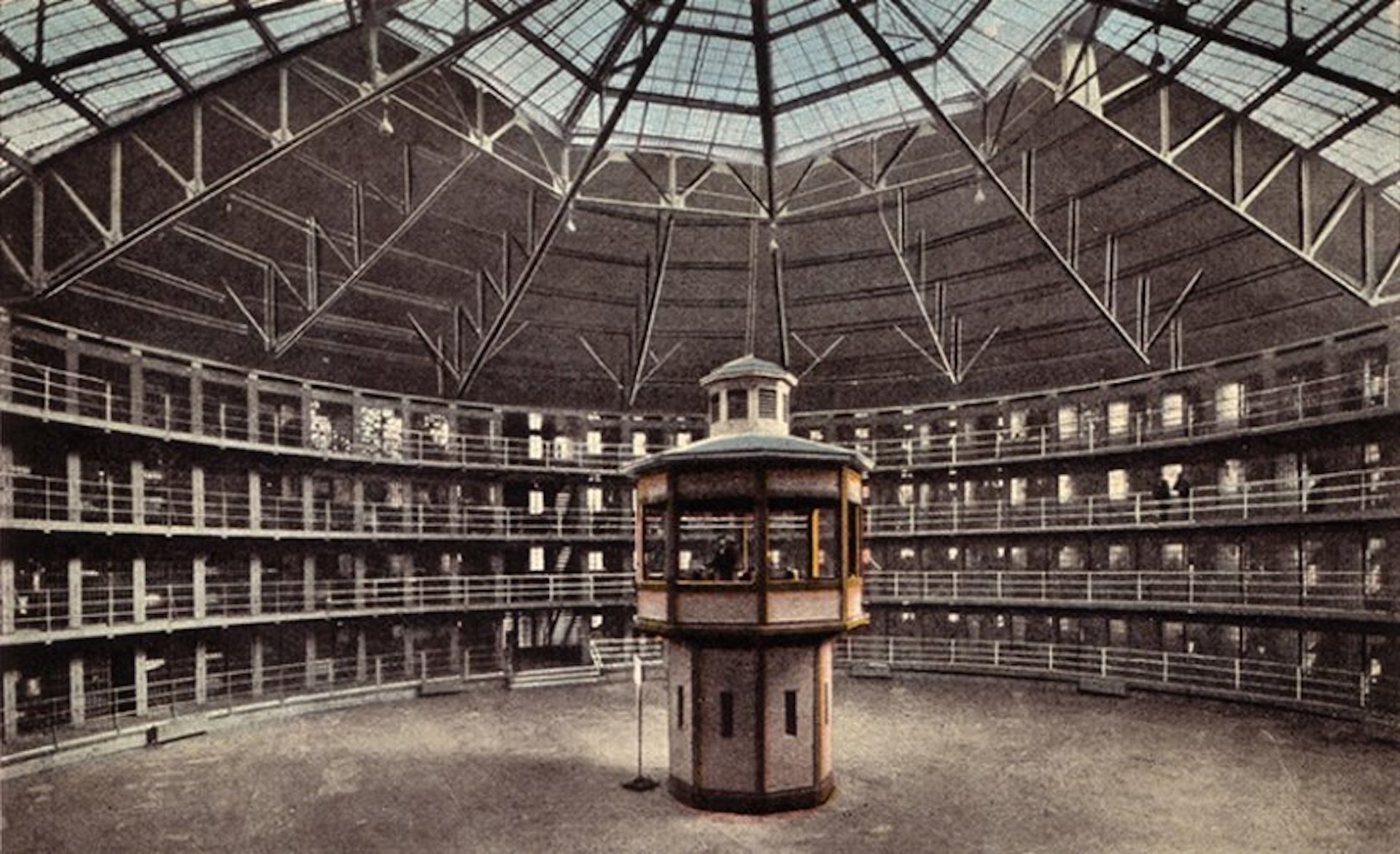
And the way for the construction of the panopticon was paved.
How the Panopticon Was Built
The Constitution says the federal government is not allowed to spy on us, which is why third-party private entities have slipped into this role on behalf of the government, according to a number of lawsuits that are making their ways through the courts, notably Kennedy v. Biden.
Since their inceptions, companies like Facebook and Google have received funding from the government to build and deploy the technology that sucks up our data. Allowing the awful chimera of public-private partnerships to control our communications has been our undoing. To note an important example, Palantir Technologies, founded by Peter Thiel, is a creation of the Central Intelligence Agency. Palantir works on top of the infrastructure created by Alphabet and Meta and gathers online activity in order to profile every U.S. citizen. Palantir, which appears to have replaced DARPA’s Total Information Awareness program, is justified as part of an unconstitutional precrime effort, as Whitney Webb has reported. Clearly, there needs to be a separation of business and state akin to the separation of church and state to stop the crony capitalism that is morphing into fascism. Although Peter Thiel has claimed to be a Libertarian, his Palantir is providing the tools for a totalitarian corporatist government.
Meanwhile also Thiel’s PayPal Mafia confederate, Elon Musk has been made rich with cheap Federal Reserve fiat money to back his various 4IR-adjacent ventures. With his Department of Defense contracts to built satellite surveillance infrastructure (Palantir is also a Starlink client), he is poised to some day put regional Internet Service Providers out of business, leaving the entire communications system under the control (ostensibly) of one billionaire.
But what can we do? Private companies aren’t mandated by law to respect our privacy or our right to free speech. So we put up with it and check off the “agree to terms” box. Then we feebly call on Congress to “regulate” the tech companies, which Congress will be pleased to do, asking the tech companies themselves to write the regulations, which will only end up codifying how often and in what way companies can “legally” steal our information and continue to censor us.
The real solution is already in the Constitution: we just have to enforce it.
Certain Products/Services Are Vulnerable to Monopolization
Anti-trust regulation is not the solution.
In August 2023, a U.S. District Court ruled that Google is in violation of anti-trust laws. Similarly, we can say Meta, the parent company that owns Facebook, Instagram, and WhatsAp, monopolizes a huge portion of private communications. If Google or its parent company Alphabet is broken up, spawning numerous baby googles, they will likely end up colluding with each other, regaining centralized control over our communications, while maintaining the illusion of competition. When Bell Atlantic, the northeast’s main telephone company, was trust-busted it wound up spawning Verizon, which simply gobbled up the smaller competitors. When anti-trust laws were used to break up Standard Oil, this resulted in enormous profits for the stockholders of the various new companies and did not reduce the power of the oil industry leaders.
As Henry George observed in the late 19th century, owning and controlling finite natural resources and public infrastructure is distinct from other kinds of business activities that can be well regulated by the free market. People have as much of a choice of Internet service, electricity service, and cell phone service providers as they have choice which roads, train tracks, bridges, and ports to use. Communication and transportation systems tend to be centralized by nature.
[…]
Funding and Control of Public Infrastructure
I like the US Postal System. It does not run on tax dollars. People who choose to use the Post Office pay for the service. If only all government services, like Social Security insurance, medicine, and primary education, operated on a voluntary pay-per-use basis.
As Stephen Zarlenga, founder of the American Monetary Institute, cogently argued, it is not necessary to collect taxes to fund public infrastructure. If US Treasury notes were created for the purpose of buying the cable Internet lines and maintenance equipment from the providers that currently hold the contracts with the local authorities, the new notes would be backed by the value of the infrastructure purchased. As citizens pay the USPS to use the Internet, the asset would be more economically advantageous than gold locked in a vault.
[…]
A government Internet service could be run as effectively as any private Internet service, if the employees were rewarded and punished based on the quality of their performances, as in any business. The Pendleton Act and the Civil Service Act of 1883 were passed to protect federal employees from being fired for partisan reasons. This has resulted in making it difficult to fire federal employees for any reason, allowing poor performers to stay on the job.
[…]
If the Internet cable lines could be maintained by the USPS, this would also solve the very serious problem of rural residents not having access to high-speed Internet because it is not profitable for private providers. The main point of having the USPS is making sure all citizens have equal access to a communication system.
The other point of the Post Office originally was to bring in revenue for the federal government. It’s rather quaint that the founders imagined the government would have to earn its keep rather steal money through taxation. Currently, U.S. cable companies enjoy a whopping 25% return on their investments, according to McKinsey Co. This includes delivery of TV, regulated by the Federal Communications Commission, which is also derelict in its duty to prevent centralization of powers. The free market hasn’t been able to work its magic on this monopolized industry, which has some of the highest rates and poorest cable/Internet service in the developed world.
Today, delivery companies like UPS and FedEx are quite free to compete against the Post Office to deliver mail. Any delivery vehicle can use the roads, which are built and maintained by governments, but they have to obey the road rules. On a USPS Internet, different private companies could provide search engines, email readers, platforms, apps, and websites, like the cars that drive on the roads. But the information that is carried by those companies would be protected by the Constitution.
No embedded social media buttons. No third-party cookies. The provider you use would not be allowed to scan your email, listen in on your private conversations, record any of your activity across various websites or profile you. Your anonymity could be preserved. Platforms couldn’t sell your data or use it to train AI (which isn’t the marvel it’s purported to be). They would not be able to keep people who are subscribed to your feed from seeing your posts. They wouldn’t be able to rig your search results. Search engines wouldn’t be able to scan comments you’ve made on social media or in comments sections where the “intended recipients” are specifically limited to that forum. You would be able to delete your content at any time, and a copy of it could not be saved in their permanent file on you.
[…]
The New Public Square
YouTube is the new public square, according to comedian Jimmy Dore, who is not alone in making this argument. Discussing Candace Owen’s removal from the platform for speaking out against Zionism, Dore went further, saying that YouTube should be nationalized. I disagree with the idea of nationalizing web platforms (not just the lines), even as I sympathize with the motivation.
I liken YouTube to a private car driving on a public road and think it should be treated as such. But it is true that tax-payers have subsidized some of those Big Tech vehicles to such an extent that the public might have some claim to partial ownership. According to Kit Klarenberg, Google wouldn’t exist without funding from the CIA and the NSA. Facebook had similar support, reports Whitney Webb.
[…]
Via https://off-guardian.org/2024/12/19/how-do-we-escape-the-panopticon/

