
Episode 21 Religious Struggles in an Age of Faith
The Middle Ages Around the World
Dr Joyce E Salisbury
Film Review
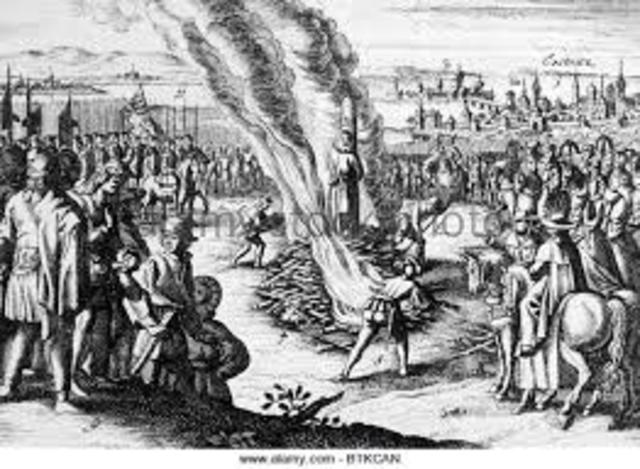
In 1275, Pope Innocent III called the Lateran Council, the official founders of the Inquisition. The failure of the Catholic Church and religious belief to curb an increase in hunger and disease had led to an increase in mysticism, in which people reached out to God directly rather than going through a priest. The Inquisition’s response was to label mystics heretics and burn them at the stake.
The English scholastic John Wycliffe (1328-1384) was a groundbreaking Bible translator at a time when the church only allowed priests to read the Bible in Latin or Greek and interpret it for their parishioners. Wycliffe claimed there was no Biblical basis for the Pope’s earthly authority and called on popes to renounce their earthy power and leave governance to kings.
This mistrust of papal authority eventually led French king Philip IV to challenge the Pope’s right to tax church land and prosecute French clergy charged with crimes. Following Pope Benedict XI’s death in 1305, Philip persuaded the college of cardinals to appoint a French archbishop pope. Clement V and the popes who succeeded him ruled from Avignon (France) for 72 years.
The European plague epidemic beginning in 1346 left the Catholic church in relative turmoil. A shortage of priests to perform last rights, combined with a big increase in deaths, led many Catholics to be buried in mass graves in unconsecrated ground. It also resulted in mass pogroms against Jews (accused of causing plague by poisoning wells), especially in Germany. Feudal lords, who were often in debt to Jewish moneylenders, encouraged the pogroms.
In 1375 a nun who saw visions, Catherine of Siena, wrote the French pope persuading him to return to Rome. When he died in 1378, there were two popes, one in Rome and one in Avignon.
In 1409, the Council of Pisa deposed both popes and appointed a new one in Rome. When the first two popes refused to step down, there were three popes. in 1418, the Council of Constance in Germany deposed all three popes and elected Martin V, the first Renaissance Pope.
Film can be viewed free with a library card on Kanopy.
https://www.kanopy.com/en/pukeariki/watch/video/13172786/13172832


Then I wonder where Martin Luther fit into this pucture, a little later. I remember he posted his famous 95 theses on the church door at Nantes of Germany in 1518 or so and inspired the Lutheran movement in upper latitudes.
LikeLike
Dr Salisbury draws a clear line between medieval religious struggles and those of the Renaissance, which she asserts started in 1453 (with the capture of Constantinople by the Turks).
LikeLike