
Episode 12 Mongol Conquests from China to Russia
The Middle Ages Around the World
Dr Joyce E Salisbury
Film Review
Dr Salisbury starts her lecture with a brief history of Temugen (the future Genghis Khan), whose family was expelled by their tribe following his father’s assassination (when he was 8). Miraculously, owing to their mother’s amazing hunting skills and ingenuity, they survived. Determined to seek revenge for his father’s assassination, Temugen had already amassed a major army by the time he was 18.
By the time Genghis Khan died in 1227, the Mongols controlled an immense swath of land from the Caspian Sea to the Pacific.
His successors all followed the Genghis Khan’s example in appointing women to manage their fortunes and empire while they were away at war. The Mongols also enacted firm laws against trading or raping women or treating them as spoils of war. Salisbury also credits their religious tolerance (in contrast to Europe’s Catholic intolerance) as a major factor in their successful conquest of most of Asia and much of eastern Europe.
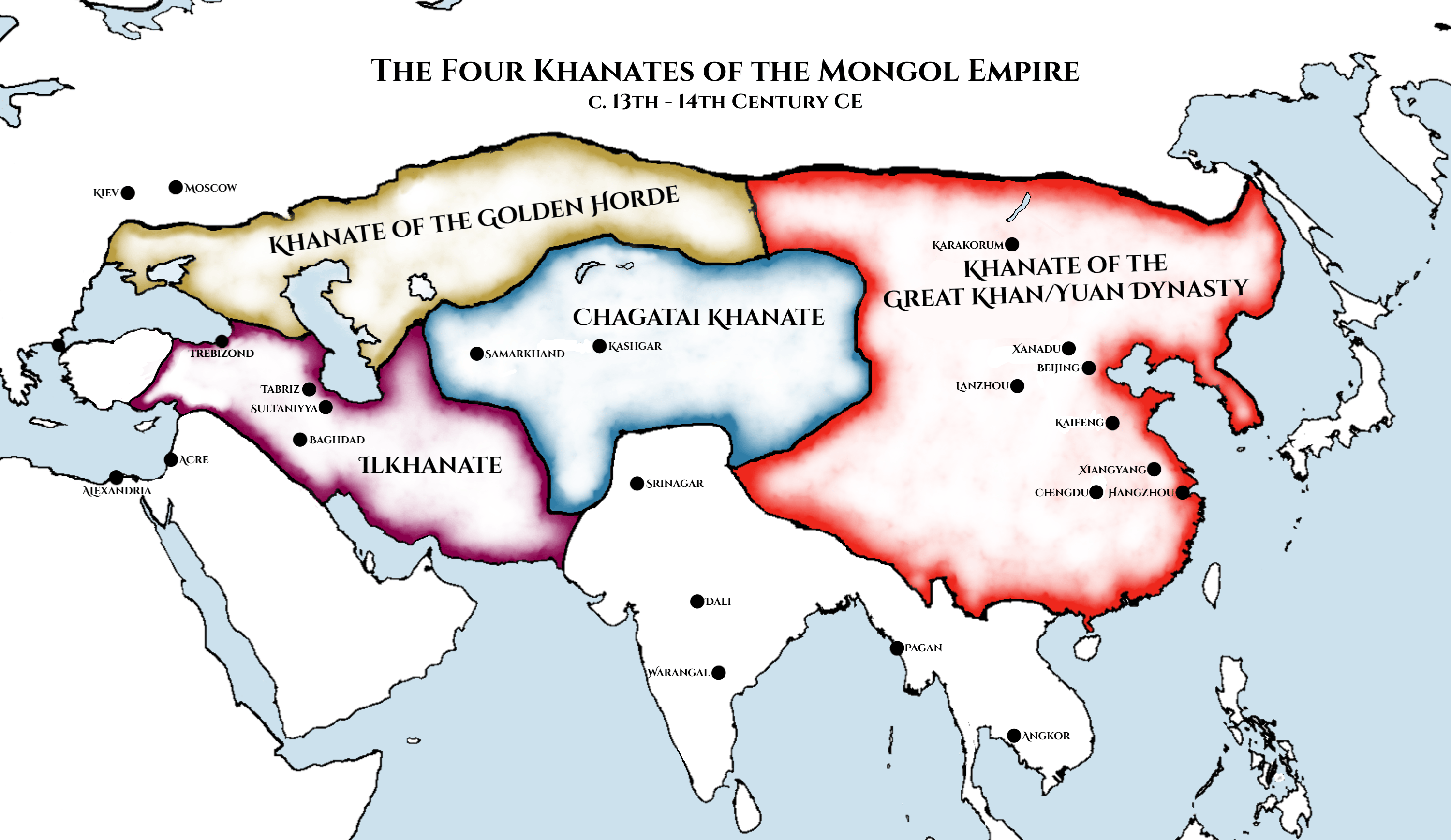
Under Genghis Khan’s successors, the Mongol empire was split into four khanates: the Chagatai Khanate, the Golden Horde, the Ilkhanate and the Yuan Empire (China).
Chagatai Khanate
Chagatai (second son of Genghis Khan) and his successors focused mainly on repeated invasions of northern India and the eventual formation of the Delhi Sultanate. His son Tolui left his wife Sorghaghtani to rule in his place while he drank and went to war. She continued to rule the Chatagai Khanate for another 20 years following his death.
Golden Horde
The Mongols first crossed the Caucasus mountains onto the Russian steppes four years before the death of Genghis Khan (in 1227). Under Ogedei’s rule, 130,000 Mongol warriors pushed further west and in 1238-1239 laid waste to every major Russian. Moscow’s Grand Prince Ivan I (1328-40) entered into a trade alliance with the Mongols appointing him to collect (and receive a kickback) the tribute the other Russian princes owed them. This would greatly expand the wealth and prominence of Moscow. Under Batu (grandson of Genghis Khan), most Golden Horde leaders converted to Islam.
Ilkhanate
Encompassing the former Persian empire and the Abbasid Caliphate, most Ilkhanate Mongols converted to Islam. During the Mongol sack of Baghdad in 1258, the Mongols allowed the Muslim scholars associated with the Wisdom Schools to leave the city before decimating it. Following the Mongol conquest of Baghdad, most Ilkhanate Mongols convert to Islam and Persian historians began writing in Persian rather than Arabic.
Yuan Dynasty
As Great Khan, Ogedei dispatched Kublai (son of Toluti and Sorghaghtani) to make war against the Song empire in southern China. He employed gunpowder he obtained from Jin engineers (Genghis Khan had conquered the Jin empire in 1211) and siege engines provided by both Jin and Persian engineers. On becoming emperor of the Yuan dynasty, Kublai allowed the Han gentry to keep their estates, converted to Buddhism and married a Christian woman (like his mother). While Mongol women who settled in in China refused to bind their feet, Han women continued to do so.
Kublai’s main achievements were stockpiling grain to avert a great famine and expanding the Great Canal to facilitate shipping grain, mainly grown in southern China, to the north The Yuan Dynasty played a critical role in enuring security for Silk Road travel, greatly increasing prosperity in the Middle East, Central and South East Asia, as well as religious ideas and scientific transfer. Under their rule, the Chinese collaborated with Muslim scholars on advancing mathematics, geography and map making.
Prior to his death in 1294, Kublai nearly bankrupted the empire with two failed invasions of Japan. The pain of his tax increases fell heaviest on Chinese peasants, leading to extreme civil unrest and the eventual overthrow of the Yuan dynasty in 1368.
Film can be viewed free with a library card on Kanopy.
https://www.kanopy.com/en/pukeariki/watch/video/13172786/13172817
 The Most Revolutionary Act