
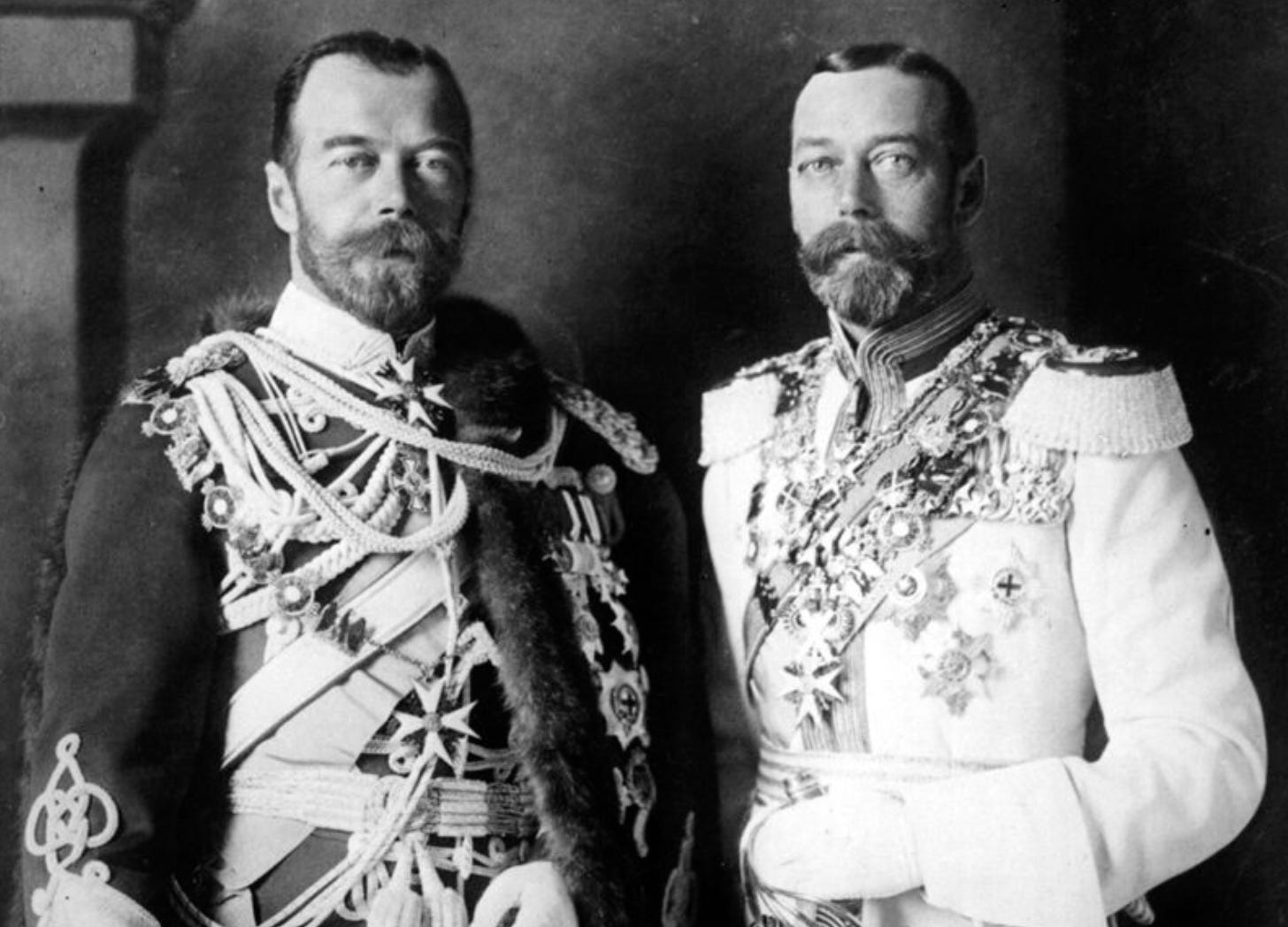
Greedy for power and Persian oil fields, King George V of England (right) plotted the overthrow of his cousin Tsar Nicholas II (left).
By Richard Poe
SUMMARY: Was the Bolshevik Revolution fake? Was Lenin’s 1917 coup little more than a “color revolution,” a staged event, orchestrated by foreign intelligence services? Strong evidence suggests that it was. In the 1920s, prominent Russian exiles accused Great Britain of plotting the Tsar’s downfall. George Buchanan, British ambassador to Russia from 1910 to 1918, devoted 16 pages of his 1923 memoir to denying this charge. But the charge was true. The British secret services had destabilized Russia, just as they had previously destabilized France in 1789. They had infiltrated and weaponized the Bolsheviks, just as they had previously weaponized the Jacobin movement against Louis XVI. While the Tsar was technically Britain’s ally in World War I, British elites feared that a victorious Russia would threaten Britain’s global dominance. Bolshevism provided the solution, demolishing the Tsar’s once-mighty empire, and plunging Russia into chaos and civil war. — RICHARD POE
“THIS MOVEMENT among the Jews is not new,” wrote Winston Churchill. “From the days of … Karl Marx, and down to Trotsky… this worldwide conspiracy for the overthrow of civilisation… has been steadily growing.”1
Churchill was talking about communism.
It was February 8, 1920. As Churchill wrote, all eyes were on Russia, where Bolsheviks and anti-Bolsheviks— “Reds” and “Whites”—were battling for control of the country.
[…]
Churchill blamed it all on a “worldwide conspiracy” of Jews.
[…]
Churchill declared that the subversive role of “Jewish revolutionaries… in proportion to their number in the population” was “astonishing,” not only in Russia, but throughout Europe.
In April, 1919, the British Foreign Office issued a report called the “Russia No. 1 White Paper: A Collection of Reports on Bolshevism in Russia,” also known as the “Bolshevik Atrocity Bluebook.” It identified Jews as the driving force behind the Tsar’s murder and the Bolshevik Revolution.3
The British press followed up with a coordinated, anti-Jewish propaganda campaign, largely based on the Protocols of the Elders of Zion, a document of dubious origin purporting to reveal a Jewish plot to enslave the world.
“Embarrassing Breadcrumb Trail”
The first-ever British edition of The Protocols appeared in February, 1920, under the title The Jewish Peril. Here too, the hand of the British government was evident.
The people involved in producing the book left an “embarrassing breadcrumb trail to the door of the British Establishment,” notes Alan Sarjeant in his 2021 study The Protocols Matrix.4 Sarjeant concludes that the Jewish Peril was “part of a sophisticated propaganda offensive conceived and financed at the highest levels” of British power.5
The translators of The Jewish Peril, George Shanks and Edward G.G. Burdon, were military men with ties to Britain’s war propaganda apparatus.6
Its publisher, Eyre & Spottiswoode, was a respected government press entrusted with publishing the King James Bible, the Anglican Prayer Book, and other works owned by the Crown.7
The Jewish Peril’s first press run of 30,000 copies exceeded that of F. Scott Fitzgerald’s The Great Gatsby in 1925.8
According to Sarjeant, the promotional campaign for The Jewish Peril “was so professionally devised that practically all of Britain’s national and regional newspapers had received a copy for review by the first week of February 1920” —that is, just in time for the splash created by Churchill’s February 8 article.9
Blame-shifting
Why did the British Establishment turn so suddenly on the Jews?
I believe this was done to provide a scapegoat—a Jewish scapegoat—to deflect from British complicity in the Russian Revolution.
To be clear, Churchill was not wrong when he said Jews were disproportionately represented in the Bolshevik movement. They were. But that was only half the story.12
The other half is that the Bolsheviks themselves were pawns in a larger game. A British game.
And Churchill knew that.
MI6 came to Trotsky’s rescue, ordering his release from a Canadian internment camp on April 29, 1917. Trotsky thereupon embarked for Russia and joined the Revolution.
The Bolsheviks Had Help
The reality is that the Bolsheviks had no power to overthrow the Russian government nor to defeat the Russian military. Without British help, they could have done neither.
Of all the dirty secrets of the Russian Revolution, this is the dirtiest.
Our story begins with Leon Trotsky.
It was Trotsky who directed the Bolshevik coup of November 7, 1917, and Trotsky who led the Red Army to victory in the Russian Civil War.
Without Trotsky, there would have been no Soviet Union.
But Trotsky did not accomplish these feats on his own. He had help from the British government.
Trotsky’s longstanding ties to British intelligence have never been adequately explained.
Trotsky and British Intelligence
When the Tsar was overthrown on March 15, 1917, Trotsky was working as a journalist in New York City. He set sail for Russia, but British authorities arrested him when his ship stopped in Halifax, Nova Scotia.
The British held Trotsky for a month in a Canadian internment camp.
For reasons unknown, Britain’s Secret Intelligence Service (SIS) came to Trotsky’s rescue, ordering his release. The order came from William Wiseman, US station chief for Britain’s foreign intelligence division, now known as MI6.13
Following Trotsky’s release on April 29, 1917, he embarked for Russia and joined the Revolution. The rest is history.14
In Russia, British handlers kept Trotsky close. One of his handlers was Clare Sheridan, who happened to be Winston Churchill’s first cousin. She was a sculptress who claimed to be a Bolshevik sympathizer. Sheridan sculpted Trotsky’s portrait, and was rumored to be his lover.15 Reliable sources have identified Sheridan as a British spy.16
Trotsky was banished by Stalin in 1929, spending the rest of his life on the run.
During the Moscow Treason Trials of 1938, Trotsky was convicted, in absentia, of working for the British SIS. The star witness against him was Soviet diplomat Christian Rakovsky, who testified that British intelligence had blackmailed him in London in 1924, using a forged letter, all allegedly with Trotsky’s knowledge and approval.17
“I went to Moscow and talked to Trotsky [afterwards],” Rakovsky testified. “Trotsky said that the forged letter was only an excuse. He agreed that we were to work with the British Intelligence.”
Princess Olga Paley, widow of the Tsar’s uncle Grand Duke Paul, accused Britain of complicity in the Revolution. In 1922, she wrote: “The English Embassy had become a hotbed of propaganda. The Liberals met there constantly. It was at the English Embassy that it was decided to abandon the legal ways and embark on the path of the Revolution.”
[…]
If Rakovsky’s charge is true, then Trotsky was already working for British intelligence as early as 1924. In that case, his relationship with the British was likely established some time earlier, perhaps as early as 1917, when MI6 mysteriously freed him from a Canadian internment camp.
The evidence suggests that Trotsky was already under SIS control in 1920, when Churchill publicly denounced him as a scheming “International Jew.”
[…]
British Betrayal
Sir George Buchanan, who was British ambassador to Russia from 1910 to 1918, would devote 16 pages of his 1923 memoir to denying that Great Britain had orchestrated the Russian Revolution.18
Why did he need to deny this?
The reason is that prominent Russian exiles were accusing Britain of complicity in the Revolution, among them Princess Olga Paley (pronounced pah-LAY), widow of the Tsar’s uncle Grand Duke Paul.
Paul was the brother of Alexander III, who was Nicholas II’s father.
In the June 1, 1922 Revue de Paris, Princess Paley wrote: “The English Embassy, on orders from [Prime Minister] Lloyd George, had become a hotbed of propaganda. The Liberals, Prince Lvoff, Miliukoff, Rodzianko, Maklakoff, Guchkoff, etc., met there constantly. It was at the English Embassy that it was decided to abandon the legal ways and embark on the path of the Revolution.”19
The Princess likewise accused French ambassador Maurice Paléologue of assisting Buchanan in these intrigues, albeit reluctantly. “His position at this period was very delicate,” she wrote. “He [Paléologue] was getting from Paris the most definite orders to support in everything the policy of his English colleague, and yet he realized that this policy was contrary to the interests of France.”20
Russian liberals like the Grand Duke Paul had been led to believe that Britain would help them establish an enlightened constitutional monarchy, run on democratic principles. Instead, Russia got five years of civil war, followed by 70 years of communist rule.
[…]
Knowledge of British Plans
When Princess Paley identified the British Embassy as the nerve center of the Revolution, she was not just passing along gossip. She had inside knowledge of British operations in Petrograd.
Strange Alliance
“A strange ally, Great Britain,” the Princess mused in her 1924 autobiography Memories of Russia 1916-1919.25
In her book, the Princess wonders how Russians could have been fooled into trusting the British, “for, in the history of Russia,” she writes, “the animosity of England traces a red line across three centuries.”
She was right. The Princess correctly notes that Britain struggled for 300 years to stop Russia from attaining what she calls a “free sea” (by which she meant access to warm-water ports). Much blood had been spilled over this.
Bolshevism, the Princess suggests, was just one more weapon deployed by the British to keep Russia weak.
“Is it not to Great Britain that we owe the continuation of the Russian agony?” she asked. “Great Britain supports wittingly… the Government of the Soviets, so as not to allow the real Russia, the National Russia, to come to life again and raise itself up.”
[…]
Russian Defeat—a British War Goal?
In her memoir, Princess Paley states that British Prime Minister Lloyd George, “on hearing of the fall of Tsarism in Russia, rubbed his hands together, saying, ‘One of England’s war-aims has been attained!’”28their Russian ally, from the very outset of the war.conquered Russia 300 years earlier.
[…]
Trotsky Assumes Command
At this point, the strange figure of Leon Trotsky re-emerges.
Trotsky had been arrested by Kerensky’s Provisional Government in the aftermath of the “July Days” mutiny.
However, on September 17—forty days after Kornilov’s attempted coup—Kerensky decided to release Trotsky from prison. For the second time in five months, Trotsky had been set free just when the Revolution needed him.144
Upon his release, Trotsky took charge of the Bolshevik resistance.
He was elected Chairman of the Petrograd Soviet on October 8. On October 10, Trotsky led the Soviet in a vote for armed revolution.
It was therefore no surprise when, on the night of November 6-7, 1917, Trotsky made his move, leading the Bolsheviks in a successful coup.
Stalin acknowledged Trotsky’s leading role in the coup, in a Pravda article of November 6, 1918. Stalin wrote:
“All practical work in connection with the organization of the uprising was done under the immediate direction of comrade Trotsky, the president of the Petrograd Soviet. It can be stated with certainty that the party is indebted primarily and principally to comrade Trotsky for the rapid going over of the garrison to the side of the Soviet and the efficient manner in which the work of the Military-Revolutionary Committee was organized …”145
On March 14, 1918, Trotsky was appointed People’s Commissar of Army and Navy Affairs, making him, effectively, commander-in-chief of the Red Army and Red Fleet.146
What happened next is one of history’s great riddles—the inscrutable mystery of the Russian Civil War.
On the night of November 6-7, 1917, the Bolsheviks had seized control of a handful of cities. But the vast Russian Empire remained unconquered. It took five years and more than 10 million dead for the Red Army to subdue the rest of the country.147
At the height of the Russian Civil War, in December 1918, more than 300,000 White Russian troops, supported by over 180,000 Allied troops, faced a Red Army of about 300,000. The Reds were surrounded, boxed into a small area around Moscow and Petrograd, and cut off from supply lines. “On every front, the Bolsheviks were being pressed back towards Moscow,” writes Martin Gilbert in World in Torment (1975).148
How did the Bolsheviks manage to win?
[…]
When Princess Paley wrote her 1924 memoir, the fighting had not yet stopped in Russia. The last scattered bands of anti-Bolshevik guerrillas were still being hunted down in Central Asia.
The Princess wrote, “Is it not to Great Britain that we owe the continuation of the Russian agony? Great Britain supports wittingly… the Government of the Soviets, so as not to allow the real Russia, the National Russia, to come to life again and raise itself up.”149
Was the Princess right? Did the Red Army and the “Government of the Soviets” prevail due to British support?
Considerable evidence suggests that they did.
Opposition to Russian Nationalists
Prime Minister David Lloyd George never wanted to fight the Bolsheviks, according to British historian Martin Gilbert in his 1975 book, World in Torment: Winston S. Churchill 1917-1922.
In Lloyd George’s view, Britain’s real fight in Russia was against the nationalists and monarchists.
There were practical reasons for this policy.
In 1917, high-ranking British statesmen were pursuing plans to carve up the Russian Empire into a patchwork of buffer states and to bring the oil-rich Caucasus under British control.
[…]
The Myth of Allied Intervention
During the Russian Civil War, more than 200,000 foreign troops were deployed on the soil of the former Russian Empire. These included nearly 60,000 British troops, 70,000 Japanese, and smaller numbers of Americans, French, Czechs, and others.153
Soviet propaganda promoted the myth for 70 years that the “imperialist” nations of the world had ganged up on Russia to crush the Bolshevik Revolution. But that was never their mission. Had the Allies wished to drive out the Bolsheviks, they could have done so easily.
The British sent troops to Russia—and persuaded other countries to do so—not to fight Bolshevism, but to pursue other objectives.
Breaking Up the Russian Empire
As mentioned above, Britain’s true objective was to carve up the Russian Empire, breaking off border regions into independent “buffer states.”
This was the principal reason for the Allied intervention.
Separatism weakened Russia and made it easier for Britain to exert control over the region. For that reason, the Allies pursued a consistent policy of helping separatist forces in former Russian provinces.
These efforts proved successful in Finland, Poland, and the Baltics, all of which achieved independence. However, the strategy met with only temporary success in Ukraine, the Caucasus, and other regions, which were soon reconquered by the Red Army.154
In the end, the Allies did very little fighting in Russia. When they did fight, it was not always against the Bolsheviks. They helped the White armies only in situations where White operations happened to coincide with other Allied objectives. On other occasions, the Allies helped the Reds.
It is a little-known fact that the first Allied troops to land in Russia were a contingent of British Royal Marines who ended up fighting alongside the Red Guards to defeat a force of anti-Bolshevik Finns.
Trotsky himself had requested the British intervention.
[…]
Trotsky’s Telegram
Murmansk was a vital Arctic seaport which had been Russia’s lifeline throughout World War I.
On March 1, 1918, Trotsky sent a telegram to the commander of the Murmansk Soviet, Alexei Mikhailovich Yuryev, stating (falsely) that peace talks with the Germans had “apparently broken off” and ordering him to “protect the Murmansk Railway” and “accept any and all assistance from the Allied missions.”155
[…]
Trotsky’s telegram to Yuryev would later be used against him as evidence in his 1937 treason trial.159
The astonishing fact is that Trotsky singlehandedly legitimized Allied intervention in Russia, arranging for the British to receive a formal invitation from a Bolshevik official, Yuryev.
The first British troops landed at Murmansk on March 6, 1918.160
They fought their first battle on May 2, fighting for the Bolsheviks, not against them.
Finnish White Guards had captured the nearby town of Pechenga. It was feared they might be acting as a vanguard for the Germans.
From May 2-10, the Royal Marines fought shoulder-to-shoulder with the Red Guards, driving the Finns out of Pechenga.161
[…]
 The Most Revolutionary Act
I know history is written by the ‘winners,’ but, as a Brit, I live and learn!
Thanks for posting.
LikeLiked by 1 person
Indeed. It’s always troubled me that Trotsky was an immoral womanizer who somehow accumulated the wealth to live an affluent lifestyle in exile in Mexico. Now it finally makes sense.
LikeLike