
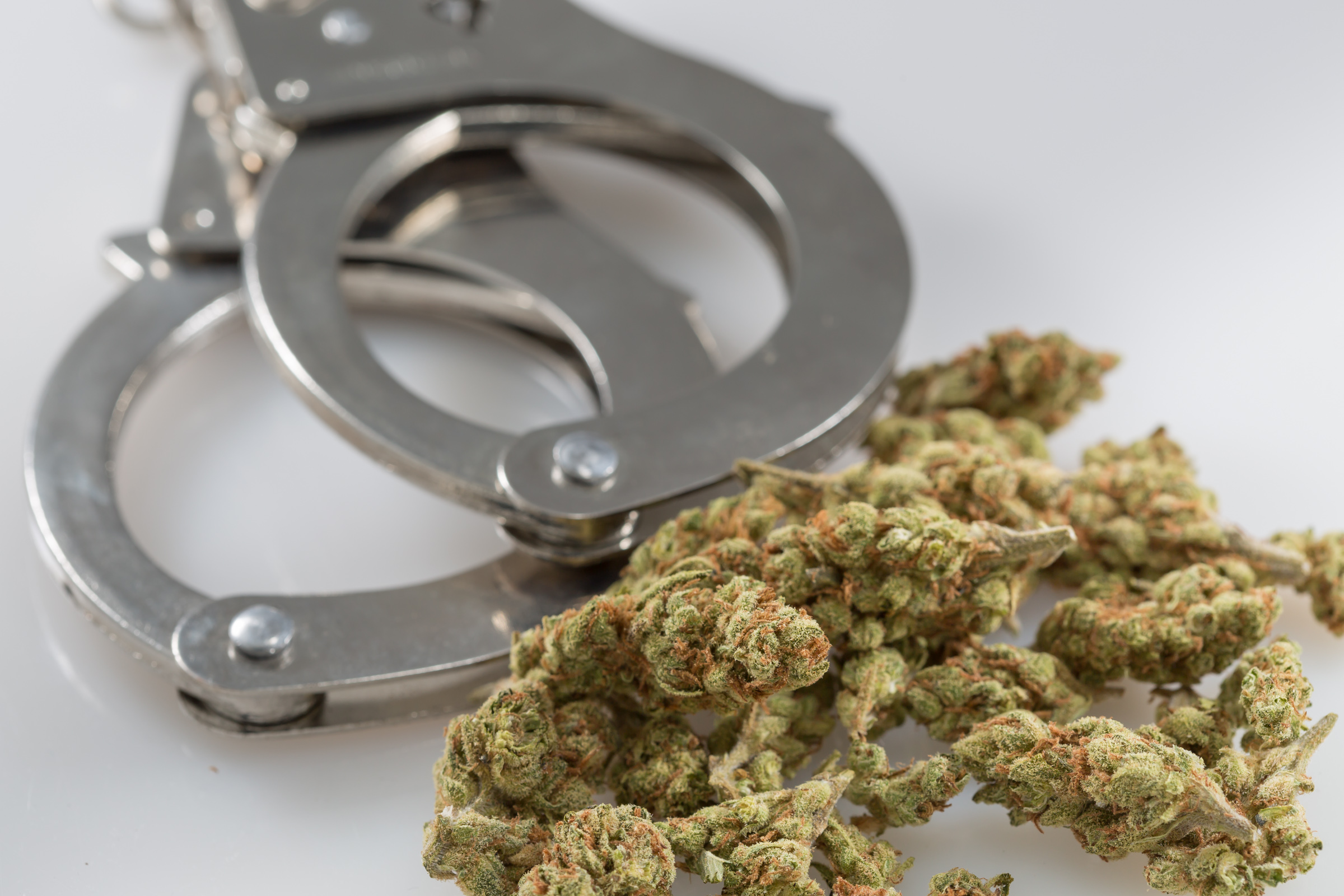
Even as more states continue to legalize marijuana, new FBI data shows that at least 200,000 people were arrested over cannabis in 2023—and simple possession again made up the vast majority of those cases. Those figures are likely understated, however, given inconsistencies in the federal data and ongoing questions about the agency’s methodology.
At a time when the public and both major party presidential nominees find themselves aligned in their opposition to criminalizing people over low-level marijuana offenses, advocates say the federal data released on Monday further underscores the need to urgently change course.
The 2023 data, according to FBI, comes from more than 14 million criminal offenses reported to the Uniform Crime Reporting (UCR) Program, which is submitted by over 16,000 state, local and tribal agencies whose jurisdictions comprise more than 94 percent of the country’s population. That’s slightly more data coverage compared to the FBI’s crime report from the prior year.
Because not all agencies provide data for the complete reporting periods, FBI has explained that the bureau calculates estimated crime numbers, essentially extrapolating “by following a standard estimation procedure using the data provided.” In terms of total reported arrests for “drug/narcotic,” for example, FBI said there were 879,118 arrests.
Those numbers, however, aren’t consistent throughout the FBI report. In a section on arrests by region, FBI said there were 746,292 total drug arrests in 2023. In a separate analysis of historical trends, meanwhile, FBI reported just 635,066 drug arrests last year. Another section on racial breakdowns says there were 726,623 drug abuse violations.
The agency further reported that there were 1,544,907 crimes involving a person’s suspected use of drugs other than alcohol in 2023.
Using the agency’s estimated numbers, the 870,874 arrests for drug abuse violations account for about 12 percent of the approximately 7.5 million estimated arrests nationwide in 2023, according to one section of the report.
Of all total drug-related arrests in the new report, FBI said, 23 percent were for marijuana possession—more than for possession of any other listed substance. Arrests for selling or manufacturing cannabis, meanwhile, made up 2 percent of total drug arrests.
According to the data, 200,306 estimated arrests occurred for marijuana possession and another 16,844 estimated arrests were for cannabis sales or manufacturing in 2023. The numbers are down from 2022, but advocates say the continued criminalization at the current scale remains unacceptable, especially in the face of growing public consensus in favor of legalization.
At the same time, frustrations over FBI’s inconsistent data reporting on cannabis and other drug arrest trends have persisted.
In terms of controlled substances seized in 2023, there were 417,661 marijuana seizures out of 1,058,537 total drug seizures, representing about 39 percent of actions.
One part of the FBI report discusses trends over time, showing that there were 1,113,032 drug offenses charged in 2014 and 635,066 drug offenses charged in 2023—a reduction of about 43 percent, though it’s not clear how much of the change is due to the agency’s shifting methodology for reporting arrests and how much is due to actual changes in enforcement practices and state drug laws over the past decade.
Arrests of Black people made up about 29 percent of drug arrests in 2023, FBI reported—a disproportionate number given that, according to the U.S. Census Bureau, about 13.6 percent of Americans are Black. Meanwhile, nearly 69 percent of drug arrests were of white people, 1.6 percent were people who identified as American Indian or Alaska Native, about 1.1 percent were Asian American and about 0.2 percent were Native Hawaiian or other Pacific Islander.
“While there has clearly been a longterm decline in the total number of marijuana-related arrests nationwide, it is discouraging that there still remains significant gaps in the available information,” NORML Deputy Director Paul Armentano said. “At a time when voters and their elected officials nationwide are re-evaluating state and federal marijuana policies, it is inconceivable that government agencies are unable to produce more explicit data on the estimated costs and scope of marijuana prohibition in America.”
“Nonetheless, even from this incomplete data set, it remains clear that marijuana-related prosecutions remain a primary driver of drug war enforcement in the United States,” he said. “Hundreds of thousands of Americans continue to be arrested annually for low-level cannabis-related violations even though a majority of voters no longer believe that the responsible use of marijuana by adults should be a crime.”
FBI’s arrest data is widely relied on by lawmakers, researchers and media to understand and contextualize law enforcement trends. Any inconsistencies influence not just the public’s understanding of crime and law enforcement, but also potentially how policy is crafted and implemented.
Apparent errors in FBI marijuana were pointed out to the bureau in May 2022, when a longtime drug reformer and former congressional staffer, Eric Sterling, claimed to have discovered that a Maryland police department was reporting cannabis possession citations issued under the state’s decriminalization law at the time as arrests as part of a data-sharing partnership with FBI.
Since other state and local law enforcement agencies appear to not be reporting cannabis citations as arrests, Sterling reasoned, the inconsistent practice could significantly alter FBI’s annual reports—making it harder to draw reasonable policy conclusions from the data.
Last year—about 14 months after Sterling sent the inquiry—the office finally replied. Rather than address the apparent problem, however, the Department of Justice’s (DOJ) Office of the Inspector General’s investigations division said it had “determined that the matters that you raised are more appropriate for review by another office within the DOJ” and referred the inquiry to FBI’s own inspection division.
The delay, Sterling told Marijuana Moment in a phone interview at the time, suggests DOJ’s own investigators are “overwhelmed and not able to process the incoming complaints in any kind of timely manner, and the ability to respond to much more serious instances of misconduct is compromised.”
FBI’s cannabis enforcement reporting is also compromised by the fact that local and state police are not required to share data to inform the agency’s annual report, meaning it offers an incomplete overview of national law enforcement activities. The agency itself says that certain data may not be comparable to previous years because of different levels of participation over time.
[…]
 The Most Revolutionary Act
Pingback: More Than 200,000 Americans Arrested Over Marijuana Last Year, Most for Possession MEK Enterprises Blog - Breaking News, SEO, Information, and Making Money Online!The Number 1 Online Blog Worldwide!
Let me begin by saying that I am extremely irritated by weed smoke, and any other smoke, be it from cigarettes or other drugs smoked. My eyes start streaming, turn red, my sinuses act up, my nose runs, and I am totally messed up, physically. So, I wish they would arrest every damn body in my apartment building because I am the ONLY one NOT doing drugs!! Children live in this building and the parents are messing up their growing lungs smoking that mess. The majority of these dope fiends are getting their rent paid, for the most part by HUD, and they are still claiming to be late with the rent or don’t have it because the dog ate their rent check. No, they smoked it up. Those of us who live in apartments have it bad with dope fiends for neighbors.
LikeLike
I hate cannabis smoke as well, Shelby. I suppose this is one small advantage in the states that have legalized it – it becomes obtainable as “edibles” (usually drops or gummies). It’s a godsend for people of my age with glaucoma as it’s cheaper and more effective than the products produced by Big Pharma.
LikeLiked by 2 people
Yes, I have glaucoma as well as cataracts, and I just don’t take anything for it. You have no idea how much suffering I go through, and like I said in a previous comment, if not for having an outrageous sense of humor, I would have long since slit my throat.
LikeLiked by 1 person
In Nebraska, it’s called “ditch weed”, because it grows wild there and other places. The cannabis plant is also associated with hemp, which is used the world over for making rope, paper, and clothing. Now, I hear there are moves in Georgia to produce hemp farms, but I’m not sure how they are marketing it. It prevents soil erosion and sequesters carbon.
LikeLiked by 1 person
This supports my belief that drug laws are governmental efforts to control and/or tax the use of alcohol or feel-good substances. The Opium Wars in the 1850s, which gave the British rights to four Chinese Pacific ports, including Hong Kong, for 100 years, was fought because the British were growing opium in India and exporting it overseas. Early Americans profited mightily from the “China trade”, people like Commodore Vanderbilt, the Roosevelts, and others. Later, Teddy Roosevelt, now president of the US, suported international drug tracking, along with a Methodist minister, I believe, in the Philippines. As president, Teddy continued the extensive US expansionary policies, like the FDA, which continue today.
LikeLike
Everything I’ve heard support what you say, Katherine. Both the British and American Empire were built on opium (and more recently cocaine).
LikeLiked by 2 people
Thanks for the affirmation, Dr. B. I’m sure you know Sigmund Freud was an early proponent of cocaine. In his early years he was a student of neurology and praised cocaine for its anesthetic abilities.
LikeLiked by 1 person