
Matthew Ehret
[…]
The 2009 Sabotage of a Green World Government
Before we begin, it should be recalled that China and India were instrumental in sabotaging the December 2009 COP14 agenda in Copenhagen, which had promised to establish legally binding emission target cuts to guide the de-carbonization (and de-industrialization) of much of society.
Amidst a supposed pandemic and economic meltdown, puppet leaders like Sarkozy, Merkel and Obama championed a new era of green global governance and promised to consolidate a legally binding treaty to enforce decarbonization onto the nations of the globe. But it didn’t happen.
Why not?
[…]
Apparently China and India, along with African governments like Sudan (which had not yet been carved up on the careful watch of Rhodes Scholar Susan Rice) did not wish to sacrifice their industry and national sovereignty on the altar of climate change models and technocrats that had only weeks earlier been publicly exposed as frauds by East Anglia University researchers during the embarrassing Climategate scandal.
[…]
Imposing Limits to Growth onto Humanity: Derailing Nuclear and Space Economics
Under the post-industrial logic of the Trilateral Commission agents that took over the reigns of government in the 1970s, a full spectrum program was unleashed that shattered the spirit of progress that once animated a vibrant western culture. The creative momentum towards new breakthroughs in nuclear fission and fusion power, space tech and assisting former colonial people in their aspirations for industrial progress was systematically sabotaged as a new logic of scarcity management, population reduction and global governance was made the top priority for all US foreign and domestic policy.
Funding for advanced breakthroughs in space science was destroyed with the cancellation of the Apollo missions in 1973.
[…]
Fusion funding was cut so deeply during this time that scientists were deprived of the means of building prototypes to test their ideas, resulting in a deep demoralization and idiotic “truism” that commercial fusion power “would always be 30 years away”.
Heavy industry was outsourced under a new logic of “cheap labor,” and the formerly economic independent nations of the west became ever more dependent upon sweat shops, child labor and increasing rates of unpayable debts.
Henry Kissinger pulled every string to ensure that the world would remain addicted to hydrocarbons, which became the basis upon which a new era of asymmetric war and economic terrorism under the guise of the petro-dollar would be unleashed.
[…]
Resisting Malthus and Defending Open System Economics
Now let’s begin to see what China and other nations of the Multipolar Alliance are actually doing to reverse this trend towards decay and artificial scarcity under their own particular re-definition of “sustainability”.
Unlike the post-modern basket cases in the west, Eurasian nations are not resting their entire development strategies on windmills and solar panels (although China has become a leader in the development of these things as well).[4]
Instead, what we find are competent programs for hydropower, oil, coal, natural gas, hydrogen power and importantly, next generation nuclear power (with pioneering work on Molten Salt thorium as well as fusion power in the works).
The Strategic Role of Nuclear Power
[…]
Due to the takeover by a neo-Malthusian technocratic class under Presidents Nixon, Ford and Carter, not a single new construction was permitted between 1977 and 2013, as the USA (and Canada) was forced into a nuclear moratorium. The IER graph below showcases the direct effects of the Malthusian takeover and imposition of a system of artificial scarcity onto the formerly pro-industrial growth USA.
[…]
This doctrine was formalized with Agenda 21 (later renamed Agenda 2030) and the Earth Charter, co-authored by former Soviet Premier Mikhail Gorbachev, and Strong between 1996-2000. The International Earth Charter drafting Committee was chaired by none-other than transhumanist billionaire Steven Rockefeller.
[…]
USA vs. China Energy Paradigms
In the USA, overall national energy production has not only stagnated, but has actually fallen from 26,545 Terawatt hours (TWh) in 2000 to 25,825 TWh in 2021, with an increased slide projected into the coming decades by those same forces who 1) sabotaged America’s advanced energy policies over the past decades and 2) wish to induce energy scarcity onto a frightened populous in order to justify a culling of humanity to “sustainable levels”.
In contrast, China has used this same 21-year interval very differently, increasing its annual energy use from 12,470 TWh in 2000 to 43,791 TWh in 2021.
The effects upon quality of life, per capita powers of labor, energy security, food production and educational opportunities have increased dramatically.
The one child limit (imposed by Kissinger and the Club of Rome 40 years ago) has been abolished, and average longevity, which was once led by the USA has been overtaken by China, which has lifted the average life expectancy from 44 years in 1963 to 77. 5 years today, and stands in stark contrast to the USA, whose average life expectancy fell to only 76.1 years of age as of September 2022.
[…]
China on the other hand hasn’t drunk Green New dealing kool aid, and instead thinks of energy in qualitative terms, which is why the Chinese government has made nuclear power a top priority for its coming 15-year-energy-strategy.
On Nov. 2, 2021, Bloomberg reported that “China is planning at least 150 new reactors in the next 15 years. More than the rest of the world has built in the last 35.”
India meanwhile has 23 reactors in operation, and will add 12 more by 2024.
Among those new designs built and operational in India are the fast breeder reactors imported from Russia, which opens up the door for India’s use of the abundant thorium-233 found under Indian soil, which will be used as part of India’s new three-step nuclear designs.
Between 2012-2021, Russia constructed 19 new reactors, 15 of which have been built in former colonial nations abroad.
Other nations collaborating with the Multipolar alliance have also seen the birth of a nuclear renaissance. Of those nations now making the leap into nuclear power development, we find the UAE, Saudi Arabia, Indonesia, Egypt and dozens of African nations whose leaders have all signed deals with Russia to construct nuclear power.
[…]
Looking to NASA’s recent surprise discovery that the world’s biomass has increased by over 5% due in large measure to India India and China’s reforestation and afforestation the fact is slowly emerging into the zeitgeist that the apparent conflict between humanity’s aspirations to grow vs. the health of ecosystems is a chimera.
The New Silk Road vs. Build Back Better
The Northern Corridor: Currently the most developed and utilized of the three corridors that make up the 4 trillion dollar Belt and Road Initiative (aka: New Silk Road), it consists of railways and pipelines that run from China to Kazakhstan, Russia, and Europe. Some Atlanticist geopoliticians would like to see this corridor shut down to further isolate ‘new enemy’ Russia’s transportation and commercial routes.
The Southern Corridor: Less developed but still important, this corridor involves the construction of continuous rail connections from China to Pakistan, Afghanistan, Iran, Iraq, Syria, Lebanon, and potentially Turkey, before reaching Europe through ports in Lebanon and Syria, and via land-based connections in Turkey.
This route has the potential to promote sustainable peace and reconstruction in West Asian nations, and could possibly be extended to integrate and industrialize the Persian Gulf states through large-scale high-speed railway projects like the 2000 km Persian Gulf-Red Sea high-speed railway, and hasten development prospects in the strategic Horn of Africa.
The Middle Corridor: The most complicated but no less essential of these arteries is the Trans-Caspian International Transport Route (TITR), dubbed “the Middle Corridor” and features multimodal rail and sea transit of goods from China to Europe via Kyrgyzstan, Turkmenistan, Azerbaijan, Armenia, Georgia, and Turkey.
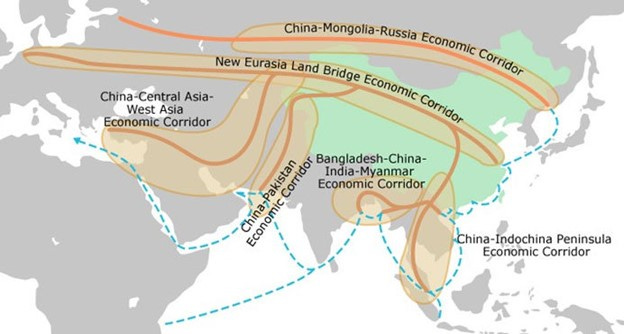
Although this path involves the shortest distance, complications and additional costs arise with the complex process of transitioning from land routes to sea routes via ports in the Caspian Sea.
In recent months, the nations along the Middle Corridor have worked to harmonize their interests and coordinate their efforts to tap, process, and move the energy resources in the Caspian Sea (which contains the fourth largest natural gas reserves in the world).
On 30 March 2022, a quadrilateral agreement was signed between Turkey, Azerbaijan, Kazakhstan, and Georgia to advance the construction of the Baku-Tbilisi-Kars railway system, the Baku-Tbilisi-Ceyhan pipeline, and the Trans Anatolian National Gas Pipeline (TANAP), which is already in operation. The TANAP is part of the larger Southern Gas Corridor, which involves seven countries and consists of 3500 km of pipelines worth $35 billion.
[…]
The Unipolar Green BRI Doppelganger
In contrast to this healthier multipolar operating system, a pathetic concept called “Build Back Better” was introduced.
The oft-repeated term was ambiguously defined, but it was embraced by technocratic leaders of Atlanticist states, including the USA’s Joe Biden, Canada’s Justin Trudeau, the UK’s Boris Johnson, and the EU’s Ursula von der Leyen. The concept was later rebranded as “Build Back Better for the World” (B3W).
Despite its warm and fuzzy image, the Global Green New Deal and B3W failed to gain traction due to a lack of concrete action plans or details on how to finance and demonstrate the viability of the grand vision.
Similarly, in March 2021, Biden and Boris Johnson unveiled a new program called the “Green Belt Initiative,” which they described as a response to China’s Belt and Road Initiative. When asked for details on how to fund the $3 trillion in investments required to make the “green transition” to a world dependent on solar panels and windmills, no specifics were provided.
Once again, the concept was under defined, but the image presented was one of a green revolution expected to usher in a new era of “clean zero carbon infrastructure” led by utopian rules-based orderistas of the transatlantic west.
Within the framing of the B3W branding, “Global Green New Deal” was often celebrated as a warm and fuzzy concept, which former Bank of England Governor Mark Carney heralded as a $130 trillion renaissance into a post-hydrocarbon age.
In September 2021, the EU’s Ursula von der Leyen announced the “Global Green Gateway” as Europe’s response to the BRI; however, this initiative faced criticism for ignoring the hundreds of thousands of engineers trained by China in Africa over the past decade, and for projecting the historic predatory lending practices of Europe onto China.
[…]
In response, the White House released its newest rebranding of the B3W in the form of a G7-led program now titled “The Partnership for Global Infrastructure and Investment”.
This program promised $600 billion over five years to recipient nations in Africa, Southwest Asia, Latin America, East Asia, and Eastern Europe to build digital infrastructure, telecommunications, green energy, and soft infrastructure with a focus on gender equity.
The goal of this program was to provide poor nations with an alternative to China’s alleged predatory lending ambitions; however, few of the nations offered this “life raft” have shown much interest so far.
International Dynamics: Open vs. Closed Systems Clash
The Belt and Road Initiative has already won over much of Africa, as BRI-connected rail, ports, and other infrastructure are providing a breath of fresh air to nations long held hostage by IMF/World Bank conditionalities.
Pakistan and much of Southwest Asia are also increasingly on board the BRI through the growing China-Pakistan Economic Corridor.
Twenty Arab states consolidated massive BRI infrastructure projects over the past three years, with Iran finalizing a $400 billion deal with China in July 2021, and even western-controlled puppet states like Turkey and Saudi Arabia realizing their lack of future within the collapsing unipolar order are grabbing the opportunity to join the New Silk Road.
Additionally, much of Latin America has also joined with hundreds of billions of dollars of infrastructure projects, with China holding controlling stakes in over 40 strategic ports across Latin America
[…]
China has set records for bridge building, tunneling, as well as water management, quantum computing, AI, advanced telecommunications, and even space science, becoming the first nation to ever land on the far side of the moon with an intent to mine Helium-3* and develop permanent bases on the Moon alongside Russia in the coming decade.
[…]
Via https://matthewehret.substack.com/p/brics-vs-the-wef-the-clash-of-two
*Ed Note: the major difference Helium 3 and Helium 4 is that the former doesn’t release radioactive protons during fusion.


Pingback: A Non-Western View of Climate Change and Sustainability | Worldtruth
Great to see Matthew Ehret’s post on your site Dr. Stuart, he writes in plain English that anyone can follow without unnecessary monologue.
Many thanks
Susan
LikeLike
I love Matt Ehret, Susan, especially his Breaking History program on Badlands Media. The reason I don’t publish more of his posts is that they’re so long. I find people who read my blog are unlikely to read anything longer than 1900 words.
LikeLike
Pingback: China’s Nuclear Energy Breakthrough | Worldtruth