
 Episode 26: Making a Modern Mummy
The History of Ancient Egypt
Professor Robert Brier
Film Review
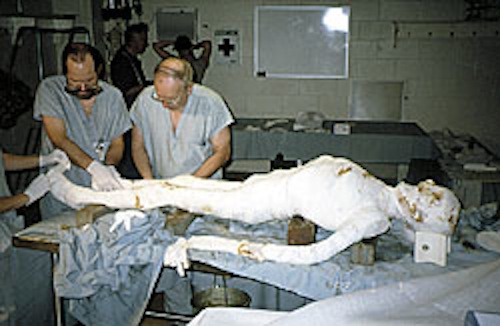
In this lecture Brier describes his experience mummifying a cadaver with the help of a surgeon friend. Owing to the absence of historical documentation, it was only in this way he could fulling understand the process.
The natron they used to dehydrate the corpse (for the 36 days recommended in Rhind Bengreal Papyri – see Egyptian Mummification: The Historical Record) from Wadi El Natrun in northern Egypt.* They obtained the frankincense and myrrh from Yemen and Sudan via a Cairo street market. Placing the body in an indoor tent heated to 105 degrees F, they covered it with 600 pounds of natron. After 36 days, their corpse had lost half its body weight, though there was still evidence of moisture in the larger muscle groups. After leaving it in the natron another 25 days, it was totally dehydrated.
The replica bronze** daggers they made were too dull to open the abdomen. Instead they used a blade an anthropologist friend flake out of obsidian for them. They had to increase the abdominal incision to three inches (instead of the 2 1/2 inches Herodotus describes – see Egyptian Mummification: The Historical Record) to remove the liver (the largest organ in the body. Leaving the heart intact, they filled the abdominal cavity with little packets of natron to facilitate further dehydration.
They found the only way to remove the brain was to use a nose hook to liquefy the brain and then hang the corpse upside down to let it run out the nose. They then used the hook to repeatedly stuff linen strips into the skull cavity until it came out clean.
*Natron is a naturally occurring mineral made up of sodium carbonate, sodium bicarbonate and sodium chloride.
**Current evidence suggests it was the ancient Egyptians who first discovered the chemistry of combining two soft metals (copper and tin) to miraculously form a hard one (bronze). Our word chemistry derives from the Egyptian “kemit (the Egyptian word for Egypt), via the Arabic word “alchemy.”
Film can be viewed free with a library card on Kanopy.
https://www.kanopy.com/en/pukeariki/watch/video/1492791/1492853
 The Most Revolutionary Act
Isn’t bicarbonate of soda just baking soda? Of course sodium chloride is just table salt. The dessication of anything employs salt, and they have lots of salt in the oceans, and probably sand dunes.
LikeLike
Interesting article, though. The dedication of trying to imitate the mummification process is telling, since I have believed it is a “lost art”. I guess it will take a couple of millennia to find out if the modern attempt worked.
LikeLike
I guess they were motivated by the fact that Egyptian embalmers were extremely secretive about the mummification process and left no written records to describe it.
LikeLike