
Episode 5 The Rosetta Stone and Much, Much More
The History of Ancient Egypt
Professor Robert Brier
Film Review
According to Brier, the Egyptian language vanished after a series of foreign conquests (by first Assyrians, then Babylonians, Nubians, Greeks and Romans) towards the end of their 3,000 year rule. The last Egyptian language inscription dates from 425 AD.
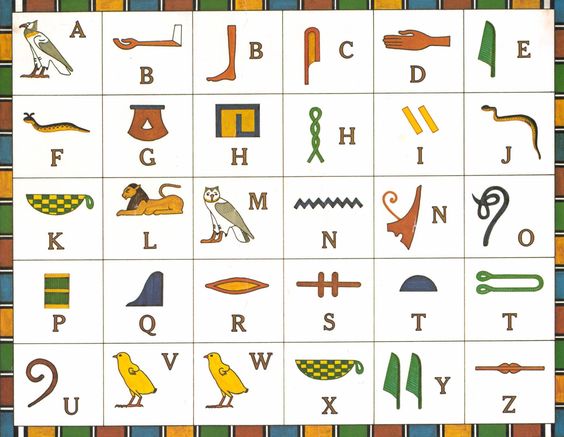
The assumption that written Egyptian (hieroglyphs) is picture writing is erroneous. Written Egyptian is a phonetic language, with each hieroglyph designating a specific sound, just as in modern languages. For example duck (pronounced “sa”) is often used to designate son (also pronounced “sa”). Writing a hieroglyph with a line under it, means the the hieroglyph represents the object, rather than the phonetic sound.
The Egyptian language could be written from left to right, from right to left or from top to bottom.
The Rosetta Stone discovered during Napoleon’s invasion of Egypt is written in two languages (Egyptian and Greek) and three scripts: hieroglyphs (used for Egyptian religious and official documents), demotic (a shorthand alphabet used by Egyptian commoners)* and Coptic (a variant of the Greek alphabetic with extra letters for sounds not found in Greek).
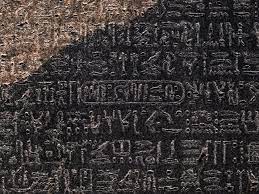 Coptic script appeared with the advent of Christianity in Egypt because St Mark wouldn’t allow converts to use “pagan” hieroglyphs. Coptic renditions of the Egyptian language survived owing to its use in Coptic services.
The Coptic word Ankh (meaning life) has survived to the present day.
_01.svg/1200px-Ankh_(SVG)_01.svg.png)
The content of the rosetta stone is a thank you note from some priests to the government for exempting them from taxes.
*Like Hebrew, written Egyptian has no vowels so is easy to abbreviate as short hand
Film can be viewed free with a library card on Kanopy.
 The Most Revolutionary Act
Pingback: The Middle Ptolemies and the Decline of Egypt | The Most Revolutionary Act
Pingback: The Middle Ptolemies and the Decline of Egypt MEK Enterprises Blog - Breaking News, SEO, Information, and Making Money Online!The Number 1 Online Blog Worldwide!