
by Brian Shilhavy
Editor, Health Impact News
It has been well-reported in the corporate media that hundreds of thousands of medical professionals have quit or retired since COVID, and those that remain are over-worked and unhappy, with many planning on retiring within the next few years.
Millions of people in the U.S. have died or been disabled since the COVID scam started in 2020, further burdening the medical system as patients increase, while medical professionals and services have decreased.
The corporate media blames this on the fake COVID “virus”, but many in the alternative media know better, and like myself, have documented how most of these deaths and injuries are actually due to the COVID shots and other COVID protocols that were implemented starting in 2020, showing how it was the medical system itself that caused most of these casualties.
The entire medical system is in the process of collapsing, as it is unsustainable in its current form.
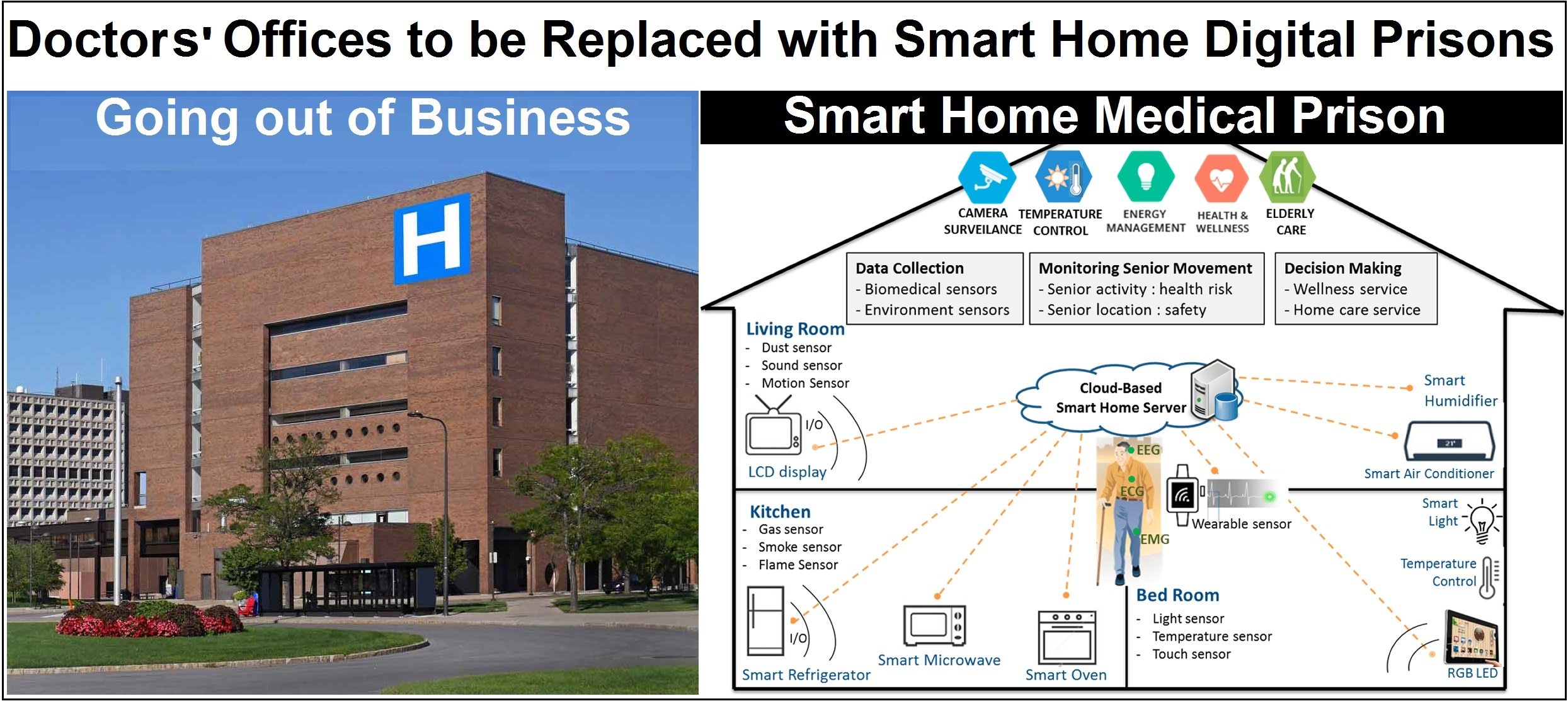
The future of the medical system that the Globalists on Wall Street and in Silicon Valley are now investing in, is home medical care, and “telehealth.” They are rapidly investing in technology to convert homes into “Smart Homes” where patients can be treated right in their own homes using the Internet and “smart” devices.
They are, of course, selling this to the public as something positive, as after all, who wouldn’t want to receive medical care in the comfort of one’s home?
However, as has always been the case, when the Globalists promise their consumers slaves things like “comfort”, “safety,” “convenience”, etc. – these products and services ALWAYS come at a cost, mainly the cost of giving up your privacy and allowing the system to have total control over you.
And if that system of “comfort, safety, and convenience” fails, they will take no responsibility for the consequences.
When a person’s home becomes a “Medical Smart Home” replacing hospitals and doctors’ offices where everything that runs that home is dependent upon the technology, what is going to happen when the Internet goes down, or the power grid becomes unstable and you don’t have reliable electricity any more?
Goal: Your Home is Your Prison
An article published today by Heather Landi at Fierce Healthcare reported where the “Hospital-at-Home” industry is today, and what they feel is necessary to increase this business (government funding).
Momentum behind hospital-at-home continues to grow, but proponents say Congress needs to act to fuel more investment
Hospital-at-home programs got a big boost in 2020 when the Centers for Medicare and Medicaid Services (CMS) launched the Acute Hospital Care at Home Waiver during the COVID-19 pandemic.
CMS allowed certain Medicare-certified hospitals to treat patients with inpatient-level care at home using Section 1135 waivers of the Social Security Act. CMS waived specific hospital Conditions of Participation that require 24-hour onsite nursing for patients.
As of March 1, 315 hospitals across 131 systems in 37 states have been approved to participate in the Acute Hospital Care at Home program. Before the waiver, 20 of these programs existed across the U.S.
However, that CMS waiver is set to expire at the end of this year and legislative action is needed to extend the waiver or make the program permanent.
Healthcare heavyweights, the American Medical Association and the American Telemedicine Association joined major health systems like Geisinger and Mass General Brigham along with tech-enabled companies to pen a letter to Congressional leaders calling for at least a five-year extension to the CMS waiver.
Home-based services for lower-acuity patients help hospitals address critical capacity issues by freeing up hospital beds for the sickest patients without increasing health system costs, proponents of the programs say.
[…]
McKinsey & Company estimates that up to $265 billion worth of care services, representing up to 25% of the total cost of care, for Medicare fee-for-service and Medicare Advantage beneficiaries could shift from traditional facilities to the home by 2025 without a reduction in quality or access.
(Full article.)
[…]
The investment into technology that the Technocrats foolishly believe will replace medical professionals is advancing about as fast as the Government-funded push into electronic vehicles (EVs) that has been rapidly advancing the past few years, and if this goes far enough, the results could be far more devastating than the collapsing EV market that is currently happening.
We now live in a generation that believes our lives are dependent upon technology, being fooled into believing that science fiction technology fantasy lands can turn into reality if they just invest enough money to make all this a reality (non-virtual)
Look at this article published by the technology publication The Information late last year, where Silicon Valley investors believe they can replace doctors and clinics through an “AI Doctor-in-a-Box CarePod” that they are placing in malls and office buildings.
Healthcare Without Health Workers: A Unicorn Pivots to an AI Doctor-in-a-Box
If Adrian Aoun has his way, the next time you visit the doctor’s office, you won’t see a single medical professional. In fact, he said, “I don’t even believe a doctor’s office should exist.”
Instead, the outspoken founder and CEO of primary care startup Forward wants you to entrust your health to a landmark new product, the CarePod—a whirring, purring autonomous module that looks like an airport lactation room crossed with a space capsule. Aoun hopes the compartments will soon be found inside malls and office buildings around the U.S. “What we really need is healthcare to be a product, not a service,” he said. “I just want to take every single thing that doctors and nurses are doing and migrate it over to hardware and software.”
Today’s unveiling of the CarePod comes alongside a $100 million Series E round that will help Forward build and deploy the devices. The new funding includes equity financing of more than $50 million as well as debt financing; Aoun declined to disclose the valuation. Preexisting backers Founders Fund, Khosla Ventures, Kleiner Perkins chair John Doerr, Tencent and Uber co-founder Garrett Camp, and new investors Samsung Next and the Abu Dhabi Investment Authority participated in the round.
The Forward CarePod is a single-occupancy compartment lit from within by violet LED lights and a chest-high touchscreen. An ambient electric hum reverberates around the vestibule while a calming yet eerily robotic voice—like Siri’s phlebotomist sister—instructs you on where to stand, how much to disrobe and when to sit back in a leather chair and strap on a blood-pressure monitor.
Patients can choose from a variety of apps that guide them through basic health exams ranging from biometric body scans and mental health surveys to blood-pressure monitoring and Covid-19 tests. Eventually CarePod users will be able to draw their own blood, which will then be tested in a miniaturized lab concealed inside the shell of the pod. That service isn’t ready yet, but Aoun demonstrated the process for The Information, suctioning a small amount of blood from his upper arm using a painless capillary-vacuum device that he likened to a mechanical leech. After the demo, blood began oozing out of Aoun’s arm as he struggled to bandage the injection point.
The autonomous medical station represents a major pivot for Forward, which runs 19 high-end health tech clinics located in urban areas across the U.S. The company, which charges $149 per month for subscription concierge care, is embarking on its post-pandemic era, which deemphasizes one-on-one time with doctors. It plans to roll out CarePods in major cities, including San Francisco, New York, Chicago and Philadelphia, through the end of the year and into the first quarter of 2024. Access to CarePods will cost $99 per month, with no discounts or bundles for existing Forward subscribers.
(Full article – Subscription needed.)
[…]
Solution: Just Say NO to (Pharmaceutical) Drugs!
The solution to not allowing yourself to become a prisoner of the Medical Mafia is actually very simple (although difficult to implement): Just stop using their products!
I am a testimony of how a person can live successfully in this world without using pharmaceutical products, as I have not purchased prescription drugs or visited a hospital for many years now. Pharmaceutical products and services are NOT essential to life. The human population has survived for thousands of years without modern pharmaceutical drugs and the allopathic medical system which started in the 1800s.
[…]
 The Most Revolutionary Act
Beeing honest, this always was my dream, but only based on my own possibility to interact with all the sensors, and without a regular connection to any thirdparty servers. But this is the crux, as they will not offer all these devices for free or an affordable price. The price will be the masses of data, they will collect. ;-/ xx Michael
LikeLike
Thank you for your honesty, OIKOS. As for myself, I would never trust the sensors to only transmit information about me. I assume they would also give off EMFs, which are proving to be extremely harmful to human health.
LikeLiked by 1 person
I have to thank you for all the very useful information! You got me! 😉 That’s true, the EMF’s are not to forget, and can be very harmful itself. Best wishes, Michael
LikeLike
Boston has big problems with a Texas-owned hospital chain that is going bankrupt.
LikeLike
I say good riddance, Trace. In my view the medical establishment has been too corrupted by corporate interests to be redeemed. I think we need to go back to where we were in 1910 when homeopathy, naturopathy and frequency medicine were banned and start over again.
LikeLiked by 1 person